Launch industry trends, based on recent history

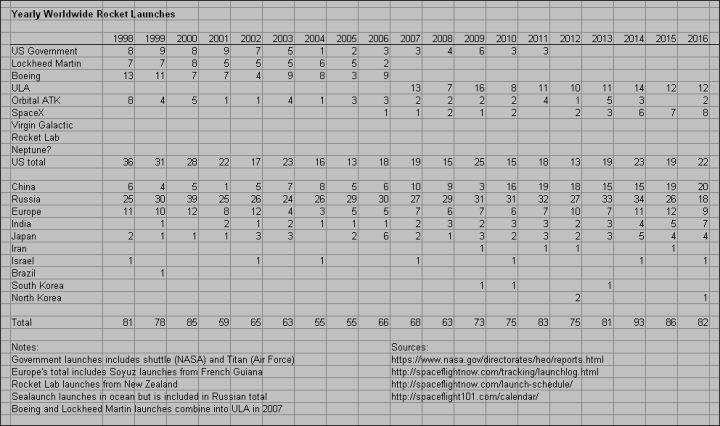
The worldwide competition to launch the most rockets each year, first noted by Doug Messier about the 2016 race that was won by a squeak by the U.S., and then augmented by my own post about the various predictions by different nations and companies about what they hope to achieve in 2017, got me to thinking. How do these numbers compare with the past? What are the launch trends? Who has been moving up and who has been moving down? And most important, what would a close look at the trends for the past two decades tell us about the future?

In order to answer these questions, I decided to compile a table of all worldwide launches since 1998.

Worldwide Launches since 1998

This table reveals some very interesting trends and facts that I had not recognized previously.
» Read more

2 comments

Japanese SS-520 rocket launch scrubbed due to weather

The launch of Japan’s new small rocket, SS-520, was scrubbed today due to bad weather.

Japanese officials announced a few minutes before the launch that the flight would be postponed due to bad weather at the space base. Authorities did not immediately set a new launch date.

The SS-520-4 will try to become the smallest rocket to ever put an object in orbit. Its sole payload is the six-pound (three-kilogram) TRICOM 1 spacecraft, a CubeSat from the University of Tokyo designed for communications and Earth observation experiments. Standing 31 feet (9.5 meters) tall and spanning around 20 inches (52 centimeters) in diameter, the SS-520-4 will blast off from a rail launch system and head east over the Pacific Ocean, dropping its lower two stages and payload enclosure into the sea in the first few minutes of the flight.

Primarily funded by a $3.5 million budget provided by the the Japanese government’s Ministry of Economy, Trade and Industry, the SS-520-4 program is a one-off demonstration by Japan’s space agency, which aims to validate low-cost technology and launch operations procedures for a future “nano-launcher” to deploy tiny satellites in orbit on dedicated rides.

The last paragraph is disappointing, but not surprising considering that this rocket is entirely owned and built by the government, which like NASA, routinely builds things and then abandons them, no matter how useful they are. I hope that some private company grabs the design here and runs with it.

9 comments

Coordinated bomb threats against Jewish schools and community centers

While the left worries about Islamaphobia: Coordinated bomb threats occurred yesterday against numerous Jewish schools and community centers in the U.S. and Great Britain, forcing the evacuation of thousands.

Jewish schools across the United Kingdom were placed on alert after bomb threats were called into metro London Jewish schools in Roehampton, Ilford and Brent on Monday morning. The schools were “warned” that explosive devices had been planted on the premises. Thorough searches were conducted at all three sites and other schools were placed on precautionary lock-downs until the “all clear” was received. Bomb threats were also called in to a few non-Jewish schools as well, according to the British Jewish Chronicle news site. “Police were alerted at around 10:30am hrs on Monday, 9 January, to phone calls made to schools in Roehampton, Ilford and Brent in which bomb threats were made. Police officers attended the schools. All three incidents were stood down a short time later. An investigation into the threat will be conducted,” Metropolitan Police said in a statement.

Meanwhile, in the United States, bomb threats were called into Jewish Community Centers (JCC)s in Delaware, Tenafly, New Jersey; Miami Beach and Jacksonville, Florida; in Rockville, Maryland; in West Nashville, Tennessee, and Columbia, South Carolina. In Delaware, police were called to search the Siegel Jewish Community Center north of Wilmington on Monday, after a bomb threat was called into the facility at around 11:45 am.

This story has gotten practically no coverage, even though it indicates a very serious and widespread threat that could very easily morph into real bombs very soon. Instead, the focus is on the Democrat protesters who appeared at congressional hearings for Jeff Sessions, Trump’s attorney general nominee, dressed most appropriately as KKK members. They were trying to imply they supported Sessions and he supported the KKK, but I think they merely proved that Democrats are very comfortable dressing as KKK members and expressing racist opinions. They certainly do not seem to have a problem with Islamic terrorism, oppression, and bigotry.

5 comments

Private money to VLT to search for Earthlike planets at Alpha Centauri

The privately funded Breakthrough Initiatives project has committed funds to upgrade the Very Large Telescope in Chile in exchange for telescope time to look for Earthlike planets in orbit around Alpha Centauri.

Facebook’s Mark Zuckerberg, Russian entrepreneur Yuri Milner and physicist Stephen Hawking are hoping to find Earth-like planets in our neighbouring star system, Alpha Centauri. Together they will upgrade the Very Large Telescope (VLT) to look for potentially habitable worlds as part of the ‘Breakthrough’ initiatives.

These planets could be the targets for a launch of tiny space probes to track down aliens within our lifetimes, the European Southern Observatory (ESO) said.

This is exactly how astronomy used to function. Rather than get money from the government in exchange for doing the research it wanted done, astronomers obtained funds from wealthy individuals or businesses to build and upgrade their telescopes in exchange for doing the research that interested these funding sources. The difference? The work was privately funded voluntarily, rather than coerced from the public through taxes.

9 comments

FAA okays SpaceX launch on Monday

As I expected, after several days of hemming and hawing, the FAA has granted SpaceX a launch license for its planned Monday launch.

The FAA license approved Friday covers all seven Falcon 9 launches planned for the Iridium Next constellation, along with landings of the Falcon 9 first stage on a barge positioned downrange in the Pacific Ocean. The $3 billion Iridium Next program aims to replace all of the company’s existing satellites, which were launched in the late 1990s and early 2000s and are now operating well beyond their design lives.

What SpaceX clearly did here was to move ahead, daring the FAA to challenge their desire to launch quickly. Government bureaucrats don’t like that, but to call SpaceX’s bluff and block the launch would have caused these bureaucrats even more problems. SpaceX knew this, and gambled that the FAA would back down. It did, and thus the launch license was issued.

5 comments

House passes bill requiring Congressional approval for major regulations

The House today passed a bill requiring Congressional approval for regulations having an economic impact of more than $100 million.

The legislation, dubbed the REINS Act, requires a regulation with an economic impact of more than $100 million annually to be approved by both chambers of Congress before it can take effect. Republicans also attached an amendment that requires agencies, when promulgating new rules, to repeal or amend existing rules to fully offset the economic costs. The House also passed comparable legislation in the last congressional session, but it faltered in the Senate. GOP leaders are taking a renewed crack after President-elect Donald Trump offered his support during the campaign.

Not surprisingly, the Democrats opposed the bill. It is unclear whether the Senate will follow suit, but with Trump in the White House and very much in favor of reducing regulation and the power of the bureaucracy, it is going to be increasingly difficult for the Democrats to block all these legislative bills.

3 comments

India considers going to Jupiter and Venus

The competition heats up: India’s space agency ISRO is considering unmanned missions to both Jupiter and Venus, while also delaying their first manned test flight four years until 2024.

More significant, the second link had this quote:

Mr Somnath said during the current fiscal, Isro planned eight PSLV flights, up from six in 2016. “Our aim is to steadily increase the launches between 12 and 20 in phases with creation of necessary infrastructure.

Like everyone else, they are getting enough business to up their launch rate. 2017 is going to be an active year in the launch market.

1 comment

Arianespace wins two contracts, aims for a dozen launches in 2017

The competition heats up: Arianespace announced yesterday that it has won two new commercial launch contracts, and will aim in 2017 to tie its own record for yearly launches at 12.

Arianespace will also seek to tie its record number of launches with 12 missions planned this year. The company first reached this cadence in 2015, and was on track to tie it again last year were it not for a shipping issue that delayed the launch of DSN-1, a Japanese X-band military communications satellite damaged en route Europe’s Guiana Space Centre in Kourou, French Guiana.

I suspect that one reason Arianespace is getting these contracts, despite charging significantly more than SpaceX, is that they are successfully getting their customer’s payloads into orbit. SpaceX has a gigantic backlog of launches, so it makes no sense to give them more work as the launches will certainly not occur when these satellite companies need them to occur. This fact only ups the pressure and the competition. SpaceX has got to start getting that backlog into orbit, or else its business model will suffer significantly.

1 comment

SpaceX launch delayed until Monday

One local news source now reports that SpaceX’s Falcon 9 launch has been delayed one day until Monday.

While officials announced at the start of week their plans to aim for a 10:28 a.m. Sunday departure, notices warning boaters and pilots of an upcoming launch now say the mission is targeting Monday, Jan. 9. The one-day delay means the launch time is expected to be a few minutes earlier to ensure the satellites are placed where needed in space.

This news has not yet been confirmed. The delay is now official.

5 comments

House passes bill to cancel all regulations created during Obama’s lame duck rule

I like this: The House today passed a bill that would allow Congress to repeal all regulations created during the last sixty days of the Obama administration.

Legislation to allow Congress to repeal in a single vote any rule finalized in the last 60 legislative days of the Obama administration sailed through the House Wednesday, the second time in less than two months. The GOP-backed Midnight Rule Relief Act, which passed the previous Congress in November, was approved largely along party lines by a vote of 238-184 on the second day of the new Congress, despite Democratic opposition. If passed by the Senate and signed by President-elect Donald Trump, the legislation would amend the Congressional Review Act to allow lawmakers to bundle together multiple rules and overturn them en masse with a joint resolution of disapproval.

What is disturbing is how few regulations Congress has cancelled over the decades. This is supposed to be an republic, whereby the rules are set by our elected officials. Instead, they have passed that responsibility off to bureaucrats, and when they hint, as they do here, that they might take back some of that power, the howls of outrage are deafening.

7 comments

The competition heats up

According to this story, China plans 30 launches for 2017, which would smash the record of launches, 22, the country set in 2016.

This website lists the known scheduled launches worldwide. As far as I can see, only 15 Chinese launches are listed. However, China’s space program is modeled after the Soviet Union’s, which means they are somewhat secretive. The first link above has been reporting on China quite reliably during the past year, so I have some faith that the goal of 30 launches seems reasonable.

In 2017 China however is not the only country, or company, that will be attempting smash records. Russia hopes to complete 29 launches, which would not be a record for that country but would be a significant recovery from the 17 they completed in 2016. India set a record of 9 launches in 2016, and hopes to top it in 2017, starting with a single launch in January that will place a record 103 satellites in orbit in one shot. Europe meanwhile shows 21 launches on its 2017 manifest, while Japan has 9, according to the second link above.

The list gets even more interesting when you look at the 2017 launches planned for each American company. SpaceX has 31 launches all by itself,. ULA has 14, while Orbital ATK plans 4.

Obviously, these predicted numbers are not what is really going to happen. SpaceX is not going to launch 31 rockets in 2017. Not a chance. However, if they can get through the year with no launch failures, they will likely complete more than half that number, since that was the pace they were aiming for in 2016 and were getting close to achieving until the September 1 launchpad explosion. Meanwhile, ULA’s prediction of 14 launches for 2017 seems wholly reasonable since ULA completed 12 launches in 2016.

What this data suggests overall is that the total number of launches in 2017 will go up, significantly. Moreover, the increase in pace will be linked to an revived commercial satellite market, as well as a newly competitive launch industry aimed at reducing costs while making its increased launch pace more routine. These factors suggest that the increases will not be a one time thing, but will instead be heralding a new standard that signals a new age in space travel.

Hold onto your hats. The next few years in space should be quite exciting.

0 comments
1 489 490 491 492 493 684