Update on Blue Origin activity at Cape Canaveral

Link here. Much of the activity the article describes has to do with preparing for a first launch of Blue Origin’s New Glenn rocket, suggesting that it might finally take place in 2024 as presently planned.

In fact, the activity also suggests that the company intends to attempt to recover its first stage from a landing ship in the ocean on that first flight.

In early October, a large Liebherr mobile crane was delivered to Port Canaveral to support Blue Origin’s continuously growing presence on the Space Coast. Once New Glenn begins flying, this crane will assist recovery operations by lifting the 57.5-meter-tall first stage from the landing vessel and onto shore.

More recently on Nov. 27, a large jig on a barge was towed into Port Canaveral and proceeded to be offloaded by Blue Origin’s new crane. This custom-made structure appears to be a stand to support New Glenn first stages after being offloaded from its landing vessel. Various work platforms will allow crews to inspect the boosters in different locations before the booster itself is transported back to the factory, or the future refurbishment facility which is still yet to be built.

It also appears the company has built a full scale test version of New Glenn to allow testing of all operations prior to launch.

Keep your fingers crossed. With former CEO Bob Smith gone, Blue Origin might finally be coming back alive at last.

ESA admits Ariane-6 will not fly until the summer of 2024

The European Space Agency today announced that the first launch of its new Ariane-6 rocket will not take place in the first quarter of 2024 and is now targeting a summer launch instead.

At a Nov. 30 briefing, ESA Director General Josef Aschbacher announced a launch period for the inaugural Ariane 6 flight of June 15 through July 31. A more precise launch date will be provided after qualification reviews in the spring of 2024. The announcement comes after a Nov. 23 long-duration test firing of a model of the core stage of the Ariane 6. That test, conducted on the launch pad at Kourou, French Guiana, was intended to simulate a full burn by the core stage.

The delay is not significant by itself, but in the large scheme of things it continues for another few months Europe’s lack of any large rockets to launch any payloads. The original plan when the Ariane-6 project was announced in the mid-2010s was for it to begin flights in 2020 with a several year overlap as the Ariane-5 was retired around 2023. As planned, the last launch of Ariane-5 occurred this summer, but Ariane-6 is now four years behind schedule.

At the moment the rocket has one more major test required, an upper stage static fire test scheduled for December. That test must go well for this new schedule to go forward, which will include a second Ariane-6 launch in 2024 followed by “as many flights as possible” in 2025. ESA hopes to do 9 to 10 Ariane-6 launches per year, most to fulfill the contract of 18 launches with Amazon to put some of its Kuiper satellite constellation into orbit.

Blacklisting is no longer enough, now the goal is justifying mass murder

Rick, stating the truth in Casablanca
When will Americans finally wake up?

It seems the rising effort of many — mostly on the left but not entirely — to blackball and censor their opponents in the past decade is no longer satisfied with these ugly goals.

Now it seems the goal is to justify mass murder and the rape and torture of women and children. We can see this by what happened during a city council event in Oakland, California yesterday. When one Jewish council member, Dan Kalb, attempted to add language condemning Hamas to a resolution calling for a ceasefire in Gaza, he was greeted by boos and an unrelenting stream of locals not only opposing his amendment but denying that the mass murder by Hamas had even occurred, that it was instead committed by Israeli troops, and that anyone who dared disagree with them was a “white supremacist.”

The video below provides a quick selection of this hate and ignorance:
» Read more

SpaceX buys the company that makes its Dragon parachutes

According to a Florida bankruptcy filing dated November 22, 2023, SpaceX has purchased for $2.2 million Pioneer Aerospace, the company that has been manufacturing the parachutes used by its Dragon cargo and manned capsules.

Apparently SpaceX bought the company in order to make sure its parachutes would still be available. This purchase also brings that operation into SpaceX itself, so that the company is no longer dependent on an outside vendor. Since its early days SpaceX has attempted to build as much as possible in-house, and this buy follows that policy.

Space industry expresses opposition to White House regulatory proposal

Not surprisingly, the Commercial Spaceflight Federation (CSF), the industry group that represents pretty much the entire new commercial space business, has sent a letter to both the House and Senate expressing strong opposition to the November 15th White House regulatory proposal that would impose heavy regulation on both launches and the construction of any private facility in space.

“We oppose the recently released National Space Council (NSPC) proposal on the topic in its current form, which fails to consider the points that CSF and many other stakeholders raised during the NSPC listening sessions last year,” CSF said in its letter to Congress.

The organization raised several concerns, including how responsibilities would be split between the two departments and the potential for “duplicative and conflicting” requirements between Commerce and Transportation. “For some operations, it is unclear which agency would hold the authority to issue a relevant license, or if multiple licenses would be needed,” it stated.

The group is concerned about giving additional responsibilities to the FAA’s commercial space transportation office without also significantly increasing its budget, noting that the office is struggling to keep up with its current launch and reentry licensing. At an October hearing of the Senate Commerce Committee’s space subcommittee, industry officials recommended increasing that office’s budget to handle launch licensing work, without any discussion of it taking on additional responsibilities.

CSF was also worried that the proposed mission authorization system could disrupt plans by NASA to shift from the International Space Station to commercial stations by the end of the decade. “Introducing a bifurcated and unclear regulatory regime for commercial space stations,” the letter stated, “could risk U.S. leadership in low-Earth orbit.”

Apparently the entire space industry came to the same conclusion I did after reading the White House proposal after its release:

Essentially, these new rules — purposely written to be vague — will allow the government to forbid any activity in space by private citizens it chooses to forbid. No private space station could launch without government approval, which will also include the government’s own determination that the station will be operatied safely. Once launched, the vagueness of these regulations will soon allow mission creep so that every new activity in space will soon fall under its review.

Since no one in the government is qualified to supervise things like this, in the end politics and the abuse of power will be the rule.

It must be noted that the entire Democratic Party caucus in the House apparently approves of this power grab, because they immediately abandoned all support of the previously negotiated proposal that the industry and Congress had worked out and a House committee was about to pass. Their opposition forced that committee vote to be canceled. According to that committee, it will resume its consideration of that bill today. We shall see if this industry opposition changes any of their minds.

Postwar in Gaza: some educated guesses

The first child hostage, 9-year-old Ohad Mundar, being released by Hamas
The first child hostage, 9-year-old Ohad Mundar,
being released by Hamas. Click for video.

The ongoing pause in fighting in Gaza in order to get some of the hostages kidnapped by Hamas out of the war zone — most especially the children — has resulted in a lot of hand-wringing about whether Israel will allow this pause to short-circuit is effort to destroy Hamas.

It will not, though the post-war situation will remain complex and difficult, as is always the case in the Middle East.

First, we must recognize that Israel is not leaving Gaza at any time in the near or even distant future, no matter what Joe Biden and the United Nations demands. Its army has now captured and controls the northern half of the strip, and it fully intends to take full control of the southern half as well, once this hostage exchange agreement concludes. It made this intention very clear just before the hostage pause was announced, when it dropped leaflets in south Gaza, warning citizens to leave. That southern campaign has not yet happened, but only because of the ongoing hostage release operation.

Nor will it matter if that exchange agreement gets extended for weeks, day by day as Hamas releases ten hostages at a time. At some point Hamas will either run out of hostages, or decide it needs to keep the hostages it has left as later bargaining chips. At that moment Israel will resume its offensive with full force. And it will do so with even more force, as there will no longer be child hostages held in Hamas control.

The political situation in Israel demands this. The Israeli public wants nothing less. Politicians and pundits in the west might whine and demand appeasement from Israel, but Israel is no longer interested in appeasing Hamas. It will no longer tolerate a terrorist base on its southeastern border, and it fully intends to re-occupy all of Gaza and make sure its leadership there is completely cleansed of the Hamas gang.

The eventual result will be a Gaza strip controlled entirely by Israeli security forces. » Read more

Pentagon is now all-in on capitalism in space

Capitalism in space: Based on recent remarks from officials as well as a number of newly issued contracts, the U.S. military has now decided to completely shift from designing and building its own space hardware — which it has increasingly done badly at great cost — to simply becoming a customer buying products from the private sector.

First we have remarks and press announcements from top Pentagon officials, stating this policy change.

Deputy Defense Secretary Kathleen Hicks, who has spearheaded Pentagon efforts to bring cutting-edge technology into defense programs, is overseeing the military’s first commercial space integration strategy.

The new strategy comes as the Pentagon seeks to tap into advancements in commercial space technology to maintain an advantage over China, now seen as America’s top military competitor. “At Deputy Secretary Hicks’ direction, the Department is currently developing our first DoD Commercial Space Integration Strategy in order to drive integration and ensure the availability of commercial space solutions during competition, crisis and conflict,” Pentagon Spokesman Eric Pahon said Nov. 27 in a statement to SpaceNews.

Nor are these merely words. On November 22, 2023 the military announced a request for proposals from twenty different commercial space companies to provide all of its military needs in orbit, with potential contracts worth up to $900 million.

The Proliferated Low Earth Orbit (PLEO) Satellite-Based Services contract, first announced in July, is run by the Defense Information Systems Agency (DISA) on behalf of the Space Force’s Commercial Satellite Communications Office (CSCO), a central marketplace for satellite services operated by the Space Systems Command.

…The PLEO contract “supports the Department of Defense’s requirement to provide worldwide, low-latency PLEO services,” said DISA. The IDIQ contracting method allows the Department of Defense, other federal agencies and international allies “to procure fully managed satellite-based services and capabilities for all domains (space, air, land, maritime and cyber) with a consistent, quality-backed, low-latency offering.”

This shift is excellent news, not only for the commercial space industry but for the American military itself. The former is guaranteed to grow and innovate as these companies compete for military business, while the latter will get what it needs more quickly and at much lower cost.

Starlink now operating for Israel in Israel and Gaza

As part of Elon Musk’s trip to Israel this week he negotiated a deal with the Israeli ministry of communications to activate Starlink over both Israel and Gaza, allowing its use by the military there.

The deal is in addition to Tesla’s recent announcement that Israelis can now charge their cars for free at its charging stations.

Musk’s trip also has put the lie to the slanders of the left that have accused him of being an anti-Semite simply because he correctly noted the leftist bias of the Anti-Defamation League (ADL), made worse by its effort to censor and blackball people. That slander has had no traction, because Elon Musk is very well known to the public, and it quickly recognized that it was an utter lie. Musk’s trip to Israel simply underlines the dishonesty of that accusation.

SpaceX launches 23 Starlink satellites

SpaceX last night successfully launched another 23 Starlink satellites into orbit, its Falcon 9 rocket lifting off from Cape Canaveral.

The first stage completed its seventeeth flight, landing on a drone ship in the Atlantic. That SpaceX now has several first stages that have been reused this much and it isn’t considered news is in itself a story. The company has actually gotten this rocket to perform like an airplane, a goal that Elon Musk aspired too more than a decade ago.

The leaders in the 2023 launch race:

87 SpaceX
53 China
15 Russia
7 Rocket Lab
7 India

American private enterprise now leads China 99 to 53 in successful launches, and the entire world combined 99 to 84. SpaceX meanwhile widens its lead over the rest of the world (excluding American companies) 87 to 84.

As a number of my readers have noted, the U.S. lead this year is entirely due to SpaceX, indicating a dominance that is actually unhealthy. Other American companies need to come forward and challenge it, because the competition will spark innovation and better rocketry. With no competition, it is inevitable that even SpaceX could get lazy.

Ariane-6’s core stage completes full 7 minute engine test

Engineers yesterday successfully completed a two-hour dress rehearsal countdown and fueling of an Ariane-6 first stage followed by a full seven minute engine burn, simulating what that stage would do during a launch.

The test took place on Ariane-6’s launchpad in French Guiana.

The November 23 test sequence was run the same way as the previous ones, with a launch sequence and final countdown representative of a launch, including removal of the mobile gantry and filling the launcher’s upper and core stage tanks with liquid hydrogen (-253° Celsius) and liquid oxygen (-183° Celsius). The test ended with the ignition of the core stage Vulcain 2.1 engine, followed by more than 7 minutes of stabilized operation covering the entire core stage flight phase. All functional aspects of Ariane 6’s core stage during the flight phase were tested.

According to the European Space Agency, only one more engine test of the Ariane-6’s upper stage remains before the spring launch can be attempted, and that engine test is planned for next month in Germany.

With the retirement of the Ariane-5 rocket in July, Europe has had no large rocket to launch payloads. Originally Ariane-6’s first launches were supposed to be in parallel with Ariane-5’s last launches, but its development is four years behind schedule.

Abraham Lincoln proclaims a day of Thanksgiving in the middle of the Civil War

Abraham Lincoln
Abraham Lincoln

The date was October 3, 1863. The Civil War was at its height, with no end in sight and no clear sign yet of victory for the Union. For all anyone knew, the great American experiment in self-government, freedom, and constitutional law was about to end in failure, with one half of the nation continuing on founded on the idea that it was okay to enslave other human beings, based on their race.

In such a moment, President Abraham Lincoln did what all past leaders in America had done, call for a day of prayer to God for the future while giving thanks for the blessings still abounding. For this purpose he set aside the last Thursday of November of that year.

Since then, Americans have never stopped celebrating Thanksgiving on that day. Today comes another Thanksgiving during a time of chaos, hate, violence, and oppression. There is much to invoke horror and outrage.

There is much more to be thankful for. As much as some have tried to squelch freedom here in America and abroad, all signs say that freedom-lovers everywhere are refusing to go down without a fight. Let us join together to renew that effort, so that “government of the people, by the people, for the people, shall not perish from the earth.”

Below is Lincoln’s Thanksgiving proclamation. If only we had leaders today who could think and write with similar elegance and humility.
—————————–
A Proclamation.

The year that is drawing towards its close, has been filled with the blessings of fruitful fields and healthful skies. To these bounties, which are so constantly enjoyed that we are prone to forget the source from which they come, others have been added, which are of so extraordinary a nature, that they cannot fail to penetrate and soften even the heart which is habitually insensible to the ever watchful providence of Almighty God.
» Read more

Eutelsat-OneWeb gets license approval in India

Less than two weeks after SpaceX obtained regulatory approval to offer its Starlink system in India, Eutelsat-OneWeb (newly merged) has now gotten its own approval.

Eutelsat-OneWeb is half owned by an Indian investment firm, so it is no surprise it obtained this approval soon after SpaceX. The two companies will now be competing aggressively for business in this giant country, whose technological capabilities has been renewed in recent years by the abandonment of a socialist/communist government for a leadership focused on encouraging freedom, capitalism, and competition.

SpaceX launches 23 more Starlink satellites

SpaceX early last night continued its campaign to reach 100 launches in 2023, its Falcon 9 rocket launching for the third time in just over four days, lifting off from Cape Canaveral carrying 23 more Starlink satellites into orbit.

The first stage completed its fifteenth launch, landing on a drone ship in the Atlantic.

The leaders in the 2023 launch race:

86 SpaceX
52 China
14 Russia
7 Rocket Lab
7 India

American private enterprise now leads China 98 to 52 in successful launches, and the entire world combined 98 to 81. SpaceX by itself is now leads the rest of the world (excluding American companies) 86 to 81.

With this launch, the number of successful orbital launches in 2023 now matches the record total of 179 set last year. With a little more than five weeks to go, expect that number to top 200 before the year is out, especially because China has historically tended to launch a lot of rockets in December.

Will libertarian Javier Milei actually be able to institute his revolution in Argentina?

The victory of libertarian and outsider Javier Milei in Argentina this past weekend has been met with joyous approval on the right and outright horror on the left. Both expect Milei to immediately begin imposing his radical anti-government polices that will eliminate whole agencies of Argentina’s federal government.

This video by Paul Joseph Watson I think provides an excellent summary of Milei’s agenda. Though Watson sees the agenda from a wholly conservative perspective, he also covers the wide range of Milei’s goals and ideas quite nicely.

After Milei’s election many other news sources did the same, describing his goals in detail. Practically none however took a close look at the reality of Argentina’s new government, and how that reality might impringe on Milei’s plans.

You see, Argentina still has a constitutional government with a federal legislature made up of a Chamber of Deputies (its House of Representatives) and a Senate. Any analysis of Milei’s future plans has got to consider the political make-up of these bodies.

And yet, though I searched hard, I could find almost news reports that discussed that make-up in any way. Politico, NPR, and CNN didn’t mention it all. The only mainstream source I could find that even mentioned the make-up of that legislature was Reuters, but it did so in a short paragraph near the end of its report, with few details.

So, though this is not my area of expertise, I decided to try to find out, both for myself and my readers.
» Read more

High altitude balloon company World View will not go public

The high altitude balloon company World View has ended its negotiations, begun early this year, with a venture capital investment firm to merge and make its stock public.

In a Nov. 17 statement, World View and Leo Holdings Corp II announced they were canceling plans announced in January to merge. The decision to end the merger was mutual, the companies said.

The companies did not give a specific reason for calling off the deal. “Over the course of 2023, World View received strong interest from potential investors,” the companies stated. “However, given challenging market conditions, World View and Leo jointly determined that it was the best course of action at this time to not proceed with their previously announced transaction.”

There could be a lot of good and bad reasons this deal fell through. Mostly likely World View officials saw the generally negative consequences experienced by other space startups that went public in this manner in the past few years, and decided it better to hold off.

Rocket engine startup Ursa Major enters solid-rocket motor business

Recognizing a desperate need of the military to ramp up production of solid rocket motors after much of its missile stockpile has been depleted by President Biden’s large gifts to the Ukraine, the rocket engine startup Ursa Major has now announced it is entering solid-rocket motor business.

Describing the solid rocket motor [SRM] market as “plagued by a broken supply chain and an overextended industrial base,” the Colorado startup today announced its plans to use its 3D printing techniques developed for liquid rocket engines to speed production of solid-fuel propulsion systems. Ursa Major has received several contracts from the Air Force Research Laboratory for its work on a new rocket engine for heavy space launch vehicles, as well as a hypersonic engine.

“Traditional SRM providers rely on production lines that are difficult to re-tool, expensive to ramp up, and dependent on a significant workforce to operate,” the company said in a press release touting its “new approach” to manufacturing, dubbed Lynx. “Ursa Major is offering a new way to scale production of SRMs,” Ursa Major CEO Joe Laurienti said in the press release. “Lynx meets the defense industry’s need for a faster, cheaper, scalable, and flexible SRM production process that results in better-performing solid rocket motors.”

The article also notes that at present the military is dependent on only two companies for new solid rockets, Northrop Grumman and Aerojet Rocketdyne (now L3Harris). The article also notes that it could take anywhere from five to eighteen years for these companies to replenish the depleted stocks.

The bottleneck however has brought several new players into the field, with the military eager to issue contracts to these new players. This decision by Ursa Major is thus a very good one.

Musk: Next Starship/Superheavy test launch could happen in only 3 to 4 weeks

Superheavy & Starship, on their way
Superheavy & Starship, shortly after liftoff on November 18th

In a tweet on November 19, 2023, Elon Musk revealed that SpaceX could be ready for its next Starship/Superheavy test launch in only a matter of weeks, assuming federal red tape doesn’t get in the way.

Starship Flight 3 hardware should be ready to fly in 3 to 4 weeks. There are three ships in final production in the high bay (as can be seen from the highway).

In reporting on the second test launch on November 18, 2023, I noted that with prototypes ready to go SpaceX could probably launch within a month. Musk has now confirmed that assessment.

I also predicted that the FAA and Fish & Wildlife would not allow such a thing, and though they will determine there is no reason not to launch again, they will not issue a launch licence until the February/April time frame.

I want this prediction clearly on the record. It is important for the public to know the source of these delays.

It is also important for the press to apply pressure on these government paper pushers so they don’t feel encouraged in their intransigence. When I made a similar (and wholly accurate) prediction in May about the second launch, many in the press criticized that prediction (directly and indirectly) for daring to say bad things about government regulators. Now it appears that others in the press are no longer so naive, and are willing to note the slowness of the licensing process.

The regulators might not want to stand in the way and are simply following procedure. The press however mustn’t treat them gently. It must hold their feet to the fire to make sure they don’t take their time doing so.

Moreover, we have seen fewer headlines claiming falsely that the rocket “blew up” or “exploded.” Instead, a large percentage of the press now got it right and noted the mission’s success and that the destruction was not an accident but part of the self-destruct system.

After the last launch I lambasted the press for getting these facts wrong. Maybe holding their feet to the fire forced a reassessment and better reporting this time around.

Musk: Starship/Superheavy launchpad essentially undamaged after launch

Superheavy launchpad post launch
Click for original image.

In a tweet posted only a short time ago, Elon Musk announced that the redesigned and rebuilt Boca Chica launchpad experienced little or no damage during the launch of Superheavy/Starship on November 18, 2023.

Just inspected the Starship launch pad and it is in great condition!

No refurbishment needed to the water-cooled steel plate for next launch.

Congrats to @Spacex team & contractors for engineering & building such a robust system so rapidly!

Musk included the picture to the right in the tweet, showing the essentially undamaged launchpad pad. A close looks suggests there was some damage to the rear pillar near the top, but overall it appears the next launch could occur here very quickly.

Musk of course is wrong about who he credits for redesigning and rebuilding this launchpad. The real credit must go to the FAA bureaucrats who led the investigation and must have clearly guided those SpaceX engineers and contractors. To expect private citizens to think for themselves and come up with such difficult engineering without supervision from government paper-pushers in Washington is unreasonable and unfair. Maybe the Biden Justice Department should consider another lawsuit against Musk, this time for spreading more disinformation!

Moreover, who cares that the launchpad deluge system worked exactly as planned? We must allow Fish & Wildlife to spend several months now to investigate this launch — as well as write a long report of many words — to make sure that deluge of water did not harm any of the wildlife that lives on this barrier island, which has a water table of essentially zero and is flooded regularly and repeatedly by storms over time.

Anyone who disagrees is clearly a bigoted racist who wants to harm little children!

SpaceX launches 22 Starlink satellites

The beat goes on: SpaceX early this morning launched another 22 Starlink satellites, its Falcon 9 rocket lifting off from Vandeberg in California.

The first stage completed its 15th flight, landing successfully on a drone ship in the Pacific.

The leaders in the 2023 launch race:

85 SpaceX
52 China
14 Russia
7 Rocket Lab
7 India

American private enterprise now leads China 97 to 52 in successful launches, and the entire world combined 97 to 81. SpaceX by itself is now leads the rest of the world (excluding American companies) 85 to 81.

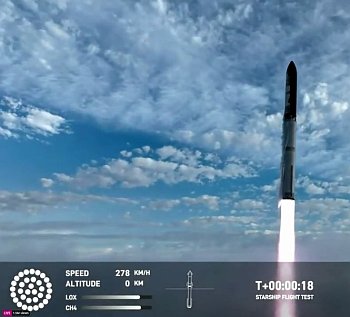
SpaceX successfully launches Superheavy and Starship

Superheavy & Starship, on their way
Note how all 33 Superheavy engines are firing.

SpaceX this morning successfully launched its Superheavy/Starship heavy lift rocket into its test orbit.

The test flight achieved far more than the first test in April. First, during the entire flight of Superheavy all 33 Raptor-2 engines fired normally. None cut out prematurely. Then at very risky hot fire stage separation — where the second stage (Starship) ignited prior to separation from Superheavy — the correct number of engines shut down, Starship’s engines fired, and Superheavy successfully separated and began its maneuvers for a soft splashdown in the Gulf of Mexico.

At that point mission controllers issued the self-destruct command to destroy Superheavy. Though it appeared that the stage was struggling to flip for its controlled return to Earth, it is also very likely that mission controllers wanted to test that flight termination system after its not perfect performance on the first test flight. Then, the self-destruct command did not activate the instant the command was given, being delayed by about 40 seconds. This time it appeared it worked as planned.
» Read more

SpaceX launches 23 Starlink satellites

While everyone is focused on the Starship/Superheavy launch scheduled for tomorrow at 7 am (Central) at Boca Chica, SpaceX tonight launched another 23 Starlink satellites, its Falcon 9 rocket lifting off from Cape Canaveral.

The first stage successfully completed it eleventh flight, landing on a drone ship in the Atlantic.

The leaders in the 2023 launch race:

84 SpaceX
52 China
14 Russia
7 Rocket Lab
7 India

American private enterprise still leads China 96 to 52 in successful launches, and the entire world combined 96 to 81. SpaceX by itself is now leads the rest of the world (excluding American companies) 84 to 81.

German rocket startup signs deal with Norwegian spaceport

Map of northern European spaceports

The German rocket startup Isar Aerospace has signed a deal to provide the Andoya spaceport in the north of Norway with a new flight tracking and safety system, to be used by all launches including Isar’s own Spectrum rocket.

The purpose of the autonomous flight tracking system is to precisely and reliably keeping track of the Spectrum launch vehicle’s position, speed and direction of travel as it ascends to orbit, which is important to guarantee Andøya Spaceport’s flight safety requirements. The objective is to further evaluate the use of the system in enabling automated flight termination functionality for launches by Andøya Spaceport’s ground system, autonomously triggering an abort of the mission if ever operational parameters of the launch vehicle are out of bounds.

This announcement today illustrates the rising competition between German rocket startups and European spaceports. Yesterday the Saxavord spaceport in Scotland and another German rocket startup, HyImpulse, announced their own launch deal. Today’s announcement is the response from Andoya and Isar.

Today’s announcement also increases the pressure in the UK’s Civil Aviation Authority (CAA) to get its regulatory act together. Andoya is positioning itself as a good alternative to the two new British spaceports in Scotland, as shown by the red dots on the map above, should red tape in the UK slow launches there.

House committee delays vote on commercial space bill due to new White House proposal

Because of the sudden announcement by the White House of its own version of a new commercial regulatory space bill, the House Science committee was forced to delay the voting on November 15, 2023 of its own new commercial space bill, put forth by Republicans.

The committee met Nov. 15 to mark up the Commercial Space Act of 2023 and one other bill. At the end of the markup, lasting more than three and a half hours including a recess, the committee’s chairman, Frank Lucas (R-Okla.) said the committee would delay votes to advance both bills until after the Thanksgiving break because of votes on the House floor and “and the nature of additional information that has become available to us.”

The latter comment appeared to be a reference to a legislative proposal released by the White House’s National Space Council less than an hour before the markup regarding a mission authorization concept for new space activities. That proposal would establish a system where both the Commerce Department and the Transportation Department would oversee activities not regulated today, based on the type of activity.

The House bill, introduced Nov. 2 by Lucas and space subcommittee chairman Rep. Brian Babin (R-Texas), would create its own mission authorization system at the Commerce Department. It would also direct Commerce to hand over responsibility for a civil space traffic coordination system to a consortium led by an academic or nonprofit organization, rather than keeping it within the Office of Space Commerce as currently planned. Lucas, in his opening remarks, said he was aware of the new White House proposal but has reservations about it. “These proposals, I fear, simply go in the wrong direction and hurt rather than support America’s space industry,” he said.

Both bills were aimed at realigning the regulatory regime governing private space activities. The House bill’s final form apparently had been written with a lot of industry input. The White House bill, supported by Democrats, appears designed instead to clamp down on commercial space by allowing the federal bureaucracy to regulate everything.

Both bills unfortunately give too much power to the federal government, though the Republican bill at least tries to shift some of that power to the private sector, where it belongs.

One of the main reasons we have had a rennaisance in commercial space in the past decade is that there has been little regulation. The private sector has been left to regulate itself, and it has generally done so very successfully because of the invisible hand of free market forces. Build things right and the world beats a path to your door. Do it badly and no regulation is needed, you go out of business.

Modern Americans no longer trust these fundamentals of freedom and capitalism, and so we have a rush by government to establish “rules,” none of which will really accomplish anything but slow development and innovation and squelch this emerging industry.

Sierra Space shakes up its staffing

Sierra Space yesterday did a major staffing shake up, laying off 165 workers while shifting 150 with secruity clearances from its parent company Sierra Nevada.

Sierra Space this week shipped the first Dream Chaser, named Tenacity, for pre-launch testing at NASA’s Armstrong facility in Ohio. The layoffs began soon after, the Sierra Space spokesperson said, noting the company conducted a surge in hiring this year to complete work on the Tenacity spacecraft.

With Tenacity shipped, Sierra Space’s spokesperson said the company is realigning to focus on the operations phase of Dream Chaser’s first mission, as well as on classified national security work. The latter part of Sierra Space’s realignment includes adding nearly 150 employees with security clearances from Sierra Nevada Corp., the aerospace and defense contractor owned by Fatih and Eren Ozmen, which the space company was spun out of two years ago. Sierra Space’s spokesperson said the company is creating a national security space team to work on several classified contracts.

This shift suggests that at least in the short run, Sierra is putting more focus on future military contracts rather than its civilian manned space projects like its LIFE space module (for the Orbital Reef space station) and future manner versions of its Dream Chaser mini-shuttle. I wonder if the company is having more internal doubts about Orbital Reef and its main partner, Blue Origin. Unlike the stations being built by Axiom and Voyager Space, which have already garnered contracts from both national and international customers, Orbital Reef has not done the same. There could be great doubts in the space community it will be built because of Blue Origin’s absymal record for building anything.

Amazon’s first two Kuiper satellites in orbit worked exactly as planned

Amazon announced today that its first two Kuiper satellites, launched into orbit by ULA’s Atlas-5 rocket on October 6, 2023, have worked exactly as planned, thus allowing the company to begin building operational satellites.

With the prototypes’ testing in space now complete, Badyal said Amazon plans to begin building the first production Kuiper satellites in December and launch the first satellites for its network in the “latter part of the first half” of 2024. Badyal emphasized that Amazon wasn’t sure what performance to expect from the prototype satellites, since “you don’t know how well it’s going to work in space.”

“They’re working brilliantly,” Badyal said.

The need of Amazon to start launching lots of satellites next year — in order to meet its FCC license requirements to put half of its 3,000+ constellation in orbit by 2026 — puts great pressure on ULA, Blue Origin, and Arianespace to get their new but as yet unlaunchd rockets operating. All three have big launch contracts with Amazon, but none presently appear to have the capability to meet the demands of those contracts.

Saxavord spaceport gets launch deal from German rocket startup

The Saxavord spaceport, one of two being built in Scotland, has signed a launch deal from the German rocket startup Hy-Impulse, with two suborbital test launches scheduled for next year and an orbital launch targeting 2025.

HyImpulse, a launch services provider and DLR spinoff based in Baden-Württemberg, Germany, is currently gearing up for its inaugural suborbital launch early next year from Australia. It will however look to conduct two suborbital launches from SaxaVord Spaceport, located in Scotland’s Shetland Islands, from August 2024 onwards. HyImpulse has already secured an Air Navigation Order (ANO) license from the UK’s Civil Aviation Authority for one launch.

These will be followed by first orbital launches from late 2025 onwards. The plan envisions rising to full commercial operations by 2030.

All this assumes that the UK’s Civil Aviation Authority (CAA) can issue the launch licenses in time. After all it only six to ten months to approve those suborbital launches, and almost two years to approve the orbital launch. So far the CAA has proven unable to approve anything within even those long time frames.

Biden White House proposes major expansion of the regulations governing commercial space

We’re here to help you! The Biden White House yesterday proposed a major expansion of the regulations that govern commercial space, with the changes aimed at splitting all regulation within the Transportaion and Commerce Departments, but expand the regulations to so as to increase the power of the government over all future activitives, from rockets to spacecraft to space stations.

According to the White House’s statement [pdf]:

Specifically, this proposal would amend 51 U.S.C. 50902 to define a “human space flight vehicle” as a vehicle, including a launch vehicle or reentry vehicle, habitat, or other object, built to operate in suborbital trajectory or outer space, including on a celestial body, with a human being on board. A license would then be required for a citizen of the United States to operate a human space flight vehicle in outer space. (51 U.S.C. 50904).

DOT would authorize the operation of a human space flight vehicle consistent with public health and safety, safety of property, space sustainability, international obligations of the United States, and national security, foreign policy, and other national interests of the United States. (51 U.S.C. 50905). This proposal adds “space sustainability” and “other national interests” to DOT’s current authority. Including “space sustainability” would allow DOT to include debris mitigation and require measures to protect the sustainable use of outer space in their regulations, to include the mitigation and remediation of orbital debris and consideration of impacts to the space operational environment. [emphasis mine]

Essentially, these new rules — purposely written to be vague — will allow the government to forbid any activity in space by private citizens it chooses to forbid. No private space station could launch without government approval, which will also include the government’s own determination that the station will be operatied safely. Once launched, the vagueness of these regulations will soon allow mission creep so that every new activity in space will soon fall under its review.

Since no one in the government is qualified to supervise things like this, in the end politics and the abuse of power will be the rule.

Moreover, by what constitutional right does the federal government have to supervise the work of all space companies, in all things? It doesn’t have that right, and in fact the Constitution was written expressly to forbid it from attempting such a thing. The Constitution however is nothing more than fish wrap in modern America.

Note that most other news reports on this proposal are making it sound as nothing more than a simple revision of the law to better organize the regulatory system. The assumption is always that the government is all-knowing and all-seeing, and has the ability to act as school teacher for everyone else.

Initially we can expect these regulations will be followed with good faith, but such things never last. Given time they will end up squelching freedom in space and the entire American effort to colonize the solar system. And should any American colony become reasonably self-sufficient under these rules (something not likely), the rules guarantee that they will revolt from American rule as quickly as possible.

At this moment this proposal is simply that. Congress needs to review it and decide if it wishes to do as the Biden White House proposes. Though it is unlikely it will pass as written, it is also likely that our present Congress will simply reword it to accept this expansion of power, in some manner.

1 57 58 59 60 61 262