
Meteorite strike in Nicaragua
A small meteorite hit the ground near Managua’s airport in Nicaragua on Saturday, creating a 39 foot wide crater.
A small meteorite hit the ground near Managua’s airport in Nicaragua on Saturday, creating a 39 foot wide crater.
By comparing data from the Voyager fly-bys of Saturn in the 1980s with new data collected by Cassini in the past decade scientists think they can now explain the changes that have occurred in Saturn’s outer F ring.
“The F ring is a narrow, lumpy feature made entirely of water ice that lies just outside the broad, luminous rings A, B, and C,” notes French. “It has bright spots. But it has fundamentally changed its appearance since the time of Voyager. Today, there are fewer of the very bright lumps.” The bright spots come and go over the course of hours or days, a mystery that the two SETI Institute astronomers think they have solved.
“We believe the most luminous knots occur when tiny moons, no bigger than a large mountain, collide with the densest part of the ring,” says French. “These moons are small enough to coalesce and then break apart in short order.”
The Rosetta science team has released their first geology map of Comet 67P/C-G, showing the nucleus’s surface divided into different kinds of terrain.
Scientists have found evidence that Jupiter’s moon Europa undergoes the same kind of plate tectonics seen on Earth.
American scientists have confirmed that water samples from the buried Antarctic Lake Whillans, first obtained in January 2013, contained almost 4,000 different species of life.
Samples from the lake show that life has survived there without energy from the Sun for the past 120,000 years, and possibly for as long as 1 million years. And they offer the first look at what may be the largest unexplored ecosystem on Earth — making up 9% of the world’s land area. “There’s a thriving ecosystem down there,” says David Pearce, a microbiologist at Northumbria University, UK, who was part of a team that tried, unsuccessfully, to drill into a different subglacial body, Lake Ellsworth, in 2013.
Rosetta has successfully achieved orbit around Comet 67P/C-G and has transmitted its first close up images. More information here and here about the rendezvous and what science the mission scientists plan to do as they orbit the comet.
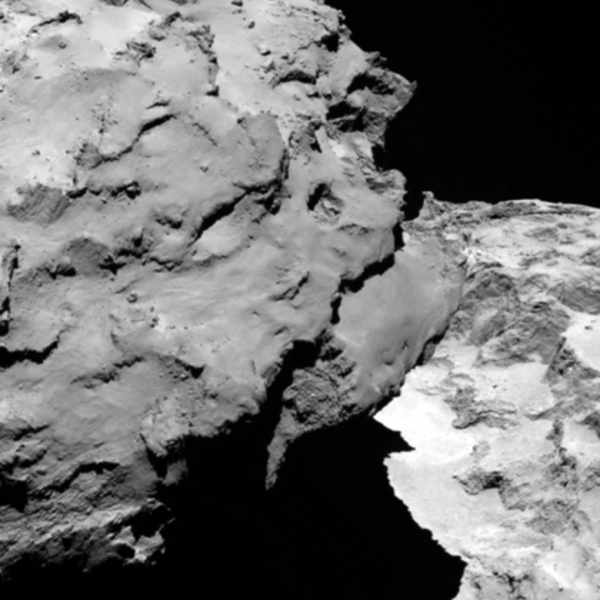
The image below is looking down and past the comet’s smaller component as it casts a shadow on the neck and the larger component beyond. As with the earlier images, the comet’s pitted and corroded surface, lacking any obvious craters, is reminiscent to me of a pile of dirty snow that has been dissolving away. In fact, when I lived in New York I would see this kind of look every winter. When the city would get a big snowfall snowplows would push it into large mounds on the side of the road. As time passed these piles would get dirty from the city’s soot and grime, and also slowly melt away. After several weeks it would look almost exactly like the surface of Comet 67P/C-G.
The images and data that will come down from Rosetta over the next year and half as it orbits the comet in its journey around the Sun will be most fascinating. Stay tuned!
In 2013 the ground-based Gemini telescope imaged a gigantic volcanic eruption on Jupiter’s moon Io.
More here, including information on two other eruptions that occurred about the same time.
The uncertainty of science: A second look at cores drilled in the Pacific northwest has raised doubts about the previous conclusions that the region faces the threat of megaquakes every few centuries.
The bottom line is that though geologists are very confident the northwest faces the threat of future quakes, they can’t yet predict with any confidence their rate or intensity.
Using computer models based on the Moon’s crater record, scientists have developed a simulation of the great early bombardment of the Earth around 4 billion years ago.
The model suggests that the biggest asteroids to hit Earth would have been as large as 3,000 kilometres across. Between one and four would have been 1,000 kilometres wide or larger, it predicts, with a total of three to seven exceeding 500 kilometres in width. The most recent of these would have hit around 4.2–4.3 billion years ago.
In comparison with Earth’s mass, the amount of rock hitting the planet would have been tiny. But it would have had an enormous effect on Earth’s surface, says Marchi. A 10-kilometre-wide asteroid was enough to kill the dinosaurs, and studies4 show that one 500 kilometres across would vaporize all of the planet’s oceans. “At 1,000 kilometres, the effects would be so wide the planet would probably be completely resurfaced with material from the mantle,” he says.
More here, including animated gifs showing this bombardment unfold.
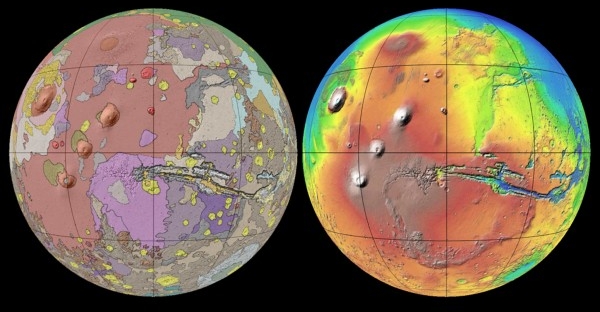
Scientists have released a new geological map of Mars based on data accumulated over the last sixteen years by four orbiters and four rovers.
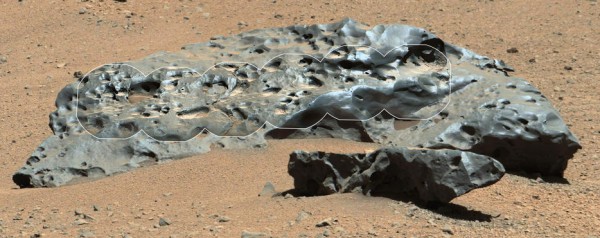
In related news, Curiosity has stumbled upon a six foot wide meteorite sitting on the surface of Mars.
A new array of seismometers, combined with a series of planned explosions, will be used to map the interior of the Mt. St. Helens volcano to a depth of eighty kilometers or fifty miles.
To get the job done, starting next week roughly 65 people will fan out across the mountain to deploy 3,500 small seismometers along roads and back-country trails. They will drill 24 holes some 25 metres deep, drop in industrial explosives used for quarrying, and refill the holes (see ‘Under the dome’). The plan is to detonate the explosives in separate shots over four nights. Each blast will shake the ground as much as a magnitude-2 earthquake.
Results from the active blasts will be combined with the passive seismic part of the experiment, which is already under way: 70 larger seismometers around the mountain are measuring how long waves from natural earthquakes take to travel through the ground. Their data can be used to probe as far as 80 kilometres down, says Vidale.
37 amazing places you must visit before you die.
Great pictures. I am happy to say that I’ve seen most of the places listed that are in the U.S. And I’ve also seen other places in the U.S. quite comparable to international locations shown here.