Drastic changes in Mars South Pole icecap

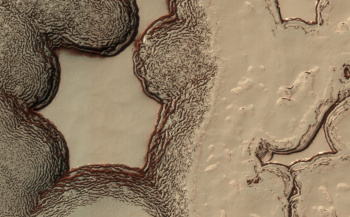
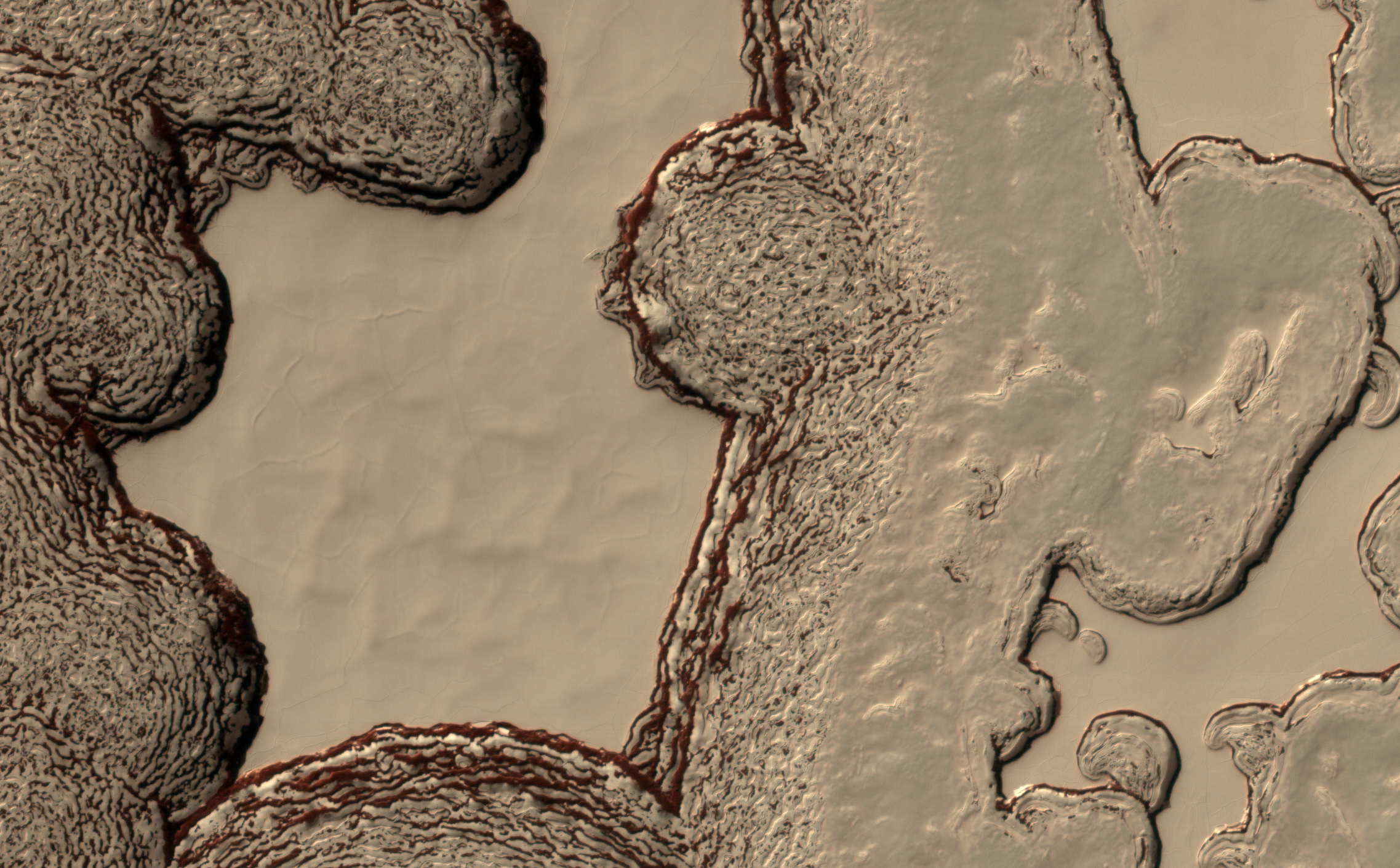
Mars South Pole 2007
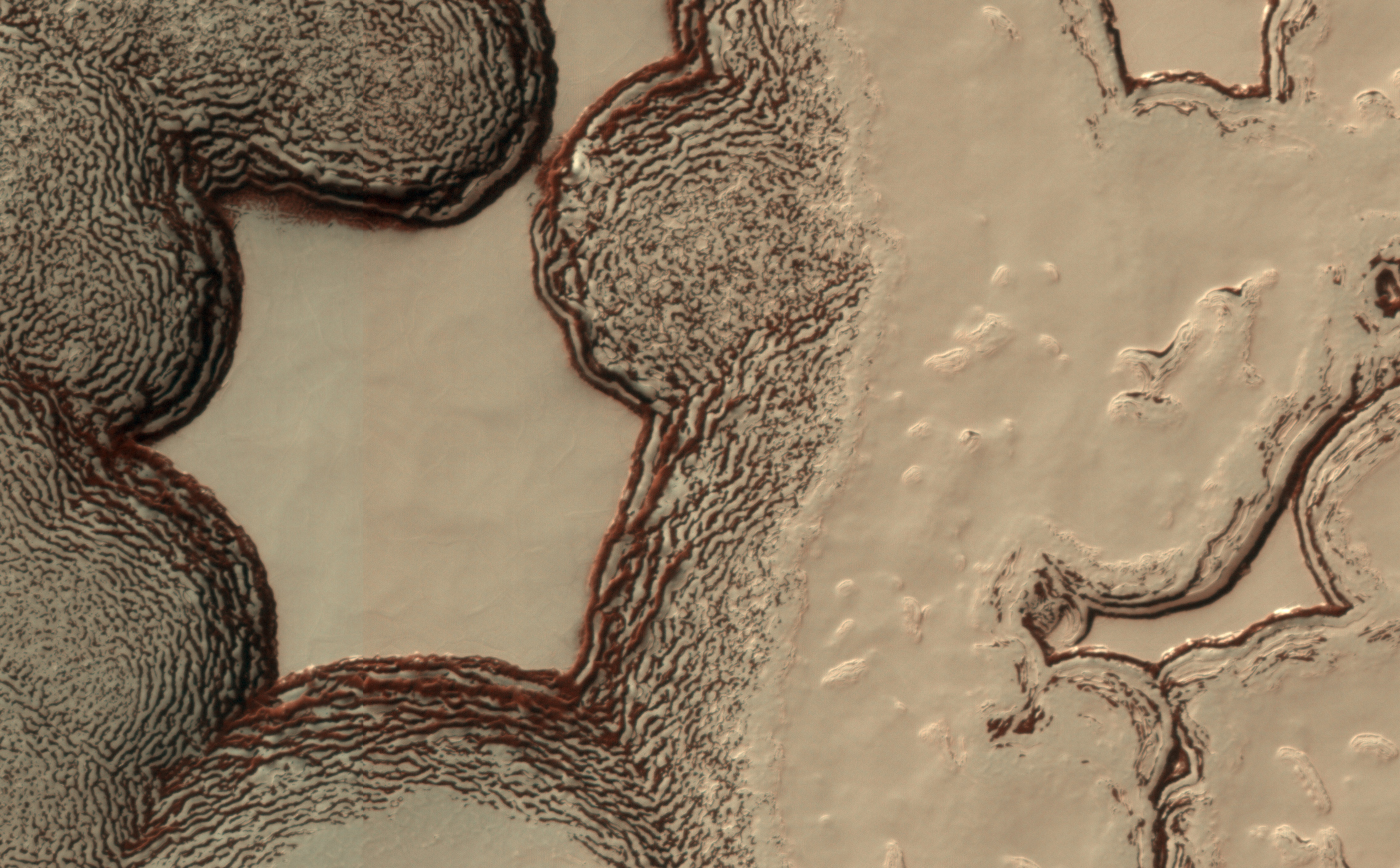
Mars South Pole 2015

Cool image time! Summer images taken by Mars Reconnaissance Orbiter 8 years apart of a specific area of the Martian south pole icecap show significant and surprising changes.

The top image on the right was taken August 28, 2007. The bottom image was taken March 23, 2015, four Martian years later. As noted by the science team, the bright flat-topped mesas have shrunk by about half, while the dark rough low areas have grown, eating into the mesa walls.

Closeup study of this area would provide a wealth of knowledge. It will also be very challenging, as the environment is harsh, hostile, and unstable. Imagine doing research in the Himalayas but with an unbreathable atmosphere and temperatures always far far below freezing.

2 comments

Balanced rock on Comet 67P/C-G

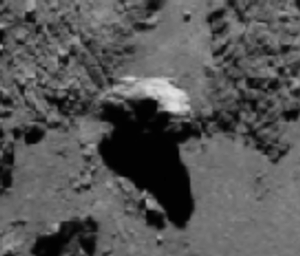
balanced rock on Comet 67P/C-G

Cool image time! Rosetta’s high resolution camera has discovered a group of balancing rocks on the surface of Comet 67P/C-G.

The image on the right, cropped and brightened by me, shows the most dramatic of these rocks. The scientists are as yet uncertain on how these rocks got to where they are.

โ€œHow this apparent balancing rock on Comet 67P/C-G was formed is not clear at this point,โ€ says OSIRIS Principal Investigator Holger Sierks from the Max Planck Institute for Solar System Research (MPS) in Germany. One possibility is that transport processes related to cometary activity played a role, causing such boulders to move from their original site and reach a new location.

It is also possible that the rocks were sitting on a base of ice that simply evaporated away over time.

0 comments

Layered mesas inside Martian crater

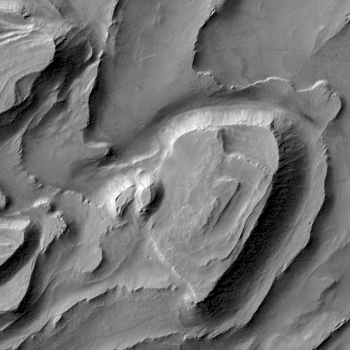
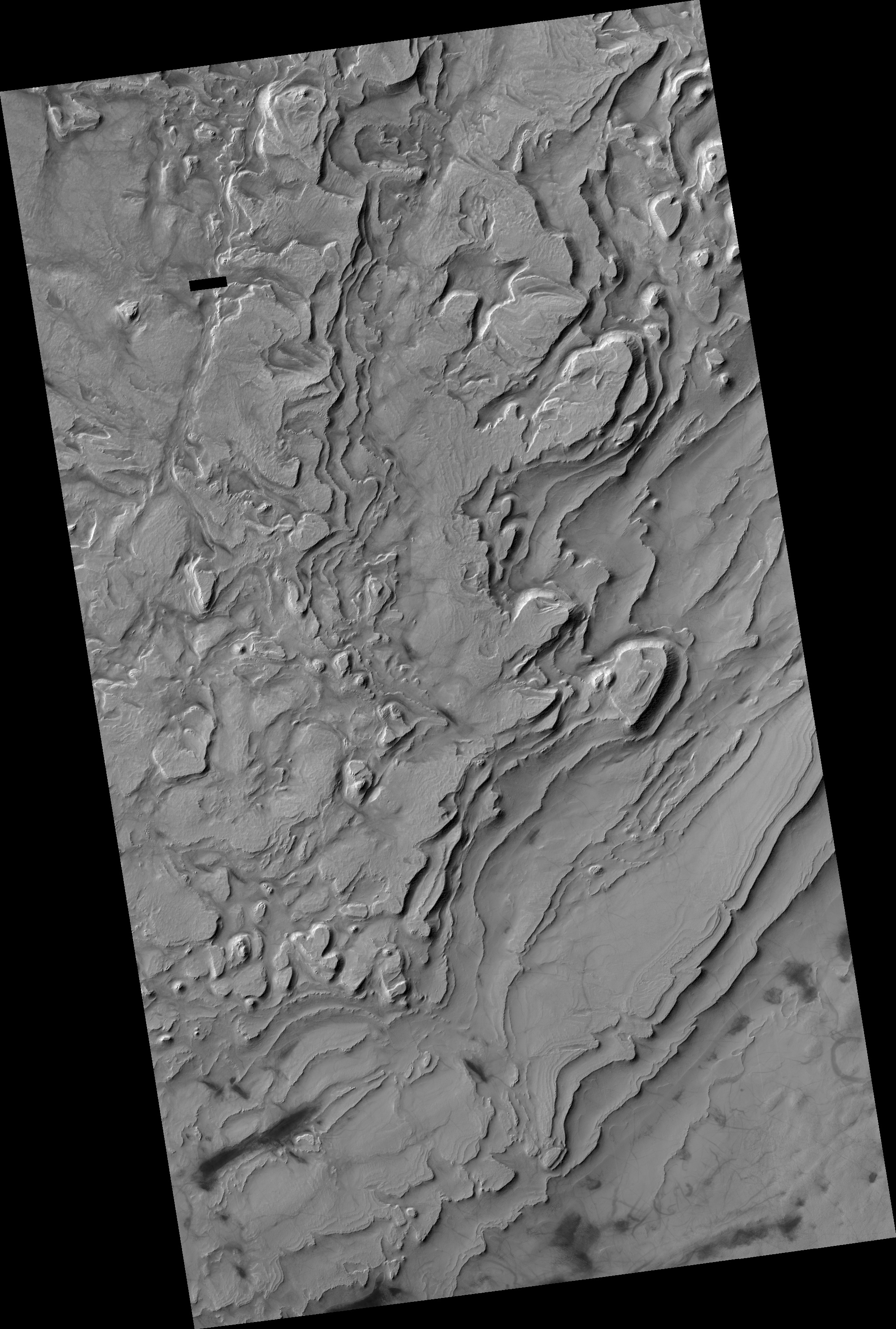
Layered mesas inside a Martian crater

Cool image time! In their weekly release of new images, the hi-resolution camera team for Mars Reconnaissance Orbiter have posted a wonderful image of the complex layering and terracing inside Spallanzani Crater, located in the high latitudes of the red planet’s southern hemisphere. The image on the right is only one small section of the much larger image.

So what is the composition of these layers? Spallanzani Crater lies in the high latitudes of the Southern hemisphere (around 60 degrees in latitude) so there is a good possibility that the deposits are ice-rich. If we look more closely we will notice fractured mounds, which sometimes indicate the presence of subsurface ice. Another interesting observation is the presence of grooves in the shaded slopes of some of the layers. Perhaps these grooves formed because of the sublimation (the direct transfer of solid ice to water vapor) of ice from these slopes since slopes tend to get warmer than the surrounding terrains.

This image hardly shows a breakthrough discovery, but I like it because it illustrates nicely the wonderful but very alien landscape of Mars. To walk its surface will be a daily adventure for its first colonists.

1 comment

Seismic data of Yellowstone has found a bigger second magma chamber

Geologists have mapped the existence of a second deeper and larger magma chamber under Yellowstone National Park.

Scientists had already known about a plume, which brings molten rock up from deep in the mantle to a region about 60 kilometers below the surface. And they had also imaged a shallow magma chamber about 10 kilometers below the surface, containing about 10,000 cubic kilometers of molten material. But now they have found a deeper one, 4.5 times larger, that sits between 20 and 50 kilometers below the surface. โ€œThey found the missing link between the mantle plume and the shallow magma chamber,โ€ says Peter Cervelli, a geophysicist in Anchorage, Alaska, who works at the U.S. Geological Surveyโ€™s Yellowstone Volcano Observatory.

The discovery does not, on its own, increase the chance of an eruption, which is driven by an emptying of the shallow chamber. The last major eruption was 640,000 years ago, and today the threat of earthquakes is far more likely. But the deeper chamber does mean that the shallow chamber can be replenished again and again. โ€œKnowing that you have this additional reservoir tells you you could have a much bigger volume erupt over a relatively short time scale,โ€ says co-author Victor Tsai, a geophysicist at the California Institute of Technology in Pasadena. The discovery, reported online today in Science, also confirms a long-suspected model for some volcanoes, in which a deep chamber of melted basalt, a dense iron- and magnesium-rich rock, feeds a shallower chamber containing a melted, lighter silicon-rich rock called a rhyolite.

0 comments

New study finds fracking does not contaminate drinking water

The uncertainty of science: A new study, using data from more than 11,000 drinking water wells in northern Pennsylvania, has found no evidence that fracking causes contamination.

The new study of 11,309 drinking water wells in northeastern Pennsylvania concludes that background levels of methane in the water are unrelated to the location of hundreds of oil and gas wells that tap hydraulically fractured, or fracked, rock formations. The finding suggests that fracking operations are not significantly contributing to the leakage of methane from deep rock formations, where oil and gas are extracted, up to the shallower aquifers where well water is drawn.

The result also calls into question prominent studies in 2011 and 2013 that did find a correlation in a nearby part of Pennsylvania. There, wells closer to fracking sites had higher levels of methane. Those studies, however, were based on just 60 and 141 domestic well samples, respectively.

The article outlines in detail the many disagreements and uncertainties of both the old studies and this new one. It also however contains this one key quote about the earlier studies, buried in the text, that illustrates the politics influencing the reporting of the anti-fracking research:

The two papers seemed to show that fracking was leading to increased concentrations of methane in drinking water. Dissolved methane is not toxic, and drinking water often contains significant background levels of the gas from natural sources. [emphasis mine]

The earlier studies were blasted everywhere by the media. They were used to show the harm fracking does, and were the justification for the banning of fracking in New York. Yet, the methane they found was not necessarily caused by fracking, and isn’t even a health concern anyway.

I wonder if the press will give this new report as much coverage. It might not be right, but it sure does indicate that the science is unsettled, and that the risks from fracking are, as usual in these days of doom-saying environmentalism, overblown.

3 comments

Watch the break up of Pangea!

Geoscientists have created a short video showing the break-up of the giant continent Pangea, beginning 187 million years ago and showing the changes in million year increments.

It is very cool to watch today’s continents slowly come into view. Make sure especially that you watch India as it suddenly starts to fly north at a relatively fast speed to smash into Asia.

0 comments

Largest ancient meteorite impact found?

The uncertainty of science: Scientists doing geothermal research in Australia have discovered evidence of what they think is the largest known impact zone from an meteorite on Earth.

The zone is thought to be about 250 miles across, and suggests the bolide split in two pieces each about 6 miles across before impact. The uncertainty is that the evidence for this impact is quite tentative:

The exact date of the impacts remains unclear. The surrounding rocks are 300 to 600 million years old, but evidence of the type left by other meteorite strikes is lacking. For example, a large meteorite strike 66 million years ago sent up a plume of ash which is found as a layer of sediment in rocks around the world. The plume is thought to have led to the extinction of a large proportion of the life on the planet, including many dinosaur species.

However, a similar layer has not been found in sediments around 300 million years old, Dr Glikson said. โ€œItโ€™s a mystery โ€“ we canโ€™t find an extinction event that matches these collisions. I have a suspicion the impact could be older than 300 million years,โ€ he said.

In other words, they find some evidence that an impact occurred, but not other evidence that is expected to be found with such an impact. Moreover, the rocks at the sedimentary layer where the impact is found are dated around 300 million years ago, a time when no major extinction took place. Either this impact didn’t really happen, or it didn’t happen when it appears it should have, or it shows that large impacts don’t necessarily cause mass extinctions.

0 comments

Giant lava tubes possible on the Moon

New analysis of the lunar geology combined with gravity data from GRAIL now suggests that the Moon could harbor lava tubes several miles wide.

David Blair, a graduate student in Purdue’s Department of Earth, Atmospheric and Planetary Sciences, led the study that examined whether empty lava tubes more than 1 kilometer wide could remain structurally stable on the moon. “We found that if lunar lava tubes existed with a strong arched shape like those on Earth, they would be stable at sizes up to 5,000 meters, or several miles wide, on the moon,” Blair said. “This wouldn’t be possible on Earth, but gravity is much lower on the moon and lunar rock doesn’t have to withstand the same weathering and erosion. In theory, huge lava tubes – big enough to easily house a city – could be structurally sound on the moon.”

You can read their paper here. If this is so, then the possibility of huge colonies on the Moon increases significantly, as it will be much easier to build these colonies inside these giant lava tubes.

10 comments

Ceres comes into focus

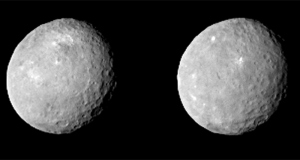
Ceres as since on February 12, 2015 by Dawn

Cool images! The Dawn science team has released new even sharper images of the giant asteroid Ceres, taken by Dawn on February 12 at a distance of 52,000 miles.

Though the surface appears to have many of the typical craters, scientists continue to be puzzled by the bright spots. This newest image suggests that they are ice-filled craters, but don’t hold me to that guess. For one thing, why are only a handful of craters filled with ice, and none of the others?

0 comments
1 135 136 137 138 139 157