German rocket startup HyImpulse signs deal to consider launching from Oman
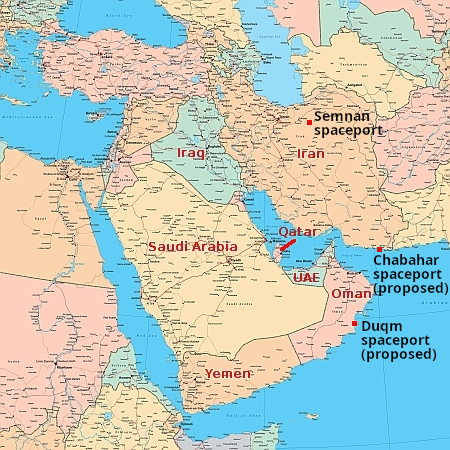
Active and proposed Middle East spaceports

The German rocket startup HyImpulse has signed an agreement with Oman to study the possibility of launching its rockets from Oman’s proposed Etlaq spaceport located near the town of Duqm.

Under the proposed collaboration, HyImpulse will evaluate both near-term mission opportunities and the feasibility of establishing a longer-term operational presence at Etlaq Spaceport. Beyond offering an alternative launch base outside northern Europe, the arrangement is expected to capitalize on Oman’s advantageous geographic latitude, enabling access to a broader range of orbital inclinations and enhancing mission flexibility for customers across the GCC [Gulf Cooperation Council], Asia and, potentially, emerging African markets.

The two sides also plan to assess the possibility of supporting future launch campaigns involving HyImpulse’s SR75 and SL1 launch vehicles from Oman. Etlaq would provide access to launch infrastructure, operational facilities and mission-support capabilities as the European company studies deployment opportunities in the Sultanate.

HyImpulse is now the second European rocket startup to sign such a deal. In 2025 the Spanish company PLD agreed to use Duqm as well.

At the same time, Oman had previously said the spaceport would see a number of suborbital test flights in 2025, none of which happened.
3 comments

German rocket startup signs deal with Nova Scotia spaceport

Proposed Canadian spaceports

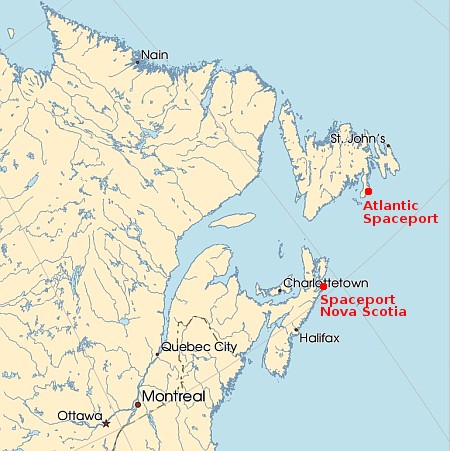
The German rocket startup Isar Aerospace, which has not yet had a successful launch, has now signed a launch agreement with Maritime Launch Services, the company that has been trying to create a spaceport in Nova Scotia for more than a decade without success.

Space company Isar Aerospace and Spaceport operator Maritime Launch Services (MLS), have signed a Letter of Intent to advance sovereign orbital launch readiness from Nova Scotia, Canada. The agreement brings together Isar Aerospace’s orbital launch system and MLS’s launch site, Spaceport Nova Scotia, which is strategically located for launches to support reliable access to mid- to high-inclination and polar orbits for Earth observation and communication satellites and constellations, supporting commercial and government missions

Isar’s Spectrum rocket failed seconds after launch in its first attempt in 2025, launching from Norway’s Andoya spaceport. Since January the company has tried again several times but was forced to scrub each time. At present the launch is tentatively scheduled for June.

MLS’s history is even more convoluted. Initially a decade ago it partnered with a Ukrainian rocket company to offer launch services at Spaceport Nova Scotia. After years of delays that deal ended for good when Russia invaded the Ukraine. Since then MLS has tried to interest both satellite and rocket companies, all to no avail. This new deal was probably made possible due to financial help from the Canadian government, which in March 2026 signed a 10 year deal with MLS worth $200 million, with the intent to encourage a “sovereign orbital capability” for Canada. Since there are no rocket companies in Canada capable of doing this, it appears that capability will now come from Germany.

4 comments

Rocket Factory Augsburg getting close to launch

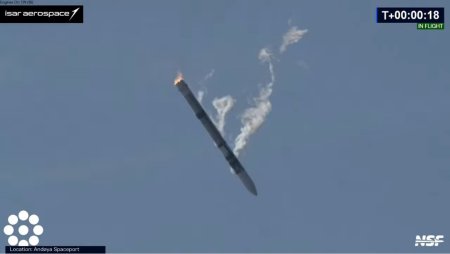
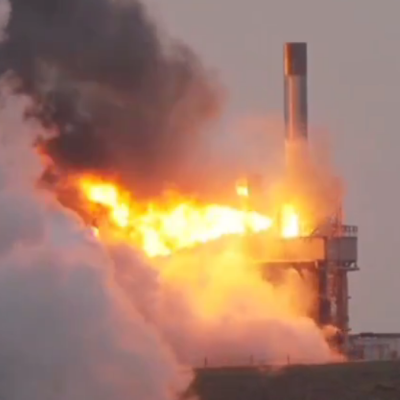
Screen capture of test failure
Screen capture from video of test failure in 2024.
Note the flame shooting out sideways.

The German rocket startup Rocket Factory Augsburg appears to finally be getting close to launching its RFA-1 rocket after a static fire test explosion in 2024 seriously delayed its plans.

Speaking to European Spaceflight in early February, Rocket Factory Augsburg CEO Prof. Dr. Indulis Kalnins, who replaced Dr. Stefan Tweraser in April 2025, explained that the rocket’s first stage is in the process of being transported from Augsburg in Germany to the launch site on Unst. The rocket’s upper stage, which has received upgrades to its single Helix engine and the associated control software, is expected to follow in the next few weeks.

On 10 February, the company announced that the new umbilical tower had been raised, standing at 52 metres high. The tower will support and stabilise the rocket and provide propellant, power, and data connections. The company has begun commissioning the repaired and upgraded launch pad. The only element still to be added is the water tanks for the water deluge system. Kalnins, however, stressed that the company is taking its time with all pre-flight testing.

It appears my speculation that the company had not yet received its launch licenses from the Civil Aviation Authority (CAA) was wrong. Those licenses were issued in January 2025, only five months after the static fire launchpad explosion. For the CAA to respond that quickly is quite surprising. Maybe it decided it shouldn’t kill a third rocket company trying to launch from the UK.

Right now the race to be the first orbital rocket launched from a European spaceport is coming down to Rocket Factory and its German competitor Isar Aerospace. Isar is gearing up to make its second attempt to launch its Spectrum rocket from Norway’s Andoya spaceport in March.

0 comments

German government hires German startup Polaris Spaceplanes to build reusable two-stage hypersonic plane

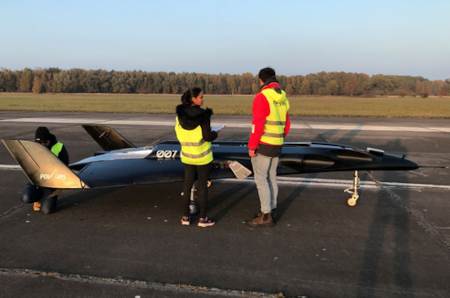
Mira-II prototype following first flight using aerospike engine
Mira-II prototype following first flight using
aerospike engine in October 2024.

The German government yesterday awarded a contract to the German startup Polaris Spaceplanes to build and fly a reusable two-stage hypersonic plane by 2027.

On 27 January, POLARIS Spaceplanes announced that it had been awarded a contract by the Federal Office of Bundeswehr Equipment, Information Technology and In-Service Support (BAAINBw) to build a fully reusable, horizontal take-off, two-stage hypersonic vehicle. The primary application of the Hypersonic Test and Experimentation Vehicle (HYTEV) will be as a hypersonic testbed for scientific and defence-related research. A variant of the vehicle with an expendable upper stage will also be capable of deploying small satellites into low Earth orbit.

According to the company, the HYTEV will be roughly the size and take-off mass of a fighter jet. The main stage will be powered by two turbofans and one of the company’s in-house developed aerospike rocket engines. The turbofans will be used for take-off and landing, and the rocket engine will accelerate the vehicle before upper-stage deployment. The upper stage will be entirely rocket-powered, with imagery accompanying the announcement appearing to show a more conventional rocket engine configuration compared with the aerospike engine equipped to the main stage. After completing its mission, it will likely be recovered under controlled glide conditions or potentially by a parachute or parafoil.

This deal appears to be an upgrade to a February 2025 German government deal with Polaris. It also follows Polaris’s successful use of an aerospike engine on a prototype test flight in 2024. While the company has shown some success, doing more than a dozen test flights with small scale prototypes (as shown in the image to the right), this program and schedule still seems quite ambitious.

3 comments

German rocket startup Isar Aerospace is getting ready for 2nd launch attempt in Norway

Isar's first launch attempt fails
Spectrum falling seconds after its launch
in March 2025

The German rocket startup Isar Aerospace has now delivered the stages of its Spectrum rocket to Norway’s Andoya spaceport, in preparation for its second launch attempt following the first launch failure in March.

On 13 November, an Isar Aerospace update on its social channels revealed that, just over seven months after its first flight ended in a fireball, the company had returned to its launch facilities at the Andøya Spaceport in Norway in preparation for the rocket’s second flight. While brief, the update stated that the main and upper stages for the flight had arrived at the company’s launch pad and that it was “gearing up for pre-flight testing.” The update did not include an expected launch date.

The company in September had completed its investigation into the March failure, determining the failure was an inability of the rocket to maintain its proper attitude control.

Road closure announcements in Norway suggest that this launch will occur prior to December 21, 2025, but this is decidedly unconfirmed. If the launch takes place then and is successful, Norway’s Andoya spaceport will have become the first European-based spaceport to launch an orbital rocket, beating out the two spaceports in the United Kingdom and the Esrange spaceport in Sweden.

0 comments

Is the German government holding up Rocket Lab’s purchase of German space communications company Mynaric?

Even though Rocket Lab announced in March that it was acquiring the German laser communications company Mynaric for $150 million, and entered into the stock purchase agreement in September, the company has not yet gotten approval for the purchase from the German government, raising questions that approval might be denied.

A central question for regulators and industry observers is whether Mynaric, once owned by Rocket Lab, would still be deemed a European entity — a status that could determine its eligibility to compete for Europe’s planned sovereign communications network, known as IRIS² (Infrastructure for Resilience, Interconnectivity and Security by Satellite). The multibillion-euro program, backed by the European Union, is designed to strengthen Europe’s independence in secure satellite communications and may restrict participation to European-controlled firms.

Those regulators however also have to consider whether IRIS will even fly. Designed to provide a government option to the internet constellations being operated or built by Starlink, Kuiper, and several Chinese projects, it is significantly delayed, vastly over budget, and unlikely to compete very successfully. There have been rumors several EU nations are even balking at building it at all.

If Rocket Labs’ purchase of Mynaric is denied, it will likely not harm that company significantly. It will however be another example of Europe cutting off its nose to spite its face. It will block this American company from providing business to Europe, even as its own government projects wither on the vine.

1 comment

Germany’s military commits to spending $41 billion on space through 2030

In another sign that the member nations of the European Space Agency (ESA) are increasingly going their own way, Germany’s defense minister announced yesterday that his agency plans to spend $41 billion on space through 2030.

According to a 25 September Bundeswehr (German Armed Forces) release published following the minister’s address, the €35 billion investment will cover five main priorities: hardening against data disruptions and attacks, improved space situational awareness, redundancy through several networked satellite constellations, secure, diverse, and on-demand launch capabilities, and a dedicated military satellite operations centre.

This commitment is going to definitely benefit the three German rocket startups, Isar Aerospace, Rocket Factory Augsburg, and Hyimpulse. It will also likely benefit the North Sea launch platform — based in Germany — that is being built by a German consortium that has already received almost one million from the government.

While the European partners in ESA have generally kept their military spending separate from that agency, in the past a large bulk of this defense spending would have been committed to ESA joint projects, such as funding the agency’s commercial launch operation, Arianespace, to do the launches. No more.

1 comment

South Korean rocket startup Innospace wins launch and marketing contract with German broadcast company

The South Korean rocket startup Innospace announced last week that it has signed a $5.8 million launch with the German broadcast company Media Broadcast Satellites (MBS) to not only launch two MBS satellites in 2026 and 2028 using its Hanbit rocket, but to have MBS market the rocket in Germany.

Under the agreement, INNOSPACE will carry out two HANBIT launch missions to deploy MBS satellites into Low Earth orbit (LEO), with one launch in 2026 and the other planned by 2028. In both launch missions, MBS satellites will serve as the primary payloads, with priority in launch scheduling and orbit determination.

INNOSPACE also signed a separate contract on the same day, officially appointing MBS as its exclusive agent for launch service sales and marketing within Germany, marking the company’s entry into the European space launch market. Following the contract, MBS will exclusively distribute launch services based on the HANBIT series to satellite customers in Germany.

Innospace has not yet launched Hanbit. It had hoped to attempt the first launch in July, but in May it delayed it to the end of 2025 due to issues found in a first stage pump. The launch itself will take place at Brazil’s long abandoned Alcântara spaceport on that nation’s northeast coast.

4 comments

Isar outlines what caused the failure on the first launch of its Spectrum rocket

Isar's first launch attempt fails
Spectrum falling seconds after launch

According to officials of the German rocket startup Isar Aerospace, its Spectrum rocket failed during its first launch in March 2025 because of a loss of attitude control, which then caused the rocket to self-destruct.

Alexandre Dalloneau, vice president of mission and launch operations at Isar, said that the company had not properly characterized bending modes of the vehicle at liftoff. “The controllability has to be tuned in order to counter such behavior,” he said. That environment was not fully modeled and incorporated into the vehicle’s control system. “We were outside the environment that we expected, so that the controllability does not succeed.”

That loss of attitude control caused the vehicle to go outside the safety zone at the launch site. That, in turn, triggered the flight termination system on the rocket. He said the company has revised its modeling of vehicle modes at liftoff to correct the problem.

The company is now working towards a second launch from Norway’s Andoya spaceport, which it hopes to attempt either late this year or early next year. Afterward it hopes to launch eight-plus times a year, based on the demand it is presently seeing for its rocket.

3 comments

Proposed North Sea offshore launch platform gets ESA okay

Launch platforms proposed for North Sea

The proposed North Sea offshore launch platform of the startup Eurospaceport has now signed an agreement with the European Space Agency to support a test launch of a suborbital test rocket by Polish rocket startup SpaceForest.

The map to the right shows approximately where Eurospaceport’s launch platform will be located for this launch. The map also shows the locations of the two proposed spaceports in the United Kingdom, as well as a second German-based launch platform, Offshore Spaceport Alliance, based out of Bremen.

The SpaceForest launch is targeting a 2026 launch, with the ESA contract covering some of the expenses. As it will be suborbital, the rocket will likely not cross over any nearby habitable land.

The Offshore Spaceport was first proposed in 2020, and has received financial support from the German government, and announced earlier this year that it would be ready to host launches by September 2025. As of yet no launches have been scheduled.

Both of these launch platforms will need to travel farther to the west in the North Sea to provide any orbital rockets a path north that will not fly over other nations. Even so, launches for both will likely be limited to polar orbits, making their value less appealing to rocket companies.

At the same time, their proximity to Europe and the ability of the launch platforms to dock in Europe gives them other advantages that will be of interest to the German rocket startups.

1 comment

German rocket startup Isar Aerospace secures $174 million in financing

The German rocket startup Isar Aerospace announced today that it has obtained $174 million in new financing from a Miami-based investment firm.

This news report adds these details:

On 25 July 2025, Isar Aerospace announced that it had signed a €150 million convertible-bond agreement with Eldridge Industries. The instrument provides the company with funding in the short term, and the debt can later be converted into equity in the form of shares, typically at a pre-agreed valuation during a future financing round or an IPO.

That Isar needed to go to an American investment firm suggests there was a lack of interest in Europe to invest in this European rocket startup. The nature of the deal also suggests the possibility that some ownership rights will shift to Eldridge over time.

In March Isar first launch attempt of its Spectrum rocket from Norway’s Andoya spaceport failed 30 seconds after lift-off. It is building two more rockets, and will use this new capital to expand its production and launch facilities.

17 comments

German rocket startup Rocket Factory Augsburg replaces its CEO

Screen capture of test failure
Screen capture from video of test failure in August 2024.
Note the flame shooting out sideways.

In a major managerial shake-up as it preps for its first launch attempt later this year, the German rocket startup Rocket Factory Augsburg has replaced its CEO, switching from someone with more general business experience to a CEO with a lot of direct experience in the space industry itself.

In an April 11 statement not widely publicized by the company, RFA announced that Stefan Tweraser, who had been chief executive since October 2021, had been replaced by Indulis Kalnins.

The announcement did not give a reason for the change, but it suggested that the company was seeking someone with expertise in the aerospace industry to lead the company. Kalnins is on the aerospace faculty of a German university, Hochschule Bremen, and has been managing director of OHB Cosmos, which focused on launch services.

…Tweraser, by contrast, came from outside the space industry. He joined RFA after past work that included being a consultant at McKinsey & Company, country director for the DACH (Germany, Austria and Switzerland) region at Google and executive at music streaming company Deezer. [emphasis mine]

The highlighted phrase provides I think the explanation for the change. The company had hoped to launch last year, but had a major failure during a static fire engine test on the launchpad, destroying the rocket first stage. The company has probably decided it needed someone in charge who had some hands-on experience with launchpad operations.

1 comment

Polaris Spaceplanes wins contract to develop “a fully reusable hypersonic research vehicle”

The European startup Polaris Spaceplanes, which has been doing tests of an aerospike engine for use in its proposed Aurora orbital re-usable spaceplane, has now won a contract from the German military to develop “a fully reusable hypersonic research vehicle”.

The contract describes the vehicle as a hypersonic testbed and experimental platform for defence-related applications, as well as scientific and institutional research. A secondary role of the vehicle will be to serve as a small satellite launch system when equipped with an expendable upper stage.

While not directly named in the update, this contract will likely kick off the development of AURORA. The contract’s initial scope is limited to the design of the vehicle. However, POLARIS revealed that the contract also includes provisions for follow-on initiatives to manufacture and flight-test the full-size vehicle.

The company has also done a series of test flights using smaller engineering test vehicles. It appears these tests convinced the German military to issue the company this contract.

This contract award also underlines Germany’s enthusiastic embrace of capitalism in space. It not only encouraged the establishment of the most rocket startups ahead of any other European nation, it is now taking action to encourage other aerospace startups as well.

0 comments

French startup The Exploration Company wins major contract from Germany

Germany’s space agency, DLR, announced today that it has signed a major contract with the French startup The Exploration Company to use its Nyx reusable capsule, still under development, for in-orbit weightlessness research.

On 20 February, during its DLR TecDays in Bonn, the German aerospace agency announced that it had signed a contract with The Exploration Company and would serve as an anchor customer for its microgravity research service. The contract secures space for 160 kilograms of scientific payloads aboard the inaugural flight of the Nyx Earth capsule in 2028. “We are supporting a startup that provides services that will be particularly valuable in a post-ISS era,” explained Dr. Walther Pelzer, Head of the German Space Agency at DLR.

Nyx’s main customer base was originally to serve as a cargo freighter for all of planned commercial space stations, having already been chosen by the European Space Agency as one of two European companies (the other being Thales-Alenia) to fly cargo demonstration missions to ISS in 2028.

This new contract illustrates the wider possibilities for profit for these capsules that has appeared in the past two years. If you can launch a returnable capsule to bring cargo, why not launch it to do in-orbit research and manufacturing? Varda in the U.S. has already demonstrated this possibility. Others apparently are now recognizing it as well.

0 comments

Germany commits almost a million dollars to build off-shore launch platform

The Germany government has now allocated $897,000 to a private consortium of four companies to help finance its promised but delayed an off-shore launch platform.

The North Sea launch platform is being developed by the German Offshore Spaceport Alliance (GOSA), a joint venture formed in December 2020 by Tractebel DOC Offshore, MediaMobil, OHB, and Harren Shipping Services. The platform will be constructed on the 170-metre-long Combi Dock I vessel and will accommodate launchers with a mass of between 36 and 52 tonnes. A 2020 feasibility study stated that the development and operation of the North Sea launch platform would cost between €22 and €30 million over six years.

The consortium had first announced the project in 2023, with the first launch of several suborbital test rockets in 2024. Since then little has been heard of this project, with those launches never occurring.

If built as promised, this platform would accommodate rockets as large as the Falcon Heavy. Its goal, besides offering the platform to all rocket companies, is apparently to give German rocket startups the option of a German spaceport so they don’t have to depend on other countries.

5 comments

German startup Atmos gets FAA approval to launch its orbital research capsule

The German startup Atmos Space Cargo has now gotten its FAA launch license for testing the re-entry capability of its first orbiting research capsule, dubbed Phoenix.

That payload review was the final regulatory step needed for the mission, Sebastian Klaus, chief executive and co-founder of Atmos, said in an interview. The company doesn’t need a separate FAA reentry license because the spacecraft is planned to reenter over international waters, he said, and there are no licensing requirements by Germany, where the company is based.

Phoenix is fully assembled and has completed environmental testing, although the company is continuing to update software for the vehicle. “Physically and from a testing point of view, the spacecraft is ready for launch,” he said.

The capsule will be deployed immediately after the Falcon 9’s upper stage completes its de-orbit burn, so that it can then test that re-entry capability using an “inflatable decelerator”, likely a larger heat shield that can be used to protect a larger capsule.

This mission will be the first in a series of flights to test that inflatable system. If successful, the capsule will then be made available for orbital manufacturing for return to Earth, similar to the American startup Varda and its capsule.

2 comments

Polaris Spaceplanes begins test flights of its second Mira prototype

After losing its first Mira prototype test plane during a flight in May, the German startup Polaris Spaceplanes has now begun test flights of its replacement, dubbed Mira-2.

With this prototype the company hopes to test its aerospike engine in flight for the first time, leading to the construction of its full scale spaceplane Aurora.

This five-metre-long vehicle is equipped with jet engines for take-off and landing and one of the company’s in-house developed AS-1 aerospike engines for rocket-powered flight.

POLARIS conducted the first three test flights of the MIRA II demonstrator at the Peenemünde Airport on the coast of the Baltic Sea. Over the three flights, the vehicle accumulated a total of 20 minutes of flight time and covered more than 50 kilometres.

All three flights were unmanned, as Mira-2 is relatively small. The company will now install the aerospike engine, with the next flights testing that engine. If successful, it would be the first time ever an aerospike rocket engine has ever flown.

0 comments

Largest corporate investor in rocket startup Rocket Factory Augsburg finalized deal to go private

The German company OHB, the largest corporate investor in the German rocket startup Rocket Factory Augsburg, has finalized its deal with the investment company KKR to go private and delist OHB from the German stock market.

OHB announced in August 2024 the deal where KKR would buy shares not owned by the Fuchs family for 44 euros ($48.70) per share. Under the deal, the Fuchs family will maintain its controlling 65.4% ownership of OHB while KKR owns 28.6%. That combined 94% ownership will allow OHB to delist from the exchange, effectively taking the company private.

It appears that both companies are committed to OHB’s investment in Rocket Factory, and by getting OHB delisted it gives them greater flexibility in doing so. It also appears that Marco Fuchs, the CEO of OHB, had decided in the last few years that for rocket startups being a public company was counter-productive in many ways.

“We saw all these SPACs fail. We see very different valuations out there. So, it’s not a good place to be, in the public market, especially in the core business model of doing space projects,” he said at the Space Tech Expo Europe conference. “It’s not exactly what capital markets appreciate.”

In a sense, this deal appears to be a show of support for Rocket Factory, even though its first launch is seriously delayed due to a recent failed static fire test of its first stage that destroyed the stage.

0 comments

Rocket Factory identifies cause of failure during rocket static fire test

According to Rocket Factory Augsburg, its investigation into the explosion during the first full nine-engine static fire test of its RFA-1 rocket earlier this week has identified the cause of the failure.

In an update on LinkedIn on 22 August, RFA COO Dr. Stefan Brieschenk announced that the company had completed an initial internal review. In what Dr. Brieschenk describes as “very preliminary” findings, he explains that the company has identified an “oxygen fire in one of the turbopumps” as the root cause of the incident. “That engine and that turbopump have run before without issues, wrote Dr. Brieschenk. “Eight engines ignited. We had multiple back-up and safety systems in place that were supposed to shut everything down – but things did not align on Monday as planned.”

As he notes, this is very preliminary. The company probably still does not know why the fire occurred in that turbopump, and it will need to find out in order to fix the problem. And without that fix, it is almost certain the UK’s Civil Aviation Authority (CAA) will not issue the company a launch license when a new first stage is built and delivered to the Saxavord spaceport in the Shetland Islands where the launch is planned.

All in all, expect a delay of at least one year before that launch can occur. Base on the CAA’s past history, that delay could easily extend to two years.

0 comments

First flight of government-built hopper to test vertical landings delayed two years

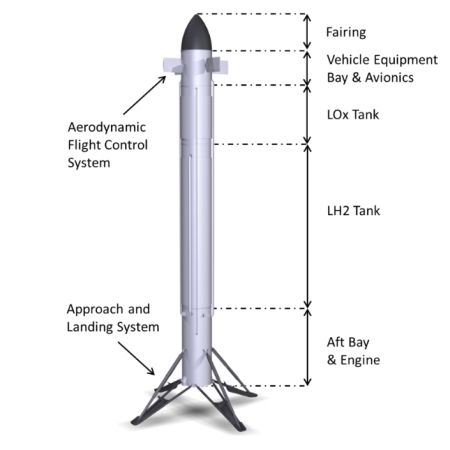
Callisto's basic design
Callisto’s basic design

This story about a first stage government-built Grasshopper-type rocket designed to demonstrate and test vertical landing has instead become a perfect demonstration of why governments should not design, build, and own anything.

It appears the first test flight of the Callisto test rocket, first proposed in 2015 and being built by a joint partnership of the German (DLR), French (CNES), and Japanese (JAXA) space agencies, has now slipped from 2024 to 2026.

Earlier this month, CNES deployed a refreshed website. Prior to that deployment, the agency’s Callisto project page had stated that the rocket’s first flight would occur in 2024. The new Callisto project page has a more detailed timeline, stating that the detailed design phase will be completed by the end of 2024. Vehicle integration in Japan is then expected in 2025, followed by a first launch from the Guiana Space Centre between 2025 and 2026. This revision outlines an approximate two-year slip in the project’s timeline. [emphasis mine]

These three agencies took almost a decade to simply conceive and design the project. Apparently they not yet even built anything. This despite a budget of slightly less than $100 million carved out of the entire budget for creating the Ariane-6 expendable. Compare that with SpaceX, which conceived its Grasshopper vertical test prototype in 2011, began flying that year, and resulted in an actual Falcon 9 first stage landing in 2015.

Will Callisto ever fly? Maybe, but don’t expect it to produce a rocket that is financially competitive with SpaceX. Instead, expect these three government agencies to subsidize its cost in order to make its price competitive on the open market. More likely Callisto will fly a few times, but will likely result in no new orbital rocket. Instead it will be superseded by the private rocket startups worldwide that are now building actual orbital rockets and will likely make them reuseable before Callisto even leaves the ground.

3 comments
1 2 3 5