Southern ocean absorbs more CO2 than expected

The uncertainty of science: Scientists have found that the ability of the southern ocean surrounding Antarctica to absorb atmospheric carbon dioxide varies much more drastically than they had predicted.

In 2011, the ocean took in 4.4 gigatonnes of CO2, according to the study — more than 10% of the CO2 emitted by human activity at the time. That was roughly double what it absorbed a decade earlier. The increase marks a sharp turnaround from simulations published a few years ago, which suggested that the ocean’s ability to absorb CO2 had dropped in the 1980s and 1990s, and predicted that this trend would continue.

“It doesn’t mean that our [climate-change] projections for the future are going to change dramatically,” says Nicolas Gruber, an environmental physicist at the Swiss Federal Institute of Technology in Zurich, who co-authored the latest paper. Rather, he says, the study shows that the ocean’s ability to absorb carbon changes more drastically than researchers had anticipated. [emphasis mine]

Typical of much of the climate research community, the scientist above insists that just because their models were wrong is no reason to change them, or the reasoning behind them. We are going to charge ahead, regardless of the facts!

12 comments

EPA withholds Colorado disaster documents demanded by Congress

Surprise! The EPA, when ordered by Congress to release documents describing that agency’s planning prior to the toxic waste disaster it caused in Colorado, has failed to meet the deadline set by Congress for turning over those documents.

“It is disappointing, but not surprising, that the EPA failed to meet the House Science Committee’s reasonable deadline in turning over documents pertaining to the Gold King Mine spill,” said Rep. Lamar Smith (R-TX). “These documents are essential to the Committee’s ongoing investigation and our upcoming hearing on Sept. 9. But more importantly, this information matters to the many Americans directly affected in western states, who are still waiting for answers from the EPA.”

Smith – who frequently spars with the EPA – is chairman of the House Science, Space, and Technology Committee. EPA director Gina McCarthy has been asked to appear and answer questions about the agency’s role in creating a 3-million-gallon toxic spill into Colorado’s Animas River on Aug. 5. Critics say McCarthy and the EPA have been unresponsive, secretive and unsympathetic toward millions of people who live in three states bordering the river.

The word “coverup” comes to mind, though how could anyone believe that the Obama administration (the most transparent in history!) would do such a thing baffles the mind.

2 comments

Oregon forest fires blamed on federal ban on logging

We’re here to help you! The logging industry is blaming the increased number of severe forest fires in Oregon during the past three years on the federal ban on logging in federal forests.

Logging on federal lands was first limited in the early 90’s. More severe limits on logging on any roadless federal land were then passed by President Bill Clinton in 2000, essentially ending the practice on federal lands.

[Andrew Miller, CEO of Stimson Lumber, one of the state’s largest lumber companies] said this was a huge mistake. “As soon as the ban on logging took effect, fire conditions worsened,” he said. “Four or five years after the ban was put in place fires started to really ramp up.” The reason for the increase is simple, he said. When logging in these areas stopped, more and more trees began to fill the lands. These trees, particularly ones that have died and become dried out, rather than be chopped down by a logging company, give the fire easily combustible fuel. “Once logging was stopped the forests got older and older and more and more trees died off,” Miller said.

The article is well written, and includes a response by a Forest Service official, who dismissed the lack of logging as the cause and instead blamed the increase in fires to extreme weather and less snowfall in the western states.

I am willing to bet that a close look at the weather in the Northwest will find that the only extreme weather they have seen in the past three years has been snow, contradicting the Forest Service official’s claim. I do not know this, and could easily be wrong, but I am still willing to bet.

2 comments

The one climate prediction that has come true

Fraud at NOAA: Several years ago Steve Goddard predicted that, no matter what the temperature records told us, NOAA scientists would begin to declare every month the hottest on record. It turns out he was 100% right!

Be sure and look at the next to last graph at the link. It shows the increasing difference between the raw, unadjusted temperature data and the adjustments made by NOAA scientists. Not surprisingly, the adjustments all increase the trend towards warming, and have been doing so more and more with each year. Nothing can justify such adjustments, under any rational scientific argument. These guys are either incompetent, stooges for their political bosses, or political hacks. Or all three.

Posted on the outskirts of Phoenix.

3 comments

A calculator beats IPCC supercomputer models in predicting climate

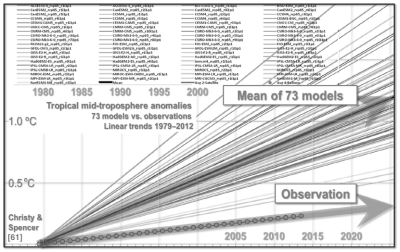
IPCC computer models vs observations

The uncertainty of science: A simple climate model [pdf], designed to run on a calculator and not relying on the premise that man-made carbon dioxide is causing global warming, appears more accurate at predicting the climate than the high-powered supercomputer models of the IPCC.

The current climate models fueling belief in manmade global warming do have fairly good “fit” to the data on which they were tested. However, the predictivity isn’t that great – see the recent warming “pause” or have a look at the figure above. They’re also hella complex, requiring thousands of hours of supercomputer computations.

Early this year, Christopher Monckton of Brenchley, Willie Soon of the Harvard-Smithsonian Center for Astrophysics, David Legates of the University of Delaware, and Matt Briggs, “Statistician to the Stars” and sometimes PJM contributor, published a paper in Science Bulletin (the Chinese equivalent of Science) entitled “Why models run hot: results from an irreducibly simple climate model”.

They took a different approach. Observing the issues with the current climate models, they constructed a very simple model working from first principles. “Irreducibly” here means “it can’t get simpler and reflect basic physics.” … This model is about one step advanced from a “back of the envelope” calculation, since it requires taking a natural logarithm as well as some multiplication, but it’s easily done with a scientific calculator — or even a slide rule.

But it models actual temperature observations better than the complex models. [emphasis in original]

The figure on the right is from the new Monckton paper, and shows the utter failure of every complex global-warming climate model to predict the global climate for the past 35 years. Whether this new very simple model is more accurate than these supercomputer models, however, remains to be seen, but their work definitely points out the uncertainty and failure of the present theories to explain the climate. They simply don’t do so, and thus are not a useful tool for gauging what we should do about the climate, if anything. As the writers of the simple model conclude,

The general-circulation models now face a crisis of credibility. Not one of them predicted a stasis of as long as 18 years 6 months in global temperatures. Indeed, it is often stated that periods [greater than] 15 years without warming are inconsistent with models’ predictions. For instance, [two IPCC papers] state: ‘‘The simulations rule out (at the 95 % level) zero trends for intervals of 15 year or more, suggesting that an observed absence of warming of this duration is needed to create a discrepancy with the expected present-day warming rate’’.

The models relied upon in [the IPCC reports] predicted twice as much warming from 1990 to 2014 as has been observed. All models predicted a warming rate in the crucial tropical mid-troposphere considerably in excess of observation. It is no longer credible to ignore these ever-widening discrepancies between prediction and observation. IPCC itself has recognized that, at least as far as medium-term prediction is concerned, the models have failed, raising the legitimate question whether the longer-term predictions may also have been exaggerated, perhaps as greatly as the medium-term predictions.

As I say over and over again, the science of climate is incredibly complex and uncertain. No one yet understands fully how the Earth’s climate functions, and anyone who claims they do is either an ignorant fool or an outright liar. Keep that in mind as this presidential election cycle unfolds and candidates are challenged by the mainstream press (made up mostly of ignorant fools and outright liars) to comment on man-made global warming.

3 comments

“When EPA is not ignoring Supreme Court limitations on it, it is blithely disregarding rule-making laws required of it.”

The story that has the quote above outlines the EPA’s recent and past history of ignoring the law and court rulings to write and impose its regulations. It also details the many times the environmental agency has used its ability to impose fines to extort concessions from private landowners, including the recent Colorado mine disaster.

Like the IRS, the EPA has become an out-of-control agency, a haven for fascists eager to use their power to squelch anyone that opposes them. With the former, this power is used by partisan Democrats to help the Democratic Party and hurt its opponents. With the latter, this power is used to destroy private property rights in the name of leftwing environmental fantasies, even if that use of power ends up doing terrible damage to the environment.

3 comments

NOAA scientists predict developing El Niño could be strongest ever

The uncertainty of science: NOAA scientists yesterday predicted that the developing El Niño in the Pacific could be strongest ever recorded.

They appear to base this prediction on two factors:

It started unusually early — in March instead of June. This could be because warm waters left over from last year’s weak El Niño gave it a head start, says Anthony Barnston, chief forecaster at the International Research Institute for Climate and Society at Columbia University in Palisades, New York.

And this would be the second El Niño year in a row, following the weak El Niño that developed late last year, Barnston adds. A similar El Niño double-header happened between 1986 and 1988, but forecasters predict that the current El Niño will become stronger than either of those two events.

A strong El Niño would help end the drought in California. However, I wouldn’t bet the house on this prediction, considering how poorly last year’s prediction fared. Scientists really don’t yet understand all the factors behind this phenomenon, so their predictions are pretty much guesses at this point.

2 comments

The sunspot decline continues

On Monday NOAA posted its monthly update of the solar cycle, showing the Sun’s sunspot activity in July. As I have done every month since 2010, I am posting it here, below the fold, with annotations to give it context.

Sunspot counts continue to decline at a rate faster than predicted or is usual during ramp down from solar maximum. Normally the ramp down is slow and steady. This time it has so far been more precipitous. While the 2009 prediction of the solar science community (indicated by the red curve) suggests minimum will occur sometime after 2020, the actual counts suggest it will occur much sooner.

» Read more

7 comments

Solar panels more climate damaging than coal

Surprise, surprise! A comparison of the entire production process for both solar and coal power has found that solar power is more damaging to the environment and the climate.

Not only does the production, transport, and use of solar panels dump more total CO2 into the atmosphere than coal power plants, the manufacture of the solar panels adds many more toxic chemicals to the environment than coal.

According to Ferroni, the other huge drawback presented by PV systems are the nasty chemicals and industrial gases used for their manufacture. The production of solar panels in China entails nitrogen trifluoride (NF3) and sulfur hexafluoride (SF6), which are extremely potent heat-trapping gases that leak out during the process. NF3 has a greenhouse gas potency that is 16,600 times greater than CO2; SF6 is 23,900 times more potent. Reports show that these gases emitted annually into the atmosphere from the manufacture of solar panels is equivalent to over 70 million tonnes of CO2 in terms of greenhouse effect. In 2010 over 17.5 GW of rated capacity of solar cells were installed. Thus the emissions per square meter of solar panels comes out to be 513 kg CO2 – a huge amount!

The manufacture of solar cells also uses other chemicals like (HCl), silizium carbide, and silver among others. The total alleged warming potential of these chemicals comes out to be an estimated 30 kg CO2 per square meter of PV module. Oddly (likely to avoid embarrassment) the solar industry has yet to release any detailed data on the warming potential and impacts of the chemicals used in their manufacture.

But President Obama tells us solar power is good! It must be true!

16 comments

Four skeletons at Jamestown identified

Archeologists have now linked four recently discovered skeletons at the first British North American settlement at Jamestown with historic individuals among the first settlers.

Skeletal remains buried beneath a historic church in Jamestown, Virginia, belonged to four prominent settlers of North America’s first English colony. The group included a minister, two military captains and the first English knight ever buried on the continent, a research team announced on 28 July at the Smithsonian Institute’s National Museum of Natural History in Washington DC. “These men witnessed the first three years of the establishment of the colony,” said James Horn, the president of the Jamestown Rediscovery Foundation.

Smithsonian anthropologists teamed up with archaeologists at Jamestown Rediscovery to identify the four incomplete skeletons, which were excavated in 2013. First, the researchers narrowed down the potential candidates by analysing a handful of surviving documents from the colony’s early years. Then they used chemical tests, genealogical records, digital analysis of bones and artefacts and contextual clues to make the final identifications.

Having studied the history of Jamestown in great detail for my own masters degree, I can say that this scientific work is spectacular. I would add that I hope that the researchers, having identified these remains, will now allow them to be buried again in peace.

If you want to be amused, you can also read Science’s short article on this discovery. As is typical of that politically driven journal, the article feels compelled to insert a comment about global warming, even though it has nothing to do with this particular research and the claim — that “some scientists think Jamestown (on the Virginia coast) could be overtaken by rising sea levels by the end of this century” — has not yet been proven and is in fact a very speculative assertion.

0 comments

The Earth from a million miles away

Earth from a million miles away

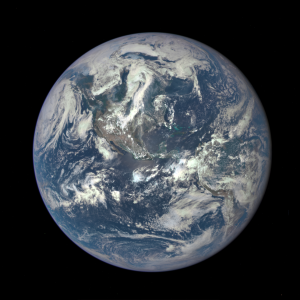
Cool image time! NASA’s DISCOVR solar observation probe has released its first image of the Earth, taken from its station-keeping position a million miles from Earth.

This camera was originally designed for Al Gore’s proposed propaganda mission where a spacecraft would take daily pictures of the Earth to pound home his environmental agenda. Eventually NASA found a real use for the satellite’s overall structure and location, observing the Sun’s activity and give us advance warning of dangerous flares or coronal mass ejections.

They left the Earth-viewing camera on board, partly because it was built already (it would cost money to remove) and partly because daily images like this can be of some scientific value.

0 comments

A new double dynamo theory to explain the Sun’s solar cycle

A team of solar scientists have proposed a new theory that they think explains the ebb and flow of the Sun’s eleven year solar cycle, and if right can explain the periodic occurrence of grand minimums where there are essentially no sunspots for decades, such as the Maunder Minimum in the 1600s.

The theory proposes that the Sun has two different dynamos that produce different magnetic waves in its interior. Like waves that can either cancel each other out or combine for more power, these two dynamos do the same over time and thus effect the Sun’s sunspot/solar cycle.

“We found magnetic wave components appearing in pairs, originating in two different layers in the Sun’s interior. They both have a frequency of approximately 11 years, although this frequency is slightly different, and they are offset in time. Over the cycle, the waves fluctuate between the northern and southern hemispheres of the Sun. Combining both waves together and comparing to real data for the current solar cycle, we found that our predictions showed an accuracy of 97%,” said Zharkova.

Zharkova and her colleagues derived their model using a technique called ‘principal component analysis’ of the magnetic field observations from the Wilcox Solar Observatory in California. They examined three solar cycles-worth of magnetic field activity, covering the period from 1976-2008. In addition, they compared their predictions to average sunspot numbers, another strong marker of solar activity. All the predictions and observations were closely matched.

Looking ahead to the next solar cycles, the model predicts that the pair of waves become increasingly offset during Cycle 25, which peaks in 2022. During Cycle 26, which covers the decade from 2030-2040, the two waves will become exactly out of synch and this will cause a significant reduction in solar activity.

“In cycle 26, the two waves exactly mirror each other – peaking at the same time but in opposite hemispheres of the Sun. Their interaction will be disruptive, or they will nearly cancel each other. We predict that this will lead to the properties of a ‘Maunder minimum’,” said Zharkova. “Effectively, when the waves are approximately in phase, they can show strong interaction, or resonance, and we have strong solar activity. When they are out of phase, we have solar minimums. When there is full phase separation, we have the conditions last seen during the Maunder minimum, 370 years ago.”

And on this same subject, last week NOAA posted its monthly update of the solar cycle, showing the Sun’s sunspot activity in June. As I have done every month since 2010, I am posting it here, below the fold, with annotations to give it context.
» Read more

4 comments
1 26 27 28 29 30 57