
When to doubt a scientific consensus

Link here.

This is a beautifully written and thoughtful analysis of the state of climate science, and why intelligent and educated citizens should continue to remain skeptical of the claims coming from the global warming activist community (which now includes the Pope).

He gives a dozen different reasons for remaining skeptical of the claims of the global warming community, based both on the science as well as how they sell their position. Number 10 — “When [the claimed consensus] it is being used to justify dramatic political or economic policies” — is probably the most important:

Imagine hundreds of world leaders and nongovernmental organizations, science groups, and United Nations functionaries gathered for a meeting heralded as the most important conference since World War II, in which “the future of the world is being decided.” These officials seem to agree that institutions of “global governance” need to be established to reorder the world economy and massively restrict energy resources. Large numbers of them applaud wildly when socialist dictators denounce capitalism. Strange philosophical and metaphysical activism surrounds the gathering. And we are told by our president that all of this is based, not on fiction, but on science — that is, a scientific consensus that human activities, particularly greenhouse gas emissions, are leading to catastrophic climate change.

We don’t have to imagine that scenario, of course. It happened in Copenhagen, in December 2009. It will happen again in Paris, in December 2015.

Now, none of this disproves the hypothesis of catastrophic, human induced climate change. But it does describe an atmosphere that would be highly conducive to misrepresentation. And at the very least, when policy consequences, which claim to be based on science, are so profound, the evidence ought to be rock solid. “Extraordinary claims,” the late Carl Sagan often said, “require extraordinary evidence.” When the megaphones of consensus insist that there’s no time, that we have to move, MOVE, MOVE!, you have a right to be suspicious.
2 comments

Anti-drilling environmentalists trash environment during protest

Environmental activists protesting the launch of a drilling rig in Seattle did serious damage to a nature reserve, costing $10K to clean it up.

I am not surprised. The left and environmental movement has this annoying habit of blaming everyone else for the world’s problems, insisting that only they have the solutions. When their solutions fail, or when they screw up, however, they are never willing to admit their error, take personal responsibility, and look for a more effective solution. To them, it is always someone else’s fault.

0 comments

Flashback to ABC’s 2008 climate predictions for 2015

Working for leftist global warming activist community and the Democratic Party (but I repeat myself): In 2008 ABC News did a special on what global warming was going to do to the climate in the coming years, and predicted disaster by June 2015.

New York City underwater? Gas over $9 a gallon? A carton of milk costs almost $13? Welcome to June 12, 2015. Or at least that was the wildly-inaccurate version of 2015 predicted by ABC News exactly seven years ago. Appearing on Good Morning America in 2008, Bob Woodruff hyped Earth 2100, a special that pushed apocalyptic predictions of the then-futuristic 2015. The segment included supposedly prophetic videos, such as a teenager declaring, “It’s June 8th, 2015. One carton of milk is $12.99.” (On the actual June 8, 2015, a gallon of milk cost, on average, $3.39.) Another clip featured this prediction for the current year: “Gas reached over $9 a gallon.” (In reality, gas costs an average of $2.75.)

On June 12, 2008, correspondent Bob Woodruff revealed that the program “puts participants in the future and asks them to report back about what it is like to live in this future world. The first stop is the year 2015.” As one expert warns that in 2015 the sea level will rise quickly, a visual shows New York City being engulfed by water. The video montage includes another unidentified person predicting that “flames cover hundreds of miles.” Then-GMA co-anchor Chris Cuomo appeared frightened by this future world. He wondered, “I think we’re familiar with some of these issues, but, boy, 2015? That’s seven years from now. Could it really be that bad?”

ABC is also the same network that sees nothing wrong with its main news anchor, George Stephanopolos, giving tens of thousands of dollars to aid the presidential campaign of Democrat Hillary Clinton. Think of these details the next time you see any news reporting from them.

14 comments

Ramp down to solar minimum continues

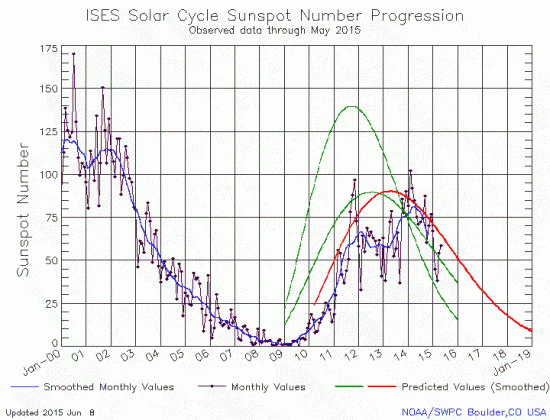
On Sunday NOAA posted its monthly update of the solar cycle, showing the Sun’s sunspot activity in May. As I have done since 2010, I am posting it here, with annotations to give it context.

May 2015 Solar Cycle graph

The graph above has been modified to show the predictions of the solar science community. The green curves show the community’s two original predictions from April 2007, with half the scientists predicting a very strong maximum and half predicting a weak one. The red curve is their revised May 2009 prediction.

Sunspot activity once again increased in May, though it continues to remain below the 2009 prediction of activity. Though it is still early in the ramp down, a look at the present pattern suggests that (as I also noted last month) sunspot activity is declining much faster than normal. In the past, the ramp down after solar maximum was long and drawn out, while ramp up was much faster. This ramp down seems much more precipitous than past solar cycles.

I should add that in early April Sunspot Index and Long-term Solar Observations (SILSO) had declared that the peak of the solar maximum had occurred in April 2014, and that they could now sum up the overall weakness of this maximum.

Cycle 24 proves to be 30% weaker than the previous solar cycle, which reached 119.7 in July 2000, and thus belongs to the category of moderate cycles, like cycles 12 to 15, which were the norm in the late 19th and early 20th century. Compared to strong cycles, such cycles typically feature a broader maximum, with a 3-year plateau on top of which two or more surges of activity can produce sharp peaks of similar height.

I had missed this announcement when it was first posted. It is worth noting however, especially since their discussion in April is interesting to read in the context of what has happened since.

1 comment

Senator proposes criminal charges against global warming skeptics

Fascists: Senator Sheldon Whitehouse (D-Rhode Island) has proposed that racketeering charges be considered against fossil fuel companies who express skepticism about human-caused global warming and dare to disagree with any environmental regulations imposed based on this theory.

As he writes today in his Washington Post op-ed:

 The fossil fuel industry, its trade associations and the conservative policy institutes that often do the industry’s dirty work met at the Washington office of the American Petroleum Institute. A memo from that meeting that was leaked to the New York Times documented their plans for a multimillion-dollar public relations campaign to undermine climate science and to raise “questions among those (e.g. Congress) who chart the future U.S. course on global climate change.”

Gee, industry skeptics of global warming wish to use their first amendment rights to debate the issue! How dare they! Worse, they might use money to finance their effort! (I wonder why I and most other skeptic bloggers never get any of this cash.)

As noted at the first link, the idea that any disagreement with global warming advocacy should be criminalized is not a new thing, and has increasingly been advocated by that leftwing community. Whitehouse is now tying this to the criminalization of the use of money to express that disagreement. Tie that to the effort of the Democratic Party to rewrite the first amendment to allow government to restrict speech, and you have the basic outline of a fascist movement intent on squelching freedom.

10 comments

NOAA caught tampering with temperature data again

A close look at NOAA’s temperature data for Maine has revealed that sometime between 2013 and 2015 the data was drastically adjusted to cool the past and warm the present.

No explanations for these changes has been offered. For some years they cooled the past as much as 4 degrees Fahrenheit, an adjustment that cannot be justified under any scientific method. As asked at the link, “Would someone please try to explain why this isn’t the biggest scandal in the history of science?”

4 comments

Coral islands defy sea level rise

The uncertainty of science: Despite having some of the highest rates of sea level rise in the past century, the 29 islands of Funafuti Atoll in the Pacific show no signs of sinking.

Despite the magnitude of this rise, no islands have been lost, the majority have enlarged, and there has been a 7.3% increase in net island area over the past century (A.D. 1897–2013). There is no evidence of heightened erosion over the past half-century as sea-level rise accelerated. Reef islands in Funafuti continually adjust their size, shape, and position in response to variations in boundary conditions, including storms, sediment supply, as well as sea level.

Be aware as well that the cause of the rise in sea level here is not clearly understood. It could be the global warming we have seen since the end of the Little Ice Age of the 1600s, or other more complex factors.

1 comment

Nature ignores the elephant in the room

In an article on the possibility that a section on the edge of the Antarctica icecap might be melting, the journal Nature illustrated some of the political agenda-driven science that corrupts climate science and the journalism that covers the field by never noting that the icecap is presently setting size records.

Read the article at the link. Though they never mention global warming, they hint at it repeatedly by noting the arrival of new warm ocean currents. More importantly, they fail to place the whole issue in context by never noting the record-setting growth of the icecap in recent years. For a section of the icecap fringe to suddenly accelerate its “surge to the sea five years ago” during a period when the icecap has been expanding in an unprecedented manner is hardly surprising, and is hardly an indication of global warming. Instead, it suggests the icecap is behaving exactly as one would expect, shedding excess ice as it expands.

By not mentioning the icecap’s recent growth the article allows an uneducated reader to come the incorrect conclusion: that only global warming could cause this melting. It also avoids revealing the complexity and uncertainties that surround this climate research.

6 comments

Top scientists to review data adjustments of temperature data

The uncertainty of science? A panel of five scientists has been formed to review the adjustments to the global temperature data at NOAA and the Goddard Institute of Space Studies (GISS) that have consistently cooled the past but warmed the present, thus creating the illusion of more warming than the raw data suggests.

Careful analysts have come up with hundreds of examples of how the original data recorded by 3,000-odd weather stations has been “adjusted”, to exaggerate the degree to which the Earth has actually been warming. Figures from earlier decades have repeatedly been adjusted downwards and more recent data adjusted upwards, to show the Earth having warmed much more dramatically than the original data justified.

So strong is the evidence that all this calls for proper investigation that my articles have now brought a heavyweight response. The Global Warming Policy Foundation (GWPF) has enlisted an international team of five distinguished scientists to carry out a full inquiry into just how far these manipulations of the data may have distorted our picture of what is really happening to global temperatures.

The global warming scientists at NOAA and GISS are finally going to challenged to explain their adjustments, something they have so far refused to do. For my part, I will be very surprised if they can come up with a scientifically justified explanation.

7 comments

Seven big failed environmentalist predictions

Link here.

Like the author, I remember every single one of these doomsday predictions. I also remember how every single one of these predictions was wildly wrong. Until these fear-mongers can reliably predict things, I see no reason to believe them.

His article however does provide one entertaining tidbit:

You know how old I am? I’m so positively ancient that I remember when one of Jimmy Carter’s big answers to the impending shortage of oil was to increase federal funding for research on how to extract oil from shale. It ended the way you would expect: it went nowhere. But some decades later, private oil companies did find a way to more economically extract oil from shale—and environmentalists promptly made it public enemy #1.

All true. And just one more example of how the government fails at something while private enterprise, fueled by the profit motive, finds a way to make that exact same thing happen.

3 comments

The distortion of the global surface temperature datasets

Link here. Goddard does a good job of illustrating the differences between the measured and reported climate temperature datasets, and how the reported numbers are consistently shifted to make the past cooler than measured and the present hotter than measured.

He often attributes this bias to dishonest tampering with the data to support the theory of global warming. He might be right, but it is important to remember that you shouldn’t necessarily assign malice to things that are just as easily explained by human error or stupidity. In this case he also notes that almost all the weather stations that have been decommissioned in the past few decades have been located in rural areas. To replace their data, global warming scientists average the data from nearby stations, most of which are in urban areas that exhibit warmer temperatures because city constructs tend to cause local warming. The result? The recent datasets tend to show a strong trend upward.

What is causing a cooling in the datasets from prior to 1970 however is not explained by mere error. The data hasn’t changed. Someone must be deciding to adjust it downward, for reasons that are simply not justifiable.

0 comments

Global Warming advocates debunk their own theory

Climate models vs climate reality

The statements and data provided by advocates of human-caused global warming themselves provide strong evidence that their theory of human-caused global warming is wrong.

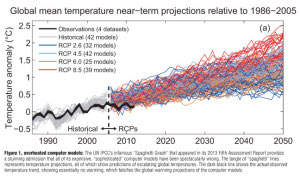
The article is detailed and includes a lot of hard but easy-to-digest data, such as the graph on the right, which shows how all the computer models predicting global warming have failed to predict the lack of warming for the past eighteen years. (The models predicted the rising colored lines. Actual global temperatures are shown by the black line.) This quote however is a nice summation:

Allow us to cite one more example out of many that could be brought to bear. On June 6, 2007, the New Zealand Climate Science Coalition published an analysis of seasonal climate predictions made by the New Zealand Institute of Water and Atmospheric Research (NIWA) showing that the Institute did not even achieve 50 percent accuracy. Director Dr. Jim Renwick’s response was telling. “Climate prediction is hard, half of the variability in the climate system is not predictable, so we don’t expect to do terrifically well,” he told the New Zealand Herald. Dr. Renwick, who is an IPCC lead author and a member of the UN’s World Meteorological Organization (WMO) Commission for Climatology Expert Team on Seasonal Forecasting, stated on New Zealand Radio, “The weather is not predictable beyond a week or two.”

This is huge! Phil Jones, a top AGW guru, admits “we don’t know what natural variability is doing,” and Judith Curry says that the climate models are “imperfect and incomplete” and natural causes “dominate” human effects on global temperatures. And IPCC/WMO bigwig Jim Renwick concedes his organization’s climate predictions are wrong more than half the time — and they can’t predict the weather more than two weeks out. Yet, we are supposed to empower national and international politicians and bureaucrats to completely regulate, re-engineer, tax, and regiment human civilization on a planetary scale, based upon the same faulty computer models that have universally, spectacularly failed — over and over again.

I hate to say this, but it appears that the only “deniers of reality” we have in this debate are the political advocates of human-caused global warming, people like Barack Obama, Joe Biden, and Al Gore, who continue to refuse to recognize the reality that there has been no warming during the past eighteen years.

8 comments
1 27 28 29 30 31 57