Lightning on Jupiter

Lightning on Jupiter
Click for original image.

Cool image time! The picture to the right, cropped and reduced to post here, was taken on December 30, 2020 by Juno during its 31st close fly-by of Jupiter, and was enhanced and processed by citizen-scientist Kevin Gill.

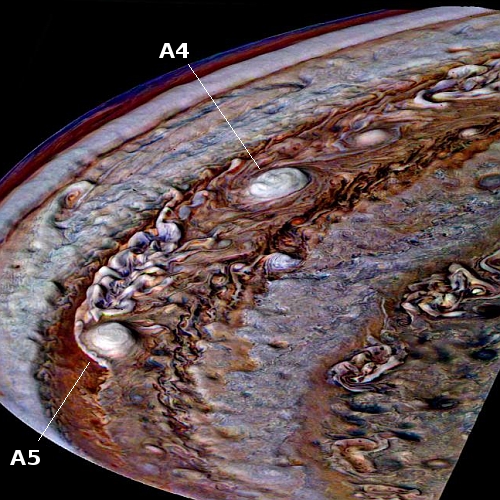
In this view of a vortex near Jupiter’s north pole, NASA’s Juno mission observed the glow from a bolt of lightning. On Earth, lightning bolts originate from water clouds, and happen most frequently near the equator, while on Jupiter lightning likely also occurs in clouds containing an ammonia-water solution, and can be seen most often near the poles.

Juno was about 20,000 miles above Jupiter’s clouds when it took this picture, located at about 78 degrees north latitude.
4 comments

The grooved surface of Ganymede

The grooves of Ganymede
Click for original image.

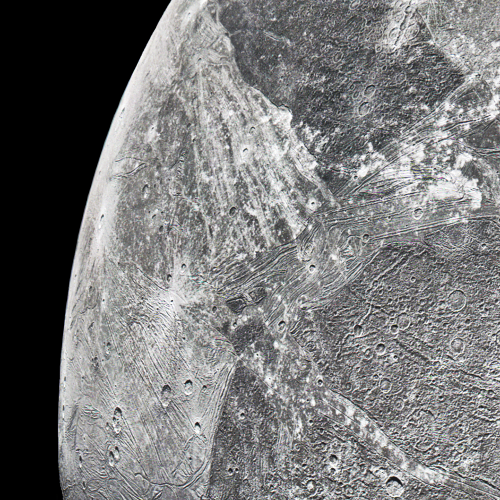
Cool image time! The picture to the right, reduced to post here, was taken on June 7, 2021 when the Jupiter orbiter Juno did a close flyby of the moon Ganymede, taking four pictures.

Citizen scientists Gerald Eichstädt and Thomas Thomopoulos have now reprocessed parts of those images to bring out the details more clearly (the other new versions available here, and here).

I have chosen to highlight the picture to the right however because it so clearly shows the puzzling grooves that cover much of Ganymede’s surface. While these parallel grooves in many ways mimic the grooves often seen on top of valley glaciers on Earth and Mars, on Ganymede they do not follow any valley floor. Instead, they form patches of parallel grooves that travel in completely different directions, depending on the patch. At the moment their origin is not understood.

These grooves are one of the mysteries that Europe’s Juice probe will attempt to solve when it arrives in orbit around Jupiter in 2031.

1 comment

Engineers free stuck radar antenna on Juice probe to Jupiter’s big moons

Engineers have successfully freed the 52-foot wide radar antenna on the Juice probe to Jupiter, shaking it enough to release a pin that was blocking deployment.

The pin was freed by employing “back-to-back jolts”. Imagine when you roll your car back and forth to get it freed from mud or snow. It appears this is what they did with the pin.

Juice will arrive in Jupiter orbit in 2031, where it will make numerous fly-bys of Europa, Calisto, and Ganymede, and then settle into an orbit around Ganymede alone. The radar antenna was essential for probing the ice content of these worlds, below the surface.

Hat tip to reader Mike Nelson.

6 comments

Jupiter’s clouds in 3D

Jupiter's clouds in 3D
Click for original image.

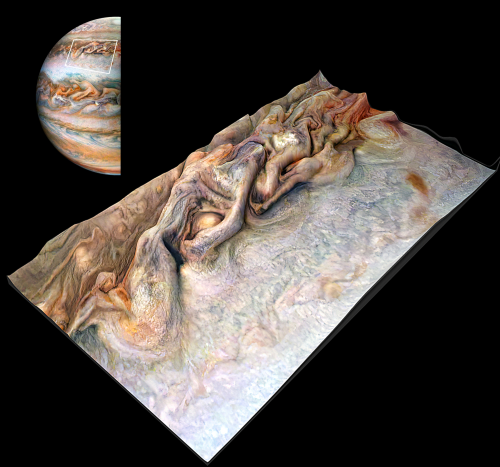
Another cool image! The picture to the right, cropped and reduced to post here, was created by a team of citizen scientists from a raw Juno image during its 40th close fly-by of Jupiter. From the caption:

Visual interpretation of relief (exaggerated) on Jupiter based on depth estimation from a single image

2D process: Enhanced RGB, enlargement and crop of image taken on 2022-02-25 02:21 UT – perijove 40 – Junocam

Process on 3d image : not based on a DTM, but a visual interpretation of the surface by depth estimation from a single image

The white box on the global image on the upper left marks the approximate area coverd by the oblique 3D picture. Though the vertical relief is greatly exaggerated as well as simulated from a flat image, it provides us a nice sense of the turbulent nature of Jupiter’s more active bands. The larger structures in the colored band appear to act like giant waves in a river rapids. And for reasons not yet understood, the more active areas of that upper atmosphere is divided into bands determined by latitude.

2 comments

Radar antenna on Europe’s JUICE probe to Jupiter stuck

European Space Agency officials revealed yesterday that the 52-foot radar antenna on its JUICE probe to Jupiter has failed to deploy as planned, and that they are attempting to shake what they think is a small pin free that is in the way.

Engineers suspect a tiny pin may be protruding. Flight controllers in Germany plan to fire the spacecraft’s engine in hopes of shaking the pin loose. If that doesn’t work, they said they have plenty of time to solve the problem.

Juice, short for Jupiter Icy Moons Explorer, won’t reach the giant planet until 2031. It’s taking a roundabout path to get there, including gravity-assist flybys of Earth and our moon, and Venus.

The radar antenna is needed to peer beneath the icy crust of three Jupiter moons suspected of harboring underground oceans and possibly life, a major goal of the nearly $1.8 billion mission. Its targets include Callisto, Europa and Ganymede, the largest moon in the solar system.

If this antenna cannot be freed, it will prevent JUICE from doing one of its prime missions.

11 comments

Arianespace launches JUICE mission to Jupiter

Arianespace early today used its Ariane-5 rocket, on its next-to-last launch, to send the European Space Agency’s (ESA) JUICE mission on its way to Jupiter to study its large moons.

It will take eight years for JUICE to get to Jupiter, using flybys of the Earth, Moon, and Venus along the way. This journey might also include a flyby of an asteroid, depending on orbital mechanics and the spacecraft’s condition.

Once at Jupiter it will, from ’31 to ’34, do thirty-five flybys of the Ganymede, Callisto, and Europa, and then enter orbit around Ganymede for most of 2035, before being sent to crash onto the planet to end its mission.

Ariane-5 meanwhile has one more launch, in June. After this Arianespace will not at present have an active large rocket, as its Ariane-6 replacement is not yet flying, its maiden flight presently scheduled for the fourth quarter of this year.

This was also Europe’s first launch in 2023, so it does not get listed on the leader board. The leaders of the 2023 launch race are as follows:

23 SpaceX (with a launch scheduled for tonight)
15 China (with a launch scheduled for tomorrow)
6 Russia
3 Rocket Lab

American private enterprise still leads China 26 to 15, but is now tied with the entire world combined 26 all.

0 comments

Juno captures close-up images of Jupiter’s moon Io

Io as seen by Juno

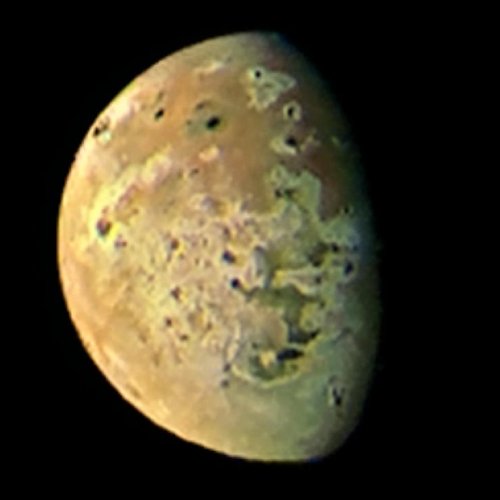
On March 1, 2023 the Jupiter orbiter Juno passed within 33,000 miles of the gas giant’s moon Io, getting its first close-up images.

Several citizen scientists have processed those images. The photo to the right, cropped and reduced to post here, was created by Andrew R Brown. This particular picture was one of five taken by Juno during the fly-by. Jason Perry processed all five here, with this caption:

Most of the dark spots seen across Io’s surface are the result of volcanic eruptions. These include East Girru, a dark spot that was not seen the last time Io was seen at this resolution during the New Horizons encounter with Jupiter in February 2007. East Girru was undergoing a major eruption at the time but hadn’t had time to produce a new lava flow before the end of the week-long encounter. This small flow field, measuring 3,200 square kilometers (1,390 square miles) in size, may have also been reactivated during an eruption in October 2021, as seen by Juno JIRAM.

Another apparent surface change is at Chors Patera, which has undergone a significant reddening since Galileo last observed it in October 2001. Reddish materials on Io are indicative of the presence of short-chain sulfur and are often associated with high-temperature, silicate volcanism. Additional dark spots near the terminator, the boundary between Io’s day and night sides, are the shadows of tall mountains. The dark spot at middle right in the upper right image may be due a mountain 5500 meters (18,000 feet) tall.

The smallest object resolved in this image is about 22 miles across.

3 comments

Astronomers discover twelve more Jupiter moons

In reviewing ground-based data from 2021 and 2022, astronomers have discovered another twelve Jupiter moons, bringing that planet’s total moon population to 92.

All of the newly discovered moons are small and far out, taking more than 340 days to orbit Jupiter. Nine of the 12 are among the 71 outermost Jovian moons, whose orbits are more than 550 days. Jupiter probably captured these moons, as evidenced by their retrograde orbits, opposite in direction to the inner moons. Only five of all the retrograde moons are larger than 8 kilometers (5 miles); Sheppard says the smaller moons probably formed when collisions fragmented larger objects.

One newly discovered moon, dubbed Valetudo, is about 3,000 feet across and orbits in a retrograde orbit that crosses the orbits of several other moons that orbit in the opposite direction. As the article notes, “This highly unstable situation is likely to lead to head-on collisions that would shatter one or both objects.”

6 comments

Juno’s camera experiences temperature problem

Because of an unexpected rise in its temperature, Juno’s camera was unable to take its full schedule of planned images during its January 22, 2023 close approach of Jupiter.

The JunoCam imager aboard NASA’s Juno spacecraft did not acquire all planned images during the orbiter’s most recent flyby of Jupiter on Jan. 22. Data received from the spacecraft indicates that the camera experienced an issue similar to one that occurred on its previous close pass of the gas giant last month, when the team saw an anomalous temperature rise after the camera was powered on in preparation for the flyby.

However, on this new occasion the issue persisted for a longer period of time (23 hours compared to 36 minutes during the December close pass), leaving the first 214 JunoCam images planned for the flyby unusable. As with the previous occurrence, once the anomaly that caused the temperature rise cleared, the camera returned to normal operation and the remaining 44 images were of good quality and usable.

Engineers are analyzing the issue to try to determine its cause, as well as a fix. The camera at this moment appears to be operating properly, with the next close fly-by occurring on March 1, 2023.

1 comment

Jupiter and two of its Moons, as seen by Cassini during 2018 fly-by

Cool video time! Back in December 2000 the spacecraft Cassini made a fly-by of Jupiter on its way to Saturn, which it then orbited from 2004 to 2017. In 2018 JPL scientist Kevin Gil took the images from that flyby to create a short movie, first showing two of Jupiter’s moons, Io and Europa, as they drifted above the Great Red Spot.

Then, for the second half of the movie Gil used Cassini images taken when in orbit around Saturn to show the moon Titan moving across the rings of Saturn.

I have embedded this short video below. If I had posted this back in 2018, I don’t remember. No matter. It is amazing enough to watch again.

Hat tip BtB’s stringer Jay.
» Read more

5 comments

Animation of Jupiter’s clouds

Cool video time! Using a photo taken by Juno during its 2018 fly-by of Jupiter, citizen scientist Thomas Thomopoulos has created a short animation showing the flow of Jupiter’s clouds. He also added some 3D relief by assigning elevation to the image’s greyscale, with lighter regions assigned higher altitudes.

I have embedded the animation below. Run it at the slowest speed for the best effect. It is quite spectacular, though it is also important to note that it is not reality. Thomopoulos is simply giving us a hint of the natural evolution of the cloud structures, both in elevation and in time.

You can see another equally impressive animation by Thomopoulos here of several of Jupiter’s polar storms, using AI technology to smooth out the loop.
» Read more

0 comments

Lucy team suspends efforts to complete deployment of unlatched solar panel

Lucy's planned route
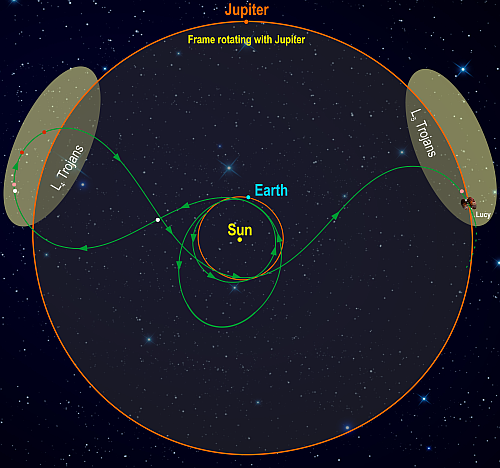
Lucy’s planned route to explore the Trojan asteroids

The Lucy science team has decided to suspend its efforts to complete the deployment of the unlatched solar panel that failed to fully open shortly after launch, having determined that little can be accomplished while the spacecraft is so far from the Sun.

A series of activities in 2022 succeeded in further deploying the array, placing it into a tensioned, but unlatched, state. Using engineering models calibrated by spacecraft data, the team estimates that the solar array is over 98% deployed, and it is strong enough to withstand the stresses of Lucy’s 12-year mission. The team’s confidence in the stability of the solar array was affirmed by its behavior during the close flyby of the Earth on Oct. 16, 2022, when the spacecraft flew within 243 miles (392 km) of the Earth, through the Earth’s upper atmosphere. The solar array is producing the expected level of power at the present solar range and is expected to have enough capability to perform the baseline mission with margin.

The team elected to suspend deployment attempts after the attempt on Dec. 13, 2022, produced only small movement in the solar array. Ground-based testing indicated that the deployment attempts were most productive while the spacecraft was warmer, closer to the Sun. As the spacecraft is currently 123 million miles (197 million km) from the Sun (1.3 times farther from the Sun than the Earth) and moving away at 20,000 mph (35,000 km/hr), the team does not expect further deployment attempts to be beneficial under present conditions.

The spacecraft will do another Earth fly-by on December 12, 2024, which will send it to the Trojans on the left side of the map above. Before that Lucy will do a mid-course correction in February 2024, at which time the engineers will reassess whether to try again to latch the panel, when Lucy is closer to Earth and thus also closer to the Sun.

1 comment

Racing above the clouds of Jupiter

Racing above the clouds of Jupiter
Click for full image.

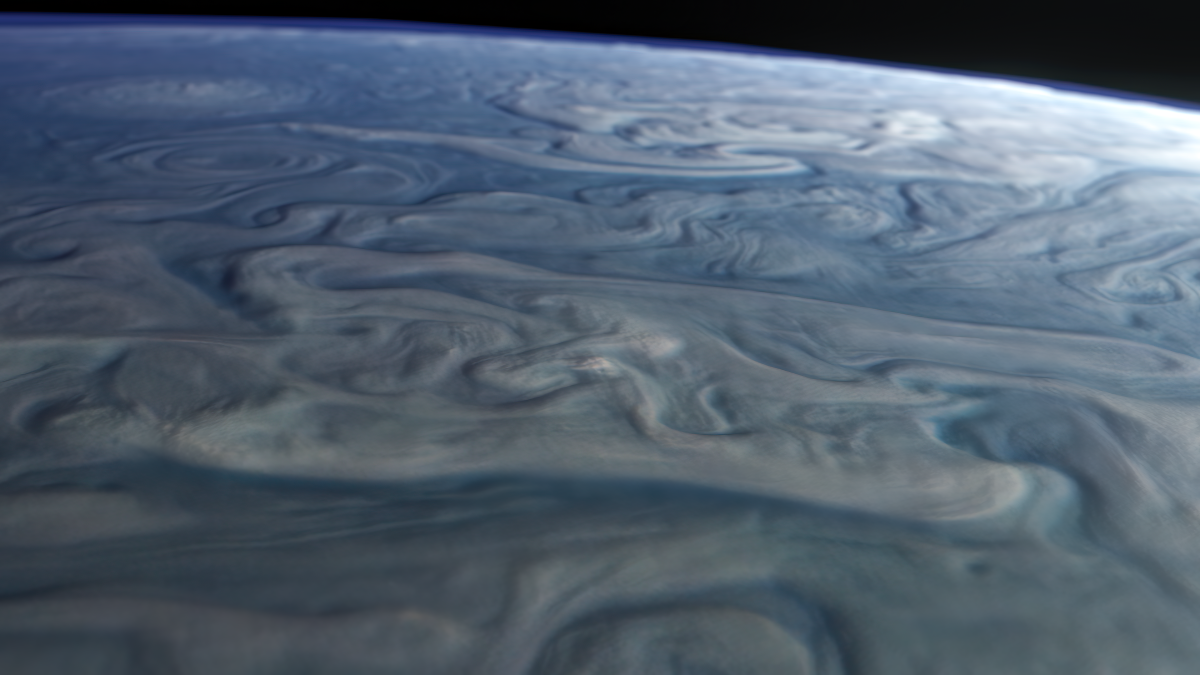
Cool image time! The photo above, reduced in size to post here, was created from a raw Juno image by citizen scientist Kevin Gill. From his caption:

A low perspective over Jupiter’s North Polar Storms. Used imagery from the Juno spacecraft’s recent Perijove 47 to render a simulated view as if the viewer were only a few thousand kilometers above the clouds. Applied simulated altimetry, shadowing, and upper atmospheric transparency depth in Blender and Photoshop to render this.

To get some perspective on how large Jupiter is, the planet’s curve is about comparable to the same curve seen by astronauts of the Earth at a height of about 300 to 400 kilometers. In this image however we are about ten times higher.

3 comments

A new hotspot map of Io, based on Juno data

Hot spot map of Io
Click for original figure.

Scientists have compiled a new map of the many volcanic hotspots on the Jupiter moon Io, based on data obtained by Juno, including 23 spots previously undetected. From the paper’s abstract:

We mapped the hot spot distribution on Io’s surface by analyzing the images acquired by the JIRAM instrument onboard the Juno spacecraft. We identified 242 hot spots, including 23 not present in other catalogs. A large number of the new hot spots identified are in the polar regions, specifically in the northern hemisphere. The comparison between our work and the most recent and updated catalog reveals that JIRAM detected 82% of the most powerful hot spots previously identified and half of the intermediate-power hot spots, thus showing that these are still active. JIRAM detected 16 out of the 34 faint hot spots previously reported.

The map above is taken from figure 2 of the paper. The data, when compared to other earlier data, confirms that many of these hot spots are long-lived, and have been erupting now for decades.

1 comment

Largest volcanic eruption in years detected on Io

Using instruments on a ground-based telescope, one scientist based at the Planetary Science Institute (PSI) in Arizona has detected the largest volcanic eruption in years on the Jupiter moon Io.

PSI Senior Scientist [Jeff] Morgenthaler has been using IoIO, located near Benson, Arizona to monitor volcanic activity on Io, since 2017. The observations show some sort of outburst nearly every year, but the largest yet was seen in the fall of 2022. Io is the innermost of Jupiter’s four large moons and is the most volcanic body in the Solar System thanks to the tidal stresses it feels from Jupiter and two of its other large satellites, Europa and Ganymede.

IoIO uses a coronagraphic technique which dims the light coming from Jupiter to enable imaging of faint gases near the very bright planet. A brightening of two of these gases, sodium and ionized sulfur, began between July and September 2022 and lasted until December 2022. The ionized sulfur, which forms a donut-like structure that encircles Jupiter and is called the Io plasma torus, was curiously not nearly as bright in this outburst as previously seen. “This could be telling us something about the composition of the volcanic activity that produced the outburst or it could be telling us that the torus is more efficient at ridding itself of material when more material is thrown into it,” Morgenthaler said.

The material released by this eruption could impact Juno during future close approaches of Jupiter.

0 comments

Juno snaps heat image of Jupiter’s volcano-covered moon Io

Io's volcanoes
Click for full image.

The image to the right, cropped and reduced to post here, was taken on July 5, 2022 by one of the infrared instruments on the Jupiter orbiter Juno of the moon Io, known for having many many active volcanoes.

This infrared image was derived from data collected by the Jovian Infrared Auroral Mapper (JIRAM) instrument aboard Juno. In this image, the brighter the color the higher the temperature recorded by JIRAM.

Each bright spot is an active volcano, some of which have been in the past photographed during eruptions. In fact, the first such photo was taken in March 1979 by the Voyager-1 spacecraft just after its fly-by of Jupiter, and was the first time any active volcano outside of Earth had ever been identified.

What made that discovery more profound was that only a week earlier scientists had published a paper predicting active volcanoes on Io, caused by the strong tidal forces from Jupiter’s gravity.

Since then planetary scientists have been studying Io’s volcanism repeatedly, tracking the evolution of specific volcanoes over time as they erupt and then become dormant.

1 comment

A pseudo-oblique view of Jupiter’s cloud-tops

A pseudo-oblique view of Jupiter's cloud-tops
Click for original image.

Cool image time! The image to the right, cropped, reduced, and annotated to post here, was created on October 18, 2022 by citizen scientist Thomas Thomopoulos from one of the photos taken by Juno during its close fly-by of Jupiter in May 2018.

He created this three dimensional relief by assigning different elevation values across the image’s greyscale, with white having the highest elevation. This relief is thus not based on actual topography, but it provides a nice way to illustrate the cloud structures of Jupiter’s cloud tops. It also, as Thomopoulos notes, provide a good way to possibly “see a representation in relief of surface movements.” Nor is his topography based on greyscale far wrong, since in many Jupiter images the lighter colored clouds are generally higher because the darker ones are in shadow.

The map below provides the context and scale of this image.
» Read more

6 comments

Lucy to fly past Earth on October 16th

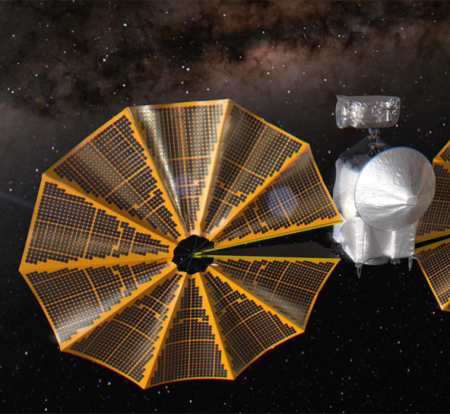
Lucy solar panel graphic
Artist’s impression of solar panel

As part of its planned route to get to the Trojan asteroids in Jupiter’s orbit, the planetary probe Lucy is scheduled to fly only 220 miles above the Earth’s surface on October 16th.

Lucy will be passing the Earth at such a low altitude that the team had to include the effect of atmospheric drag when designing this flyby. Lucy’s large solar arrays increase this effect.

“In the original plan, Lucy was actually going to pass about 30 miles closer to the Earth,” says Rich Burns, Lucy project manager at NASA’s Goddard Space Flight Center in Greenbelt, Maryland. “However, when it became clear that we might have to execute this flyby with one of the solar arrays unlatched, we chose to use a bit of our fuel reserves so that the spacecraft passes the Earth at a slightly higher altitude, reducing the disturbance from the atmospheric drag on the spacecraft’s solar arrays.”

That solar array remains unlatched (as shown in the graphic above), but because it is almost completely deployed and is producing about 90% of its intended electricity, engineers have ceased efforts to complete deployment and latching.

0 comments

Europa in true color

Europa in true color
Click for full image.

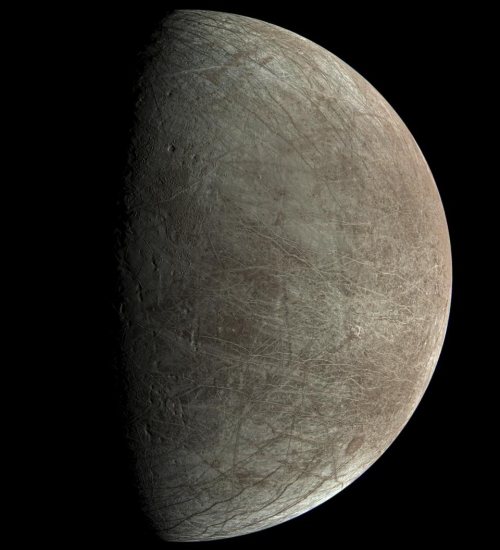
The photo to the right, cropped and reduced to post here, was taken on September 29, 2022 by the Jupiter orbiter Juno during its close fly-by of Europa. Citizen scientist Bjorn Jonsson has processed it to bring out the details. From his caption:

This is an approximately true color/contrast, reprocessed version of Europa image PJ45_1. It is more carefully processed than the version I posted very shortly after the raw image data was released. The color should be fairly close to Europa’s real color and probably slightly more accurate than the color of the earlier version I posted. North is up.

The Sun is coming from the right, so those are craters in the upper left, close to the shadowed limb of the planet. The red color has been known for decades, and appears in many cases to be seepage coming up from the many meandering ridges that criss-cross the planet’s surface. Their chemistry/make-up is not fully known at this time.

Juno came within 219 miles of Europa, the closest any spacecraft has come since the Galileo orbiter circled Jupiter in the 1990s. I was expecting close-up images of the surface, from that close distance, but have not yet seen any. Instead, most of the images released and processed by citizen scientists have been global images from farther away. Thus, at this moment it does not appear Juno took pictures at this closest distance.

2 comments

NASA releases first Juno image from the first close fly-by of Europa in decades

First released Juno image of Europa
Click for full image.

Kevin Gill's processed Juno image of Europa
Click for full image.

NASA yesterday released the first image from the successful close fly-by by Juno of Jupiter’s moon Europa since the 1990s. That photo, reduced and sharpened, is above.

The first picture NASA’s Juno spacecraft took as it flew by Jupiter’s ice-encrusted moon Europa has arrived on Earth. Revealing surface features in a region near the moon’s equator called Annwn Regio, the image was captured during the solar-powered spacecraft’s closest approach, on Thursday, Sept. 29, at 2:36 a.m. PDT (5:36 a.m. EDT), at a distance of about 219 miles (352 kilometers).

This is only the third close pass in history below 310 miles (500 kilometers) altitude and the closest look any spacecraft has provided at Europa since Jan. 3, 2000, when NASA’s Galileo came within 218 miles (351 kilometers) of the surface.

Meanwhile, the raw images have been pouring in, and citizen scientists have been quickly processing them. The photo to the right is only one example, created by Kevin Gill. I have cropped it to show one section in full resolution.

Expect many more processed images, especially those taken at closest approach, in the coming days.

2 comments
1 2 3 4 5 13