Fossilized rivers on Mars

The uncertainty of science: Using high resolution images from Mars Reconnaissance Orbiter scientists have identified more than 10,000 miles of fossilized rivers on Mars.

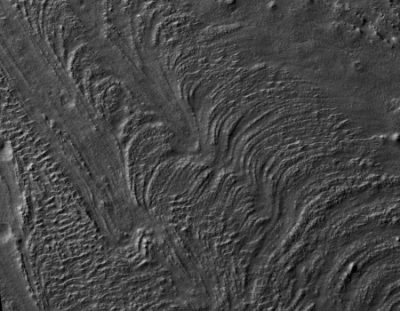
The new study examined images covering an area roughly the size of Brazil at a much higher resolution than was previously possible – six metres per pixel compared to 100 metres per pixel. While a few valleys were identified, the team revealed the existence of many systems of fossilised riverbeds which are visible as inverted channels spread across the Arabia Terra plain.

The inverted channels are similar to those found elsewhere on Mars and Earth. They are made of sand and gravel deposited by a river and when the river becomes dry, the channels are left upstanding as the surrounding material erodes. On Earth, inverted channels often occur in dry, desert environments like Oman, Egypt, or Utah, where erosion rates are low – in most other environments, the channels are worn away before they can become inverted. “The networks of inverted channels in Arabia Terra are about 30m high and up to 1–2km wide, so we think they are probably the remains of giant rivers that flowed billions of years ago. Arabia Terra was essentially one massive flood plain bordering the highlands and lowlands of Mars. We think the rivers were active 3.9–3.7 billion years ago, but gradually dried up before being rapidly buried and protected for billions of years, potentially preserving any ancient biological material that might have been present,” added Joel Davis.

These geological forms are different than most of the more well-known Martian channels in that they are not channels but meandering riverlike ridges, higher than the surrounding terrain. Arabia Terra, where they are located, is a transition region in the northern mid-latitudes between Mars’s southern highlands and its northern flat plains, where some believe an ocean once existed.
2 comments

A glacier on Mars

A glacier on Mars

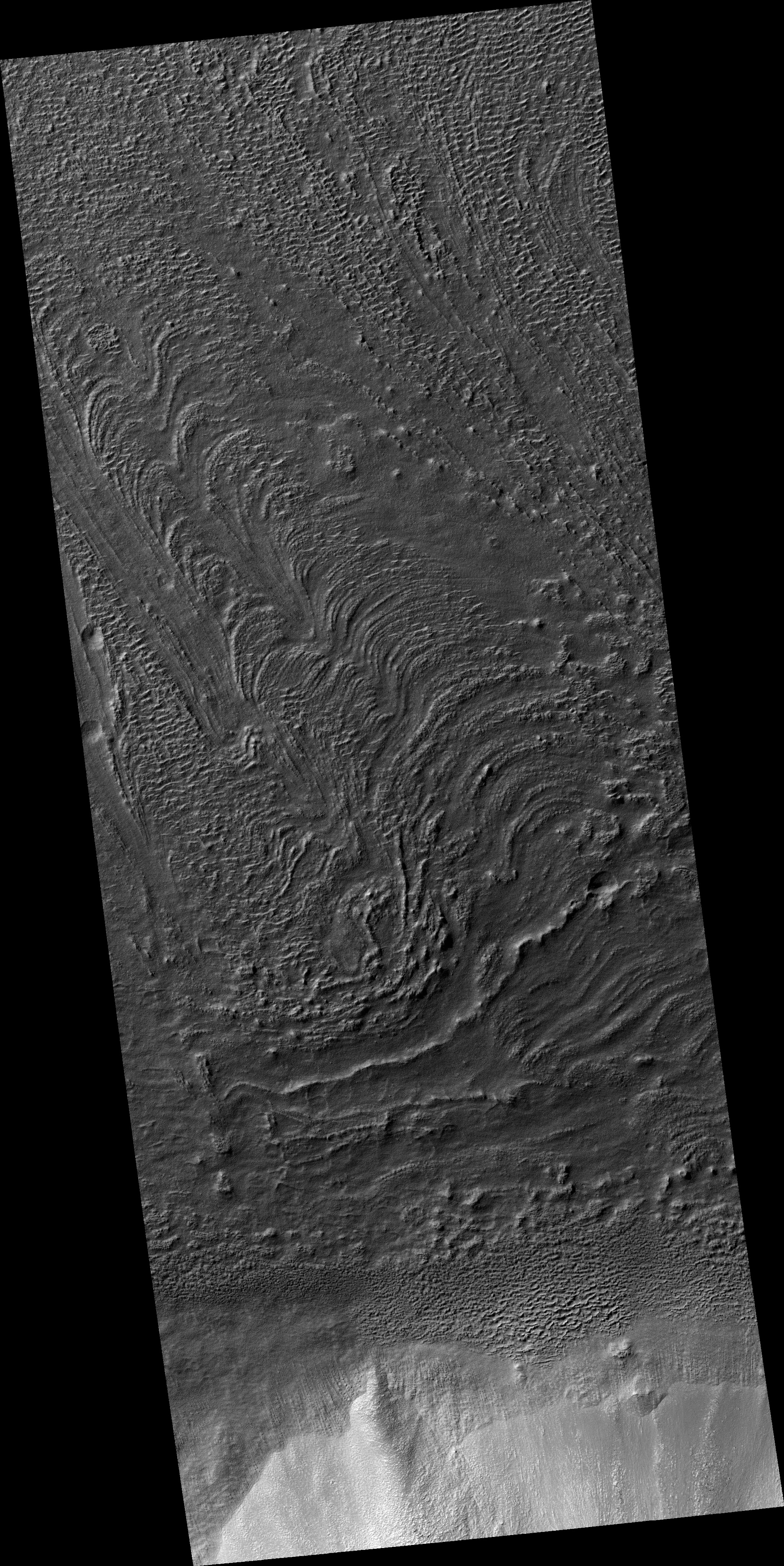
Cool image time! The image on the right, cropped and reduced in resolution, is a Mars Reconnaissance Orbiter picture taken on March 28, 2016 of a glacial flow coming down off of mountains in Mars’ northern mid-latitudes. The mountains are to the south and beyond the bottom right. The flow is to the northwest. The full image can be found here. As noted on the image site,

These flow-like structures were previously called “lobate debris aprons,” but the Shallow Radar (SHARAD) instrument on [Mars Reconnaissance Orbiter] has shown that they are actually debris-covered flows of ice, or glaciers. There is no evidence for present-day flow of these glaciers, so they appear to be remnants of past climates.

Need I say it? This is water, on Mars, and in abundance. Think that this might be good real estate when those first settlers arrive?

1 comment

New images of failed Beagle 2 on Mars

By carefully improving the resolution of images taken by Mars Reconnaissance Orbiter of the landing site of the 2003 European Mars lander Beagle 2, scientists think the lander might have successfully landed but failed to deploy its solar shields completely.

Showing a bright blip in dusty terrain, the new picture is four times the resolution of previous images. The image adds weight to the theory that the diminutive spacecraft – just under a metre in diameter – landed as planned on Mars in 2003, but failed to fully unfurl its solar panels. “Given the size of Beagle 2, even with super-resolution images you are not likely to see more than a series of blobs because it is so small,” said Mark Sims, of the University of Leicester and former mission manager for Beagle 2. “What it does show is that it is on the surface and it is at least partially deployed.”

The technique they have developed for improving image resolution will also be useful to tease out new details about the Martian surface.

0 comments

An avalanche on Mars, as it happens

Avalanche on Mars

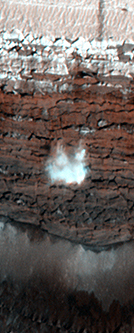
Cool image time! In their routine monitoring for avalanches at the layered deposits at the Martian north pole, the Mars Reconnaissance Orbiter science team captured the avalanche on the right, as it happened.

This picture managed to capture a small avalanche in progress, right in the color strip. … The small white cloud in front of the brick red cliff is likely carbon dioxide frost dislodged from the layers above, caught in the act of cascading down the cliff. It is larger than it looks, more than 20 meters across, and (based on previous examples) it will likely kick up clouds of dust when it hits the ground.

They note that avalanches in this area of Mars are common in the spring when things are warming, and have been documented previously, but possibly not so dramatically.

4 comments

A detailed status update on Mars Reconnaissance Orbiter

Link here. The orbiter, which continues to send down spectacular images while acting as a workhorse communications relay for the rovers on the ground, appears to be in reasonable shape. It has enough fuel to operate into the late 2020s. The other known problems appear manageable.

Zurek said the most significant technical issue aboard MRO is in one of the spacecraft’s inertial measurement units used to determine the orbiter’s motion and orientation. Zurek said a laser inside one of the unit’s gyroscopes is showing signs of aging, and ground controllers are trying to coax the sensor along by switching to an identical backup unit.

In the meantime, engineers are working on changing the orbiter’s navigation logic to rely on star trackers in case both navigation sensors go down, Zurek said. One of the gimbals used to point MRO’s power-generating solar panels toward the sun is also sticky, a sign of age-related “arthritis” aboard the spacecraft, Zurek said.

MRO also abruptly switches to its backup “B side” computer on occasion, temporarily interrupting scientific observations for a few days each time. Zurek said the orbiter’s ground team has learned to deal with the problem, which has escaped diagnosis with a root cause.

Of course, there are always the unknown problems that haven’t yet popped up that could be devastating. Let us hope none appear soon, since NASA will not be able to send a replacement until 2022, at the earliest.

0 comments

The wild Martian terrain

Yardangs on Mars

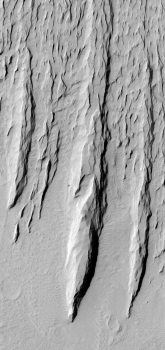
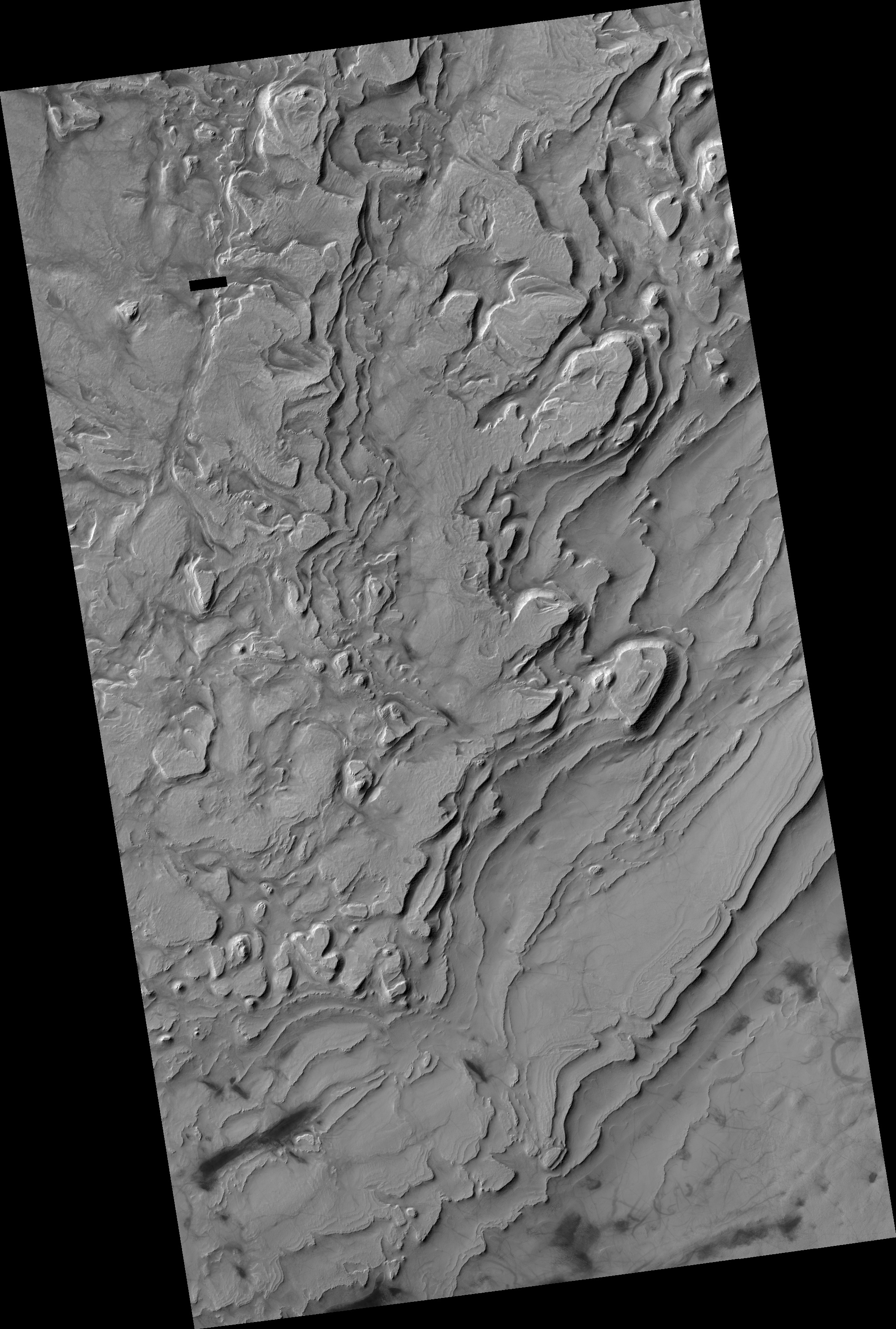
This week’s image release from the high resolution camera on Mars Reconnaissance Orbiter illustrate well the wild and mysterious geology of the Martian surface. I include cropped sections from two images here, just to give you a taste. Go to the link to do your own exploring.

The image to the right is a cropped and scaled down version of the original image, so the details are not easily seen. Make sure you look at the original. The strange yardang ridges, all aligned alike, rise up out of a relatively smooth plain.

Yardangs are formed when a surface that is composed of materials of differing strengths (i.e., of both harder and softer materials) is shaped by the abrasive action of sand and dust carried by the wind. In this case, and given the proximity of the Apollonaris Patera volcanic center, we think that these wind-carved deposits are comprised of volcanic ash and pyroclastics that erupted from Apollonaris when it was last active in the not-too-distant geologic past. Over time, the softer materials (likely volcanic ash) were eroded away, leaving behind the harder materials in the form of elongated ridges that are parallel to the direction of the prevailing wind. The end result is a stunning, out-of-this-world display of yardangs, sculpted with the artistic chisel of the Martian wind.

That’s the theory, anyway. The actual geological process that formed these ridges is probably a lot more complicated.

The image below the fold illustrates the on-going surface activity on Mars.
» Read more

0 comments

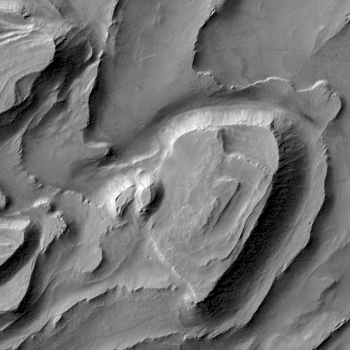
Layered mesas inside Martian crater

Layered mesas inside a Martian crater

Cool image time! In their weekly release of new images, the hi-resolution camera team for Mars Reconnaissance Orbiter have posted a wonderful image of the complex layering and terracing inside Spallanzani Crater, located in the high latitudes of the red planet’s southern hemisphere. The image on the right is only one small section of the much larger image.

So what is the composition of these layers? Spallanzani Crater lies in the high latitudes of the Southern hemisphere (around 60 degrees in latitude) so there is a good possibility that the deposits are ice-rich. If we look more closely we will notice fractured mounds, which sometimes indicate the presence of subsurface ice. Another interesting observation is the presence of grooves in the shaded slopes of some of the layers. Perhaps these grooves formed because of the sublimation (the direct transfer of solid ice to water vapor) of ice from these slopes since slopes tend to get warmer than the surrounding terrains.

This image hardly shows a breakthrough discovery, but I like it because it illustrates nicely the wonderful but very alien landscape of Mars. To walk its surface will be a daily adventure for its first colonists.

1 comment

Mars Reconnaissance Orbiter photographs Comet Siding Spring

During Comet Siding Spring’s flyby of Mars on Sunday Mars Reconnaissance Orbiter was able to capture an image of the comet’s nucleus.

Prior to its arrival near Mars astronomers estimated the nucleus or comet’s core diameter at around 0.6 mile (1 km). Based on these images, where the brightest feature is only 2-3 pixels across, its true size is shy of 1/3 mile or 0.5 km.

0 comments

Fresh impacts caused by Curiosity during landing

impacts from Curiosity debris

The image on the right is a cropped close-up of a Mars Reconnaissance Orbiter image taken in early September that shows a fresh cluster of impacts, all smaller than six feet across. Nearby but not visible in this image are four larger craters about 12 to 15 feet in diameter. The impact cluster is located just northwest of Gale Crater and was not present in images taken before Curiosity’s arrival on Mars. The cluster is also in line with other impact craters produced by other debris dropped by Curiosity as it descended onto the Martian surface.

Scientists are at the moment unsure what spacecraft debris caused these impacts.

Assigning each of the impacts to specific pieces of hardware is a challenging puzzle, but it is thought that the four large craters were produced by two large tungsten weights that broke in half to make these four craters, or by pieces of the cruise stage, which was designed to break up in the atmosphere for planetary protection purposes, to kill any Earthly microbes.

The cluster imaged here adds to the mystery, and may have been produced by a piece of the cruise stage that traveled farther through the Martian atmosphere and was therefore more thoroughly fragmented by the time it crashed onto the surface.

Identifying the source of the debris is a challenging engineering problem that also has scientific interest. Knowing what caused the impacts and then studying how the surface was changed by them will tell geologists a great deal about the make up of that surface.

3 comments
1 86 87 88 89 90