A problem with drilling on Mars

In drilling a new hole while scientists considered Curiosity’s future route to Mount Sharp, the drill cut off operations prematurely.

Engineers think that the rock might have shifted during drilling, causing the robot rover to abort. They have ordered the rover to take a lot of pictures of the situation so they can figure out what happened.

I should note that engineers take a large risk every time they use Curiosity’s drill, as the design of the rover’s electrical system is such that the drill might short everything out while it operates. Thus, when I see a story about a problem with any drilling operation, I become very concerned. In this case, however, it appears to not be a problem with the rover itself.

5 comments

Curiosity retreats from Hidden Valley

Finding its sandy floor slipperier than expected, engineers have backed Curiosity out of Hidden Valley to drill some holes while they reassess the rover’s route.

The rover’s wheels slipped more in Hidden Valley’s sand than the team had expected based on experience with one of the mission’s test rovers driven on sand dunes in California. The valley is about the length of a football field and does not offer any navigable exits other than at the northeastern and southwestern ends. “We need to gain a better understanding of the interaction between the wheels and Martian sand ripples, and Hidden Valley is not a good location for experimenting,” said Curiosity Project Manager Jim Erickson of JPL. …

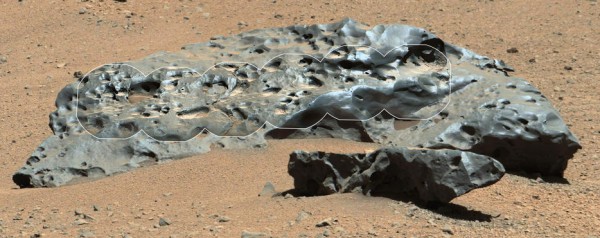
Curiosity reversed course and drove out of Hidden Valley northeastward. On the way toward gaining a good viewpoint to assess a possible alternative route north of the valley, it passed over the pale paving stones on the ramp again. Where a rover wheel cracked one of the rocks, it exposed bright interior material, possibly from mineral veins.

More and more, the journey to Mount Sharp appears to be increasingly adventurous for the rover.

2 comments

The next U.S. Mars rover will try to make and store oxygen

Of the seven science instruments proposed for the next U.S. Mars rover, scheduled for a 2020 launch date, MOXIE test the engineering to produce and store oxygen, pulled from the Martian atmosphere.

Developed in partnership with NASA’s Jet Propulsion Laboratory, it’s based on the fact that the Martian atmosphere, though extremely thin, is composed of 96 percent carbon dioxide, which means its a vast potential source of oxygen for future explorers and settlers. Essentially, MOXIE is a fuel cell in reverse. Instead of generating electricity by using oxygen to burn a fuel, it uses a process called solid oxide electrolysis , where electricity is employed to split carbon dioxide into oxygen and carbon monoxide.

This process would see Martian air pumped into the unit through a dust filter and pressurized before being passed into a fuel cell. At high temperatures, some ceramic oxides act as oxygen ion conductors. In the fuel cell, a thin, non-porous disc of this ceramic separates two porous electrodes. One electrode acts as the cathode and the other as the anode. Carbon dioxide passes through the cathode and when it comes into contact with the ceramic, the interaction of electricity and the ceramic causes the carbon dioxide to split into oxygen and carbon monoxide. The oxygen and the carbon monoxide are then separated and the oxygen stored.

What makes this unusual is that NASA has actually dedicated one science instrument to engineering research, not pure science. The agency does not do this much anymore, but such research is essential if the U.S. is going to someday send humans to other planets.

0 comments

ExoMars will likely miss 2018 launch date

Because of technical and financial issues the European/Russian ExoMars rover mission is expected to miss its 2018 launch window.

The main reason for the delay would be the ExoMars’ brand-new landing system, which is designed to safely take the rover through a fiery descent in the Martian atmosphere and then softly land it on the surface of the Red Planet.

In addition to its late development start, the landing system has a complicated share of responsibilities between Russia and Europe, which greatly slows down the work. For example, the overall landing system is being developed by NPO Lavochkin in Moscow, while its parachute system will be provided by Europe. Many other aspects of the mission are similarly intertwined.

To further complicate matters, NPO Lavochkin, which traditionally builds all Russian planetary probes, but also some of the highly classified military satellites, is notorious for its Soviet-style secrecy. As a result, it is harder for the two sides to coordinate the work, Europeans sources said. Finally, the translation of documents between Russian and English further delays the work on the project.

The program is also significantly over budget.

1 comment

Commercial communications satellites for Mars?

The competition heats up? NASA is considering a different commercial approach for providing communications to and from its Mars probes.

The purpose of NASA’s request for information, or RFI, released July 23 “is to explore new business models for how NASA might sustain Mars relay infrastructure, consisting of orbiters capable of providing standardized telecommunication services for rovers and landers on the Martian surface, in the Martian atmosphere, or in Mars orbit,” according to a posting on the Federal Business Opportunities website.

According to the post, NASA will use information it receives from respondents to inform its future Mars exploration strategies, but the agency has not decided to pursue a commercial interplanetary telecom initiative. “We are looking to broaden participation in the exploration of Mars to include new models for government and commercial partnerships,” said John Grunsfeld, associate administrator of NASA’s science mission directorate, in a statement. “Depending on the outcome, the new model could be a vital component in future science missions and the path for humans to Mars.” [emphasis mine]

It is important to highlight the fact that NASA has not yet made a decision on this issue. The best thing the agency could do, in my opinion, would be to step back, design nothing, but let private companies bid on providing the service. The expertise at many of the private satellite companies providing communications efficiently and inexpensively to private customers worldwide would easily provide NASA better communications at Mars for less money.

In other words, like manned flight and cargo delivery to ISS, NASA should simply become a customer, and let private companies build and own the products that NASA buys.

5 comments

Protecting the Mars orbiters from comet flyby

Engineers are repositioning the American spacecraft orbiting Mars so that they will be better protected by the planet when Comet Siding Spring flies past on October 19.

The comet’s nucleus will miss Mars by about 82,000 miles (132,000 kilometers), shedding material hurtling at about 35 miles (56 kilometers) per second, relative to Mars and Mars-orbiting spacecraft. At that velocity, even the smallest particle — estimated to be about one-fiftieth of an inch (half a millimeter) across — could cause significant damage to a spacecraft.

NASA currently operates two Mars orbiters, with a third on its way and expected to arrive in Martian orbit just a month before the comet flyby. Teams operating the orbiters plan to have all spacecraft positioned on the opposite side of the Red Planet when the comet is most likely to pass by.

1 comment

The UAE wants to go to Mars

The competition heats up: The United Arab Emirates (UAE) announced today that it is creating a space agency to build and launch an unmanned mission to Mars by 2021.

The announcement included this statement by his Highness Sheikh Mohammed bin Rashid Al Maktoum, Vice-President and Prime Minister of the UAE and Ruler of Dubai:

Despite all the tensions and the conflicts across the Middle East, we have proved today how positive a contribution the Arab people can make to humanity through great achievements, given the right circumstances and ingredients. Our region is a region of civilisation. Our destiny is, once again, to explore, to create, to build and to civilise. We chose the epic challenge of reaching Mars because epic challenges inspire us and motivate us. The moment we stop taking on such challenges is the moment we stop moving forward.

I wish them luck, since building spaceships and exploring the heavens is a far better occupation that trying to kill Jews. I remain skeptical however. They will have to show real achievement before I will believe this is something more than a simple feel-good public relations stunt by the UAE’s leaders.

2 comments

Curiosity’s journey continues

After more than a full Martian year, Curiosity has finally traveled beyond the area of its initial landing zone.

The 1-ton Curiosity rover has now cruised out of its landing ellipse, the area β€” about 4 miles wide by 12 miles long (7 by 20 kilometers) β€” regarded as safe ground for its August 2012 touchdown within Mars’ huge Gale Crater, NASA officials said.

The interesting factoid from this article is how much smaller this landing zone was for Curiosity compared to all other previous landers, illustrating how the technology has advanced during the last four decades since Viking.

0 comments

Dry ice evaporation creates the fresh gullies on Mars

New data from Mars Reconnaissance Orbiter shows that the fresh gullies that have been seen on the Red Planet are caused by dry ice evaporation, not liquid water as had been hoped.

Dundas and collaborators used the High Resolution Imaging Science Experiment (HiRISE) camera on MRO to examine gullies at 356 sites on Mars, beginning in 2006. Thirty-eight of the sites showed active gully formation, such as new channel segments and increased deposits at the downhill end of some gullies.

Using dated before-and-after images, researchers determined the timing of this activity coincided with seasonal carbon-dioxide frost and temperatures that would not have allowed for liquid water.

Frozen carbon dioxide, commonly called dry ice, does not exist naturally on Earth, but is plentiful on Mars. It has been linked to active processes on Mars such as carbon dioxide gas geysers and lines on sand dunes plowed by blocks of dry ice. One mechanism by which carbon-dioxide frost might drive gully flows is by gas that is sublimating from the frost providing lubrication for dry material to flow. Another may be slides due to the accumulating weight of seasonal frost buildup on steep slopes.

The findings in this latest report suggest all of the fresh-appearing gullies seen on Mars can be attributed to processes currently underway, whereas earlier hypotheses suggested they formed thousands to millions of years ago when climate conditions were possibly conducive to liquid water on Mars.

0 comments
1 181 182 183 184 185 212