The barren hills west of Jezero Crater

The barren Martian hills west of Jezero Crater
Click for full panorama.

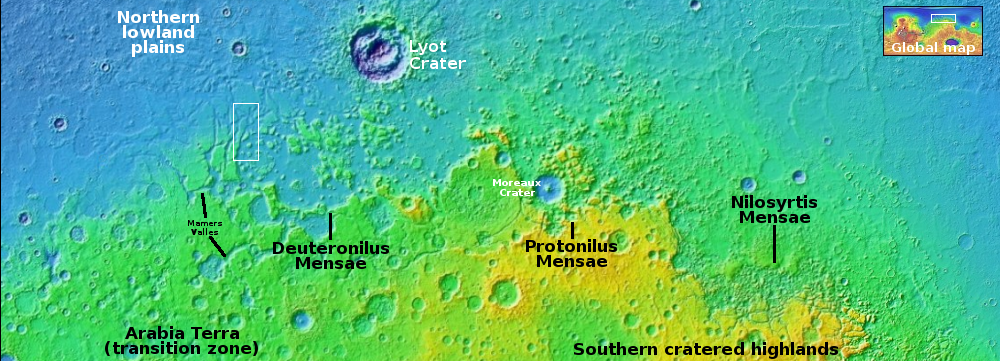
Overview map
Click for interactive map.

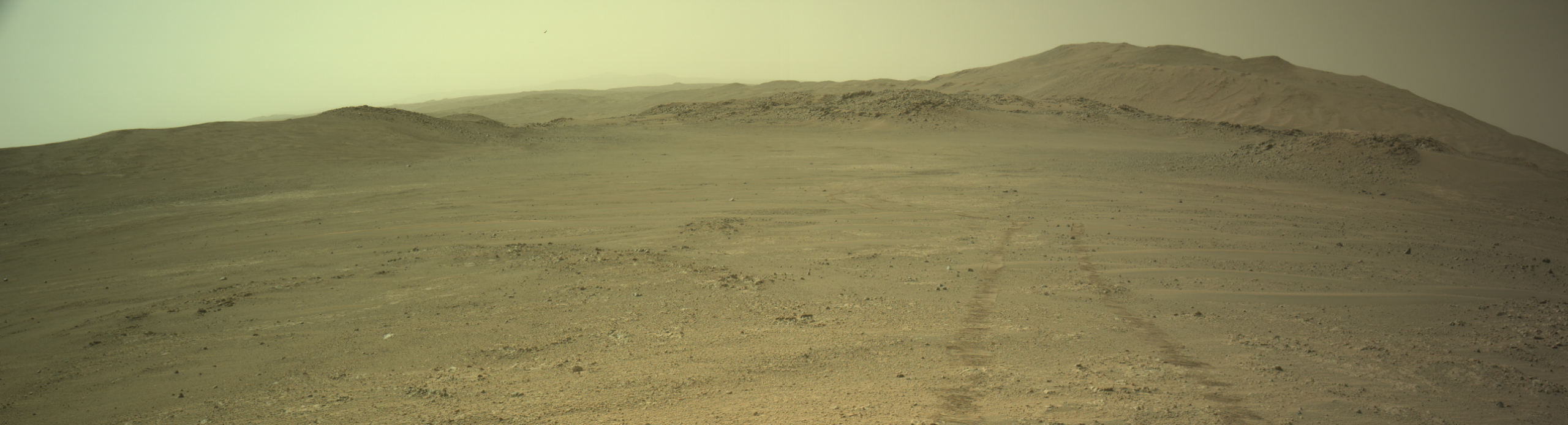
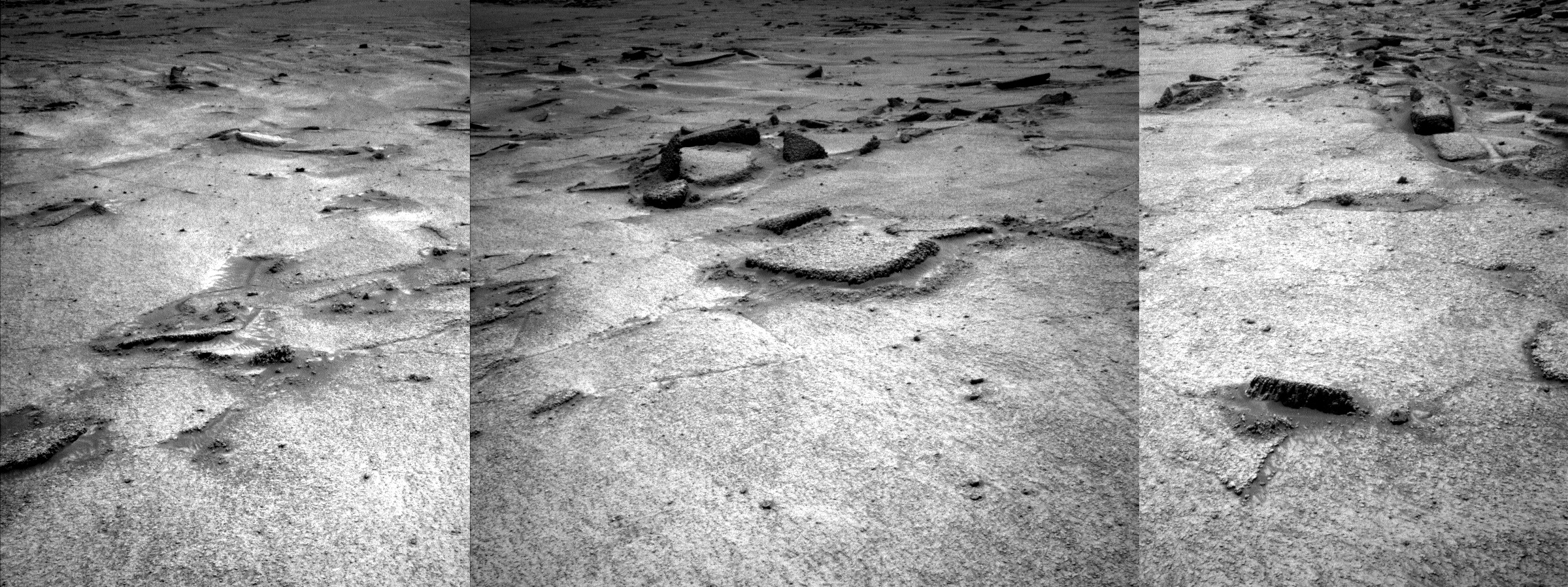
Cool image time! The panorama above, cropped and reduced to post here, was created on April 5, 2026 using 46 pictures taken by one of the high resolution camera’s on the Mars rover Perseverance. It also attempts to show this terrain in natural color.

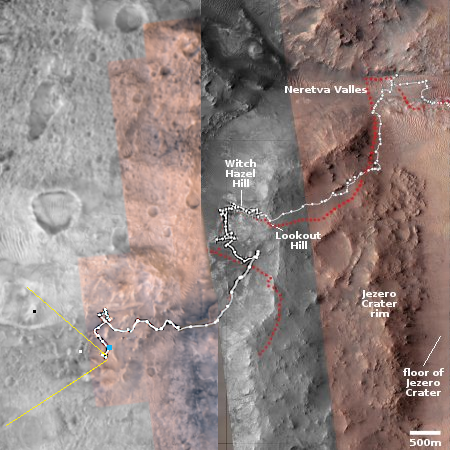
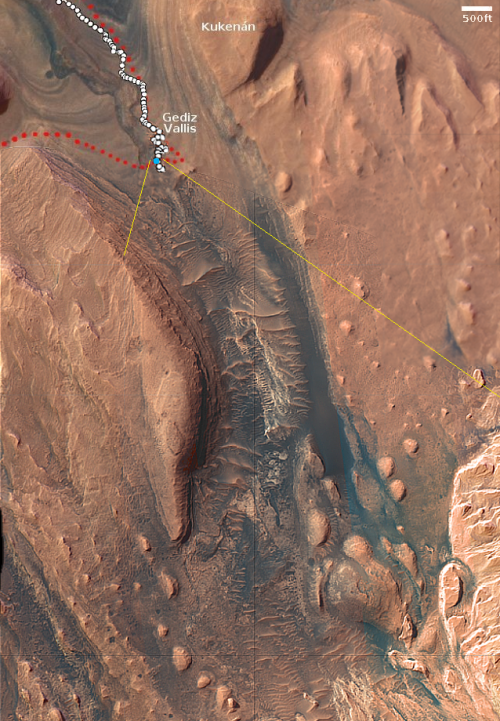
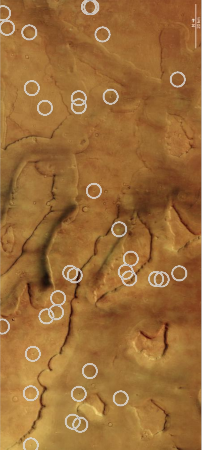
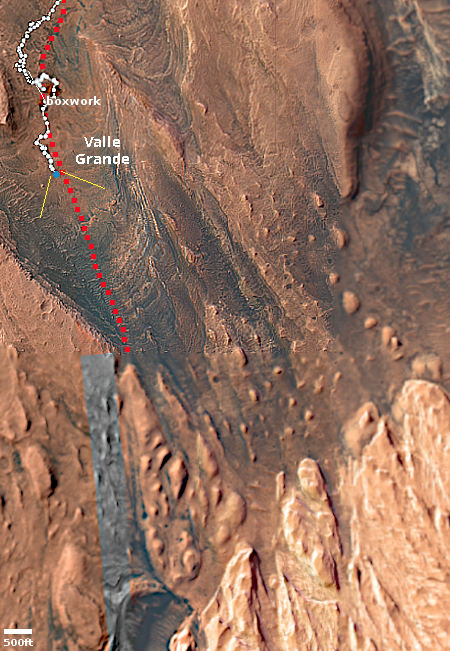
The blue dot on the overview map to the right marks Perseverance’s present location. The green dot indicates where I think the rover was when the panorama was taken. (Note: I think the press release incorrectly lists the Sol number for these dates, but as I am not sure I can only guess.) The yellow lines indicate approximately the terrain seen in the full panorama.

As the press release notes, “the panorama offers one of the richest geological vistas of the rover’s mission, revealing a windswept landscape of diverse rock textures.” It also appears this is the direction the rover is presently headed.

I ask my readers to once again look at this panorama. It shows an utterly barren terrain. There is no life here, and if there ever was it was gone billions of years ago and never did much to shape the landscape. While some at NASA and in the planetary community like to tout the possibility of life on Mars in order to lobby for funding, the reality we see says there is none, and that life will only appear on Mars when humans finally arrive there to build new human societies.

Brain terrain on Mars?

Brain terrain on Mars?
Click for original picture. For full image go here.

Cool image time! The picture to the right, cropped and expanded to post here, was taken on April 2, 2026 by the high resolution camera on Mars Reconnaissance Orbiter (MRO). Labeled simply as a “terrain sample”, such images are usually taken not as part of any specific research project, but to fill a gap in the camera’s schedule. The camera team needs to take pictures at a regular cadence to maintain its proper temperature.

When they have such a gap, they try to find interesting things to photograph, and usually succeed. In this case we are looking at what I think the scientists dub “brain terrain,” a feature unique to Mars that is thought related to near surface ice and its sublimation, though at present the origins of brain terrain remain murky. The scale is approximately 100 meters across the width of this picture.

However, the location of this brain terrain makes any conclusions about its origin difficult.
» Read more

Corroding glacial features inside Martian crater

Overview map
Glacier country in the Martian northern mid-latitudes.

The corroding glacial floor of a Martian crater
Click for original image.

Today’s cool image gives us another nice example of the ample availability of near surface ice on Mars, even if it might take a bit of processing to extract it from the dust and soil. The picture to the right, rotated, cropped, and reduced to post here, was taken on March 31, 2026 by the high resolution camera on Mars Reconnaissance Orbiter (MRO).

The picture captures in detail most of the floor of a 5.8-mile-wide unnamed crater, located in the northern mid-latitudes of Mars, in a 2000-mile-long strip I like to call glacier country, because practically every image taken there shows extensive glacial features. The white dot on the overview map above shows the location within that strip, with the inset showing the full crater, as well as the surrounding terrain.

The softness of this landscape strongly suggests a topsoil well impregnated with ice. The crater’s rim is itself very soft and subdued, suggesting melting and sublimation over time.

The material in the floor of the crater resembles peeling paint, which in this case suggests the ice there has been sublimating away as well. Nonetheless, there remains a lot under the surface. Future Martian colonists will certainly come to this region to gather ice for their own purposes.

Curiosity looks closely at the broken slab that had been stuck on its drill bit

The rock Atacama
Click for original image.

As expected, the science team for the Mars rover hasdecided before moving on it would take a close look at the 28 pound slab of rock that had been stuck on its drill bit and when finally dropped free broken into several pieces when it hit the ground.

The top picture to the right, cropped and reduced to post here, shows that entire rock, labeled Atacama by the science team. The two insets below are close-ups of the delicate layering at the rock’s left edge as well as the drill hole itself. From team’s update today:

The highest-priority activities after liberating the drill included imaging the drill with Mastcam and ChemCam RMI, and imaging into the now-empty drill hole with MAHLI (the image above). The science team made the most of the freshly-broken surfaces created when Atacama fell back to Mars, and the freshly-exposed sand once hidden underneath Atacama.

The exposed sand is off camera, to the right. Expect a paper published about that sand, buried likely for millions of years, sometime in the next year or so.

The delicate flutes at the rock’s left edge are somewhat common rock features seen by Curiosity, made possible by Mars’ thin atmosphere and its one-third Earth gravity. On Earth the gravity and weather generally destroys such things. On Mars the lack of violent weather and light gravity allows them to form, and the thin wind even helps in their formation.

Springtime on the residual icecap of the Martian south pole

Weird hatchwork at the Martian south pole
Click for original image.

Cool image time! The picture to the right, cropped and rotated so that north is to the top, was taken on March 28, 2026 by the high resolution camera of Mars Reconnaissance Orbiter (MRO).

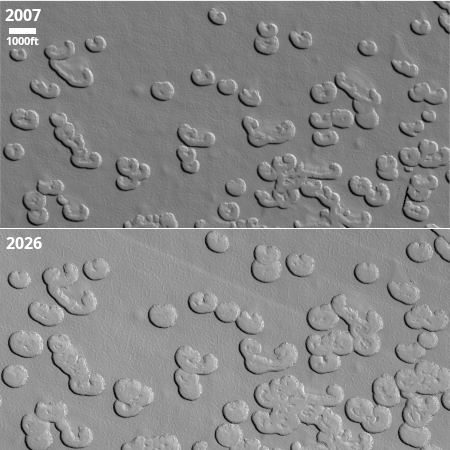
It shows what the science team labels a “south polar residual cap site.” The location is about 200 miles from the Martian south pole, well within the south polar ice cap. A second picture of this same spot was taken only a few days later, and was labeled “bright and dark fans on patterned ground.” With the second image the science team added their nickname for this location, “Troy,” which makes referencing it easier.

The hatchwork is the mystery here. In fact, the scientists have been monitoring this geology since 2020 to see if there have been any changes, either long term or seasonally. Almost certainly they have spotted seasonal changes, as indicated by the hatchwork itself and explained below, but I don’t access to the higher resolution images that would show any major modifications on a larger scale.
» Read more

Psyche approaches Mars

Mars as seen by Psyche
Click for original image.

The asteroid probe Psyche is now approaching Mars for a May 15, 2026 fly-by that will slingshot it out to the metal asteroid Psyche in 2029.

The image to the right, cropped and expanded to post here, was taken on May 3, 2026 when the spacecraft was still about three million miles away.

The observation was acquired by the multispectral imager instrument’s panchromatic or broadband filter, with an exposure time of just 2 milliseconds. Even with this very short exposure time, the crescent is extremely bright and parts of the image are oversaturated. The light seen here is sunlight reflected off the surface of Mars and also scattered by dust particles in its atmosphere. Because the quantity of dust in the atmosphere can vary rapidly over time, the anticipated brightness of the crescent was hard to predict before this early image was acquired.

The dustiness of Mars leads to sunlight being scattered by its atmosphere, making the crescent appear to extend farther around the planet than if it had no atmosphere (as with our Moon).Of note, on the right side of the extended crescent, there appears to be a gap, which coincides with the planet’s icy north polar cap. The cap is currently in winter and mission specialists hypothesize that seasonal clouds and hazes may be forming in that region, possibly blocking the atmospheric dust’s ability to scatter sunlight like it does elsewhere around the planet.

Though the spacecraft had had a thruster issue last year, all seems well at this time.

Testing new high speed rotors for the next generation of Mars helicopters

Ingenuity with missing blade
Ingenuity with its missing blade, at its final resting place on Mars.
Click for original image.

Engineers from JPL and the aerospace company AeroVironment have been testing a new set of high speed rotors that they hope to use on the next generation Mars helicopters, designed to increase their payload capacity by as much as 30%.

The rotors of Ingenuity — the first helicopter to fly on Mars — never spun faster than 2,700 rpm, because at faster speeds it would be approaching the speed of sound (on Mars), when unpredictable things could happen. Engineers are pushing those limits with these new rotors, in a chamber mimicking the thin Martian atmosphere.

The test engineers had taken the precaution of lining part of the chamber with sheet metal in case the blades broke apart during the supersonic experiment. From a control room a few yards away from the chamber, the team watched displays showing data and a view inside the chamber as the rpm climbed as high as 3,750. At that rate, the tips were traveling at Mach 0.98 [just under the Martian speed of sound]. Then the engineers activated a fan inside the chamber that pelted the rotors with headwinds. After each run, they increased in wind velocity for the next run.

The team pushed rotor tip speeds to Mach 1.08, boosting the Mars vehicle’s lift capability by 30%. This breakthrough allows future missions to support heavier scientific payloads, including advanced sensors and larger batteries for extended flight. Next the team tried their luck with the two-bladed SkyFall rotor. Because it is slightly longer than the three-bladed version, only 3,570 rpm was needed to achieve the same near-supersonic speed at the rotor tips prior to introducing the headwinds.

NASA administrator Jared Isaacman has said he wants to send a fleet of helicopters to Mars in 2028, on that first nuclear-powered mission. Whether or not that mission happens as he proposed, there is ample evidence scientists plan on sending more helicopters there in the next few years (see here, here, here). These tests lay the groundwork for those future missions.

Curiosity unintentionally picks up a rock slab

Sequence showing slab picked up and then dropped
Click for movie. Original images found here, here, here, and here.

In their latest drilling campaign using the drill on the Mars rover Curiosity, the science team picked up a big surprise that could have been a serious problem, but turned out all right in the end. When they tried to extract the drill from the hole, the drill instead stayed stuck to the rock, and picked the whole rock up instead.

The four images to the right show the sequence, sourced from here, here, here, and here.

On April 25, 2026, Curiosity drilled a sample from a rock nicknamed “Atacama,” which is an estimated 1.5 feet in diameter at its base, 6 inches thick and weighs roughly 28.6 pounds (13 kilograms). When the rover retracted its arm, the entire rock lifted out of the ground, suspended by the fixed sleeve that surrounds the rotating drill bit. Drilling has fractured or separated the upper layers of rocks in the past, but a rock has never remained attached to the drill sleeve. The team initially tried vibrating the drill to shake off the rock, but saw no change.

Then, on April 29, they tried reorienting Curiosity’s robotic arm and vibrating the drill again. Imagery in the GIF shows sand falling from Atacama, but the rock stayed attached to the rover.

Finally, on May 1, Curiosity’s team tried again, tilting the drill more, rotating and vibrating the drill, and spinning the drill bit. The team planned to perform these actions multiple times but the rock came off on the first round, fracturing as it hit the ground.

Had they not been able to release the rock it could have seriously impacted the mission, even ended it.

As noted by the science team in their own update today about this situation:

Future activities involve wrapping up the drill campaign on Atacama and, nominally, seeking a more firmly rooted drill target in order to collect drill tailings for analysis, which were lost from Atacama as part of the effort to dislodge the drill bit from the rock.

In other words, they are going to have hunt around for a better drill spot, as they really do want to study some drill samples at this location. They have left the boxwork area and have moved uphill closer to the pure sulfite unit, and want to see how the geology has changed.

A cool crater in Starship’s prime candidate zone on Mars

Overview map

Crater in the Starship landing zone on Mars
Click for original image.

Cool image time! The picture to the right, rotated, cropped, reduced, and enhanced to post here, was taken on August 16, 2025 by the high resolution camera on Mars Reconnaissance Orbiter (MRO). In mid-March it was featured as a captioned image by MRO’s science team. From their caption:

When they form, impact craters dig up material from below the surface and throw it outwards into what geologists call an ejecta blanket. The fastest ejected material travels the furthest so material from different depths can end up at different distances from the crater.

This HiRISE image shows a pedestal crater in Arcadia Planitia that has material of different brightness and color at various distances from the crater. This could tell us more about the material that’s buried below the surface here, but the situation is complex.

The caption however fails to mention the most interesting two aspects of this crater’s ejecta blanket. One, it suggests strongly that there was a lot of near surface ice at impact that melted to produce this splash apron.

Second, and even more intriguing, the 3,100-foot-wide unnamed crater is located smack dab in the middle of the candidate landing zone on Mars for SpaceX’s Starship spacecraft, as shown by the overview map above. The white dot marks the location of this crater, while the red dots mark the four prime landing sites, as suggested by scientists in a 2021 paper [pdf], based on conclusions drawn from two workshops organized by SpaceX and these scientists. The other dots are other MRO images of this region, and include a number of potential secondary landing sites.

This zone is in the northern lowland plains of Mars, in a mid-latitude region where near-surface ice is plentiful. The splash apron of this crater provides further evidence of that near surface ice.

Curiosity looks at a small crater as it climbs Mount Sharp

Antofagasta crater
Click for full resolution. Click here, here, and here for original images.

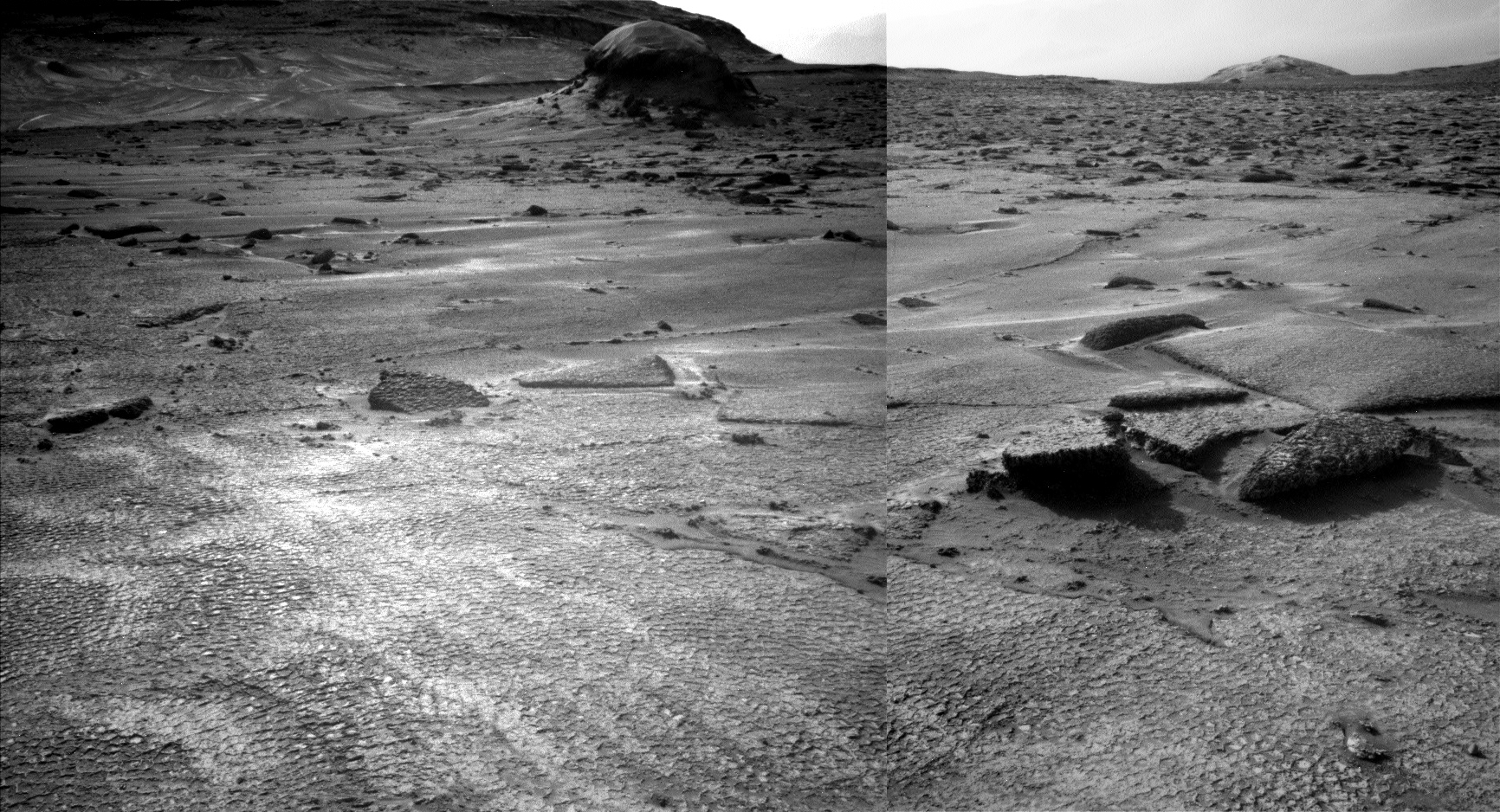
Cool image time! The panorama above, created from three pictures taken by the right navigation camera on the Mars rover Curiosity (see here, here, and here), takes a look at a small relatively fresh crater on the slopes of Mount Sharp. From an update from the rover’s science team yesterday:

At the beginning of the week, Curiosity arrived right on target on the rim of the 10-meter (33 feet) “Antofagasta” crater. The crater looked fresh and deep as we had hoped with a nice well-defined rim that didn’t look too eroded, but the bottom of it turned out to be filled with dark rippled sandy material that covered up the most interesting rock layers. There were a few rock exposures just above the sand cover that seemed like they might have been deep enough to have been sheltered from space radiation between the time their sediments were deposited and the crater-forming impact, but reaching them from the rim would have put the rover at such an awkward angle that we wouldn’t have been able to deliver the sample to the instruments.

Overview map
Click for interactive map.

It’s possible that we might have been able to get into a better position by instead placing the rover on the rippled crater fill, but the chance that the rover could get stuck in all that sand made it much too high a risk. We also looked at the nearby blocks in case they could have been ejecta from the crater, but since all the rocks visible in the crater wall looked very similar to each other, there wasn’t a good way to tell which ejecta blocks might have come from the deeper layers of the crater. Because of this, the team decided against attempting to drill in or around the crater.

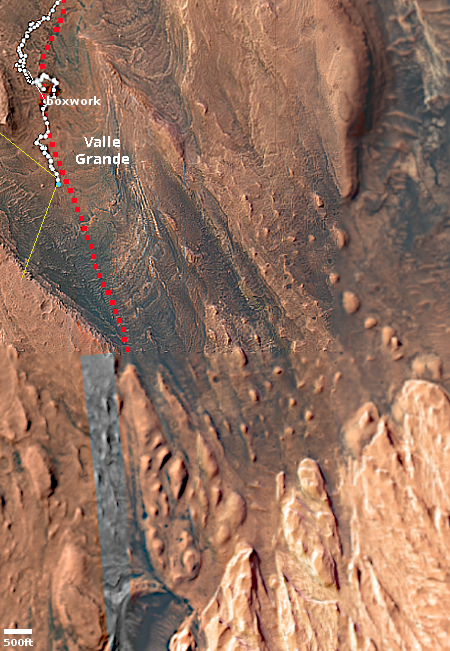
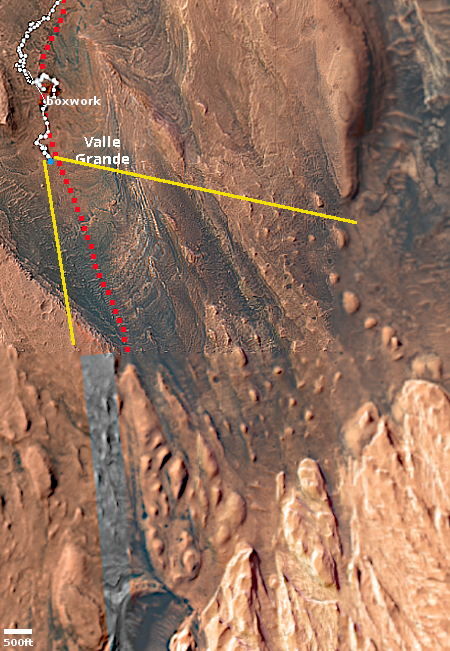
The overview map to the right provides the context. The blue dot marks Curiosity’s location when the pictures above were taken. The yellow lines roughly indicate the area covered by the panorama. The red dotted line marks the future planned route, the white dotted line the rover’s actual travels.

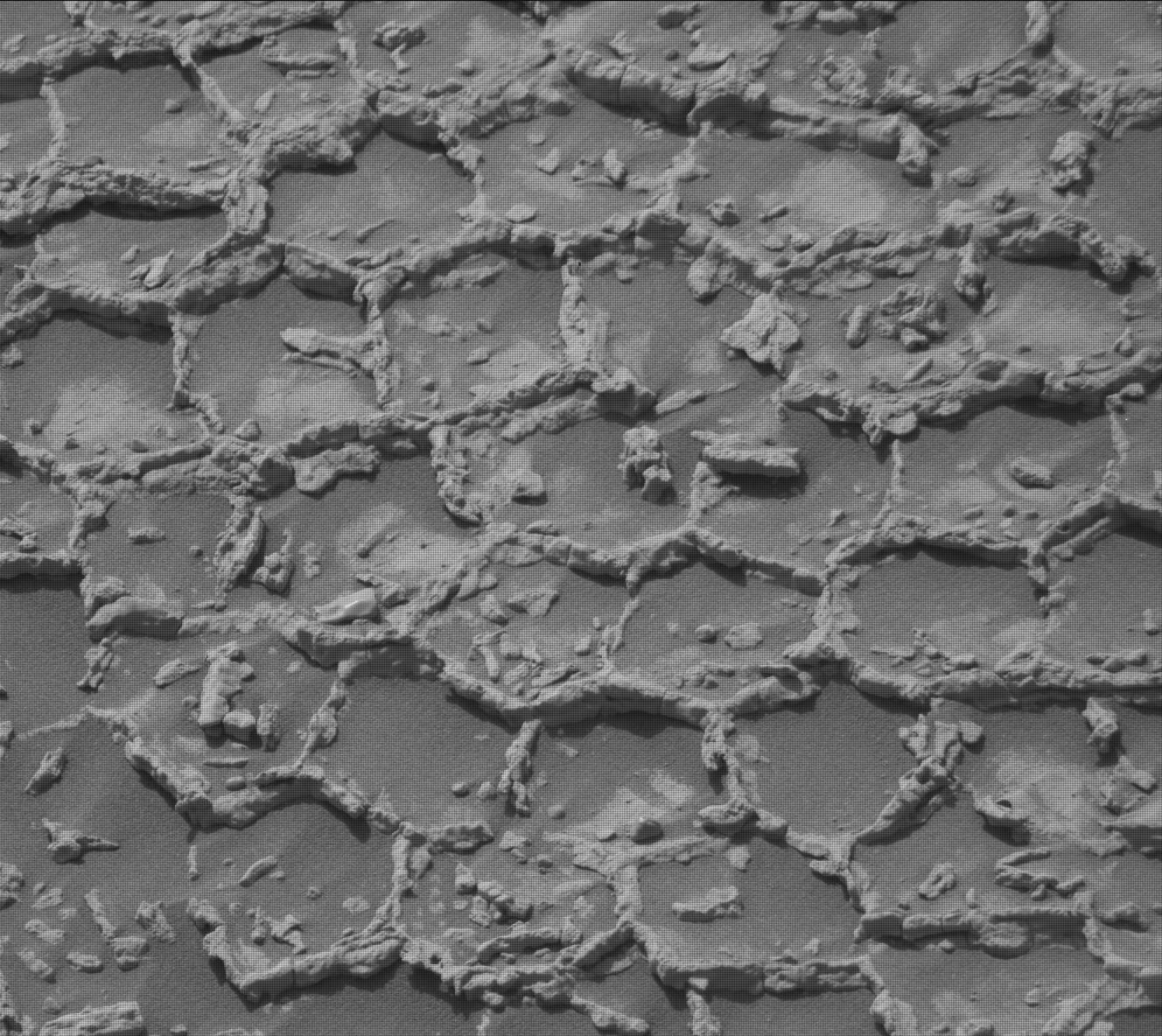
Note the flat rocks in the foreground of the panorama, all part of the crater’s rim. Each looks like a large flat paving stone that was very precisely shattered into numerous tiny pieces, all about the same size. Very strange. On Earth you’d assume some craftsman had laid these small pieces down like tiles, but of course, that couldn’t have happened on Mars.

The movement of surface ash on Mars over a half century

Viking and Mars Express images side-by-side for comparison
Go here and here for original images.

Overview map

Cool image time! In comparing images of one location on Mars taken a half century apart, scientists using Europe’s Mars Express orbiter have discovered that the dark ash covering this region has shifted south by about 200 miles.

The two images above show the change, with a Viking orbiter image taken sometime in 1976 on the left and the Mars Express image taken in 2026 on the right. Both images have been enhanced to match each other, with the white box marking an area seen in close-up by Mars Express.

The overview map to the right provides the context. This region is inside Utopia Basin, one of the largest ancient impact basins on Mars, thought to have been formed by an impact that occurred a little more than four billion years ago. Much of Mars’ dark volcanic dust is thought to come from the Medusae Fossae Formation, a gigantic volcanic ash field the size of India and located on the other side of the planet, in between all of the red planet’s largest volcanoes. Over the eons that ash has gotten distributed across the globe.

In this case, it not only covers large areas of Utopia Basin, but over a half century the prevailing winds in the thin Martian atmosphere has been enough to shift the edge of this particular ash field south by 200 miles.

Martian mountains on Mount Sharp

Panorama looking up Mount Sharp
Click for larger full resolution image. For original images go here and here.

Overview map
Click for interactive map.

Cool image time! The panorama above was created using two pictures taken by the high resolution camera on the rover Curiosity on Mars (here and here).

The overview map to the right gives the context. The blue dot marks Curiosity’s position on the day before these pictures were taken, climbing through the foothills on the flanks of Mount Sharp. I do not know if it traveled again before taking these two pictures above. The white dotted line its past travels, while the red dotted line its planned future route. At present Curiosity has climbed about 3,500 feet up the mountain. It is still about 15,000 feet below the peak, which is about 25 miles away and not visible from here.

The yellow lines indicate where I think the panorama is looking, though I admit that I am not sure. The view is distant, since this is high resolution camera. This panorama might actually be looking in a completely different direction, downhill at one of the hills that Curiosity previously drove past. The air is very dusty, which means if the rim of Gale Crater is in the background, 20-30 miles away, we can’t see it.

Regardless, the science team has finally finished its many nine-month-long survey of the boxwork geology, and has sent Curiosity climbing again. I think these pictures are part of their review of the future terrain, as they plan the rover’s route through the lighter-colored sulfate terrain higher on the mountain. If instead they are looking downhill, they were taken both to review previously viewed geology as well as to measure the dustiness of the atmosphere.

Feathery eroding layers on Mars

Feathery layers on Mars
Click for original image.

Cool image time! The picture to the right, cropped, reduced, and enhanced to post here, was taken on February 23, 2026 by the high resolution camera on Mars Reconnaissance Orbiter (MRO). It shows what the science team calls “layers exposed around [a] streamlined feature”.

The elevation difference between the mesa top on the left and the canyon floor on the right is about 1,000 feet. The layers are the terraces stepping downward along that drop.

What makes these layers interesting is how they have been exposed. The material that makes up the layers appears very sandy and delicate, so it breaks away it very small pieces, just like sand on a beach. The result is this feathery look. If you look close you can see that some small craters have been partly obliterated by that erosion, with their existence only marked by their remaining rim, on the high side.
» Read more

Cracked bedrock on Mars?

Cracked Martian landscape
Click for full image.

For today’s cool image we return to Mars. The picture to the right, cropped and brightened to post here, was taken on December 3, 2025 by the high resolution camera on Mars Reconnaissance Orbiter (MRO).

The focus of the picture was a strange crater in the floor of Mawrth Vallis, a channel that drains northward from Mars’ cratered southern highlands to its northern lowland plains. You can see the crater in the full image if you click on the picture. It is intriguing because its rim is strangely abrupt and flat on all sides, something that is not seen with impact craters, which have a raised rim of material plowed out by the impact.

In the picture to the right I have however focused on the two small 50-70-foot-high mesas and cracked ground that surrounds them. What struck me was the dry appearance of this landscape. Located at 23 degrees north latitude, it is in the dry tropics of Mars, where little near surface ice is found. The cracks emphasize this conclusion, as they so well resemble the cracks you see in dried mud on Earth.
» Read more

Growing damage to the wheels of the Curiosity Mars rover

Close-up of the wheel in the worst condition
Images cropped and reduced to post here. For the original images go here and here.

Survey of wheels

Every few months or so the Curiosity science team uses one of the rover’s cameras to do a survey of the rover’s wheels to track their condition. Since early in the mission they had found the wheels were not holding up as well as expected as they rolled over the rough terrain in Gale Crater and on Mount Sharp, and so they take great care in how they move the rover as well as review the wheels regularly.

A year ago it had appeared that the damage to one particular wheel had increased, to a point where its outer section might even break off.

Yesterday the science team did another survey, as shown in the picture to the right.

The two photos above (found here and here) focus on one particular wheel of that survey, which I suspect is the same wheel that was the focus of last year’s post. After taking the first image on the left the team moved Curiosity so that the other side of the wheel could be photographed. As you can see, the damage is extensive, so much so that it is possible the wheel could collapse entirely in the not-to-distant future.

It also looks like another wheel is beginning to see similar damage (see here and here), though not yet as extreme.

The good news is that Curiosity has six wheels, and that it can continue to travel even with the loss of one or maybe two wheels. It also appears that future terrain might not be so rocky.

The bad news is that this wheel damage is likely the one problem that will likely end the mission, possibly sooner than anyone would like. And from these photographs, that end might be sooner rather than later.

China to begin construction of its Mars sample return spacecraft

China’s state-run press today announced it is about to begin construction of its Mars sample return spacecraft, Tianwen-3, set for launch in 2028.

Based on the announcement, that date seems very unlikely.

China’s mission to retrieve samples from Mars will advance to the flight model development phase within this year, Liu Jizhong, chief designer of the Tianwen-3 mission, said on Thursday. Building on the preliminary technical research and demonstrations, the mission has achieved breakthroughs in key technologies. The engineering team is now focused on developing prototypes, Liu, also a national legislator, told reporters.

The Mars sample return mission is scheduled for launch around 2028, with the goal of returning no less than 500 grams of Martian samples to Earth by around 2031. [emphasis mine]

They only have two years to get the spacecraft built, and it involves “an orbiter, a returner, a lander, an ascender, and a service module.” While China is basing this mission’s design on its successful Chang’e lunar sample return missions, returning samples from Mars is significantly more challenging. The ascent vehicle will have a much greater gravity to overcome, and doing a robotic rendezvous and docking in orbit around another planet millions of miles from Earth has never even been tried.

Curiosity looks uphill at its upcoming travels

Panorama looking up Mount Sharp
Click for original.

Overview map
Click for interactive map.

Cool image time! Since May 2025 Curiosity has been exploring in great detail the boxwork formations located on the lower slopes of Mount Sharp. It is now about to complete those investigations, with the Curiosity science team beginning their planning for moving onward and upward.

The panorama above, enhanced to post here, was taken on March 2, 2026 by the rover’s right navigation camera. It looks uphill along the valley that Curiosity is in toward the mountainous region the rover is targeting. Note that the peak of Mount Sharp is not visible, being more than 25 miles away beyond the horizon and about 15,000 feet higher up.

The blue dot on the overview map to the right mark Curiosity’s present position. The yellow lines indicate roughly the area this panorama covers. The red dotted line marks the rover’s approximate planned route, while the white dotted line indicates Curiosity’s actual travels.

Right now Curiosity is traveling through a geological layer the scientists have dubbed the sulfate unit. The lighter colored hills seen on the horizon have also been identified as sulfate, but believed to be much more pure. The geology there should be very different. Instead of rough and rocky it could be like traveling over soft porous sand. This however is merely a guess on my part, based on imagery of those light-colored hills.

The actual route through those hills however remains unknown. Either the science team has not yet released it, or is still trying to figure out the best way through.

Rocket Lab completes in-space commissioning of two Escapade Mars orbiters

Built by Rocket Lab for NASA and launched in November 2025, the company has now completed the in-space commissioning of two Escapade Mars orbiters and is about to hand operations over to the University of California Berkeley Space Sciences Laboratory (UC-Berkeley).

With both spacecraft now fully commissioned and successfully operating at the Earth–Sun Lagrange Point 2 (L2), Rocket Lab is preparing to hand over operational control to [UC-Berkeley], who will lead science operations at L2 and prepare the mission for its cruise to Mars.

Under contract from [UC-Berkeley], Rocket Lab was selected to design, build, and provide commissioning operations of the two high delta-V Explorer-class interplanetary spacecraft for ESCAPADE. Rocket Lab moved from concept to launch readiness in just over three years, proving commercial collaboration can deliver important science key to supporting future human and robotic exploration of Mars on ambitious schedules and for significantly smaller budgets than typical interplanetary missions. This speed was made possible through Rocket Lab’s vertically integrated spacecraft production, with key components including solar arrays, reaction wheels, propellant tanks, star trackers, radios, avionics, and flight software designed and built in-house.

Launched from Cape Canaveral Space Force Station in November 2025, the twin ESCAPADE spacecraft, known as Blue and Gold, completed spacecraft commissioning and executed two precise trajectory correction maneuvers, placing both spacecraft into their loiter trajectory near L2, approximately 1.5 million kilometers from Earth.

Both spacecraft will be sent on their way to Mars in December 2026 when orbital mechanics between the Red Planet and Earth are right for the journey. Once in Mars orbit the two orbiters will allow for a three-dimensional study of the interaction between the solar wind and Mars’ atmosphere.

Though this is a NASA-funded mission, note that it was built a commercial company and operated not by NASA but by a university. For this reason, it was not only built fast and at a low cost, it uses an innovative flight path that allowed it to be launched anytime and wait in orbit for the right moment to go to Mars. This last innovation provides for a lot more flexibility.

Mars’ fast moving gigantic lava floods

A Martian crater broken by flowing lava
Click for original image.

Cool image time! The picture to the right, rotated, cropped, and reduced to post here, was taken on December 12, 2025 by the high resolution camera on Mars Reconnaissance Orbiter (MRO).

The science team labels this a “crater interrupted by flow.” And what a flow! This unnamed 1.4-mile wide crater was not only filled and partly buried by the flow, that flow was so strong it cut through the crater’s rim at two points, refusing to let that rim block it in any way.

The flow in this case is lava, coming down from the Tharsis Bulge where four of Mars’ biggest volcanoes arose. And that flow was quite vast, as the nearest of those volcanoes, Arsia Mons, is almost 800 miles away. Because of Mars’ relative light gravity, about 39% that of Earth’s, lava on Mars can flow across large distances in a very short time. It might have only taken a few weeks for that flow to cover that 800 miles.
» Read more

The weird landscape of Mars’ death valley

Taffy terrain
Click for original image.

Cool image time! The picture to the right, rotated, cropped, reduced, and enhanced to post here, was taken on October 28, 2025 by the high resolution camera on Mars Reconnaissance Orbiter (MRO).

The science team labels this “bands near mesa,” an apt description. What we are looking at is a geological feature unique to Mars, but also unique to only one particular place on Mars, the planet’s death valley, the place in Hellas Basin with the lowest relative elevation of any spot on Mars.

The feature is called taffy terrain. According to a 2014 paper, the scientists posit that this material must be some sort of “a viscous fluid,” naturally flowing downward into “localized depressions.” Those localized depressions however happen to also be at the very basement of Mars.

Note how in some spots the bands appear to have been stripped off, exposing small hollows in which dust has become trapped over time to form ripple dunes.
» Read more

UAE extends mission of its Al-Amal Mars orbiter

Deimos with Mars in the background
Al-Amal’s 2023 image of Deimos, the first good
picture of the moon ever taken. Click for full movie.

The United Arab Emirates (UAE) yesterday announced it is extending the mission of its Al-Amal Mars orbiter (“Hope” in English) to 2028, significantly beyond its initial planned mission of two years.

Launched in July 2020, the Hope Probe successfully entered Mars orbit in February 2021 after a seven-month interplanetary journey, marking a historic achievement as the first Arab nation to reach the Red Planet. Originally designed as a two-year mission to observe and study Mars’ atmosphere, the probe has far exceeded expectations. Since reaching Mars, it has gathered around 10 terabytes of scientific data, shared through more than a dozen datasets with research institutions worldwide.

The probe itself was mostly built by American engineers and organizations, as part of a deal to train UAE students. Once in operation around Mars, the UAE and those students took over almost all operations. It orbits Mars in a very wide orbit, allowing it to study global weather and atmosphere conditions, such as dust storms.

A sinuous Martian ridge of uncertain origin

A sinuous ridge of uncertain origin
Click for original image.

Cool image time! The picture to the right, rotated, cropped, reduced, and sharpened to post here, was taken on July 21, 2025 by the high resolution camera on Mars Reconnaissance Orbiter (MRO). It was posted today by the camera team as a captioned image, with the caption as follows:

The sinuous ridge is approximately 10 meters wide and several kilometers long. The floor surrounding this ridge has been eroding laterally, forming pits and circular features suggestive of removal (sublimation) of subsurface ice. However, landforms such as channels or moraines that might suggest the presence of water or ice are lacking, so the ridge itself does not appear to have formed by fluvial or glacial processes.

Perhaps this curious feature is an exhumed dike formed from magma emanating from Alba Mons in subsurface fractures.

Alba Mons is a gigantic shield volcano to the west.
» Read more

A sculptured Martian landscape

Weird Martian landscape
Click for original.

Cool image time! The picture to the right, cropped and sharpened to post here, was taken on December 4, 2025 by the high resolution camera on Mars Reconnaissance Orbiter (MRO).

The science team labels this landscape “olivine-rich plains”, which is a magnesium iron silicate mineral of some industrial value that is quite common on Earth. Its presence here suggests there could be other valuable minerals in this region.

I post the image because the landscape is so weird and beautiful. The orange color suggests these ridges are covered with dust, if not made of dust entirely. The small areas with a greenish tint that appear to mostly appear on north-facing cliffs could be frost, except this is in the southern hemisphere where north-facing cliffs get more sunlight. As it was autumn when this picture was taken frost is an unlikely explanation.

More likely the green indicates exposures of bedrock or coarser boulders.
» Read more

Windswept Martian volcanic ash?

Volcanic ash on Mars?
Click for original image.

Cool image time! The picture to the right, rotated, cropped, reduced, and sharpened to post here, was taken on November 30, 2025 by the high resolution camera on Mars Reconnaissance Orbiter (MRO).

The science team labels this simply as “Features,” the vagueness of which I can understand after digging in to get a better idea of the location and geography.

The location, as shown by the white dot on the overview map below, is inside the Medusa Fossae Formation, the largest volcanic ash field on Mars that is thought to be the source of much of the red planet’s dust. That ash field is large and very deep, and was put down more than a billion years ago when the giant volcanoes of Mars were active and erupting. Thus it is well layered, and many images of that ash field show that layering exposed by the eons of Martian wind scouring its surface.

In this case, that scouring appears to have produced this feathery surface, though the origin of those ridges might have instead come from volcanic flows that are now hardened. Or we could be looking at ancient channels produced by ice or water, though that would have to have been a very long time ago, as this image is located in the Martian dry tropics, where no near surface ice presently exists.
» Read more

New gullies on Mars?

Fresh gullies on Mars?
Click for original image.

Cool image time! The picture to the right, cropped and reduced to post here, was taken on November 6, 2025 by the high resolution camera on Mars Reconnaissance Orbiter (MRO).

The science team labels this image “Fresh-Looking Gullies.” It was clearly taken to study the gullies flowing down the north interior crater wall of this 4.4 mile-wide unnamed crater, about 1,500 feet deep.

What causes these gullies remains an open question. They are found in many places in the Martian mid-latitudes. When first discovered scientists thought they might be related to the sublimation of underground ice. More recent research suggests they are formed by the seasonal dry ice frost cycle that in the high latitudes has carbon dioxide condense to fall as snow in autumn and then sublimate away in the spring.
» Read more

Communications resume with Mars

First images back from Curiosity and Perseverance
Go here and here for the original images.

It appears the solar conjunction that has blocked all communications with the rovers and orbiters for the past three weeks around Mars has now fully ended, with the first new images appearing today from both Curiosity and Perseverance.

The two images to the right were downloaded today. The top image was taken on January 20, 2026 by Curiosity’s front hazard avoidance camera. It appears to be looking uphill in the direction the rover is soon to travel, climbing Mount Sharp. If you look closely you can see the mountain’s higher ranges on the horizon, just to the right of the rover itself.

The bottom picture was actually taken on January 15, 2026 by Perseverance, but was only downloaded today. Both science teams had programmed their rovers to take images throughout the conjunction, scheduled for download when communications resumed.

The picture was taken by Perseverance’s left high resolution camera located on top of the rover’s mast. It looks down at the ground near the rover at the pebbles and rocks that strewn the relatively smooth surface of the terrain west of Jezero crater.

Neither image is particularly ground-breaking. What is important however is that both images prove the rovers are functioning as expected. Expect a lot more data to arrive in the next few days, all gathered during three weeks of blackout.

A 10-mile-long avalanche on Mars

Overview map

A ten mile long avalanche on Mars
Click for original image.

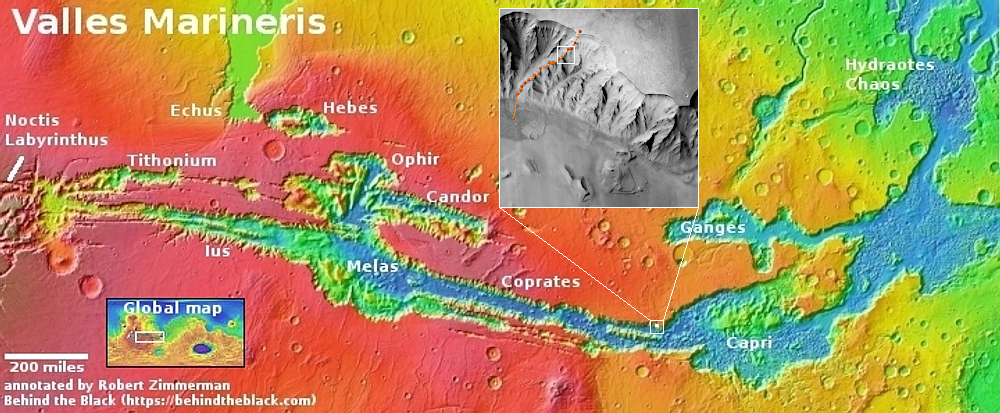
Cool image time! The picture to the right, cropped, reduced, and sharpened to post here, was taken on November 8, 2025 by the high resolution camera on Mars Reconnaissance Orbiter (MRO). It shows only three miles of a ten-mile-long avalanche inside the solar system’s largest canyon, Valles Marineris.

The white dot on the overview map above marks the location. In the inset the white rectangle indicates the area covered by the picture to the right. I have indicated the avalanche’s full extent beyond this.

Overall, the landslide fell about one mile along those ten miles. That there are about a dozen small craters on top of the slide tells us this happened quite a long time ago.

As always, the scale of Valles Marineris boggles the mind. Though this avalanche fell about 5,000 feet (the same depth of the south rim of the Grand Canyon), that drop only covered one fifth of Valles Marineris’s depth. At this point, from the rim to the floor the elevation difference is about 23,000 feet, which would place the rim among the 100 highest mountains on Earth. And of course, this is only one small spot in this gigantic canyon that runs 2,500 miles east-to-west, with its depth about the same that entire length.

Mars Reconnaissance Orbiter’s high resolution camera is showing its age

More data drop-outs from MRO

In a cool image earlier this week I noted that, in going through the archive of images most recently sent back from Mars Reconnaissance Orbiter’s (MRO) high resolution camera, it appeared the camera was exhibiting more anomalies, and that we must therefore “be prepared for the loss of this camera and orbiter in the somewhat near future.”

In reviewing the archive again yesterday I noticed even more evidence of deterioration, as illustrated by the picture to the left. Not only are there blank vertical strips of no data, but the color drops out of the color strip halfway down, something I had never seen before. Nor was this the only picture with these issues.

I decided to email Alfred McEwen of the Lunar & Planetary Laboratory in Arizona. who until recently had been the camera’s principal investigator, to find out what is really going on. His answer:

Yes, HiRISE is getting old, just like us. There are 2 issues:

  • 1. Sometimes RED4 fails, leaving a gap in the RED products and color.
  • 2. Bit flips create bad pixels (zeros) in RED1_1 and RED3_1. This can still be mitigated by raising electronics temperatures, and we were just approved for an increase, so this problem should soon be reduced for a year or two. One problem with these increased temperatures is that our calibration isn’t correct, leading to the stripe-ing and strange colors that you noted, although dusty air can also create such issues. The calibration will eventually get updated, but funding is extremely tight.

The first issue explains the drop-out in the color strip. This appears to be a relatively new problem.

The second issue explains the two additional black strips to the right of the color strip. (Bit flips are cases where the radiation of space causes a binary bit to flip randomly from 0 to 1, or visa versa.) Bit flips are something engineers expect in spacecraft, but it appears on MRO they are occurring with more and more frequency.

A third issue, the failure of the electronics unit for CCD RED4 that occurred in August 2023, causes a loss of data in the color strip (see the b&w version of the image above for an example), which the camera team has compensated for using other color filters in that area.

According to McEwen, while the team seems confident the increased temperatures, combined with re-calibration, will fix or reduce issue #2, it is less confident about its impact on the camera’s lifespan.

We wish we knew. We’ve raised temperatures many times and it still works, so we keep raising temperatures incrementally just in case.

All in all, however, McEwen says he expects the high resolution camera to be able to produce images for at as long as MRO operates (at least a decade more), though with time we might be finding the images become narrower and narrower strips.

Martian glacier flowing past small peak

Overview map

Martian glacier flowing past small peak
Click for original image.

Cool image time! The picture to the right, rotated, reduced, and sharpened to post here, was taken on November 24, 2025 by the high resolution camera on Mars Reconnaissance Orbiter (MRO).

As is proper, the science team labels this vaguely as a “flow obstacle in lobate debris apron.” The obstacle is that small peak. The lobate debris apron is the material flowing past, resembling in almost all details what a glacier looks like on Earth. The scientists use vague terms because they don’t want to trap themselves into a conclusion before it is confirmed.

Nonetheless, based on all the data MRO and other Mars orbiters have been gathering for the past decade, we are almost certainly looking at near-surface ice flowing downhill and past that peak.

The white dot in the overview map above marks the location, on the western end of the 2,000-mile-long mid-latitude strip I label “glacier country,” because practically every image from this region shows features such as this.

The arrow in the inset shows the direction of the downhill grade, dropping from 2,000 to 3,000 feet from the surrounding plateau. The peak itself rises about 130 feet above the flow on the uphill side, but 650 feet above on the downhill side. Apparently the flow piled up somewhat as it hit the peak.

That flow however is likely inactive at this time. Though the researchers have repeatedly monitored the many glacial flows they have found on Mars in the decade since MRO arrived in Mars orbit, so far I have heard of no example showing any movement. And that covers about five Martian years.

These images do prove one thing: Mars is not dry. It has plenty of water near the surface, though locked in ice.

Exposed weirdness on floor of Martian crater

Crazy shapes on floor of Martian crater
Click for original image.

Cool image time! The picture to the right, rotated, cropped, reduced, and sharpened to post here, was taken on November 27, 2025 by the high resolution camera on Mars Reconnaissance Orbiter (MRO).

The science team labels this “exposed crater floor materials”. While properly vague, that hardly suffices. This image could easily fall into my “What the heck?!” category of Martian geology that is difficult to understand, no less explain.

The color strip suggests that dust dominates near the top and bottom, though dust is also present in the middle. The patches with the bluish tint in the middle suggests these lighter swirls and patches are bedrock.

Of course, none of that explains the weird shapes of these patches, nor why they exist at all.

Before delving into those weird shapes, we must note the two vertical black strips to the right of the color strip, indicating a gap in data. Such gaps have been appearing more frequently of late, suggesting MRO’s age, almost a decade in orbit around Mars, is beginning to show itself. A failure in 2023 in one filter band of the high resolution camera already leaves blank the color swath in black and white images. These new blank strips indicate further issues, warning us that we must be prepared for the loss of this camera and orbiter in the somewhat near future.
» Read more

1 2 3 85