Boulder tracks on Mars

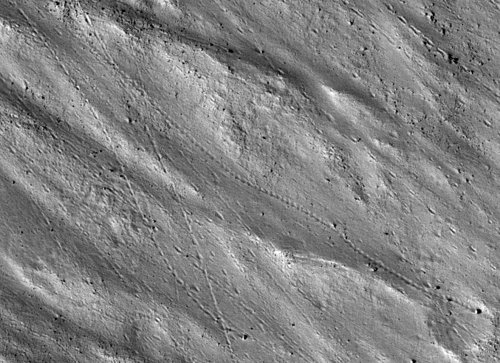
Here’s a nice picture from the HiRISE camera on Mars Reconnaissance Orbiter, released July 7, showing the boulder tracks left by rocks bouncing down the escarpment of Kasei Valles in the low gravity of Mars. Fun quote:

Some of these blocks traveled downhill several hundred meters (yards) as they rolled and bounced, leaving behind a trail of indentations or poke marks in the surface’s fine-grained, light-toned soils. The raised borders in some of these poke marks indicate they are relatively recent features, unaffected by wind erosion, or that this soil has cohesive properties, such as if it was cemented.

Boulder tracks on Mars

0 comments

Avalanches on Mars

Saturday’s weekly dump of publications from the American Geophysical Union also included a paper that showed visual proof of avalanches on Mars! In this case, the location is Russell Crater, “a large crater in the southern hemisphere that exposes a large dune field in its center.” The avalanches occur because a frost layer made up of dry ice and a little bit of frozen water builds up on the crest of the dunes. When that frost melts, dark streaks about three to six feet wide and about 150 feet long appear, flowing downhill. The scientists believe these are avalanches made up of “a mixing of sand, dust, and unstable CO2 gas.”
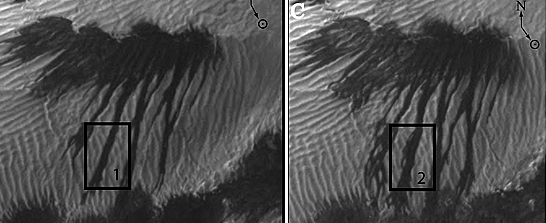
wide shot of before and after
Before and after shots of the dark streaks flowing down the dune.
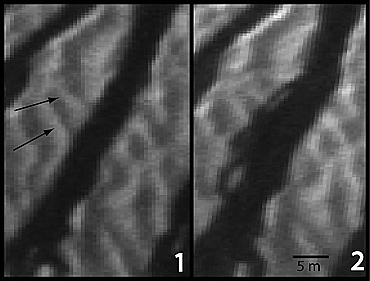
close-up, before and after
Close-ups of the streaks, before and after.

0 comments
1 210 211 212