
The life story of a meteorite
A close analysis of a meteorite that landed on the roof of a California home have allowed scientists to traces its history from inception to Earth impact.
A close analysis of a meteorite that landed on the roof of a California home have allowed scientists to traces its history from inception to Earth impact.
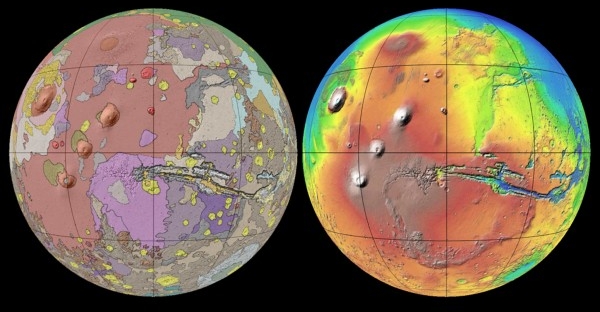
Scientists have released a new geological map of Mars based on data accumulated over the last sixteen years by four orbiters and four rovers.
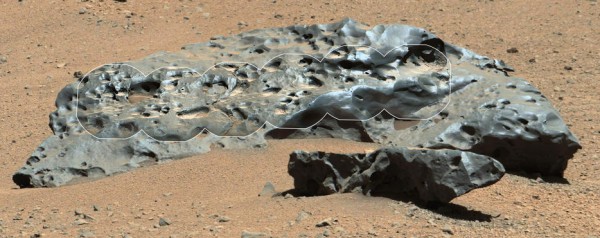
In related news, Curiosity has stumbled upon a six foot wide meteorite sitting on the surface of Mars.
A skydiver’s helmet cam videotapes a meteorite zipping past him as it falls.
The incident happened back in the summer of 2012, when skydiver Anders Helstrup and other members of the Oslo Parachute Club took to the skies above Hedmark, Norway. Helstrup documented the jump with two cameras fixed to the front and back of his helmet. Helstrup tells NRK (the largest media outlet in Norway) that on the way down he felt “something” happen, but didn’t know what. It was only after landing and reviewing his camera footage that he discovered something shocking: a rock had fallen from the heavens and missed him by just a few yards.
Video below the fold. The news woman is annoying, but the footage is quite cool.
» Read more
The accumulated evidence from the Chelyabinsk meteorite now suggests the risk of large asteroid impacts might be ten times greater than previously estimated.
The Chelyabinsk asteroid had approached Earth from a region of the sky that is inaccessible to ground-based telescopes. In the 6 weeks before the impact, it would have been visible above the horizon only during the daytime, when the sky is too bright to see objects of its size, says Borovička.
“The residual impact risk — from asteroids with yet-unknown orbits — is shifting to small-sized objects,” says Peter Brown, a planetary scientist at the University of Western Ontario in London, Canada, and an author on the Nature papers.
Of the millions of estimated near-Earth asteroids 10–20 metres in diameter, only about 500 have been catalogued. Models suggest that an object the size of the Chelyabinsk asteroid hits Earth once every 150 years on average, Brown says. But the number of observed impacts exceeding 1 kiloton of TNT over the past 20 years alone hints at an actual impact risk that may be an order of magnitude larger than previously assumed,
The data also now suggests that the Chelyabinsk asteroid was twice as big as previously thought, and that it had an almost identical orbit to a much larger already known asteroid.
Divers have pulled fragments from the February 15 Chelyabinsk meteorite impact out of nearby Chebarkul Lake.
Posted from Gaitlinburg, Tennessee, the Coney Island of the Smoky Mountains. The drive today was sadly a lot longer than planned, as we hit bad traffic in Nashville.
The uncertainty of science: Is this meteorite from Mercury? Some scientists now say no.
Was a meteorite found in Africa in 2012 originally from Mercury?
The search to find and understand the Chelyabinsk meteorite.
The meteorite that landed in Russia on February 15 has now been traced to the Apollo family of near Earth asteroids.
Russian scientists have identified the first fragments from Friday’s meteorite in Chelyabinsk.
The pieces, found on the ice of a lake, were stony chondrites.
More on today’s Russian meteorite: Largest in a century.
My earlier skepticism appears incorrect. This impact actually happened.
Note the article’s sense of outrage and panic that we aren’t looking for these types of rocks:
Although a network of telescopes watches for asteroids that might strike Earth, it is geared towards spotting larger objects — between 100 metres and a kilometre in size. “Objects like that are nearly impossible to see until a day or two before impact,” says Timothy Spahr, Director of the Minor Planet Center in Cambridge, Massachusetts, which tracks asteroids and small bodies. So far as he knows, he says, his centre also failed to spot the approaching rock.
Yet, today’s impact actually illustrates the wisdom of excluding this kind of small asteroid from searches. They aren’t big enough to do serious harm, and trying to find them would hamper searches for larger asteroids that do pose a serious risk.
An meteorite that crashed in the Sierra Nevada mountains in April was traveling at the fastest speed on record for an meteorite, almost 18 miles per second.
Meteorite hunters in Poland have found Eastern Europe’s larges meteorite, weighing almost 700 pounds.
The uncertainty of science: Meteorite experts now think the rock that hit a pastor’s house could be a piece from last week’s San Francisco fireball.
At first they said, “Yes it was from space,” then they said “No it is not from space.” Now they think yes.
False alarm: The rock found on Sunday is not part of the meteor that fell over San Francisco last week.
The first piece of a meteor that fell over San Francisco on Wednesday has been found.
The 2.2-ounce meteorite hit the roof of Rev. Kent and Lisa Webber on St. Francis Avenue on Thursday night, but they didn’t realize at the time what it was, according to Novato Patch.
Scientists studying a meteorite thought to come from the asteroid Vesta have concluded that it contains evidence that the asteroid once had a magnetic field.
This appears to be a very tentative finding, intriguing and possible, but not yet strongly proven.
Own of piece of the Moon: A four pound meteorite originally from the Moon is up for auction and is expected to sell for more than that $340K.