
Indian’s private rocket startup Skyroot completes a perfect first launch
Click for source.
In a spectacular success, the Indian private rocket startup Skyroot today completed the first launch of its smallsat rocket Vikram-1, placing several payloads into orbit.
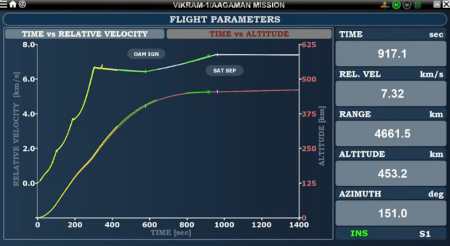
The graphic to the right shows the rocket’s flight path from the ground to orbit, overlaid over its nominal planned flight path. The match is precise. During the launch everything worked exactly as intended, an achievement on a first launch almost no rocket company has ever accomplished, including SpaceX.
During the broadcast there were several things I noticed that were of interest. First, Skyroot launched from India’s government spaceport at Sriharikota, operated by the country’s space agency ISRO. During normal ISRO launches the control room is filled with more than a hundred controllers, packed tightly in several rows. For this private launch, however, that control room appeared to have less than third of those numbers, many of which I suspect were ISRO employees tasked with monitoring the launch to protect the agency’s assets. Those controllers who appeared part of Skyroot’s team, in the front row, were few.
Second, in the viewing gallery at the back were several important ISRO managers, including the head of the agency. While everyone else around them cheered the success enthusiastically, they sat quiet, with some having very dour expressions. This could have simply been an effort at professionalism, but I suspect it also had an element of resentment and fear. Skyroot’s launch today of a smallsat private rocket is something ISRO has not been able to do for almost two years. The agency’s PSLV rocket has failed at launch twice in a row, and remains grounded.
In fact, right now Skyroot’s one launch is the only Indian launch of the year.
Moreover, Skyroot represents the future, and ISRO the past. The Modi government has been pushing hard to transition from the present government model, where ISRO owns, runs, and controls the entire Indian space program, to the capitalism model, where the private sector does it, and the government is merely the customer. ISRO has been somewhat resistant to this change, slow-walking many Modi directives.
This success signals the beginning of a new era in India, one in which private enterprise, competition, and freedom fuel innovation and success. It also signals an era where ISRO will become less powerful and important. Those ISRO managers know this, and some clearly didn’t like the prospect.
The leader board for the 2026 launch race remains unchanged.
86 SpaceX
45 China
10 Rocket Lab (plus two suborbital HASTE launches)
9 Russia
For the third straight year SpaceX leads the entire world combined in total launches, 86 to 79.

On Christmas Eve 1968 three Americans became the first humans to visit another world. What they did to celebrate was unexpected and profound, and will be remembered throughout all human history. Genesis: the Story of Apollo 8, Robert Zimmerman's classic history of humanity's first journey to another world, tells that story, and it is now available as both an ebook and an audiobook, both with a foreword by Valerie Anders and a new introduction by Robert Zimmerman.
The print edition can be purchased at Amazon or from any other book seller. If you want an autographed copy the price is $60 for the hardback and $45 for the paperback, plus $8 shipping for each. Go here for purchasing details. The ebook is available everywhere for $5.99 (before discount) at amazon, or direct from my ebook publisher, ebookit. If you buy it from ebookit you don't support the big tech companies and the author gets a bigger cut much sooner.
The audiobook is also available at all these vendors, and is also free with a 30-day trial membership to Audible.
"Not simply about one mission, [Genesis] is also the history of America's quest for the moon... Zimmerman has done a masterful job of tying disparate events together into a solid account of one of America's greatest human triumphs."--San Antonio Express-News