
Yutu might still live!
It appears that last week”s news of the death of China’s first lunar rover, Yutu, were premature. The rover is actually only in hibernation, and might come back to life next month, with limited capabilities.
It appears that last week”s news of the death of China’s first lunar rover, Yutu, were premature. The rover is actually only in hibernation, and might come back to life next month, with limited capabilities.
The competition heats up? According to one North Korean official, that country’s goal in space is to put a spacecraft on the Moon sometime in the next five years.
I actually believe this official. Their dear leader has demanded this, and they are sincerely trying to do it. Since they have had enormous trouble simply launching short range ballistic missiles, I have serious doubts they will make it happen, at least within five years.
China’s first lunar rover, Yutu (Jade Rabbit in English) has finally ceased operations after 31 months.
The rover stalled shortly after it moved away from its lander, Chang’e 3, but its instruments were still able to gather data, and they did so for about 10 times longer than originally planned.
The competition heats up: Moon Express, one of the leading private competitors in the Google Lunar X-Prize, has gotten FAA approval for its planned 2017 Moon landing.
It is looking like 2017-2018 will be very exciting years for private space. We will not only see the first launches of privately-built manned spacecraft, we will see the first privately-built and -funded missions to both the Moon and Mars.
The uncertainty of science: After more than 2 1/2 years on the lunar surface China’s Chang’e 3 lunar lander has detected no water at its landing site.
This result, while not in direct conflict with the orbital data from India’s Chandrayaan-1, suggests that the question of water on the Moon is a very complex one. Chandrayaan-1 detected evidence that suggested their might be deposits of water in certain surface regions, locked up in the regolith. Chang’e 3 found no water at its specific location. The two results do not have to conflict, but the latter does raise the uncertainty of Chandrayaan-1’s detection.
The competition heats up? Russia has announced plans to build a 12-person lunar base by 2030.
Color me skeptical. Since the late 1990s I have been reading these stories about ambitious Russian space plans, none of which has ever happened. In fact, they all remind me of the dozens of ambitious space plans announced by NASA over the years, none of which ever happened either. Typical of big government projects, they end up on the scrapeheap because government can’t do things quickly or efficiently.
The competition heats up: China announced plans today to send its next lunar lander, Chang’e 4, to the Moon’s farside south pole in 2018.
The lander of Chang’e-4 will be equipped with descent and terrain cameras, and the rover will be equipped with a panoramic camera, he said. Like China’s first lunar rover Yutu, or Jade Rabbit, carried by Chang’e-3, the rover of Chang’e-4 will carry subsurface penetrating radar to detect the near surface structure of the moon, and an infrared spectrometer to analyze the chemical composition of lunar samples.
But unlike Chang’e-3, the new lander will be equipped with an important scientific payload especially designed for the far side of the moon: a low-frequency radio spectrometer. “Since the far side of the moon is shielded from electromagnetic interference from the Earth, it’s an ideal place to research the space environment and solar bursts, and the probe can ‘listen’ to the deeper reaches of the cosmos,” Liu said.
The U.S. had been in the lead in the land rush to gain dominance in the possibly water-rich lunar south pole. We apparently have lost this lead with decision of President Obama and Congress to focus elsewhere, either the asteroids or Mars.
The competition heats up: The next Chinese lunar probe will be an unmanned sample return mission
They hope to fly it in the second half of 2017.
Edgar Mitchell, 85, one of only twelve humans to ever walk on another planet, passed away today after a short illness.
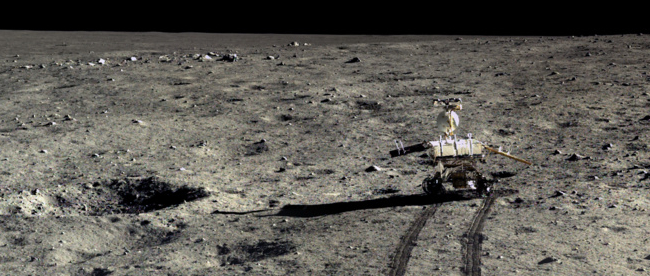
China has made available a new batch of very cool images taken by its Chang’e 3 lander and Yutu rover, and Emily Lakdawalla at the Planetary Society has figured out how to view them.
In a recent guest blog post, Quanzhi Ye pointed to the Chinese version of the Planetary Data System, and shared the great news that Chang’e 3 lander data are now public. The website is a little bit difficult to use, but last week I managed to download all of the data from two of the cameras — a total of 35 Gigabytes of data! — and I’ve spent the subsequent week figuring out what’s there and how to handle it.
So, space fans, without further ado, here, for the first time in a format easily accessible to the public, are hundreds and hundreds of science-quality images from the Chang’e 3 lander and Yutu rover. I don’t usually host entire data sets (PDS-formatted and all) but I made an exception in this case because the Chinese website is a bit challenging to use.
The image above is a cropped version of Yutu, taken by the lander. Be sure and go to the link to see the full image as well as others.
The competition heats up: China has announced plans to land the first probe on the far side of the Moon.
They are aiming for a launch two years hence. No word on how they plan to communicate with the lander, as direct communications will not be possible.
A research team at JPL has concluded that the unidentified piece of space junk that had been in lunar space but crashed to Earth in November was likely the engine module used by the 1998 Lunar Prospector mission.
The junk’s identity is by no means certain, but the “leading candidate” is the translunar injection module of Lunar Prospector, says Paul Chodas, an asteroid tracker at NASA’s Jet Propulsion Laboratory in Pasadena, California. The module nudged the probe out of Earth orbit and then detached from the main spacecraft, which orbited the Moon for 19 months before it was deliberately slammed into the lunar south pole in July 1999.
Speculation about the source of the debris, known as WT1190F, ran rampant even before it plummeted through the atmosphere on 13 November. The only artificial object to make an uncontrolled re-entry at a precisely predicted place and moment, it presented a unique chance to witness such an event in real time. Researchers took advantage of the opportunity, monitoring the debris from a chartered jet as well as from ground-based observatories.