
Frost on the Moon?

A new analysis of Lunar Reconnaissance Orbiter data suggests that the coldest spots at the Moon’s south pole are also its brightest, even though they are generally in shadow, suggesting that the surface there might have a thin layer of water frost.

These are also the areas where hydrogen has been detected, which strengthens the theory that this is water.

However, the result is not a positive one for future colonists as it suggests that the amount of water on the Moon is far less than hoped. First, there is this:

The icy deposits appear to be patchy and thin, and it’s possible that they are mixed in with the surface layer of soil, dust and small rocks called the regolith. The researchers say they are not seeing expanses of ice similar to a frozen pond or skating rink. Instead, they are seeing signs of surface frost.

Second, they have not detected this same pattern at the north pole, which strongly suggests that the permanently shadowed areas there do not even have frost.

Overall, this result suggests that the Moon might have water on its surface, but not in great quantities.
3 comments

LRO hit by meteoriod in 2014

LRO as it was hit by a meteor

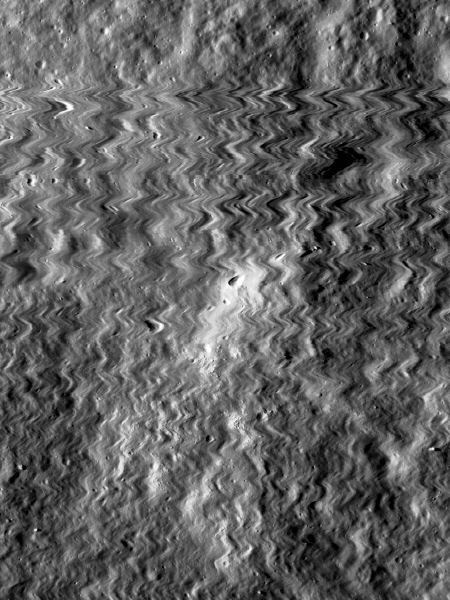
While taking an image in October 2014, Lunar Reconnaissance Orbiter had apparently been hit by some small object, causing it to vibrate and create the zig-zag distortions seen on the image, a cropped section of which is shown on the right.

Clearly there was a brief violent movement of the left NAC [Narrow Angle Camera]. The only logical explanation is that the NAC was hit by a meteoroid! How big was the meteoroid, and where did it hit? The physical properties and vibration modes of the NAC are very well known – during development a detailed computer model was made to ensure the NAC would not fail during the vibrations caused by the launch, which are severe. The computer model was tested before launch by attaching the NAC to a vibration table that simulates launch. The model was solid, both NACs survived the test, and launch.

Most of each NAC is sequestered inside the spacecraft structure, so only the leading edge of the baffle and the radiator are exposed to space, and thus are potential targets for impactors. From the detailed computer model, the LROC team ran simulations to see if we could reproduce the distortions seen the image. Assuming an impact velocity of 7 kilometers per second and a density 2.7 g/cm3, an impacting particle would have been 0.8 mm in diameter (~half the size of a pinhead). If the velocity was faster, then the particle would have been smaller, and if slower then larger.

For comparison, the muzzle velocity of a bullet fired from a rifle is typically 0.5 to 1.0 kilometers per second. So the meteoroid was traveling much faster than a speeding bullet. In this case LROC did not dodge a speeding bullet, but rather survived a speeding bullet!

The image is fascinating because you can see the vibrations slowly disappear as the zig-zags shrink and fade.

14 comments

3D printing of bricks, using moondust

European engineers have managed to print bricks using simulated moondust and focused sunlight.

The resulting bricks have the equivalent strength of gypsum, and are set to undergo detailed mechanical testing. Some bricks show some warping at the edges, Advenit adds, because their edges cool faster than the centre: “We’re looking how to manage this effect, perhaps by occasionally accelerating the printing speed so that less heat accumulates within the brick. But for now this project is a proof of concept, showing that such a lunar construction method is indeed feasible.”

The video at the link is very unconvincing. While it shows film of the printing process, it does not show film of anyone holding or manipulating the finished bricks. Instead, it shows one or two photos of finished bricks, all of which give the impression that these bricks crumble easily at the edges, I suspect that the bricks are simply too fragile for practical use.

So, is this a proof of concept? Maybe. They have at least shown that 3D printing using materials on the Moon might work.

24 comments

NASA looks to private companies for lunar missions

Capitalism in space: NASA has issued a request for information on possible private commercial missions capable of carrying NASA payloads to the Moon.

From the announcement:

NASA has identified a variety of exploration, science, and technology demonstration objectives that could be addressed by sending instruments, experiments, or other payloads to the lunar surface. To address these objectives as cost-effectively as possible, NASA may procure payloads and related commercial payload delivery services to the Moon

In other words, NASA has money to spend on lunar science missions, and rather than plan those missions itself, as it has done since the 1960s, it is now offering to buy and launch proposals from private companies.

2 comments

Court allows lawsuit against NASA agent who detained elderly couple

A court has ruled that an elderly couple can sue NASA and the agent that detained them for possessing a tiny Moon rock that had been given to the woman’s deceased previous husband for his work at NASA in the 1960s.

The U.S. 9th Circuit Court of Appeals said Joann Davis, the widow of an engineer who worked with NASA, was entitled to show that her detention was “unreasonably prolonged and unnecessarily degrading.”

The federal agent “organized a sting operation involving six armed officers to forcibly seize a Lucite paperweight containing a moon rock the size of a rice grain from an elderly grandmother,” Chief 9th Circuit Judge Sidney R. Thomas wrote for a three-judge panel.

Read the whole story. It is another example of NASA overreach in its false believe that owns all moon rocks from the Apollo missions, even those that had been given away during that time. I hope this woman bankrupts the agent for what he did. I also hope she sues NASA as well, as their policy is wrong.

2 comments

Sweden delivers science instrument for Chinese lunar probe

The new colonial movement: The Swedish Institute of Physics has completed construction and delivered a science instrument to be flown on China’s Chang’e 4 spacecraft that will bring an orbiter, lander, and rover to the Moon’s far side in 2018.

The instrument will be installed on the rover, and will study the surface and how it interacts with the solar wind. This will also be a continuation of research performed by India’s Chandayaan-1 orbiter.

1 comment

Blue Origin proposes unmanned lunar mission

The competition heats up: Blue Origin has proposed building for NASA an unmanned lunar mission to visit Shackleton Crater at the Moon’s south pole by 2020.

The Post says the company’s seven-page proposal, dated Jan. 4, has been circulating among NASA’s leadership and President Donald Trump’s transition team. It’s only one of several proposals aimed at turning the focus of exploration beyond Earth orbit to the moon and its environs during Trump’s term.

As described by the Post, the proposal seeks NASA’s support for sending a “Blue Moon” lander to Shackleton Crater near the moon’s south pole. The lander would be designed to carry up to 10,000 pounds of payload. It could be launched by Blue Origin’s New Glenn rocket, which is currently under development, or by other vehicles including NASA’s Space Launch System or United Launch Alliance’s Atlas 5. [emphasis mine]

The important take-away from this story is not the proposal to go to the Moon, but the proposal, as highlighted, that other rockets could do it instead of SLS. Though the proposal includes SLS as a possible launch vehicle, NASA’s giant rocket simply won’t be ready by 2020. That New Glenn might be illustrates again how much better private space does things, as this rocket is only now beginning development. If it is ready by 2020, which is what Blue Origin has been promising, it will have taken the company only about four years to build it, one fourth the time it is taking NASA to build SLS.

0 comments

Bigelow advocates his space stations for lunar missions

The competition heats up: Robert Bigelow today advocated using his privately built inflatable space station modules as a tool for launching future American lunar missions.

Bigelow’s company is eager to put a space station depot in lunar orbit, from which such activities and others can be initiated, as well as support onboard research. “We do not have the technologies, and there is zero business case for Mars. We do have a business case for the moon. And that’s why the moon absolutely makes the best sense,” Bigelow said. “And we can do the lunar activities far sooner than we can with Mars, which stretches out to, NASA’s views are Mars may be in the 2040s.”

His “New Space” company, Bigelow Aerospace of Las Vegas, designs space habitats, including a fully self-contained space station with 330 cubic meters of living and working space, which he said is ready for a lower-Earth orbit or, in about three years given the expected advancements in rocketry, for lunar orbit.

The key statement above is the comparison between lunar missions and Mars missions, at this time. The Moon has the chance to be profitable in the near future. Mars does not. If you had money to invest (even if it is taxpayer dollars) which would you invest it in?

2 comments

NASA considers putting astronauts on first SLS/Orion flight

Faced with indications that Trump wants a manned lunar mission during his first term, NASA’s acting administrator has asked his engineers and management to look into the possibility of putting humans on the first SLS/Orion launch, now set for late in 2018.

As the Acting Administrator, my perspective is that we are on the verge of even greater discoveries. President Trump said in his inaugural address that we will “unlock the mysteries of space.” Accordingly, it is imperative to the mission of this agency that we are successful in safely and effectively executing both the SLS and Orion programs.

Related to that, I have asked Bill Gerstenmaier to initiate a study to assess the feasibility of adding a crew to Exploration Mission-1, the first integrated flight of SLS and Orion. I know the challenges associated with such a proposition, like reviewing the technical feasibility, additional resources needed, and clearly the extra work would require a different launch date. That said, I also want to hear about the opportunities it could present to accelerate the effort of the first crewed flight and what it would take to accomplish that first step of pushing humans farther into space. The SLS and ORION missions, coupled with those promised from record levels of private investment in space, will help put NASA and America in a position to unlock those mysteries and to ensure this nation’s world pre-eminence in exploring the cosmos.

This is incredibly stupid. That first flight will be the very first time SLS will fly. It will also be flying with an upper stage engine that has also never flown before. It will take the Orion capsule to the Moon, when the capsule itself has not yet even done one orbit around the Earth. To put people on it makes no engineering sense at all.

22 comments

Gene Cernan, 82, has passed away

Gene Cernan, the last Apollo astronaut to walk on the Moon, passed away today.

His words as he stepped off the lunar surface still resonate to me.

This is Gene, and I’m on the surface; and, as I take man’s last step from the surface, back home for some time to come – but we believe not too long into the future – I’d like to just (say) what I believe history will record: that America’s challenge of today has forged man’s destiny of tomorrow. And, as we leave the Moon at Taurus–Littrow, we leave as we came and, God willing, as we shall return, with peace and hope for all mankind. Godspeed the crew of Apollo 17.

At the time, I firmly believed that we would return relatively soon. It has now been almost a half century, and no human since has left Earth orbit.

5 comments

Moon Express completes funding for Google X-Prize lunar mission

The competition heats up: Moon Express, one of the five remaining contestants vying for the Google Lunar X-Prize, announced today that it has raised an additional $20 million to complete the necessary funding needed to complete its mission.

The new round brings the total Moon Express has raised to $45 million. Richards said the company is looking to raise an additional $10 million as a “contingency” and to support future missions. “This is not a stunt,” he said. “We’re not putting all our eggs in one basket.”

The company is developing a small lunar lander called the MX-1E. The spacecraft is designed to land on the moon and then “hop” to another landing site, fulfilling the requirement of the Google Lunar X Prize to travel at least 500 meters across the surface after landing. That initial mission will carry scientific and commercial payloads from several customers. Richards said Moon Express is currently focusing on the spacecraft’s key technology, its propulsion system. The company previously tested that propulsion technology in tests at NASA’s Kennedy Space Center, but Richards said the company is making changes to improve its performance.

That additional performance is needed since the spacecraft will launch on Electron, a small launch vehicle being developed by U.S.-New Zealand company Rocket Lab, which can only take the lander into low Earth orbit. Earlier mission concepts called for launching on a larger vehicle that could place the spacecraft into a geostationary transfer orbit. “We need that extra punch from our own engine in order to get to the moon,” Richards said.

The article provides one more tidbit, this time about Rocket Lab and its Electron rocket:

The company’s current schedule calls for integrating the spacecraft in July, and then shipping it to Rocket Lab’s New Zealand launch site in October. The launch, scheduled for late this year, will be the seventh or eighth operational flight of the Electron, Richards said, shortly after a NASA mission under a Venture Class Launch Services contract Rocket Lab received in late 2015.

Although Rocket Lab has yet to launch an Electron — its first test flight is scheduled for no earlier than February — Richards believed the company would be ready in time for Moon Express, which faces a deadline of the end of this year to win the $20 million Google Lunar X Prize before the prize expires. [emphasis mine]

In other words, if things go as planned, Rocket Lab will launch Electron in February, and then do about one launch per month before it launches Moon Express. That will be an impressive start for the new rocket company, should they succeed in doing it.

3 comments

The Earth and Moon, as seen from Mars

The Earth and Moon as seen from Mars

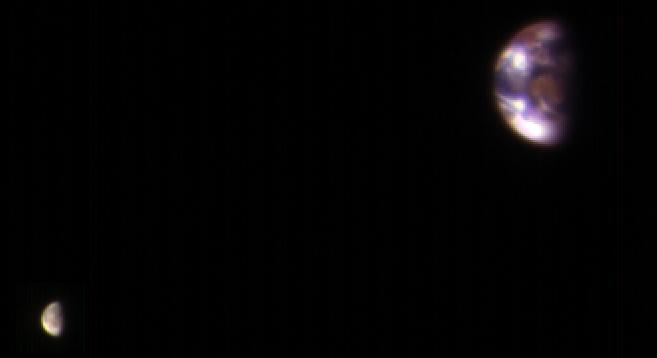
Cool image time! The image above, a composite of four separate Mars Reconnaissance Orbiter pictures, was taken on November 20, 2016.

Each was separately processed prior to combining them so that the moon is bright enough to see. The moon is much darker than Earth and would barely be visible at the same brightness scale as Earth. The combined view retains the correct sizes and positions of the two bodies relative to each other.

The reddish region on Earth is Australia, with Antarctica the bright white area below that.

9 comments
1 68 69 70 71 72 94