29 Teams, One Purchased Ride, and One Mystery for The Google Lunar X Prize
29 teams, one purchased ride, and one mystery for the Google Lunar X Prize.
29 teams, one purchased ride, and one mystery for the Google Lunar X Prize.
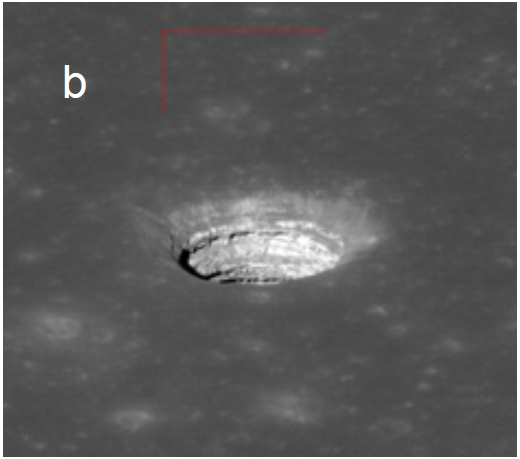
The discovery of new caves on the Moon keep coming. Today I have two new stories. The first is a discovery by professional scientists of a giant lava tube cave in the Oceanus Procellarum or Ocean of Storms. The second is the detection of a plethora of caves and sinks on the floor of the crater Copernicus, found by a NASA engineer who likes to explore the gobs of data being accumulated by Lunar Reconnaissance Orbiter and made available to all on the web.
The image below of the Moon’s near side, taken by India’s Cartosat-2A satellite and taken from the science paper, shows the location of lava tube in Oceanus Procellarum (indicated by the red dot) and the crater Copernicus.
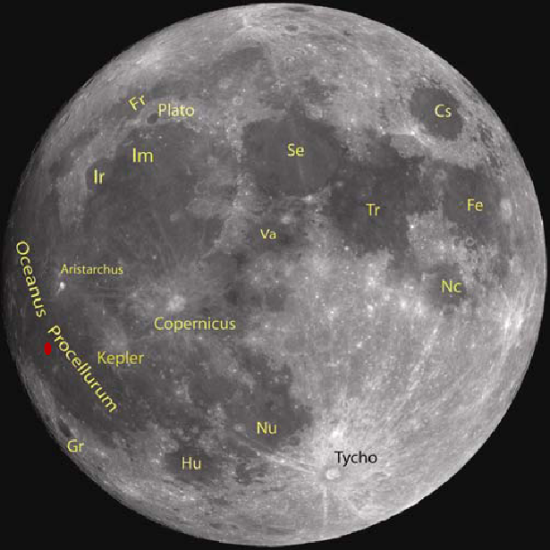
First the professional discovery. Yesterday, the Times of India reported the discovery of lava tube more than a mile long on the Moon. I did not post a link to the article because I didn’t think the news story provided enough information to make it worth passing along. Today however, fellow caver Mark Minton emailed me the link where the actual research paper could be downloaded [pdf]. This I find definitely worth describing.
» Read more
The Google Lunar X Prize has announced the final roster of teams competing for its $30 Million prize.
We need to find them! Trees from space, planted here on Earth. You can see the known list here.
More images of lunar cave pits have been posted by the scientists of Lunar Reconnaissance Orbiter (LRO). They have also published their first paper [pdf] about these cave pits for the 2011 Lunar and Planetary Science Conference taking place in March. The paper summarizes, with images, what is know about the three pits on the Moon that have each been imaged a number of times at different angles and lighting situations.
One of the competitor’s for the Google Lunar X prize has signed a contract with SpaceX to use the Falcon 9 to get its spacecraft to the Moon. Key quote:
The Falcon 9 upper stage will sling Astrobotic on a four-day cruise to the Moon. Astrobotic will then orbit the moon to align for landing. The spacecraft will land softly, precisely and safely using technologies pioneered by Carnegie Mellon University for guiding autonomous cars. The rover will explore for three months, operate continuously during the lunar days, and hibernate through the lunar nights. The lander will sustain payload operations with generous power and communications.
If you’re interested, seats are available for a tourist trip around the moon in a Soyuz capsule. And the Russians say the Soyuz is ready to go!
An Israeli team has entered the Google Lunar X Prize competition, hoping to land a nanosat on the moon for only $8 million.
Keith Cowing is trying to locate a missing spectacular blow-up poster of the Lunar Orbiter “Earthrise” image from 1966, shown here.