
Tag: Moon
Junk journalism
In a piece today at the Huffington Post, science journalist Seth Borenstein declares the wonders of NASA’s next mission: to send astronauts to an asteroid by 2025, as declared by President Obama.
If you believe this is going to happen, then I have a bridge I want to sell you. To do it we need a spaceship in which people can live for at least a year, and a rocket to get that ship into orbit. Not only do we not yet know how to build such a spaceship, we no longer have the capability of putting it into orbit. In case you’re unaware (Borenstein acts like he is), the space shuttle no longer exists. And under this administration and Congress, any replacement we get isn’t going to be able to launch such an interplanetary spaceship anywhere in the near future, especially faced as we are with the present federal debt.
The disgraceful thing about this article, however, is the lack of skepticism shown by Borenstein.
» Read more
Public test of privately built moon lander delayed by gyro
A public test of privately built moon lander has been delayed by gyro problem. Key quote:
One customer has already bought a ticket with Moon Express, asking them to deposit a small telescope on the dark side of the Moon. Jain says the company will also offer low cost ways for anyone to use the moon as a kind of time capsule. “If something goes to the moon it stays there forever, people will pay to sends things like photos, or maybe your hair or DNA.”
A flag in the dust
Bumped: I posted this essay last July 20th on the anniversary of the Apollo 11 landing on the moon. I think it is worth rereading again, even as the shuttle is about to return to Earth for the last time.
Today, July 20th, is the anniversary of the Apollo 11 landing on the Moon, the first time ever that a human being arrived on another planet. Americans love to celebrate this event, as it symbolizes one of the finest moments in our history, when we set out to achieve something truly great and noble and succeeded far better than we could have imagined. Not only did we get to the Moon as promised, over the next three and a half years we sent another five missions, each with increasingly sophisticated equipment, each sent to explore some increasingly alien terrain. Forty-plus years later, no one has come close to matching this achievement, a fact that emphasizes how difficult it was for the United States to accomplish it.
There is one small but very important detail about the Apollo 11 mission, however, that most Americans are unaware of. In mounting the American flag, the astronauts found the lunar surface much harder than expected. They had a great deal of trouble getting the flagpole into the ground. As Andrew Chaikin wrote in his book, A Man on the Moon, “For a moment it seemed the flag would fall over in front of a worldwide audience, but at last the men managed to steady it.” Then Armstrong took what has become one of the world’s iconic images, that of Buzz Aldrin standing on the lunar surface saluting the flag of the United States of America.
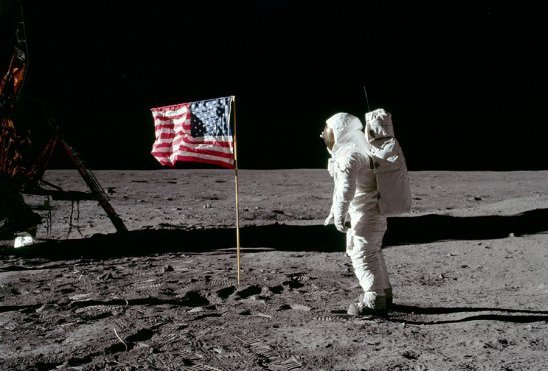
What people don’t know, however, is that when Armstrong and Aldrin blasted off from the lunar surface, the blast wave from the Lunar Module’s rocket knocked the flag over. As Chaikin also wrote, “Outside, a spray of gold foil and debris from the descent stage flew away in all directions. The flag toppled to the dust.”
Thus, for the last four decades this American flag, shown so proudly unfurled on the surface of the Moon, has actually been lying unceremoniously on the ground, in the lunar dust.
It might actually be possible to see this, though the photos at this time remain unclear and quite blurry.
» Read more
Hubble has discovered a fourth moon orbiting Pluto
Hubble has discovered a fourth moon orbiting Pluto.
Second ARTEMIS space probe about to enter lunar orbit
The second ARTEMIS space probe will enter lunar orbit on Sunday.
“With two spacecraft orbiting in opposite directions, we can acquire a full 3-D view of the structure of the magnetic fields near the moon and on the lunar surface,” said Vassilis Angelopoulos, principal investigator for the THEMIS and ARTEMIS missions and a professor of space physics at UCLA. “ARTEMIS will be doing totally new science, as well as reusing existing spacecraft to save a lot of taxpayer money.”
Confessions of a moon rock thief
Confessions of a moon rock thief.
And in a related story: Fish captain fights to keep long-missing moon rock.
Prime real estate
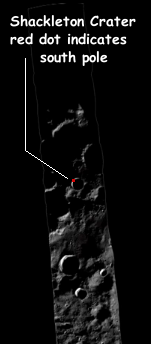
Since the 1990s, scientists have suspected that water-ice might be hidden in the forever-dark floors of the polar craters on the Moon. If so, these locations become valuable real estate, as they not only would provide future settlers water for drinking, the water itself can be processed to provide oxygen and fuel.
Moreover, the high points near these craters, including the crater rims, are hoped to be high enough so that the sun would never set or be blocked by other mountains as it made its circuit low along the horizon each day. If such a place existed, solar panels could be mounted there to generate electricity continuously, even during the long 14-day lunar night.
Below the fold is a six minute video, produced from images taken by Lunar Reconnaissance Orbiter (LRO) from February 6, 2010 to February 6, 2011, in an effort to find out if such a place actually exists. It shows how the sunlight hits the south pole across an entire year.
» Read more
Mining the moon for water and nuclear fuel
Mining the moon for water and fuel.
Texas-based Shackleton Energy Company has already begun operations aimed at mining the Moon within the next few years. The company’s plans for mining and refining operations would involve melting the ice and purifying the water, converting the water into gaseous hydrogen and oxygen, and then condensing the gases into liquid hydrogen, liquid oxygen and hydrogen peroxide, all potential rocket fuels.
Shackleton CEO Dale Tietz says the water extracted would be used almost exclusively as rocket fuel to power operations both within Low Earth Orbit (LEO) – such as space tourism and the removal of space-debris – on the Moon, and further out into space. ‘We are a for-profit business enterprise moving forward, and so we are only going there really for one reason and that is to mine, prospect mine and harvest water for rocket propellant production,’ says Tietz.
First ARTEMIS Spacecraft Successfully Enters Lunar Orbit
The first of two ARTEMIS spacecraft has successfully entered lunar orbit.
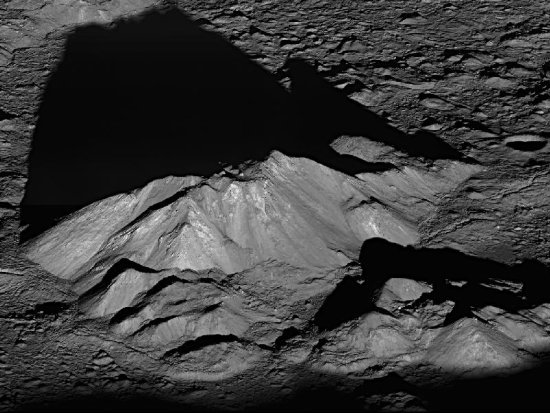
Breathtaking view of the central peak of Tycho Crater
Another astonishing space photograph, this time from lunar orbit, taken by Lunar Reconnaissance Orbiter on June 11, 2011.
The image looks down at the central peak of Tycho crater, with enough detail to make out individual boulders at the summit. Go the link to see some closeups.
China’s lunar probe leaves lunar orbit
China’s second lunar probe, Chang’e 2, has been boosted out of lunar orbit and beyond.