
The recovery of the Lunar Orbiter images from the 1960s
The early Lunar Orbiter images, taken in the mid-1960s, have been reprocessed and recovered, in a spectacular manner.
The early Lunar Orbiter images, taken in the mid-1960s, have been reprocessed and recovered, in a spectacular manner.
Using old Apollo data, scientists have detected the Moon’s molten core.
Amateur astronomer Thierry Legault traveled to Oman to not only photograph the Moon as it eclipsed the Sun on January 4, but also capture the International Space Station at the same moment. The image he took of both as they crossed in front of the Sun is amazing.
An evening pause: The Christmas eve telecast by the Apollo 8 astronauts from lunar orbit, December 24, 1968, probably the most listened to space telecast in history. The story behind how and why these men said what they did is the central theme of my first book, Genesis, the Story of Apollo 8.
Last night’s lunar eclipse, as photographed by Jeff Bliss in Pleasanton, California.
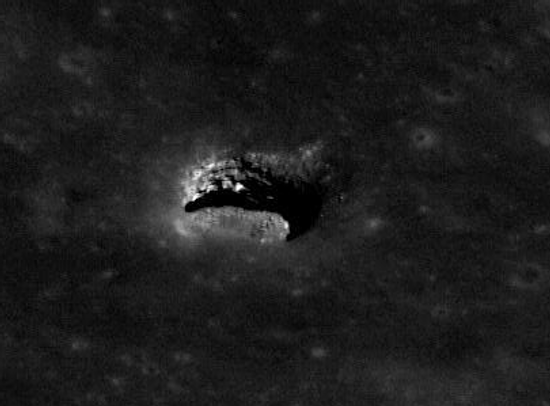
NASA engineer James Fincannon emailed me the image below, cropped from this Lunar Reconnaissance Orbiter scan. It shows a side view of the same lunar pit previously discussed by me in July (here and here).
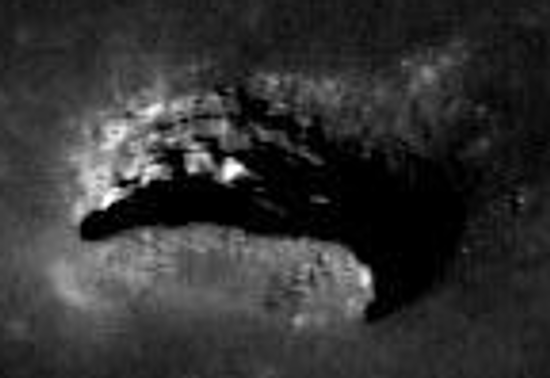
This image below was almost certainly ordered up by LRO scientists after seeing the images above so that they could get a look at the pit’s walls. I have further cropped it and blown it up so we can get a really good look too! See the second image below.
In this side view, we are looking across the top of the pit at the far wall and floor. On that far wall you can see what look like three coarse horizontal layers, below which is a deeply shadowed floor layer that is probably either cave passage or a significant overhang. Further processing will probably be bring out some further details and hopefully answer this question.
In a previous post, I had noted that this wall is probably about 200 feet deep. This new image thus gives any experienced rock-climber or caver a very nice sense of what a rappel down the side of that pit would be like. To me, it reminds me of some of the open-air cave pits I’ve rappelled into in New Mexico.
Update: I should note that that overhang/cave entrance at the bottom of the pit is probably at least 30 feet high. An impressive entrance, indeed.
Also, lunar scientist Paul Spudis emailed me with these comments:
[The pit] is very similar to some tube systems that I have studied in Hawaii. The wall units are exposed lava flows. They are probably all from the event which made this flow — a single flow can be made up of multiple flow units, hence, the apparent “layering.”
Of course, getting into an open pit and then moving through open void lava tubes that radiate from it are two different things. In terrestrial tube systems, many tubes are open and accessible but sometimes they are not. They can be blocked up by frozen lava or rubble from adjacent tube collapse.
Unfortunately, I don’t think we’re going to know what the situation on the Moon is until we get there. However, I must say, this particular area looks very promising.
The image below was produced by Lunar Reconnaissance Orbiter by assembling data from numerous images over six months. The levels of brightness and darkness indicate the percentage of time in which an area is sunlight. The red dot just below the rim of Shackleton shows the approximate location of the south pole.
As you can see, the rim of Shackleton Crater nearest the south pole is illuminated by the sun most of the time, while the nearby crater floor never gets sunlight. This data confirms what Japanese scientists found using their lunar probe, Kaguya. The south pole has the ideal combination of locations with nearly continuous bright sunlight (to provide power) and nearly continuous darkness (where explorers will likely find significant amounts of frozen water), making this is an excellent location to build that first lunar base. And from the image you can see that the Shackleton Crater rim is not the only spot near the south pole with these conditions.
Also, if you look at the close-up image of Shackleton’s rim that I posted here, you will see that there is plenty of room to land and set up residence.

A Croatian space mission to the Moon?
Videos from the Chinese lunar probe, Chang’e 2.
Take a look at these spectacular images China released from its Chang’e 2 lunar probe that they say show potential landing sites for later Chinese probes.
China today released the first photos taken by Chang’e 2, its second lunar orbiter launched on October 1. More here, including one image.