NASA to hire private lunar probes for future missions

Capitalism in space: Rather than build its own future lunar landers and rovers, NASA is now planning to hire these services from private companies, with missions flying as soon as 2021.

Under a program called Commercial Lunar Payload Services (CLPS), NASA would buy space aboard a couple of launches a year, starting in 2021. The effort is similar to an agency program that paid private space companies such as Elon Musk’s SpaceX to deliver cargo to the International Space Station (ISS). “This a new way of doing business,” says Sarah Noble, a planetary scientist at NASA headquarters in Washington, D.C., who is leading the science side of NASA’s lunar plans.

Scientists are lining up for a ride. “It really feels like the future of lunar exploration,” says Erica Jawin, a planetary scientist at the Smithsonian Institution’s National Museum of Natural History in Washington, D.C. She and other attendees at the annual meeting of the Lunar Exploration Analysis Group in Columbia, Maryland, last week were eager to show NASA why their small experiments would be worthy hitchhikers on the landers.

Several companies, including Astrobotic, Moon Express, and iSpace, are vying to establish a commercial moon market. Buying rides to the moon from launch providers like Rocket Lab, each firm hopes to become the go-to carrier for other companies seeking to prospect the moon for rocket fuel ingredients, or to gather rocks to sell for study. But a contract with NASA is the real prize. Moon Express, for example, has designed the MX-1, a lander roughly the size and shape of Star Wars’s R2-D2. But, “We won’t pull the trigger until we know we have a CLPS award,” says Moon Express CEO Robert Richards in Cape Canaveral, Florida.

The companies selected for CLPS must deliver at least 10 kilograms of payload by the end of 2021, NASA says. It is scrambling to find instruments that are ready to fly. “What do you have sitting on shelf now that you can throw onto the mission immediately?” Noble says. “We’re looking for flight spares, engineering models, student-built projects. It’s a little bit of a weird call for us.” The agency is planning to pay up to $36 million to adapt eight to 12 existing scientific instruments to the initial small landers; by the middle of next decade it aims to build a pipeline of instruments for bigger landers that might also carry rovers.

These are going to small missions with limited lifespans and limited abilities. They will however be cheap, fast, and many. In the end I am certain NASA (and the taxpayer) will get far more bang for the buck.

2 comments

NASA suggests retirement of SLS when BFR and New Glenn fly

Capitalism in space: During an interview at a November 1st conference, a NASA official mentioned that if SpaceX’s Big Falcon Rocket (BFR) and Blue Origin’s New Glenn begin flying successfully the agency will seriously consider retiring SLS.

“I think our view is that if those commercial capabilities come online, we will eventually retire the government system, and just move to a buying launch capacity on those [rockets],” Stephen Jurczyk, NASA’s associate administrator, told Business Insider at The Economist Space Summit on November 1.

However, NASA may soon find itself in a strange position, since the two private launch systems may beat SLS back to the moon – and one might be the first to send people to Mars.

I have been saying that this should happen since almost the first day this website was started in 2011. To quote from a September 14, 2011 post:

To be really blunt, this new rocket, like all its predecessors, will never fly either. It costs too much, will take too long to build, and will certainly be canceled by a future administration before it is finished. It is therefore a complete waste of money, and any Congress that approves it will demonstrate how utterly insincere they are about controlling spending.

It appears that I was wrong with this prediction on one count. SLS might actually fly a few times, but only to allow its supporters in Congress and NASA to justify that support. When the private rockets come on line in the early 2020s, cheaper, faster, and better designed (with re-usability), NASA and Congress will then finally say that these rockets are better and that SLS will die, and they will also both make believe they were saying that from the very beginning.

4 comments

Advisory panel to Space Council pans Gateway

The advisory panel to the Space Council gave NASA’s Gateway lunar orbiting platform low marks in a meeting in Washington yesterday.

NASA’s plan for returning to the Moon met with opposition today at a meeting of the National Space Council’s Users’ Advisory Group (UAG). Not only members of the UAG, but former NASA Administrator Mike Griffin, who was there as a guest speaker on other topics, offered his personal view that NASA is moving too slowly and the lunar orbiting Gateway is unnecessary.

Makes sense to me, especially based on the description of Gateway put forth by NASA at the meeting:

In the first part of the 2020s, NASA plans to launch series of very small and later mid-sized robotic landers and rovers, while at the same time building a small space station, currently called the Gateway, in lunar orbit. The Gateway is much smaller than the International Space Station (ISS) and would not be permanently occupied. Crews would be aboard only three months a year and eventually the Gateway would be a transit point for humans travelling between Earth and the lunar surface or Mars.

The presentation also said under this plan that Americans would not land on the Moon until 2028.

It is all fantasy. I guarantee if the government goes with Gateway it will not land on the Moon before 2035, and that is optimistic. Tied as it is to very expensive SLS and the government way of building anything, Gateway will likely see at least five years of delays, at a minimum. Remember also that the first manned launch of SLS is not expected now before 2024, and will likely have a launch cadence of less than one launch per year. How NASA expects to complete Gateway and then land on the Moon only four years later, using this rocket, seems very unrealistic to me.

This does not mean Americans won’t get to the Moon sooner however. I fully expect private enterprise to do it in less than a decade, and for far cheaper. Eventually the dunderheads in government will realize this, but we must give them time to realize it. Their brains work slowly.

5 comments

NASA approves Falcon 9 for all science missions

NASA today announced that it has certified SpaceX’s Falcon 9 rocket as qualified to launch all of its science missions.

With only one mission out of 61 flights of the Falcon 9 ending in failure, the rocket appears to have met the high standards NASA demands from all of the rockets it uses. Two of those successful missions include other flights under the LSP: Jason-3 and TESS.

With the addition of this latest notch on its belt, SpaceX is poised to conduct the most sensitive, in terms of cargo, flights that the agency has—those of astronauts to the International Space Station.

As noted in the quote, this certification makes it certain that NASA will allow its astronauts to fly on the Falcon 9, even if its own safety panel continues posing its bureaucratic demands.

0 comments

NASA completes final parachute test for 2020 Mars rover mission

NASA has completed the third and final parachute test for its as yet unnamed 2020 Mars rover mission.

Three separate test launches (one Oct. 9, 2017, April 20, 2018, and Sept. 7, 2018) determined which parachute design would be used for the Mars 2020 mission. In 2012, a similar parachute concept was used for the Curiosity rover mission.

For this test, NASA said the parachute, which was made of nylon, Kevlar and Technora fibers, was packed into a “small drum-sized bag” before being launched to an altitude of about 23 miles (37 kilometers) and a speed of about Mach 1.8. Then, within less than a half-second, the 180-pound parachute was deployed and fully inflated with a volume of “a large house.”

Though doing engineering tests to prove your concept always makes sense, didn’t NASA do this for Curiosity, which then proved its parachute concept further by actually landing on Mars successfully? The 2020 rover is supposed to be saving money by using the Curiosity design. Why were these tests necessary?

5 comments

Head of Webb investigation: Webb was “a step too far”

The head of an investigation panel into the James Webb Space Telescope admitted this week that, though he and the panel fully support the telescope’s completion and launch, he also believes the telescope was too ambitious and “a step too far.”

Speaking at a meeting of the Committee on Astronomy and Astrophysics of the National Academies’ Space Studies Board Oct. 29, Tom Young said that while the mission may ultimately be a success, its difficulties provide lessons as NASA considers future large astronomy missions in the next decadal survey.

“I, personally, have come to the conclusion that JWST had too many inventions, too much risk, and was a step too far,” he said at the end of a presentation about the review board’s work.

Young emphasized that he was neither opposed to JWST being completed nor had doubts it could be done successfully. “There are a group people who are diehard supporters of JWST, and there are others who support it, but they’re really angry at the cost growth and the schedule delays,” he said.

You think? Webb was supposed to cost about $500 million, and launch in 2007. Its budget is now almost $10 billion, and it will not launch before 2021. In the process it has destroyed the entire astronomy program at NASA, preventing the construction of any other space telescopes.

The key question is whether the astronomy community or NASA has learned anything from this disaster. I personally am doubtful, since they are still pushing for WFIRST, a similar big boondoggle that will cost billions and is already overbudget and behind schedule, though it is only in its design stage.

5 comments

Chandra goes into safe mode

When it rains it pours: The Chandra X-ray Observatory went into into safe mode on October 10 for reasons that are either not yet understood or have not yet been revealed.

Chandra, Spitzer, and Hubble are the three remaining of the original four great observatories proposed in the late 1980s, with the Compton Gamma-Ray Observatory the fourth. Compton was de-orbited in 2000. Spitzer’s infrared observational capabilities became limited when its cryogenic cooling gas became exhaused in 2009.

Hubble and now Chandra are both in safe mode, leaving astronomy badly crippled.

This situation is actually the fault of the astronomical community, which in the early 2000s put all its money behind the James Webb Space Telescope, leaving little for the construction of replacement space telescopes for either Hubble or Chandra. In addition, the astronomical community has continued to put is money behind similar big, expensive, and giant projects like Webb, pushing for WFIRST with its 2011 decadal survey. Like Webb, WFIRST will cost billions and take almost a decade to build and launch, assuming there are no delays.

Meanwhile, the workhorses in orbit are failing one by one.

2 comments

Update on Hubble: no real news

NASA today released an update on the effort to bring the Hubble Space Telescope out of safe mode and back to full operation.

The only new information they really provide is what they will do, depending on whether they can fix the back up gyroscope or not.

If the team is successful in solving the problem, Hubble will return to normal, three-gyro operations. If it is not, the spacecraft will be configured for one-gyro operations, which will still provide excellent science well into the 2020s, enabling it to work alongside the James Webb Space Telescope and continue groundbreaking science.

In other words, if they cannot find a way to get this third gyro functioning properly, they will shut down one of the two remaining working gyros so that it can operate as a backup, and operate the telescope on one gyroscope.

I find the last section of the quote above very amusing, in a dark sort of way. Not only does NASA rationalize the sad loss of Hubble’s ability to take sharp images, it tries to rationalize the decade-long delays it has experienced building the James Webb Space Telescope. Webb was supposed to have been launched in 2011. It should have been up there already, working alongside Hubble for the past seven years.

Now, the best we can hope for is that Webb will finally reach space while Hubble is still functioning, in a crippled condition. I would not be surprised however if Webb is further delayed, and Hubble is gone before it gets into space.

1 comment

Audit of SLS predicts more cost overruns and delays

Ever get a feeling of deja vu? A report by NASA’s inspector general yesterday slammed NASA and Boeing for their management of the SLS program, noting that the first unmanned launch will likely be delayed further and the cost for the program will go up another $4 billion.

The much-anticipated premiere of NASA’s Space Launch System rocket will likely see yet another push to the right, this time beyond mid-2020, as the program faces billions in cost overruns, according to a scathing audit released Wednesday by the agency’s Office of Inspector General.

Originally slated to launch from Kennedy Space Center’s pad 39B in December 2017, a 322-foot-tall version of the rocket known as SLS Block 1 will likely still be unprepared for a liftoff on the uncrewed Exploration Mission-1 by June 2020, auditors said. Even if teams could technically meet that deadline, NASA would need to offer Boeing, the contractor building the first two core stages, an infusion of $1.2 billion: $800 million to secure first stage delivery to KSC by December 2019 and an additional $400 million to make sure EM-1 launches by June 2020.

“Consequently, in light of the Project’s development delays, we have concluded NASA will be unable to meet its EM-1 launch window currently scheduled between December 2019 and June 2020,” a portion of the 50-page report reads.

The report [pdf] states that Boeing’s budget will have to double to $8 billion to meet these demands. In truth, SLS has cost the taxpayers a lot more than that, probably in the range in excess of $30 billion, if you add up all the yearly appropriations from Congress specifically applied to this rocket project and extend them through the first manned launch, now probably not taking place prior to 2024. (See my policy paper, Capitalism in Space, to see the breakdown.)

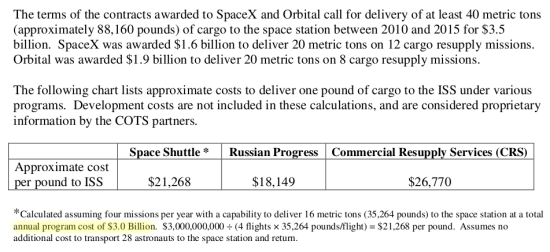
If this audit is correct, and I see no reason not to believe it, it will have taken the modern NASA more than twenty years to build and launch a single manned capsule, with a total cost of over $60 billion.

SpaceX built Falcon 1, Falcon 9, Falcon Heavy, Dragon cargo, and Dragon manned in about half that time, for a cost of about $2 billion. Falcon Heavy alone cost $500 million, and took only seven years.

From whom would you buy the product?

8 comments

NASA pushes upgrades to interim and final SLS upper stages

Because of increased funding to SLS from Congress, NASA is now pushing Boeing to do upgrades to the interim SLS upper stage as well as its final full power upper stage, dubbed the Exploration Upper Stage (EUS) and originally planned for most SLS missions.

Those changes were prompted by the decision NASA made earlier this year to delay the introduction of the EUS. That stage was originally planned to enter use with the second SLS mission, Exploration Mission (EM) 2. Instead, the first flight of what’s known as the Block 1B configuration of SLS has been delayed to the fourth SLS launch, likely no earlier than 2024.

“That has put a slow down on the Exploration Upper Stage work,” said (John Shannon, vice president and program manager for the Space Launch System at Boeing). “We were rapidly approaching the critical design review.”

NASA has asked Boeing to spend some time to try and “optimize” the EUS with the goal of increasing the amount of additional payload it can carry. Such co-manifested payloads, such as modules for NASA’s proposed lunar Gateway, would be carried on the SLS underneath the Orion spacecraft. (emphasis mine)

Shannon also made what might be the biggest understatement I have ever heard when asked about SLS’s endless delays, noting that “We underestimated that somewhat,” referring to the time it has taken to build the rocket.

NASA got Congress to give them extra money to allow more flights of the interim stage, since putting humans on EUS on its first flight was absurdly risky. This way they could also avoid further delays on that first SLS/Orion manned mission, now set for 2023, almost twenty years since it was first proposed. By pushing for more upgrades, they can also justify again stretching the program out longer, thus stretching out the pork without actually flying anything.

The contrast with SpaceX’s development of Falcon Heavy with NASA’s development of SLS continues to be striking. The former was conceived, built, and launched in less than ten years, for a cost of half a billion. The latter remains unflown and unready to fly after fourteen years of development, and likely will not fly for another six years plus. And its development cost will likely top $50 billion by that time.

If I was a customer looking to buy a product, I would laugh NASA out of the room if it tried to sell me its SLS rocket. Unfortunately, the critters in Congress aren’t that smart, and continue to pour money into this dead end project, money that could be much more effectively spent buying rockets from the private sector.

5 comments

NASA study says deep space will cause cancer and destroy stomachs

We’re all gonna die! A NASA study on rats using simulated space radiation suggests that long duration space missions beyond Earth orbit will cause cancer as well as significant harm to human intestines.

The study, published by cancer researchers at Georgetown University Medical Center, used mice to test exposure to heavy ion radiation, which mimics the galactic cosmic radiation found in deep space. If that sounds complicated, essentially researchers compared “space” radiation to X-ray radiation and found its effects to be much more dangerous.

After long exposures to a low dose of galactic radiation, mice had permanent damage to their gastrointestinal tracts and could no longer absorb nutrients in food. The mice also developed cancerous growths in their intestines — raising concerns that astronauts who venture far into space would face the same deadly health issues. “While short trips, like the times astronauts traveled to the moon, may not expose them to this level of damage, the real concern is lasting injury from a long trip,” said Kamal Datta, head of Georgetown’s NASA Specialized Center of Research, in a press release.

More here.

Must I point out the uncertainties and weaknesses of this study? They did the test on rats. They simulated the radiation. And it appears they simulated the radiation dosages assuming the spacecraft would have little or no shielding, an absurd approach.

Space is dangerous, but there is no reason to exaggerate the dangers wildly, unless you wish to generate fake reasons for additional funding, as NASA is prone to do.

4 comments

NASA signs agreement to work with SpaceIL’s privately built lunar rover

Capitalism in space: NASA, the Israeli space agency, and the private Israeli space company SpaceIL have signed a cooperative agreement to work together when SpaceIL’s privately built lunar rover is launched to the Moon in December.

NASA will contribute a laser retroreflector array to aid with ground tracking and Deep Space Network support to aid in mission communication. ISA and SpaceIL will share data with NASA from the SpaceIL lunar magnetometer installed aboard the spacecraft. The instrument, which was developed in collaboration with the Weizmann Institute of Science, will measure the magnetic field on and above the landing site. The data will be made publicly available through NASA’s Planetary Data System. In addition, NASA’s Lunar Reconnaissance Orbiter will attempt to take scientific measurements of the SpaceIL lander as it lands on the Moon.

This agreement is the first step in the transition from having the government build planetary probes to it becoming a customer, buying these probes from private companies that build them for profit.

0 comments
1 101 102 103 104 105 192