NASA changes its contract arranged for commercial space

Turf war: At conference yesterday at the Johnson Space Center, NASA proposed changing how it issues its commercial space contracts so as to give it more control over their design and construction. The commercial companies are not happy.

Brett Alexander, a space industry consultant who counts among his clients the secretive aerospace startup Blue Origin of Kent, Wash., said at the July 20 briefing that industry needs to know NASAโ€™s legal reasoning for dismissing SAAs as an option for the next CCDev round. โ€œFrom an industry standpoint โ€ฆ weโ€™re kind of flying blind because [NASA] has not divulged what its legal reasoning is, and I think they need to do that in writing. Not a couple charts, not things that you brief, but a legal brief that says โ€˜hereโ€™s whyโ€™โ€ a traditional procurement is necessary.

My own sources say this change in contractual approach will significantly slow development of the new commercial manned space rockets and ships, possibly beyond 2017.

The only reason I can see for NASA to do this is to maintain control over manned space, even if they are not building anything. I think NASA is instead going to find out that doing anything to slow this development will be politically very dangerous for them.

5 comments

The next Mars rover will land at Gale Crater

The next Mars rover will land at Gale Crater.

The car-sized Mars Science Laboratory, or Curiosity, is scheduled to launch late this year and land in August 2012. The target crater spans 96 miles (154 kilometers) in diameter and holds a mountain rising higher from the crater floor than Mount Rainier rises above Seattle. Gale is about the combined area of Connecticut and Rhode Island. Layering in the mound suggests it is the surviving remnant of an extensive sequence of deposits. The crater is named for Australian astronomer Walter F. Gale. . . . The portion of the crater where Curiosity will land has an alluvial fan likely formed by water-carried sediments. The layers at the base of the mountain contain clays and sulfates, both known to form in water.

More here, including images of landing site.

0 comments

Perry and other lawmakers blast Obama over shuttle retirement

Texas Governor Rick Perry, as well as other lawmakers from Congress, blasted Obama today over the shuttle retirement.

Bah. Perry claims to be a so-called small government conservative, yet he wants the government to spend a fortune to build and run the space program. Meanwhile, Senators John Cornyn (R-Texas) and Kate Bailey Hutchinson (R-Texas) were around in Congress when President George Bush announced the shuttle’s retirement seven years ago. Their effort since then to fund pork through NASA and thus have NASA build a giant new rocket system, either Constellation or its new Congressionally-designed replacement, has been a disaster. Right now it would be better, and far cheaper, if they stopped fighting the new commercial space companies and instead get behind them, especially since the Obama administration itself has done a very poor job of selling this new industry.

A little support from Congress could go a long way to not only reinvigorating the aerospace industry, it could speed our country’s return to manned space, with multiple competing companies.

3 comments

A flag in the dust

Bumped: I posted this essay last July 20th on the anniversary of the Apollo 11 landing on the moon. I think it is worth rereading again, even as the shuttle is about to return to Earth for the last time.

Today, July 20th, is the anniversary of the Apollo 11 landing on the Moon, the first time ever that a human being arrived on another planet. Americans love to celebrate this event, as it symbolizes one of the finest moments in our history, when we set out to achieve something truly great and noble and succeeded far better than we could have imagined. Not only did we get to the Moon as promised, over the next three and a half years we sent another five missions, each with increasingly sophisticated equipment, each sent to explore some increasingly alien terrain. Forty-plus years later, no one has come close to matching this achievement, a fact that emphasizes how difficult it was for the United States to accomplish it.

There is one small but very important detail about the Apollo 11 mission, however, that most Americans are unaware of. In mounting the American flag, the astronauts found the lunar surface much harder than expected. They had a great deal of trouble getting the flagpole into the ground. As Andrew Chaikin wrote in his book, A Man on the Moon, “For a moment it seemed the flag would fall over in front of a worldwide audience, but at last the men managed to steady it.” Then Armstrong took what has become one of the world’s iconic images, that of Buzz Aldrin standing on the lunar surface saluting the flag of the United States of America.
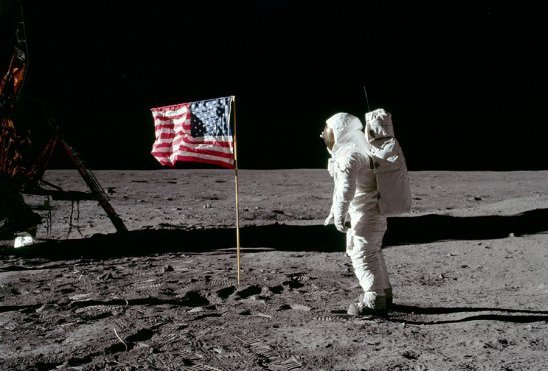
Aldrin saluting the flag

What people don’t know, however, is that when Armstrong and Aldrin blasted off from the lunar surface, the blast wave from the Lunar Module’s rocket knocked the flag over. As Chaikin also wrote, “Outside, a spray of gold foil and debris from the descent stage flew away in all directions. The flag toppled to the dust.”

Thus, for the last four decades this American flag, shown so proudly unfurled on the surface of the Moon, has actually been lying unceremoniously on the ground, in the lunar dust.

It might actually be possible to see this, though the photos at this time remain unclear and quite blurry.
» Read more

4 comments

The dying NASA astrophysics program

The dying NASA astrophysics program.

With support from President Barack Obama, the agency’s Earth science budget is at an all-time high. Over the next four months, the planetary science division is due to launch three major missions: to the Moon, to Mars and to Jupiter. And the heliophysics division plans to send a probe plunging into the blistering atmosphere of the Sun, closer than ever before. But because the overall NASA science budget is relatively flat, something had to give. Since 2008, astrophysics funding has plunged relative to other NASA science and relative to physics and astronomy funding at other agencies.

2 comments
1 163 164 165 166 167 192