
More delays for Blue Origin’s BE-4 rocket engine

Capitalism in space: According to a report yesterday at Ars Technica, more delays are expected in the delivery of Blue Origin’s BE-4 rocket engine to ULA, possibly preventing the first launch of Vulcan from occurring in ’22.

Testing suggests the engine itself is functioning well. However:

Blue Origin is unlikely to deliver two flight-ready versions of the BE-4 rocket engine to United Launch Alliance (ULA) before at least the second quarter of 2022, two sources say. This increases the possibility that the debut flight of ULA’s much-anticipated new rocket, Vulcan, could slip into 2023.

Vulcan’s first stage is powered by two BE-4 engines, which burn methane and are more powerful than the space shuttle’s main engines. The sources said there recently was a “relatively small” production issue with fabrication of the flight engines at Blue Origin’s factory in Kent, Washington. [emphasis mine]

Translation of the highlighted words: We have built the engine, it is working great, but we have suddenly discovered we haven’t figured out the mass production process for building it quickly and in large numbers so as to support numerous launches by both ULA’s Vulcan and Blue Origin’s New Glenn rockets.

ULA claims it can get Vulcan off the ground only a few months after getting those flightworthy BE-4 engines because it has done most of the design work using the dummy “pathfinder” BE-4 engines Blue Origin provided last year. Don’t believe it. The company is going to have to install working engines on Vulcan, and then do static fire tests to validate not only the rocket but its entire launch process. Such testing usually takes months, and is rarely completed in less than half a year, even by SpaceX.

These problems at Blue Origin means that both Vulcan and New Glenn will likely launch more three years behind schedule. Instead of 2020, both will fly no earlier than 2023, at best.
6 comments

BE-4 engine delayed until ’22

Capitalism in space: The CEO of ULA, Tory Bruno, admitted yesterday that the first production versions of Blue Origin’s BE-4 rocket engine, required for his company’s new Vulcan rocket, will not be delivered until until early ’22.

Bruno had previously said he expected the engines in late 2021 but on Friday he confirmed the BE-4s will not arrive until early 2022. “I was hoping to get those engines for Christmas. I had giant stockings at home waiting for them,” Bruno quipped in the CNBC interview.

“I’ll say it’s taking them a little longer to fabricate my production engines. They’re in the factory now being built at Blue Origin,” said Bruno. “The COVID epidemic has affected them and their supply chain and it’s just taking a little bit longer, but they’re doing very, very well,” he added. “There’s been no problems with them and in fact, we’re doing the final testing, or what we call certification testing. And that is just going really, really well.”

It appears that Blue Origin is dealing with the difficulties of production, not design, at this point, the same kind of issue that SpaceX recently revealed with its Raptor engine. Blue Origin needs to be able to manufacture these engines at a somewhat high pace, as both ULA’s Vulcan and Blue Origin’s New Glenn rocket use it. It appears that in designing it Blue Origin didn’t think about the manufacturing until very late in the game.

Bruno also said that he plans on flying Vulcan twice in ’22. We shall see.

12 comments

Amazon picks rocket startup ABL to launch 1st two prototype Kuiper satellites

Capitalism in space: Amazon has chosen the smallsat startup rocket company ABL to launch its first two prototype Kuiper satellites, with that launch targeted for ’22.

KuiperSat-1 and KuiperSat-2 will reach orbit via the RS1, a new rocket developed by California-based ABL Space Systems. Amazon also announced today that it has signed a multi-launch deal with ABL to provide these early Project Kuiper launches.

The 88-foot-tall (27 meters) RS1 is capable of launching 2,975 pounds (1,350 kilograms) of payload to LEO, according to its ABL specifications page. ABL is charging $12 million for each launch of the two-stage rocket. The RS1 has not flown yet, but ABL has said that it aims to conduct a debut launch from Alaska’s Pacific Spaceport Complex before the end of 2021.

Earlier this year, Amazon announced that it had signed a deal with United Launch Alliance (ULA), whose Atlas V rocket will loft operational Project Kuiper craft on nine different launches.

Does anyone notice what rocket company has not won these contracts, even though its owner is also Amazon’s founder and biggest shareholder? That’s right, as far as I can tell, Blue Origin’s New Glenn rocket has apparently not won any contracts to launch Amazon’s Kuiper satellites. Notice also that the deal with ULA uses its Atlas-5 rocket, not its new Vulcan rocket, even though ULA wants Vulcan to replace the Atlas-5 beginning in ’22.

Since both New Glenn and Vulcan depend on Blue Origin’s troubled BE-4 rocket engine, these contracts strongly suggest that the engine’s technical problems have not yet been solved, and that neither rocket will be flying in ’22 as both companies have promised.

14 comments

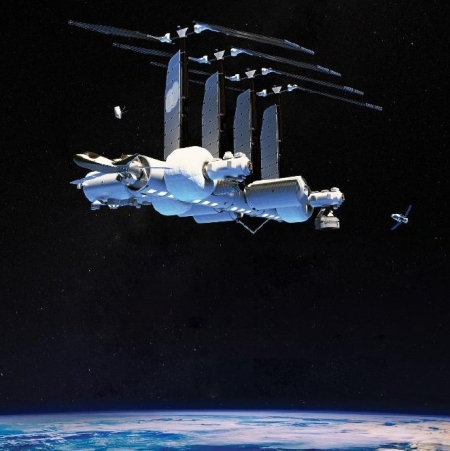
Sierra Space teams up with Blue Origin to build its Life space station

Proposed Orbital Reef space station

Capitalism in space: Sierra Space and Blue Origin today announced [pdf] that they are forming a consortium of space companies to build a space station they dub Orbital Reef. From the press release:

The Orbital Reef team of experts brings proven capabilities and new visions to provide key elements and services, including unique experience from building and operating the International Space Station:

  • Blue Origin – Utility systems, large-diameter core modules, and reusable heavy-lift New Glenn launch system.
  • Sierra Space – Large Integrated Flexible Environment (LIFE) module, node module, and runway-landing Dream Chaser spaceplane for crew and cargo transportation, capable of landing on runways worldwide.
  • Boeing – Science module, station operations, maintenance engineering, and Starliner crew spacecraft.
  • Redwire Space – Microgravity research, development, and manufacturing; payload operations and deployable structures.
  • Genesis Engineering Solutions – Single Person Spacecraft for routine operations and tourist excursions.
  • Arizona State University – Leads a global consortium of universities providing research advisory services and public outreach.

I suspect that this deal is actually telling us that Jeff Bezos is spreading some of his Blue Origin money to help finance Sierra Space’s work. The deal also appears to be an effort to generate work for Blue Origin’s not-yet-launched New Glenn rocket and Boeing’s not-yet launched Starliner capsule.

The release says nothing about target dates, but the overview [pdf] on the Orbital Reef website says they are aiming for the second half of this decade.

While the success of such a project can only increase the competition and lower the cost to orbit, thus making the settlement of space more likely, this announcement reeks of the same kind of high-minded promises that came with Blue Origin’s Blue Moon lunar lander: Big plans by the best and most established space companies, with little firm commitment by these companies to actually build anything.

Compared to the Blue Moon lunar lander project, however, this project has one very significant difference that could make it real. Orbital Reef is not being touted in order to win a government contract. It is being touted as a commercial station for private customers. Such a project will require these companies to either invest their own money, or obtain outside investment capital, to build it. To make money they can’t sit and wait for their customers to pay for it, since customers never do that (except the government). They need to first build it.

Meanwhile, the BE-4 engine is not yet flight worthy, so that Blue Origin’s New Glenn rocket remains no closer to launch, even though it is now approaching two years behind schedule.

21 comments

ULA to no longer sell Atlas-5 launches

Capitalism in space: In an interview ULA’s CEO Tory Bruno has announced that they have contracts on all of the company’s remaining Atlas-5 rockets, and will no longer be offering that rocket for new sales.

“We’re done. They’re all sold,” CEO Tory Bruno said of ULA’s Atlas V rockets in an interview. ULA, a joint venture between Boeing and Lockheed Martin, has 29 Atlas V missions left before it retires sometime in the mid-2020s and transitions to its upcoming Vulcan rocket, Bruno said. The remaining Atlas V missions include a mix of undisclosed commercial customers and some for the Space Force, NASA, and Amazon’s budding broadband satellite constellation, Project Kuiper.

This means that the company is now firmly committed to its Vulcan rocket, which also means it is entirely committed to the repeatedly delayed BE-4 engine that Blue Origin is building for that rocket. This announcement suggests that Bruno is confident that the BE-4’s problems have been overcome, and that Blue Origin is about to begin regular assembly of the many flightworthy engines ULA will need.

If so, this is really good news. It not only means that Vulcan launches will finally begin, but that Blue Origin might also begin flying its New Glenn rocket. Both will give the U.S. some competitive options for getting big payloads into space. Right now the only real choice at a reasonable price is SpaceX, and having one choice is never a good thing.

9 comments

Blue Origin BE-4 engine delayed again

In an interview ULA’s CEO Tory Bruno revealed that Blue Origin is not going to deliver the first two flightworthy BE-4 engines this summer, as promised, with delivery now probably not until the end of the year.

“I will not get them before the end of the year,” said Tory Bruno, CEO of ULA, in an exclusive Denver Business Journal interview ahead of this week’s Space Symposium industry gathering in Colorado Springs. “It will be shortly into the beginning of the 2022 calendar year, and anywhere in there will support me being able to build up a rocket and have that Vulcan waiting on my customer, Astrobotic.”

…“We’ve actually be been able to accommodate this, but I’ll be straight with you, the dates we’ve set up for them now— we really don’t have the ability to make any big moves after this,” Bruno said. “I need them to diligently work through the plans we have and get done on time.”

ULA needs to launch its new Vulcan rocket twice in order to get approved for its first military launch, now expected in less than 12 months. They thus no longer have any schedule margin.

15 comments

Top engineers and managers fleeing Blue Origin

According to this story today, Blue Origin this summer lost at least sixteen top management and engineering employees, all leaving in a very short time.

At least 16 key leaders and senior engineers have left Blue Origin this summer, CNBC has learned, with many moving on in the weeks after Bezos’ spaceflight.

…Others quietly updated their LinkedIn pages over the past few weeks. Each unannounced departure was confirmed to CNBC by people familiar with the matter. Those departures include: New Shepard senior vice president Steve Bennett, chief of mission assurance Jeff Ashby (who retired), national security sales director Scott Jacobs, New Glenn senior director Bob Ess, New Glenn senior finance manager Bill Scammell, senior manager of production testing Christopher Payne, New Shepard technical project manager Nate Chapman, senior propulsion design engineer Dave Sanderson, senior HLS human factors engineer Rachel Forman, BE-4 controller lead integration and testing engineer Jack Nelson, New Shepard lead avionics software engineer Huong Vo, BE-7 avionics hardware engineer Aaron Wang, propulsion engineer Rex Gu, and rocket engine development engineer Gerry Hudak.

Those who announced they were leaving Blue Origin did not specify why, but frustration with executive management and a slow, bureaucratic structure is often cited in employee reviews on job site Glassdoor.

There is another possibility that would be more hopeful. It could be that Jeff Bezos is shaking up the company because of its poor accomplishments during the past four years, since CEO Bob Smith was hired.

That Smith however is still there makes this guess unlikely. The article also notes that Smith’s approval among Blue Origin employees is abysmal, with only 15% approving his management, when compared to high numbers given to the management leaders at SpaceX and ULA.

Thus, this exodus is more likely a sign that that the rats are fleeing what they see as a sinking ship.

It would be a mistake to dismiss Blue Origin however. The company is swimming in dough because of Bezos’ deep pockets, and he is free to do what he thinks must be done to fix things. Under such conditions it is very unlikely Blue Origin will disappear. More likely Bezos will straighten things out, though the company now has to play big catch up, not only against SpaceX but also against the fleet of new orbital rocket companies about to come on line — all doing so ahead of Blue Origin.

There is also the possibility that this story has got its facts wrong. It makes a very big error near the beginning, claiming that former SpaceX engineer Lauren Lyons had left Blue Origin to join SpaceX, when she had actually left SpaceX to take a big promotion at Firefly. My mistake. Lyons had moved from SpaceX to Blue Origin. This job change was leaving Blue Origin to go to Firefly.

Hat tip to reader Jay.

10 comments

The trials and tribulations of Blue Origin’s BE-4 engine

Link here. The article tries to provide some explanations for the delays at Blue Origin that have put the BE-4 engine years behind schedule.

The first and most important fact gleaned from the article is that flightworthy versions of this engine will not be ready this summer as promised, and will likely not get delivered to ULA for its Vulcan rocket before the end of the year, causing its inaugural launch to be delayed to the second half of ’22. This also means that Blue Origin’s own orbital rocket, New Glenn, will likely not launch until late next year, at the earliest.

Moreover, the engines that Blue Origin will deliver to ULA will not be fully tested, and might require replacement if tests on other engines reveal more problems.

The article’s most important revelation about the delays however is this:

One of the most persistent problems, sources said, is that the BE-4 engine testing and development program has been relatively “hardware poor” in recent years. Effectively, this means that the factory in Washington has not had enough components to build development engines, and this has led to extended periods during which no testing has occurred on the stands in Texas.

It was surprising to hear this because back in the spring of 2017 Blue Origin stated publicly that its development program was hardware rich. After arriving as CEO in late 2017, however, [Bob] Smith appears to have focused more on a substantial reorganization of Blue Origin’s leadership rather than hardware development. Other programs were prioritized, too, so the BE-4 team did not get all the resources and freedom it needed to proceed at full throttle. [emphasis mine]

To put it more bluntly, Smith decided it was more important to rearrange the deck chairs rather than launch lifeboats into the water. As a result, Blue Origin has essentially wasted the last four-plus years.

There are signs that the company has changed course away from Smith’s focus, but we shall have to wait and see. The childish press release issued by Blue Origin yesterday, claiming its manned lunar lander was far better than SpaceX’s Starship and should have been chosen by NASA, suggests that the course change has not been as thorough as one would hope. The amount of intellectual dishonesty contained in that release is somewhat disturbing, especially coming from a rocket company:

Blue Origin appears to be, at minimum, cherry picking its comparisons. The graphic notes that the Starship-Super Heavy system hasn’t launched yet. Starship has launched six miles into the air on several occasions, but not with its Super Heavy booster. It also points out that SpaceX’s Starship facilities in Boca Chica, Texas have never accommodated an orbital launch. Blue Origin, though has never launched any rocket to orbit from anywhere.

The graphic doesn’t, however, note the cost of the Starship lunar lander. SpaceX’s proposal estimates that it will cost NASA $2.9 billion, while Blue Origin’s gave a price of $5.9 billion. [emphasis mine]

For the management of a rocket company to not recognize the fundamental facts indicated by the highlighted words above, or to make believe they are unimportant, does not bode well for that rocket company. Rather than focusing on getting its rocket finally off the ground, the management appears instead unwilling to face some hard facts, and fix them.

Meanwhile, SpaceX keeps barrelling along, focused not on petty managment issues or whiny complaints, but on actually building rockets that fly.

8 comments

Blue Origin working to make 2nd stage of New Glenn reusable

Capitalism in space: According to this Ars Technica article by Eric Berger yesterday, Blue Origin has begun working on a project dubbed Jarvis, focused on making the upper stage of its orbital and as yet unlaunched New Glenn rocket reusable.

Bezos had been asking his senior staffers about reusable upper stages, but advisers told him such an approach was unlikely to work, sources said. Bezos also seems to have been told the SpaceX “fail forward” method of rapidly prototyping and testing Starships, with few processes and procedures, would be unlikely to succeed.

However, over the last year, Bezos took note as SpaceX launched and landed its Starship vehicle. This is one of the reasons he decided to initiate a project named “Jarvis” at Blue Origin within the reusable second-stage program. Sources said Bezos has walled off parts of the second-stage development program from the rest of Blue Origin and told its leaders to innovate in an environment unfettered by rigorous management and paperwork processes. [emphasis mine]

The highlighted sentences indicate evidence that the management that Bezos brought in to run Blue Origin for him in 2017 was definitely old school big space managers, with limited vision and timid about risk-taking, and that Bezos is beginning to recognize this and shift control of the company away from them.

This is excellent news, and suggests that we shall finally see some real progress at Blue Origin, something that has been lacking for the past four years. It also suggests that Bezos now recognizes he needs to make his rocket competitive with what SpaceX has, and is taking steps to make that happen

Isn’t competition and freedom wondeful? When allowed to flourish it makes things happen fast, and with amazing daring.

11 comments

Problems with Blue Origin’s engine force more delays of ULA’s new Vulcan rocket

In a detailed and very informative review of the partnership between ULA and Blue Origin yesterday, Eric Berger at Ars Technica noted these unfolding facts:

For years, United Launch Alliance chief executive Tory Bruno had been saying the new Vulcan rocket, powered by two [Blue Origin] BE-4 engines, would launch in 2021. However, he recently told Aviation Week the first launch would slip into 2022. Bruno said this was due primarily to the mission’s customer, Astrobotic, whose Moon lander was not ready. Technically, Bruno said, Vulcan still had a chance to be ready for a 2021 launch.

This seems highly unlikely because it is already July, and United Launch Alliance (ULA) still does not have a pair of flight engines. After receiving the flight engines from Blue Origin, ULA needs to attach them to the Vulcan rocket, roll it to the launch pad, and conduct a lengthy series of tests before a hot-fire ignition. After this hot-fire test, the rocket will be rolled back to the hangar and prepared for an actual launch attempt. As of January, Bruno was saying this hot fire test with the flight engines would take place this summer. That will no longer happen.

In December both companies promised delivery of those flight engines by this summer, but so far nothing has arrived. Moreover, both companies have remained very tight-lipped about the cause of the most recent delays. In October 2020 Bruno said that an issue with the engine’s turbopumps had been identified and fixed, but if so why has the engine not arrived as promised?

A GAO report released last month had described issues with the engine’s “igniter and booster capabilities,” but Bruno himself has denied the igniter was a problem.

Regardless, Blue Origin’s inability to deliver this engine is causing problems at both companies. Both have been forced to delay the launch of their new orbital rockets. Both rockets were initially scheduled to launch in 2020, were delayed to 2021 about two years ago, and now are likely not to launch until 2022.

While ULA can still switch to its Atlas 5 rocket for some planned Vulcan launches (and has already done so), that rocket is more expensive and thus eats into the company’s profit margin. Using the more expensive Atlas 5 in bidding also makes it more difficult for ULA to compete with SpaceX in any head-to-head competition.

Blue Origin does not even have this option. Its proposed New Glenn rocket is grounded until it gets its engine operational.

All told, the failure of Blue Origin to deliver here is essentially grounding all of SpaceX’s potential American competition, a situation that is not healthy for the American rocket industry.

5 comments

GAO: Problems with Blue Origin’s BE-4 engine threaten ULA’s Vulcan rocket

Capitalism in space: According to a new report [pdf] issued by the Government Accountability Office (GAO) on June 8th, on-going technical issues with Blue Origin’s BE-4 rocket engine threaten ULA’s planned inaugural launch of its new Vulcan rocket later this year.

From page 106 of the report:

A U.S. produced rocket engine [BE-4] under development [by Blue Origin] for ULA’s Vulcan launch vehicle is experiencing technical challenges related to the igniter and booster capabilities required and may not be qualified in time to support first launches beginning in 2021. A joint program office and ULA team is tracking these challenges, and NSSL officials told us Vulcan remains on track to support first launches and certification in 2021. However, if ULA cannot complete engine qualification before the 2021 flight certification, the program might continue to rely on ULA’s Atlas V—which uses engines manufactured in the Russian Federation—to support ULA’s 2022 launches, despite a nearly $2.9 billion investment in new launch system development. [emphasis mine]

ULA has a limited number of Russian engines in its inventory. At some point it must move on to American-built engines, and if Blue Origin’s BE-4 cannot be fixed then the company will be forced to look for other options.

Both ULA and Blue Origin maintain that the first Vulcan launch will occur in the fourth quarter of this year, launching Astrobotic’s lunar lander Peregrine to the Moon, but no date has been announced. If this GAO report is describing problems that still remain as of June 2021 and have not been fixed, then expect a further delay to be announced, probably by September.

These technical issues with the BE-4 engine also impact Blue Origin’s plans to begin launching its orbital rocket, New Glenn, next year. That rocket is already two years behind schedule, delays caused partly by these engine issues and partly due to the requirements imposed by the military under the above-mentioned $2.9 billion program to develop new launch systems. Without that new engine, Blue Origin’s much-touted effort to compete with SpaceX for commercial launches will go up in smoke.

10 comments

Delays force ULA to replace Vulcan rocket with Atlas 5 on military launch

Because the development of ULA’s new Vulcan rocket is behind schedule, the Space Force has agreed to allow the company to replace it with an Atlas 5 rocket on a ’22 launch.

That mission, known as USSF-51, was awarded to ULA in August 2020 and is scheduled to launch in late 2022. The company had bid its newly developed Vulcan to fly that mission but the vehicle is not going to be ready on time. As a result, the Space Force agreed to allow ULA to launch USSF-51 on the company’s legacy vehicle the Atlas 5.

…Switching vehicles financially penalizes ULA. According to the company, the Atlas 5 is more expensive than Vulcan. Phase 2 provisions allow ULA to change vehicles but at no cost penalty to the government.

This story however is important because of what it tells us about the state of Blue Origin’s BE-4 rocket engine, required by both Vulcan and Blue Origin’s New Glenn rocket.

At this moment ULA is saying that the first launch of Vulcan is still scheduled for late this year, launching Astrobotic’s Peregrine lander to the Moon. However, for that launch to happen the rocket requires working BE-4 rocket engines for its first stage. In January Blue Origin announced it had finally completed a full throttle test of that engine after problems lasting several years, and would soon be delivering flight-worthy engines to ULA.

It is now late May, and the article at the link revealed this very significant and somewhat shocking detail buried in the text:

Blue Origin in 2020 delivered pathfinder engines for ground tests but has yet to provide a flight-qualified engine for Vulcan’s first flight. A spokeswoman for Blue Origin said May 20 the company is “on track to deliver BE-4 engines this year.” [emphasis mine]

It seems completely impossible for ULA to launch that lunar lander on Vulcan this year if it does not yet have any flight-worthy engines on hand to incorporate and test in the rocket. Worse, it appears that Blue Origin might not deliver those engines for months yet.

This story thus suggests that we will not see launches of either ULA’s new Vulcan rocket or Blue Origin’s New Glenn rocket for a considerable time.

6 comments
1 5 6 7 8 9 11