PLD targets October to begin construction of launch facilities in French Guiana

The Spanish rocket startup PLD is now targeting October to begin construction of its launch facilities in French Guiana, using the long abandoned launch site of France’s first rocket.

PLD Space plans to start building launch facilities for its Miura 5 rocket in October from the Diamant site at Guiana Space Centre, cofounder and chief business development officer Raúl Verdú told SpaceNews. Diamant has been dormant for decades after once being used for the French rocket of the same name, and “in the area where we are there is nothing,” Verdú said, “we have to do everything from scratch.”

The company hopes to do its first orbital launch in 2025.

Control of the French Guiana spaceport reverted back from Arianespace to the French space agency CNES (which has always owned it) in 2022, and since then CNES has signed deals with seven European rocket startups. PLD appears to be moving the fastest towards the first private commerical launch there.

0 comments

Brooklyn startup wins NASA contract to develop wireless communication technology for use on the Moon

The Brooklyn startup Yank Technologies has won a $150K NASA contract to develop wireless communication technology for use on the Moon.

Yank Technologies plans to develop two systems for the lunar surface: Wireless Power Receiver Converters for lunar rovers and Resonant Inductive Connectors for high voltage power transmission on the Moon and Mars.

The Wireless Power Receiver Converters are designed to improve rover efficiency and reduce mass by integrating multiple converters into a single-stage converter that supports various voltages. These converters also enhance charging reliability by accommodating misalignment and varying distances.

Resonant Inductive Connectors are designed to maintain reliable connections with high-voltage lines despite the presence of lunar regolith or Martian dust. Unlike traditional connectors, which are prone to wear and unreliable connections, these connectors are built to withstand harsh environments.

The award was likely made in late June as part of an small business award of similar development contracts to about 250 companies. Though wireless techology is well established, in this case the goal is to lower the weight of this equipment while making it space-hardened. While such work is routinely required, this contract highlights the detail work necessary for making operations on an alien planet practical.

0 comments

Rocket Factory Augsburg completes 2nd static fire test of first stage

The German startup Rocket Factory Augsburg has apparently completed a second static fire test of the first stage of its RFA-1 rocket.

The test occurred on the launchpad the company will use to launch at the Saxaford spaceport in the Shetland Islands. Video of the test is available here.

The test itself lasted for approximately 15 seconds and included five of the company’s Helix rocket engines. While this is one more than the previous test, it’s still short of the full nine-engine complement that will be utilized aboard every RFA ONE first stage.

A full static fire test of all nine engines is still necessary before launch. The rocket’s upper stage has already completed its full test compaign and is on the way to Saxaford for stacking.

The hope is that the first orbital test launch will occur before the end of the year, but for that to happen Rocket Factory must get its launch license from the UK’s Civil Aviation Authority (CAA). Based on how slow it approved its only previous launch license for Virgin Orbit (bankrupting the company because it took so long), no one should be expect a launch this year.

0 comments

Chinese Long March 6A upper stage breaks up into debris shortly after deploying satellites

Ground and satellite reconnaissance data now indicates that the upper stage of the Chinese Long March 6A rocket that on August 6 launched the 18 satellites in a proposed Chinese 14,000 satellite internet constellation broke up into numerous pieces shortly after deploying the satellites.

The detection was made by the company Slingshot Aerospace, which tracks orbital spacecraft looking for the appearance of this kind of space junk.

This is actually the second time recently that an upper stage of a Long March 6A has broken up shortly after launch. In December 2022 the same thing was detected following a November launch.

All told, this relatively new Chinese rocket has launched seven times, and has had its upper stage break up twice. Apparently, China not only doesn’t care if the lower stages of its many rockets crash on top of its own citizens, it is quite okay with littering near-earth orbital space with debris. It needs to fix the upper stage of this rocket now, so such break-ups no longer occur.

5 comments

August 7, 2024 Quick space links

Courtesy of BtB’s stringer Jay. This post is also an open thread. I welcome my readers to post any comments or additional links relating to any space issues, even if unrelated to the links below.


  • Another relatively boring press release of an image from Europe’s Mars Expresss orbiter
  • I post so few images from Mars Express because Europe releases so few, and when they do, they don’t usually provide enough good information to understand what one is looking at. For example, this release never really tells us the global location of the picture, info that is crucial to understanding it. I could look it up, but the image itself is just not that interesting.


2 comments

Students win settlement against college for censoring their speech illegally

One poster that Clovis Community College tried to censor
One of the posters that Clovis Community College officials agreed to
“gladly” remove because it made some students “very uncomfortable.”

Bring a gun to a knife fight: Back in November 2021 three students at Clovis Community College who were also members of the college club for Young Americans for Freedom (YAF) got permission to put up posters on campus showing in detail the historic and documented horrors of communist rule worldwide. The picture to the right shows one such poster.

Soon thereafter some people supposedly complained that the posters made them “uncomfortable.” Despite the fact that everything in the posters is factually true, the then college president Lori Bennett ordered the posters torn down, claiming she did it because they weren’t specifically a “club announcement.

In August 2022 the students sued [pdf] with the help of the Foundation for Individual Rights and Expression (FIRE), noting that Bennett’s policy was not only inconsistent and arbitrarily, it was mostly used to block conservative political statements college administrators did not like.

The students have now won a settlement in court.
» Read more

9 comments

NASA has decided to consider bringing Starliner down unmanned

Starliner docked to ISS
Starliner docked to ISS.

It appears that upper management at NASA has decided to force the agency to consider bringing Starliner down unmanned and extending the ISS mission of the two Starliner astronauts to a nine month mission.

The situation is definitely complicated, and no change as yet as been made. The schedule of dockings to ISS has been reconfigured to make this option possible. It appears this is the present plan:

First, they need to upgrade the software on Starliner for an unmanned mission. Apparently the present software on board is not satisfactory for an unmanned docking, even though a different Starliner has already done an unmanned docking last year. For this mission, the software relied on the astronauts to take over manually should there be an issue during undocking. In the previous unmanned demo, the software would react and prevent a problem. For reasons that make no sense, the software on the manned mission did not have this capability. Reinstalling this software will give them the option to send the two astronauts down on Dragon and returning Starliner unmanned.

Second, the next Dragon manned mission has been delayed until late September to allow time for these software upgrades, as well as give NASA and Boeing more time to analyze the situation and decide if a manned return on Starliner is possible. If they decide to not use Starliner, the Dragon capsule would come up to ISS with only two astronauts, and the two Starliner astronauts would then join them on their six month mission, coming home in the spring. For the Starliner astronauts Butch Wilmore and Suni Williams this would mean their mission will now be 8-9 months long, far longer than the original one-two week mission.

As to why these options are now being considered, it appears to me that both Boeing and NASA engineers were willing to return the astronauts on Starliner, but have been ordered to consider these options by higher ups. It appears that the last hot-fire thruster tests on ISS left everyone with some uncertainties about the situation. Engineers are fairly certain that the reasons some thrusters did not fire as planned during docking was because teflon seals expanded because of heat to block fuel flow. The problem is that these seals showed no problem at all in the most recent test on ISS. That difference creates some uncertainty as to whether they have really identified the cause of the problem. Imagine having an intermittent problem your car mechanic cannot constently make happen.

Because the thrusters did work as intended, Boeing and NASA seemed ready to return Starliner manned. In the agency review last week it appears others at the top were less sanguine (including Bill Nelson, NASA’s administrator), and demanded these new options be considered. Based on this speculation, it is almost certain Starliner will come home empty.

Whether this will have significant consequences remains uncertain. During the press briefing today, NASA officials said the agency might still certify Starliner for operational manned missions even if the capsule comes home unmanned.

21 comments

European aerospace company Safran to open production facility in U.S.

The European aerospace company Safran, which presently partners with Airbus to build the Ariane-6 rocket, has announced that it will open a production facility in Colorado for manufacturing its electrical propulsion thrusters used by satellites.

The American facility will focus on U.S. government and commercial customers, with the French line focusing on customers in the rest of the world. “With this double manufacturing line, we are able to provide trust and confidence to both U.S. domestic, national programs as well as commercial programs,” he said.

The thrusters produced by the two lines will be identical other than the sourcing of components for its power processing unit. The units produced in the United States will use U.S. components while those made in France will use foreign components.

The thruster, called the EPS X00, or “X-hundred”, is a new design and is expected to launch on satellites beginning in 2026. This announcement lets American companies know it is available to them as well. Being built in the U.S. it avoids the strict State Department ITAR regulations that would make it difficult for Safran to sell its European-built thrusters to American satellite companies.

0 comments

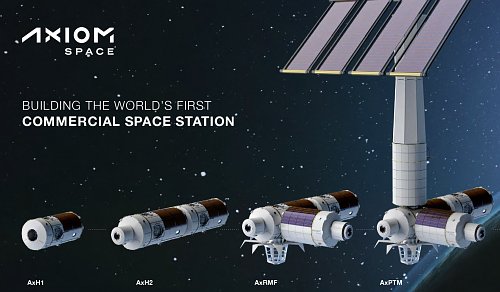
Axiom changes its CEO

Axiom's space station assembly sequence
The assembly sequence for Axiom’s space station while attached to ISS.
Click for original image.

After founding and leading Axiom for the past eight years, CEO Mike Suffredini, has decided to transfer to the company’s board of directors and pass the company’s leadership to someone else.

“I have dedicated over 40 years to advancing humanity through human spaceflight, including the past eight-plus years alongside Dr. Kam Ghaffarian at Axiom Space,” said Suffredini. “For personal reasons, I have decided to step down as CEO, effective August 9th. I will remain as an advisor to ensure a smooth transition and continue my role as a board member.”

Dr. Ghaffarian, Axiom Space’s Executive Chairman and co-founder, will assume the role of interim CEO until a permanent successor is appointed. His extensive experience and deep industry knowledge make him well-suited to lead the company during this period.

Suffredini’s a long career at NASA before founding Axiom was crucial in establishing the company’s success. He knew how to avoid all the pitfalls of working with the government agency, and was able to negotiate the right deals to make the partnership with NASA proceed smoothly. That inside knowledge probably allowed his company to beat out Bigelow Aerospace, which had been the first to build commercial space station modules but has now faded from sight.

The result is that Axiom was to fly commercial passenger flights to ISS using Dragon capsules, and is going to likely be one of the first commercial stations to begin operations. (The race to be first is presently being led by Axiom and Vast, with Vast looking to be slightly ahead.)

0 comments

Lufthansa signs deal with Airbus to train its astronauts for the Starlab space station

the proposed Starlab space station

Airbus has now signed an agreement with Lufthansa for it to train the astronauts Europe will fly to the Starlab space station, being built by a consortium of American, European, and Japanese companies.

US-based Voyager Space and Airbus signed an agreement in August 2023 to jointly pursue the development of the Starlab space station. The pair is currently targeting 2028 for the launch of the low Earth orbit destination, with commercial activities commencing in 2029. This timeline will allow for a small window of overlap with International Space Station operations before the orbiting laboratory is decommissioned in 2030.

In a 6 August announcement on Twitter, Airbus Defence and Space revealed the expanding team behind the development of Starlab. The list included Hilton Hotels for crew lodging design, Northrop Grumman for the development of an autonomous docking system for resupply spacecraft, and Lufthansa Aviation Training (LAT) for the training of future Starlab astronauts. Mitsubishi Heavy Industries, MDA Space, Palantir, and Ohio State University round out the partnership.

Though Voyager Space is supposed to be leading the project and obtained the seed money from NASA to get it started, the nature of this announcement suggests that it is Airbus who is really in charge at this time. At a minimum, the partnership has definitely transferred much control from the U.S. to Europe.

This shift should not be a surprise, since it became clear shortly after the August 2023 deal was signed that Europe had decided to focus its investment energies on Starlab and make it the European space station for the future.

0 comments

China launches first 18 satellites in a new Starlink-type internet constellation

China today launched the first 18 satellites in a new Starlink-type internet constellation dubbed Spacesail, its Long March 6A rocket lifting off from the Taiyuan spaceport in north China.

No word on where the rocket’s lower stage and four strap-on boosters landed within China. Jay notes that this Chinese constellation is now ahead of Blue Origin’s Kuiper constellation, a pattern that sadly has been repeated over and over again.

The leaders in the 2024 launch race:

77 SpaceX
33 China
9 Rocket Lab
8 Russia

American private enterprise still leads the rest of the world combined in successful launches 91 to 49, while SpaceX by itself still leads the entire world combined, including American companies, 77 to 63.

2 comments

Sunspot update: In July the Sun produced the most sunspots in almost a quarter century

Every month since this website began fourteen years ago, when NOAA posts its update of its monthly graph tracking the number of sunspots on the Sun’s Earth-facing hemisphere, I post my own analysis, adding some details to provide the larger context.

Of all those updates — numbering about 168 — this month’s is possibly the most significant. Since around 2008, the Sun began a long period where it was unusually quiet, with the solar maximum that occurred in 2014 possibly the weakest in two hundred years. Before that weak maximum begun, half the solar science community predicted it would be a very powerful maximum, while half predicted a weak maximum. Both got it wrong, though the weak prediction was closer though still too high.

When it came time to predict the next solar maximum, expected around 2025, that same solar science community was once again in disagreement. Most approved a NOAA science panel prediction in April 2020 calling for another weak minimum, similar to the one in 2014. A few dissented, however, and instead predicted in June 2020 that the maximum would be one of the strongest ever. In April 2023 however those dissenters chickened out, and revised their prediction downward, still forecasting a peak higher than the NOAA prediction but no longer anywhere as intense.

Based on what happened on the Sun in July, they should have had more faith in their earlier prediction.
» Read more

9 comments
1 113 114 115 116 117 838