NASA delays Artemis-2 wet dress rehearsal countdown due to weather

NASA today announced it is delaying until February 2, 2026 the wet dress rehearsal countdown of its Artemis-2 mission due to weather concerns.

NASA is targeting Monday, Feb. 2, as the tanking day for the upcoming Artemis II wet dress rehearsal at the agency’s Kennedy Space Center in Florida, as a result of weather. With this change, the first potential opportunity to launch is no earlier than Sunday, Feb. 8.

Over the past several days, engineers have been closely monitoring conditions as cold weather and winds move through Florida. Managers have assessed hardware capabilities against the projected forecast given the rare arctic outbreak affecting the state and decided to change the timeline. Teams and preparations at the launch pad remain ready for the wet dress rehearsal. However, adjusting the timeline for the test will position NASA for success during the rehearsal, as the expected weather this weekend would violate launch conditions.

I had previously said this dress rehearsal countdown would include the astronauts inside Orion. This was incorrect. The astronauts are in quarantine in preparation for the actual mission. Orion will be unmanned during the rehearsal countdown.

6 comments

Artemis-2 proves NASA learned nothing from the Challenger and Columbia failures

NASA: an agency still avoiding reality
NASA: an agency that still avoids reality

Our bankrupt new media continues to fail us. NASA is about to send four astronauts on a ten-day mission around the Moon in a capsule with questionable engineering, and that media continues to ignore the problem. Mainstream news outlets continue to describe the mission in glowing terms, consistently ignoring that questionable engineering. In some cases the stories even make believe NASA has fixed the problem, when it has not.

The most ridiculous example is an article yesterday from an Orlando outlet, Spectrum New 13: “How the lessons learned from the Challenger disaster apply to Artemis rockets”. It focuses entirely on the O-ring problem that destroyed Challenger, noting repeatedly that NASA has fixed this issue in its SLS rocket.

Of course it has. That’s the last war, long over. Engineers fixed this issue almost four decades ago. The article however dismisses entirely the new engineering concern of today, Orion’s heat shield, which did not work as expected during its own test flight in space in 2022. It covers this issue with this single two-sentence paragraph:

However, during re-entry, it broke up into chunks instead of burning away. This issue pushed back the Artemis II and III missions, but NASA has stated it has resolved the problem.

NASA however has not resolved the problem. It is using the same heat shield now on this manned mission, and really has no reason to assume it will work any better, even if the agency has changed the re-entry flight path in an effort to mitigate the heat shield’s questionable design.

You see, NASA with Artemis-2 is doing the exact same thing it did prior to both the Challenger and Columbia accidents. » Read more

40 comments

German government hires German startup Polaris Spaceplanes to build reusable two-stage hypersonic plane

Mira-II prototype following first flight using aerospike engine
Mira-II prototype following first flight using
aerospike engine in October 2024.

The German government yesterday awarded a contract to the German startup Polaris Spaceplanes to build and fly a reusable two-stage hypersonic plane by 2027.

On 27 January, POLARIS Spaceplanes announced that it had been awarded a contract by the Federal Office of Bundeswehr Equipment, Information Technology and In-Service Support (BAAINBw) to build a fully reusable, horizontal take-off, two-stage hypersonic vehicle. The primary application of the Hypersonic Test and Experimentation Vehicle (HYTEV) will be as a hypersonic testbed for scientific and defence-related research. A variant of the vehicle with an expendable upper stage will also be capable of deploying small satellites into low Earth orbit.

According to the company, the HYTEV will be roughly the size and take-off mass of a fighter jet. The main stage will be powered by two turbofans and one of the company’s in-house developed aerospike rocket engines. The turbofans will be used for take-off and landing, and the rocket engine will accelerate the vehicle before upper-stage deployment. The upper stage will be entirely rocket-powered, with imagery accompanying the announcement appearing to show a more conventional rocket engine configuration compared with the aerospike engine equipped to the main stage. After completing its mission, it will likely be recovered under controlled glide conditions or potentially by a parachute or parafoil.

This deal appears to be an upgrade to a February 2025 German government deal with Polaris. It also follows Polaris’s successful use of an aerospike engine on a prototype test flight in 2024. While the company has shown some success, doing more than a dozen test flights with small scale prototypes (as shown in the image to the right), this program and schedule still seems quite ambitious.

3 comments

Ariane-6 gets a new government launch contract

The European Space Agency, one agency among many
The European Space Agency, one European
agency among many

The government rocket of the European Space Agency (ESA), the Ariane-6, yesterday won a new launch contract to place a pair of Galileo GPS-type satellites into orbit for the European Union (EU).

Arianespace announced today at the European Space Conference in Brussels the signature of the launch contract with the European Union Agency for the Space Programme (EUSPA), under the delegation of the European Commission, to orbit the second pair of second-generation satellites of the Galileo constellation (Galileo L18) on board an Ariane 6 launcher. With this signature, the European Commission and the EUSPA are formalizing the launch contract of Galileo L18, following the initial mission allocation to Arianespace made in April 2024.

All told this will be Ariane-6’s fifth launch of GPS-type satellites for the EU, which appears committed to Ariane-6, even though this expendable rocket costs much more than SpaceX’s Falcon 9, in order to promote European sovereignty. Eventually Europe will develop more cost effective private rockets (in about a decade), but until then its access to space will be limited by cost.

And the extra cost is not simply the expendable nature of Ariane-6. Note also the many layers of bureaucracy listed in the quote above. For the European Union there the European Union Agency for Space Programme, working under the supervision of the EU’s European Commission. It signed a deal with Arianespace, which represents the European Space Agency as its commercial rocket division.

That’s four different bureaucracies, two within the European Union and two more related to Europe’s space effort. Each adds cost to the launch, as well as the need for complex negotiations that delay any deal.

Not

6 comments

SpaceX launches GPS satellite

SpaceX last night successfully launched a GPS satellite for the Space Force, its Falcon 9 rocket lifting off from Cape Canaveral in Florida.

The Space Force had originally hired ULA to launch this satellite, but two weeks ago it switched launch provider to SpaceX. Apparently the military wanted this satellite launched now, and for some reason ULA could not do it, even though the Vulcan rocket was supposedly ready for launch.

The first stage completed its fifth flight, landing on a drone ship in the Atlantic. The two fairing halves each completed their second flight.

The 2026 launch race:

11 SpaceX
5 China
1 Rocket Lab

7 comments

Scientists produce new estimate of the thickness of Europa’s icy crust

Europa in true color
Europa in true color, taken by Juno during that
September 2022 fly-by
. Click for full image.

Using data produced by Juno during a 2022 close-fly of Jupiter’s moon Europa, scientists have made a new estimate of the thickness of Europa’s icy crust, approximately 18 miles thick with a 6-mile margin of error.

In other words, their estimate could be as small as 12 miles thick, or as large as 24 miles thick.

You can read their paper here. From their abstract:

For the idealized case of pure water ice, the data are consistent with the existence of a thermally conductive ice shell with a thickness of 29 ± 10 km [18 ± 6 miles] and with the presence of cracks, pores or other scatterers extending to depths of hundreds of metres below the surface with a characteristic size smaller than a few centimetres in radius. An ice-shell salinity of 15 mg kg−1, as indicated by models based on terrestrial marine ice, would reduce our estimate of the thickness of the ice shell by about 5 km, substantially less than our 10 km uncertainty. The low volume fraction, small size and shallow depth of the scatterers indicate that the fracture interfaces observed at Europa’s surface are alone unlikely to be capable of carrying nutrients between the surface and the ocean. [emphasi mine]

The highlighted sentence is the important one. If this new estimate is right, than the unidentified reddish material that appears to leak out of the long ridgelike cracks on Europa’s surface, clearly visible in the picture to the right, are not coming from any underground ocean. The distances are too large.

Other estimates have suggested that ice crust could be as thin as 2 miles, but like this research the uncertainties are very large.

Meanwhile, the Juno mission is still alive, though essentially winding down operations. The mission was expected to officially end at the end of September 2025, when its budget ran out, but the just passed budget included enough money to keep it going, albeit at a relatively low level. According to the orbiter’s webpage, it will continue to orbit Jupiter, its orbit degrading naturally until it falls into Jupiter to burn up. As it does so data will continue to be collected, though at a much lower rate.

7 comments

NASA targeting January 31, 2026 for Artemis-2 dress rehearsal countdown

The flight plan for the Artemis-2 mission around the Moon
The flight plan for the Artemis-2 mission around the Moon. Click for original.

NASA engineers are now targeting January 31, 2026 for the manned dress rehearsal countdown of the Artemis-2 SLS rocket and Orion capsule.

The upcoming wet dress rehearsal is a prelaunch test to fuel the rocket. During the rehearsal, teams demonstrate the ability to load more than 700,000 gallons of cryogenic propellants into the rocket, conduct a launch countdown, and practice safely removing propellant from the rocket without astronauts inside the spacecraft.

During several “runs,” the wet dress rehearsal will test the launch team’s ability to hold, resume, and recycle to several different times in the final 10 minutes of the countdown, known as terminal count. The rehearsal will count down to a simulated launch at 9 p.m. EST, but could run to approximately 1 a.m. if needed.

This rehearsal will include the four-person crew inside the Orion capsule, which will once launched take them in a wide ten-day Earth orbit that will swing them past the Moon and then back to Earth. The crew entered quarantine at the end of last week to reduce the chance they will catch any illnesses prior to launch.

This mission carries great risk, as the capsule’s life support system has never been used in space before, while the viability of its heat shield remains questionable.

5 comments

NASA makes it official: Oman signs the Artemis Accords

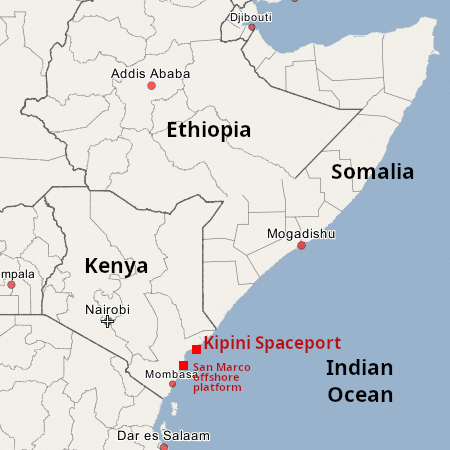
Active and proposed Middle East spaceports

In a press announcement yesterday, NASA officially confirmed that Oman has become the 61st nation to sign the Artemis Accords.

U.S. Ambassador to the Sultanate of Oman Ana Escrogima and NASA’s Deputy Associate Administrator Casey Swails participated in the event held on the opening day of the Middle East Space Conference, an international forum on space and innovation in the region. Said al-Maawali, Oman’s minister of transportation, communication, and information technology signed on behalf of the country.

I had reported early yesterday a story in Oman’s state-run press claiming that its sultan wanted his country to sign the Artemis Accords, a claim put forth by Oman officials during this conference. Apparently that was poor reporting. What actually happened was the event included the official Artemis Accords signing ceremony, which also included a number of other bi-laterial trade agreements.

As I noted yesterday, Oman has been unsuccessful so far in its efforts to bring American rocket and satellite companies to its proposed Duqm spaceport because State Department ITAR regulations, designed to protect American technology from hostile foreign powers, prevent it. This agreement hopefully includes some security guarantees that will ease those regulations and allow such deals.

The full list of all signatories to this American space alliance:
» Read more

0 comments

Oman says it wants to sign the Artemis Accords

Middle East, showing Oman's proposed spaceport
The Middle East, showing the location of
Oman’s proposed spaceport at Duqm.

In a diplomatic meeting between Oman and U.S. state department in Oman, Oman officials announced their Sultan wants his country to sign the Artemis Accords.

The two sides discussed means of maximising the benefits of the Free Trade Agreement between the two countries and augmenting American investments in sectors of priority for the Sultanate of Oman. These sectors include the digital economy, technology and space, in addition to mining, logistics, aviation and infrastructure.

Cooperation in the fields of education and culture was also discussed, particularly educational programmes, academic and professional exchange and investment in research and innovation. The two sides further exchanged views and positions on a number of regional and international issues, emphasising the importance of backing efforts for peace, stability and development.

During the dialogue, the Omani side announced the Sultanate of Oman’s approval to join the ‘Artemis Accords’ for space exploration. A cooperation statement on the 250th anniversary of the founding of the United States of America was also signed. [emphasis mine]

Much of this is diplomatic blather, meaning little. While I would expect the Trump administration welcome Oman as an Artemis Accord partner, in the talks related to the highlighted first paragraph above it likely demanded some concessions first. Free trade in Oman is going to require some protection for American technology.

For example, right now State Department rules make it difficult if not impossible to launch American satellites or rockets from Oman’s proposed spaceport in Duqm, rules imposed because Oman cannot be trusted. I expect the State Department is demanding total security control from U.S. entities on any launch before agreeing to an Oman Artemis Accord agreement.

0 comments

Russia delays launch of its own “Starlink” constellation

I’m shocked, shocked! According to news reports in Russia yesterday, Roscosmos has now delayed the initial launches for its own copycat “Starlink” constellation because the production of the satellites has fallen behind schedule.

In September 2025, Roscosmos head Dmitry Bakanov promised that by the end of 2025, the first 300 satellites would begin to be deployed in orbit as part of the Rassvet project. They are supposed to become “an analogue of the Starlink system” and provide “access to the internet at any geographical point.”

According to the publication, the postponement of the launch of the first 16 devices until 2026 may be due to the fact that the required number of satellites has not yet been assembled.

The project is being run by a Bureau 1440, supposedly a private Russian commercial company that is providing two thirds of the $5.7 billion budget, with the Russian government picking up the difference. It claims it will begin launching this year and have 318 satellites in orbit by 2028.

Wanna bet? Russia has not been able to complete any space project on time in decades, and even when its projects do finally launch, each routinely has had serious technical and quality control issues.

16 comments

Orbital tug startup Starfish Space wins $52.5 million Space Force contract to de-orbit its defunct satellites

Remora rendezvous
Images taken by Starfish’s camera during rendezvous
maneuvers.

The orbital tug startup Starfish Space yesterday announced it has been awarded a $52.5 million contract from the Space Force’s Space Development Agency (SDA) to use its Otter tug to de-orbit satellites when they have reached their end-of-life.

Under the contract, Starfish Space will build, launch, and operate an Otter spacecraft in low Earth orbit (LEO) to safely and efficiently dispose of SDA satellites at the end of their operational lives. The mission begins with an initial deorbit, with options for multiple additional deorbits, enabled by Otter’s significant capacity and ability to service several satellites in a single mission. The mission is targeting launch in 2027.

While a number of contracts have been issued in the U.S., Europe, and Japan to demonstrate de-orbit technology, this is the first operational contract ever issued. Moreover, I don’t think any of those other demo missions have actually achieved a de-orbit as of yet. Starfish itself has only successfully demonstrated rendezvous and proximity capabilities on two missions, with a third a failure. In the most recent late last year (as shown by the image on the right), Impulse’s Mira tug used Starfish software and camera to move within 1.2 kilometers of another Mira tug.

As for docking, its Otter Pup tug has flown two missions. The first failed in 2023 when both spacecraft began spinning unexpected. The second was supposed to achieve a docking, but after completing rendezvous maneuvers the company has provided no new updates. As far as we know, the docking never occurred or was a failure.

Nonetheless, it appears Starfish’s overall recent performance convinced the Space Force it could handle this new de-orbit contract.

1 comment
1 18 19 20 21 22 988