
Russian investigators conclude leak on Soyuz caused by external impact

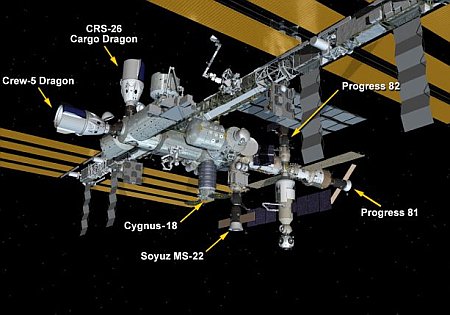
ISS as of November 28, 2022
ISS after November 28, 2022 docking of unmanned Dragon freighter.
MS-22 is the Soyuz capsule that is leaking.

The Russian investigators yesterday concluded that the coolant leak on the Soyuz capsule docked to ISS was caused by an external impact, either by a meteroid or a small piece of space junk.

A decision on whether this capsule is still usable for manned flight will be made sometime in January. If not, Russia will move up the launch of the next Soyuz to ISS one month from March to February, but launch it empty. If so, managers will leave the schedule as is.

If the engineers determine the capsule is not flightworthy, it will mean however that until February, ISS is short one lifeboat. At present there are two Dragon capsules docked to ISS, one manned and one cargo. Both return to Earth with a habitable interior, but the cargo capsule is not intended for manned flight. In an emergency however it might be possible to use it.

This situation suggests that NASA should pay to get SpaceX to upgrade the cargo Dragons so that they could always be used as an emergency lifeboat.

9 comments

Attack that injured Rogozin in the Ukraine also killed two

Dmitry Rogozin playing soldier in the Ukraine
Dmitry Rogozin playing make-believe soldier
recently in the Ukraine

More details have now emerged about the explosion that injured former Roscosmos chief Dmitry Rogozin, including the fact that the attack, in Ukrainian occupied territory in Donetsk, also killed two.

The former head of Russia’s space agency was wounded when an artillery shell exploded as he celebrated his birthday in a hotel near the front line in Ukraine. Dmitry Rogozin, a flamboyant Russian politician who was once a deputy prime minister, was reportedly hit in the buttocks, head and back by shrapnel.

Two people were killed in the attack and several others were wounded, authorities in Donetsk said on Thursday, and Mr Rogozin said he was due to be operated on. Russian state news channel Rossiya 24 TV said the former space chief was celebrating his 59th birthday at the Shesh-Besh hotel and restaurant with several other separatist officials.

But Mr Rogozin insisted the incident took place during a “work meeting”.

Russian investigators think the shell came from a French-made Caesar self-propelled howitzer.

The criticism of Rogozin concerning this story has been quite ugly.

“A party 10 kilometres away from the front line with the Ceasar’s range of 40 kilometres? I would reprimand him for being childish,” [wrote Yuri Podolyaka, a prominent pro-Kremlin blogger.] “Two people have died in that restaurant, which, I think, is on his conscience.”

Rogozin’s path has been steadily downward since he was deputy prime minister of Russia’s defense department from 2011 to 2018. First he was demoted to head of Roscosmos, where he ended up losing Russia more than a half billion in income by his cancellation of the launch contract with OneWeb. Worse, that cancellation, and Rogozin’s confiscation of 36 OneWeb satellites, ended any chance of Russia getting any international business for years to come.

These actions caused him to be fired from Roscosmos in July, and shipped to the Ukraine (the modern equivalent of Siberia) to act as an envoy in the Russian-occupied territories. Once there, he did nothing to enhance his reputation. By holding this very public birthday party, at a public place so close to the front lines, was almost guaranteeing he and his party would be attacked.

I wish he quickly recovers from his injuries, but I also think Putin would be foolish to give this guy any further positions of authority.

15 comments

Soyuz hole not caused by a Geminid meteor

According to an analysis by both NASA and Russian engineers, the 0.8 mm hole in the coolant system on the Soyuz docked to ISS was not caused by an object from the Geminid meteor shower that had occurred about the time the leak appeared.

The Soyuz vehicle, known as MS-22, sprayed its coolant into space on Dec. 14, the same day that the annual Geminid meteor shower peaked. But there’s no causal connection, NASA and Russian space officials said. “We did look at the meteor showers that were occurring,” Joel Montalbano, NASA’s International Space Station program manager, said during a press briefing on Thursday (Dec. 22). “Both the trajectory team in Houston and the trajectory team in Moscow confirmed it was not from the meteor showers; it was in the wrong direction.”

The engineers claim the hole could still have been caused by an impact, just not from these meteors.

0 comments

SpaceX and the Ukraine resolve funding issues for Starlink terminals

According to a Ukrainian official, the Ukraine has worked out a method to pay for another 10,000 Starlink terminals by obtaining funding from several European nations.

Ukraine’s deputy prime minister Mykhailo Fedorov has announced that over 10,000 additional Starlink terminals will be sent to Ukraine in the coming months, confirming that issues regarding how to fund the country’s critical satellite internet service have been resolved.

The governments of several European Union countries are ready to share payment said Fedorov (who is also Ukraine’s minister for digital transformation) in an interview with Bloomberg, affirming that “As of now all financial issues have been resolved.” Fedorov did not publicly identify which governments are contributing towards the payments but confirmed that there’s currently no contract in place and that Ukraine will need to find additional funding by spring 2023.

Elon Musk had threatened to end Starlink support without some form of payment. It appears his threat, which was almost immediately retracted, forced some action by these governments.

1 comment

ISS spacewalk postponed because controllers had to maneuver station to avoid space junk

An American spacewalk to install new solar panels to ISS yesterday was suddenly scrubbed when ground controllers identified a piece of space junk that was going to fly within a quarter mile of the station.

While flight control teams were preparing for today’s U.S. spacewalk, updated tracking data on a fragment of Russian Fregat-SB upper stage debris showed a close approach to station. Based on this new data, flight control teams directed the crew to stop spacewalk preparations as the ground team stepped into procedures to perform a Pre-Determined Debris Avoidance Maneuver (PDAM.)

Russian controllers successfully used the engines on a docked Progress freighter today to complete the avoidance maneuver, firing those engines for 10 minutes and 21 seconds.

It appears the station was never in any danger.

1 comment

Russians preparing replacement Soyuz for launch to ISS

ISS as of November 28, 2022
ISS after November 28, 2022 docking of unmanned Dragon freighter.
MS-22 is the Soyuz capsule that is leaking.

Though a final decision will not be made until the completion on December 27, 2022 of their investigation into the leak in the coolant system of the Soyuz capsule docked to ISS, the Russians have begun preparing a replacement Soyuz for launch.

A backup spacecraft to bring cosmonauts aboard the International Space Station (ISS) back to Earth will be prepared by February 19 and the spaceship is currently undergoing tests at the Baikonur spaceport, Roscosmos Chief Yury Borisov said on Monday.

That replacement Soyuz was supposed to launch in March, which means they can only accelerate its preparation by about a month. Assuming it is determined that the leaking capsule cannot be used safely as a lifeboat, this means that until February the station does not have its standard complement of lifeboats.

Should something happen that requires an immediate evacuation before February, it might be possible to get an extra three people into the two Dragon capsules presently docked to ISS, since each was designed to carry a maximum of six passengers, though generally four is considered their maximum capacity.

4 comments

Temperature in leaking Soyuz capsule drops

According to Russia’s state-run press TASS, the temperature in its leaking Soyuz capsule on ISS has now dropped to between 50 to 54 degrees Fahrenheit.

The language of the report suggests this temperature drop was the result of actions by Russia’s mission control, but that is decidedly unclear. With the thermal control system now depressurized, the capsule’s temperature could fluctuate a lot, depending on whether it is in shadow or sunlight, a condition dependent on the overall orientation of ISS itself.

A second TASS report today said that two Russian working groups are reviewing the data, and will decide around December 27th what the next step will be, including the possibility of launching a Soyuz capsule unmanned to replace this capsule.

“I believe that at the end of December, somewhere on the 27th [of December], specialists – and now two working groups have been set up – will decide on how we will resolve this situation,” [Yuri Borisov] the Roscosmos head, said in an interview with the daily Izvestia.

There is plenty of time for making decisions and “there is no hurry,” Borisov stressed.

What Borisov was really saying is that there is no reason to panic, but action must be taken without unnecessary delay.

5 comments

Russians test thrusters on leaking Soyuz

In the continuing investigation into the leak of coolant from a Soyuz capsule docked to ISS, Russian engineers yesterday tested the capsule’s thrusters, finding they functioned as normal.

As part of the ongoing evaluation and investigation, Roscosmos flight controllers conducted a successful test of the Soyuz MS-22 thrusters at 3:08 a.m. EST Friday, Dec. 16. The systems that were tested were nominal, and Roscosmos assessments of additional Soyuz systems continue. Temperatures and humidity within the Soyuz spacecraft, which remains docked to the Rassvet module, are within acceptable limits.

The highlighted words have been the Russians’ way of downplaying a serious concern. According to their own data, the temperatures in the capsule have now risen to 86 degrees Fahrenheit, which though entirely safe is higher than normal for within habitable spacecraft. Should those temperatures continue to rise, it will start to become a problem.

One solution would be circulate cooler air from the rest of the station. I suspect this is possible with equipment on board, but do not know for sure.

Right now however it surely appears that it would likely not be wise to return its crew to Earth in this capsule, and that a replacement will be required.

3 comments

Russian official: Soyuz leak possibly caused by micrometeorite hit

According to Sergei Krikalev, who heads Roscosmos’ manned program, the leak of coolant from the Soyuz capsule docked at ISS could have been caused by a micrometeorite hit.

Sergei Krikalev, a veteran cosmonaut who serves as the director of crewed space flight programs at Roscosmos, said a meteorite striking one of external radiators of the Soyuz MS-22 capsule could have caused the coolant to escape.

The malfunction could affect the performance of the capsule’s coolant system and the temperature in the equipment section of the capsule but doesn’t endanger the crew, Krikalev said in a statement.

Krikalev said Russian flight controllers were assessing the situation and following temperature indicators on the Soyuz. “There have been no other changes in parameters on the Soyuz spacecraft and the station, so there is no threat for the crew,” he said.

The “equipment section of the capsule” is its service module, not its habitable orbital module or descent module.

Krikalev, the first Russian to fly on the space shuttle and occupy ISS, is a generally very reliable source. He is speculating, but not wildly but based on what is so far known. The upcoming inspection of the Soyuz using an ISS robot arm will soon tell us whether he is right or not. Krikalev also said that the inspection will tell them whether this capsule can be used to return its astronauts to Earth.

9 comments

December 15, 2022 Quick space links

Courtesy of Jay, BtB’s stringer. All the links today have to do with the Soyuz capsule that is leaking on ISS.


  • Details about the leaking coolant are described here and here.
  • The second link provides a description of the cooling system that is leaking. It appears the leaking material could be water, or “Isooctan LZ-TK-2”.


1 comment

France orders Eutelsat to stop broadcasting Russian channels

Arcom, the French television regulation agency, yesterday ordered the communication satellite company Eutelsat to stop allowing three Russian channels from broadcasting using the satellites.

In a news release, Arcom said the television stations’ coverage of Russia’s war in Ukraine “include repeated incitement to hatred and violence and numerous shortcomings to the honesty of the information.” Eutelsat said in a brief statement that “it will no longer be involved in the broadcasting of the three sanctioned channels within the prescribed time-frame.”

Arcom’s decision comes a week after France’s top administrative court, prompted by a request from the Paris-based Reporters Without Borders advocacy group, ordered Arcom to review an initial decision to permit Eutelsat to continue carrying the stations.

Arcom’s claim, that it made this order because of the content of the broadcasts, is another example of the blacklisting/censorship culture we now live in. The French regulators could have simply stated that, as an ally of the Ukraine in the Russian-Ukraine war, it does not want French-regulated satellites to provide aid to the Russian side. There is a war going on, and this alone is a rational reason to block the Russian channels.

Instead, Arcom uses censorship as its justification. It doesn’t like what the Russians are saying, and therefore has the right to censor them. Remember this argument, because in the future Arcom will likely use it again, but next time against any one of the other broadcast channels under its control that simply says something it doesn’t like.

11 comments

Soyuz manned capsule docked to ISS is apparently leaking something

A spacewalk today was cancelled when it was suddenly noticed that some unknown substance was leaking from one of the Soyuz manned capsules docked to ISS.

During preparations for this evening’s planned spacewalk by Roscosmos cosmonauts Sergey Prokopyev and Dmitri Petelin, ground teams noticed significant leaking of an unknown substance from the aft portion of the Soyuz MS-22 spacecraft docked to the Rassvet module on the International Space Station. The spacewalk has been canceled, and ground teams in Moscow are evaluating the nature of the fluid and potential impacts to the integrity of the Soyuz spacecraft, which carried Prokopyev, Petelin, and NASA astronaut Frank Rubio into space after launching from the Baikonur Cosmodrome in Kazakhstan on Sept. 21.

The big question is whether this leak will impact the capsule’s function as a lifeboat or a return vehicle for the three astronauts it brought into space. If so, then an empty manned capsule needs to be launched, either by the Russians or SpaceX, though if the latter someone would have to pay the cost.

6 comments
1 16 17 18 19 20 133