Rogozin returns, playing a soldier in the Ukraine!

Dmitry Rogozin, about to go into battle!

Fired from his job as head of Roscosmos and exiled to the Ukraine, Dmitry Rogozin has returned to the news! He was recently interviewed on Russian television, during which the broadcast showed clips of Rogozin getting a tour from Russian troops.

The screen capture to the left show Rogozin during that tour, dressed in military gear, though most of that gear is apparently Western in make, not Russian. Go Dmitry!

According to Antoly Zak, Rogozin during the interview promised that Russia will soon occupy Kiev, Vienna, Berlin and Budapest. As I say, go Dmitry!

Since Rogozin was sent to the Ukraine in July his work there has mirrored his “successes” at Roscosmos. At Roscosmos he was instrumental in ending Russia’s deal with OneWeb, costing Putin several billion dollars in launch income while destroying any chance for years of Russia getting any international rocket business. In the four-plus months since he arrived in the Ukraine, Russia has been on a steady retreat, losing vast areas it had previously conquered.

Hat tip to BtB’s stringer Jay, who says of Rogozin, “This guy is worse than Baghdad Bob!”
4 comments

Soyuz-2 rocket launches Russian military satellite

Russia today successfully placed a military surveillance into orbit using its Soyuz-2 rocket, launching from its Plesetsk spaceport.

Like most launches from Plesetsk, the first stage and fairings landed in the interior of Russia, the drop zones in its far north.

The leaders in the 2022 launch race:

54 SpaceX
54 China
21 Russia
9 Rocket Lab
8 ULA

The U.S. still leads China 78 to 54 in the national rankings, but trails the entire world combined 85 to 78.

0 comments

Slowly the Ukrainians continue to regain their country

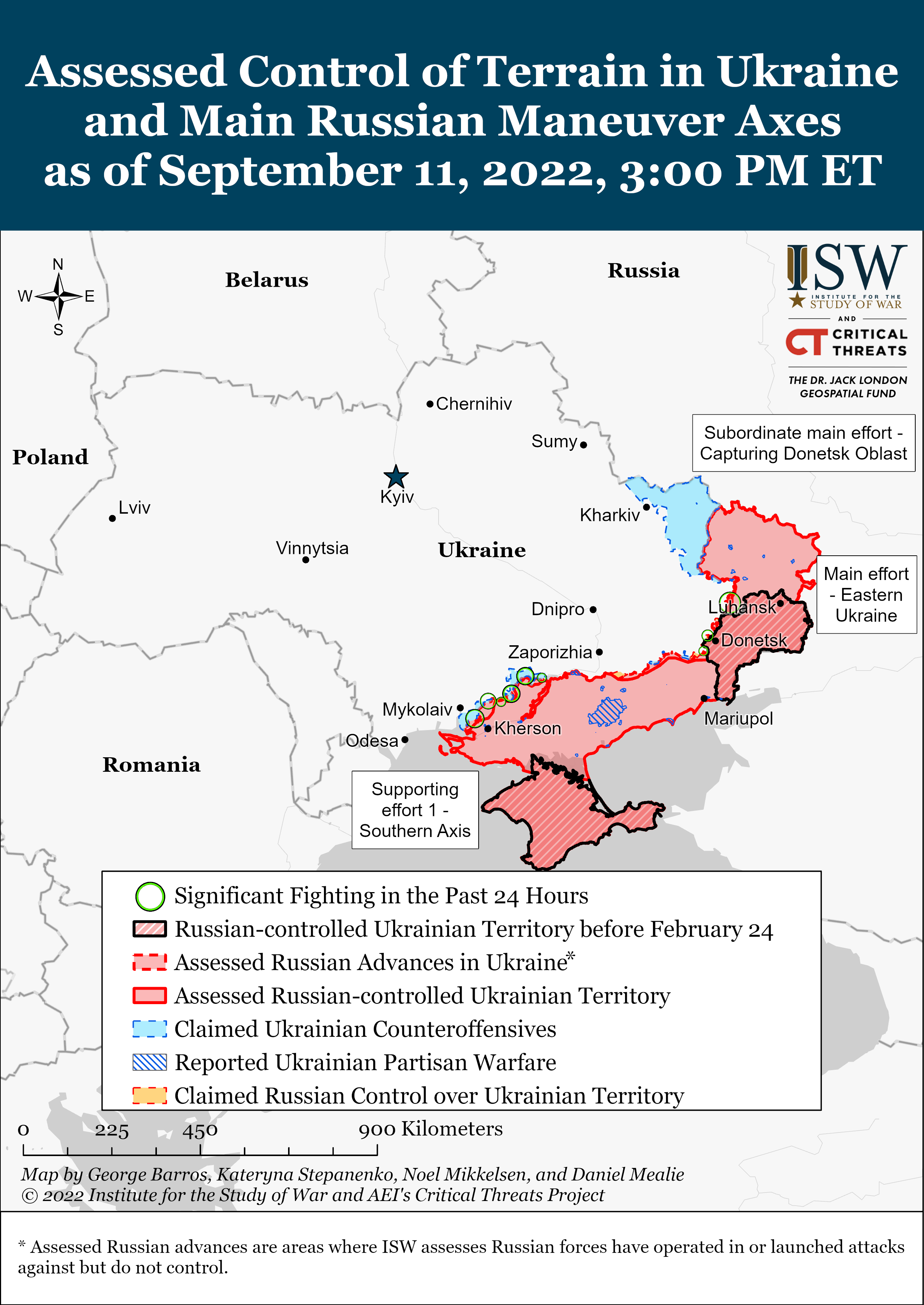
The Ukraine War as of September 11, 2022
The Ukraine War as of September 11, 2022. Click for full map.

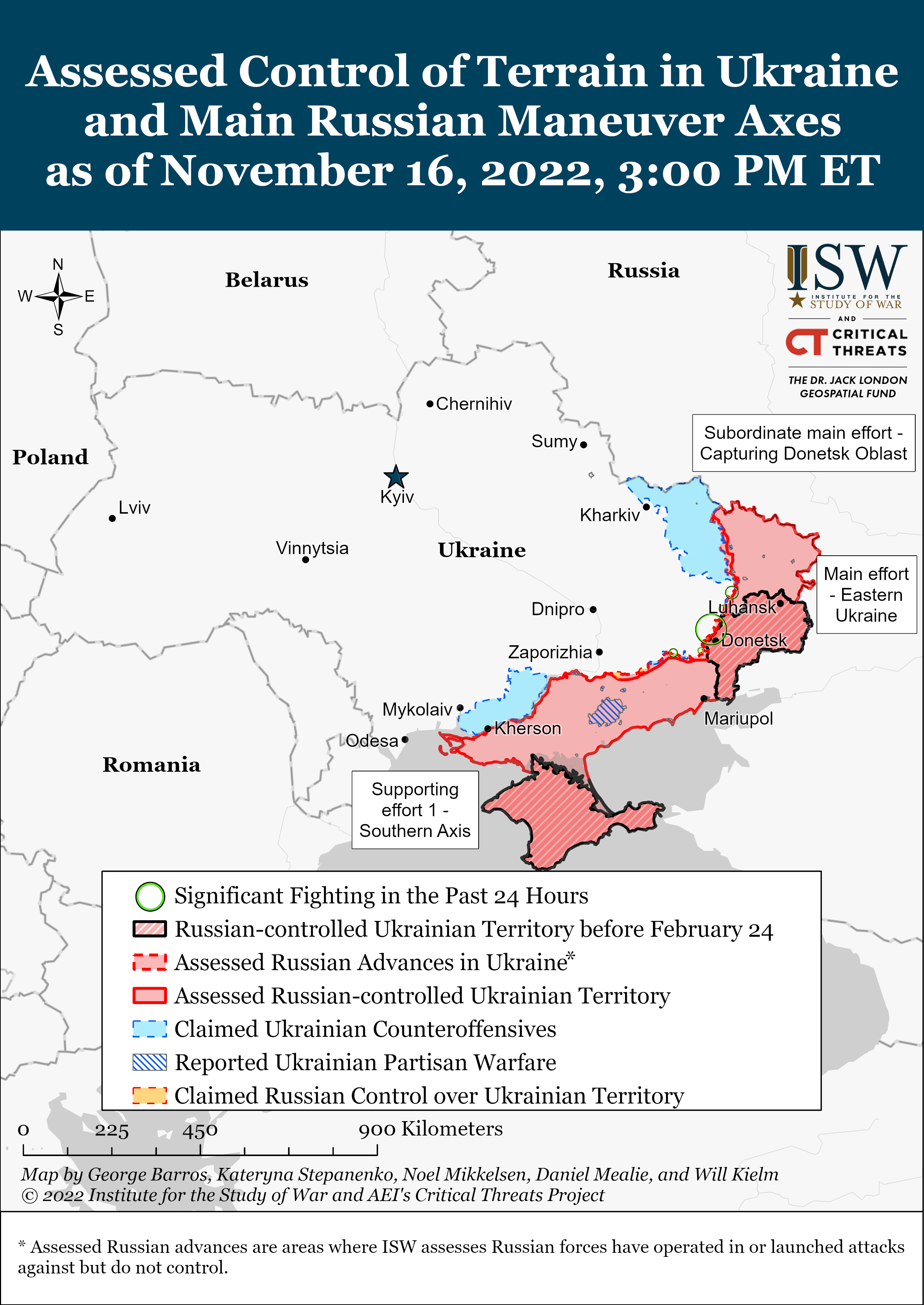
The Ukraine War as of November 16, 2022
The Ukraine War as of November 16, 2022. Click for full map.

In the two months since my last update on the Ukraine Way in September, the steady and continuing retreat of the Russians has continued, with the Ukrainians last week finally retaking all the territory north of the Dnipro River, including the city of Kherson.

The two maps to the right, created by the Institute for the Study of War (ISW) and simplified, reduced, and annotated to post here, show these gains, with the top map from their September 11, 2022 analysis and the bottom from their November 16, 2022 update. Pink areas are regions controlled by the Russians. Blue areas are regions retaken by the Ukraine. Red-striped areas are regions captured by Russian in its 2014 invasion. Blue-striped areas are regions inside Russian-occupied territories that have seen strong partisan resistance. The green lines in the top map mark the locations of important rivers.

Overall, the military actions of the Russians have continued to be haphazard, poorly thought out, and inexplicable, as they have been from the start of this war. For example, even as the Ukrainians were continuing their steady gains in the north, the Russians seemed relatively uninterested. Instead, it continued its attempts to gain ground in the middle, near Donetsk, as indicated by the two green circles. The Russians have been attempting for months to make gains in this area. Though they have captured some territory, those captures have been tiny and very costly. Nor have these captures done anything to impact the Ukrainian gains elsewhere.
» Read more

18 comments

Russian government okays ISS partnership through ’27

The Russian government yesterday approved an order allowing Roscosmos to continue to send its astronauts and spacecraft to ISS through 2027.

“The expected results are as follows: transport and technical support for the Russian segment of the International Space Station in 2023-2027, including the delivery to the station and return to Earth of Russian crews, as well as the delivery to the ISS of fuel and cargo crucial to maintaining the ISS in flight and the implementation of a long-term program for authorized works,” the instruction says.

Putin’s government is essentially admitting that it will not be able to launch its own space station by ’27, so it has to stay on ISS because that’s all it has. Whether ISS can last that long, considering the somewhat delicate state of some of the oldest Russian modules, remains unclear.

The American private stations should all be coming on line in the years from 2024 to 2030, so it appears the U.S. is covered. What Russia will do however remains unknown. I suspect it will be far more difficult politically for it to buy time on the American private stations, compared to Europe. But if it doesn’t get its own station launched, buying time might be its only option, assuming of course the U.S. government allows it to do so. And considering that other Russian officials are threatening America’s private space assets, the likelihood that Russia will be allowed on future American space stations seems remote indeed.

0 comments

Russian Progress freighter successfully launches to ISS

Using its Soyuz-2 rocket Russia tonight successfully launched a new Progress freighter to ISS.

The spacecraft will take two days to rendezvous and dock with ISS, thus delivering 2.5 tons of cargo.

The leaders in the 2022 launch race:

48 SpaceX
45 China
18 Russia
8 Rocket Lab
7 ULA

American private enterprise still leads China 68 to 45 in the national rankings, though it now trails the rest of the world combined 72 to 68.

0 comments

ISS dodges space junk from Russia’s November 2021 anti-satellite test

In order for ISS to avoid one of the approximately 585 pieces of space junk still in orbit that were produced when Russia destroyed its defunct Cosmos 1408 satellite in a November 2021 anti-satellite test, engineers fired the engines of a docked Progress freighter yesterday for just over five minutes.

Without the burn the debris would have flown within three miles of the station, too close for comfort or anyone’s margin of error.

According to a report in September, of these 585 pieces, most will burn up in the atmosphere by ’25, with only 38 pieces left afterward to pose a threat to other operating satellites and manned spacecraft.

5 comments

Russia launches 4 satellites with Soyuz-2 rocket from Vostochny

Russia yesterday successfully launched four satellites from its Vostochny spaceport, using its Soyuz-2 rocket.

Three satellites were part of Russia’s data relay satellite constellation, and one was the first test satellite of Russia’s proposed low Earth orbit broadband constellation, comparable to Starlink.

The leaders in the 2022 launch race:

48 SpaceX
45 China
17 Russia
8 Rocket Lab
7 ULA

American private enterprise still leads China 68 to 45 in the national rankings, but trails the world combined 71 to 68.

0 comments

ESA asks member nations to build lander for Franklin Mars rover

In its most recent request for funding from the member nations of the European Space Agency (ESA), the agency has asked the member nations to finance the design and construction of a new lander for its long delayed Rosalind Franklin Mars rover, replacing the Russian lander that had became unavailable due to sanctions resulting from Russia’s invasion of the Ukraine.

According to the BBC (opens in new tab), ESA will request 360 million euros to kickstart work on the new landing system, with additional funds likely needed in subsequent years. ESA has already spent some 1.3 billion euro on the ExoMars program, which also includes an orbiter that has been studying Mars’ atmosphere and surface since 2017. ESA will put the plan in front of delegates of its 22 member states at a ministerial conference in November.

“We will have to wait if the [member states] decide to go forward with the project,” Parker said. “This concept is now proposed as part of the director general’s package within [ESA’s] exploration program for decision at the ministerial [conference].”

If ESA’s member nations agree to this plan, expect the launch of Franklyn to be delayed further. Based on the normal pace in which ESA functions, that lander will take a minimum of five years to design and build (likely much longer). Though ESA is now targeting ’28 for the launch of Franklin, which was supposed to launch this past summer after a two year delay, this plan likely means it will not get off the ground this decade.

Meanwhile, there are now at least a half dozen private companies building lunar landers that could more quickly (and for less money) get a Franklin Mars lander built for ESA. None are in Europe however, which means ESA would rather have this mission delayed years so that it can funnel money to its own contractors..

0 comments

Russia’s Soyuz-2 rocket launches two military satellites

Russia today successfully launched from its Plesetsk spaceport two military satellites using its Soyuz-2 rocket.

Russian sources provided little information but it appears the launch was timed to allow these satellites to come close to an American military satellite.

Today’s launch of Kosmos-2561 and 2562 also seemed to mirror the trajectory of USA-326, with the American satellite passing over the cosmodrome roughly at the time of today’s launch.

If the latest launch is an inspector mission, it is possible that Kosmos-2562 is a subsatellite that was released by 2561 shortly after launch, as previous inspector satellites have done. Kosmos-2542 was believed to have been an inspector satellite, although never confirmed by Russia, and later released Kosmos-2543.

The launch was from the interior of Russia. The Soyuz-2 version launched was one with no side boosters, so that only the expendable core stage crashed in Russia.

The leaders in the 2022 launch race:

48 SpaceX
45 China
16 Russia
8 Rocket Lab
7 ULA

American private enterprise still leads China 68 to 45, though it now trails the world combined 69 to 68.

The launch of 36 OneWeb satellites by the biggest version of India’s GSLV rocket is right now counting down for a launch shortly. You can watch it here.

1 comment

Russia launches military satellite using Angara rocket; new global record for launches

Russia today successfully launched a classified military satellite using its new Angara rocket in its Angara-1.2 configuration.

Like ArianeGroup’s Ariane-6, Angara is modular, so depending on the payload’s launch needs, it can have additional strap-on boosters, from none to four. This launch had no side boosters at all.

The launch was the 135th of 2022, passing the record set last year of 134 successful launches for the entire world in one year. In 2022 the record was broken in the last week. This year the record has been broken two and a half months before the end of the year. Based on the number of planned launches for the rest of the year, 2022 is likely to easily exceed 150 launches.

And the reason this number going through the roof is because of the advent of private enterprise, private ownership of rockets, and intense competition. New rocket companies are sprouting up everywhere worldwide, each with their own rocket competing aggressively for business by lowering costs. The lower costs make it possible for more satellite companies to find financing because making money will be easier. This in turn results in more customers for the rocket companies, which encourages more competition which pushes the price down further.

The cycle feeds on itself, and will only end when the full potential of space exploration is reached. And since that potential is literally endless, this growth for the human race is also endless. The only thing that could stop it is if human civilization decides to stop it, intentionally, either from willful ignorance or fear.

The leaders in the 2022 launch race:

47 SpaceX
45 China
15 Russia
8 Rocket Lab
7 ULA

American private enterprise still leads China 67 to 45 in the national rankings, but now trails the rest of the world combined 68 to 67.

5 comments
1 17 18 19 20 21 133