Hayabusa-2 sees its shadow

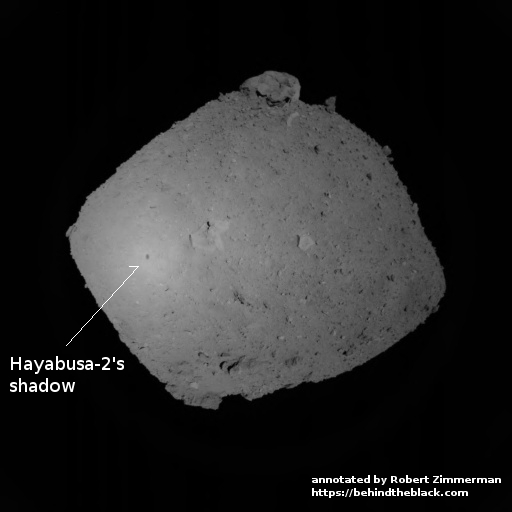
Ryugu, with Hayabusa-2's shadow

During its aborted landing rehearsal last week Hayabusa-2 imaged its own shadow as it approached within 600 meters of Ryugu.

The shadow is only a little dot on the surface of the asteroid, but to have resolved it is quite impressive. The image on the right has been annotated by me to indicate the shadow.

They have not said when they will do another landing rehearsal. Meanwhile, two of the spacecraft’s mini-landers are expected to be released sometime in the next few days.

Update: Based on the raw navigation images being released in real time from Hayabusa-2, the release of the MINERVA-II-1 has begun, with Hayabusa-2 moving in towards Ryugu in preparation for that release.

1 comment

Dress rehearsal of Hayabusa-2’s landing scrapped

The dress rehearsal of Hayabusa-2’s eventual landing on the asteroid Ryugu was cut short yesterday when the spacecraft found it could not get a reliable distance reading of the surface once it descended to 600 meters.

The problem was apparently due to the pitch black surface of the carbon-rich asteroid that made laser distance measurements difficult. JAXA says the Hayabusa 2 is in good condition, and the agency is considering changing landing procedures such as adjusting the configuration of measuring devices.

Despite the suspension, the altitude of 600 meters the explorer has descended to the asteroid is the closest ever recorded. JAXA had planned to bring down the probe to 30 meters and make detailed observations of a landing spot.

Just to clarify, this was a height record for Hayabusa-2 only.

0 comments

Hayabusa-2 scientists release updated landing schedule

The science team for Hayabusa-2 has released an updated landing schedule.

Two of the landers developed by the Japanese space agency will be deployed together by Hayabusa 2 on Sept. 21, and another landing probe provided by German and French scientists is set for its descent to Ryugu on Oct. 3.

Those landing attempts will be preceded by a landing rehearsal using the Hayabusa 2 spacecraft to approach within 100 feet (30 meters) of Ryugu next week. The spacecraft is scheduled to reach its closest point to the asteroid Sept. 12, low enough to fire and test its laser range finder, a navigation sensor to be used on future touch-and-go maneuvers to snag a sample of Ryugu for return to Earth.

Below is the very busy planetary probe schedule through January:

  • Week of September 12: Hayabusa-2 will do dress rehearsal of its Ryugu landing
  • September 21: Two of Hayabusa-2’s three Minerva-II mini-landers will land on Ryugu
  • October 3: Another Hayabusa-2 mini-lander, MASCOT, will land on Ryugu
  • October 3: The Parker Solar Probe makes first fly-by of Venus
  • Late October: Hayabusa-2 itself will land and grab a sample of Ryugu
  • November 26: The U.S. lander InSight will land on Mars.
  • December 3: OSIRIS-REx will arrive at the asteroid Bennu.
  • December: Chang’e-4 will land on the Moon’s far side.
  • January 1: New Horizons will fly past the Kuiper Belt object Ultima Thule.

During this time period Curiosity will also make two more drill attempts, and then resume its climb up Mount Sharp.

1 comment

Dates set for first landings on Ryugu

The science team for the Japanese probe Hayabusa-2 have set the dates for the first two landings on the asteroid Ryugu.

On 21 September, it will despatch the first of these piggybacked packages. A 3.3kg container known as Minerva II-1, which is mounted on the spacecraft, will deploy two robots known as Rover 1A and Rover 1B.

The 1kg “rovers” will actually move by hopping under the asteroid’s low gravity. Each one contains a motor-powered internal mass that rotates to generate force, propelling the robot across the surface. The rovers are equipped with wide-angle and stereo cameras to send back pictures from Ryugu.

Then, on 3 October, the mothership will deploy a lander called Mascot, which has been developed by the German Aerospace Center (DLR) in conjunction with the French Space Agency (CNES). Mascot, otherwise known as the Mobile Asteroid Surface Scout, is a 10kg instrument package that will gather a range of scientific data from the surface. It carries a wide-angle camera, a microscope to study the composition of minerals, a radiometer to measure temperature and a magnetometer to measure the magnetic field.

After it reaches the surface, Mascot can move its position only once, by jumping.

An earlier report had said that Hayabusa-2 would itself land late in October, but this report today leaves that landing date unstated.

0 comments

Hayabusa-2 science team lay out Ryugu landing schedule

At a press conference yesterday the Hayabusa-2 science team laid out their landing schedule for the spacecraft and its three tiny landers.

The first lander will be one of its two tiny MINERVA-II probes, and will take place in September. This will be followed by the German/French MASCOT probe in early October, followed in turn in late October by Hayabusa-2 itself.

The landings of the first two probes will help them pick Hayabusa-2’s landing site, as well as the site for last MINERVA lander.

Mission planners faced tough choices because the body almost uniformly strewn with boulders. “Ryugu is beautiful, but challenging,” said Aurélie Moussi, a collaborator from the French space agency CNES in Toulouse, at a press conference in Sagamihara, Japan, on 23 August.

…To minimize risks for MASCOT, mission planners mapped the topography of Ryugu and the distribution and size of the boulders on its surface. They ran computer simulations to produce a shortlist of ten options, and then picked one spot on the asteroid’s southern hemisphere. The choice reflected a number of criteria, including average temperatures on the ground and the materials that MASCOT will analyse with its four on-board instruments. “The other sites would have been just as good, or just as difficult,” says MASCOT payload manager Stephan Ulamec of the German Aerospace Center in Cologne. “Wherever we look, there is a lot of big boulders.”

It does appear that the boulder-strewn surface is posing a problem for the engineers.

0 comments

No water as yet detected on Ryugu

The Hayabusa-2 science team today said that their first preliminary survey of Ryugu has yet to detect evidence of water.

The Japan Aerospace Exploration Agency (JAXA) said Aug. 2 that data collected from the space probe showed no water on the boulders scattered on the surface of Ryugu.

Ryugu is a C-type asteroid, which is rich in carbon. Many C-type asteroids are known to contain moisture in their surface boulders, and experts hoped that Ryugu would be one of them.

Hayabusa-2’s visit has just begun. I still expect surprises.

0 comments

Ryugu as seen by Hayabusa-2 from less than 4 miles

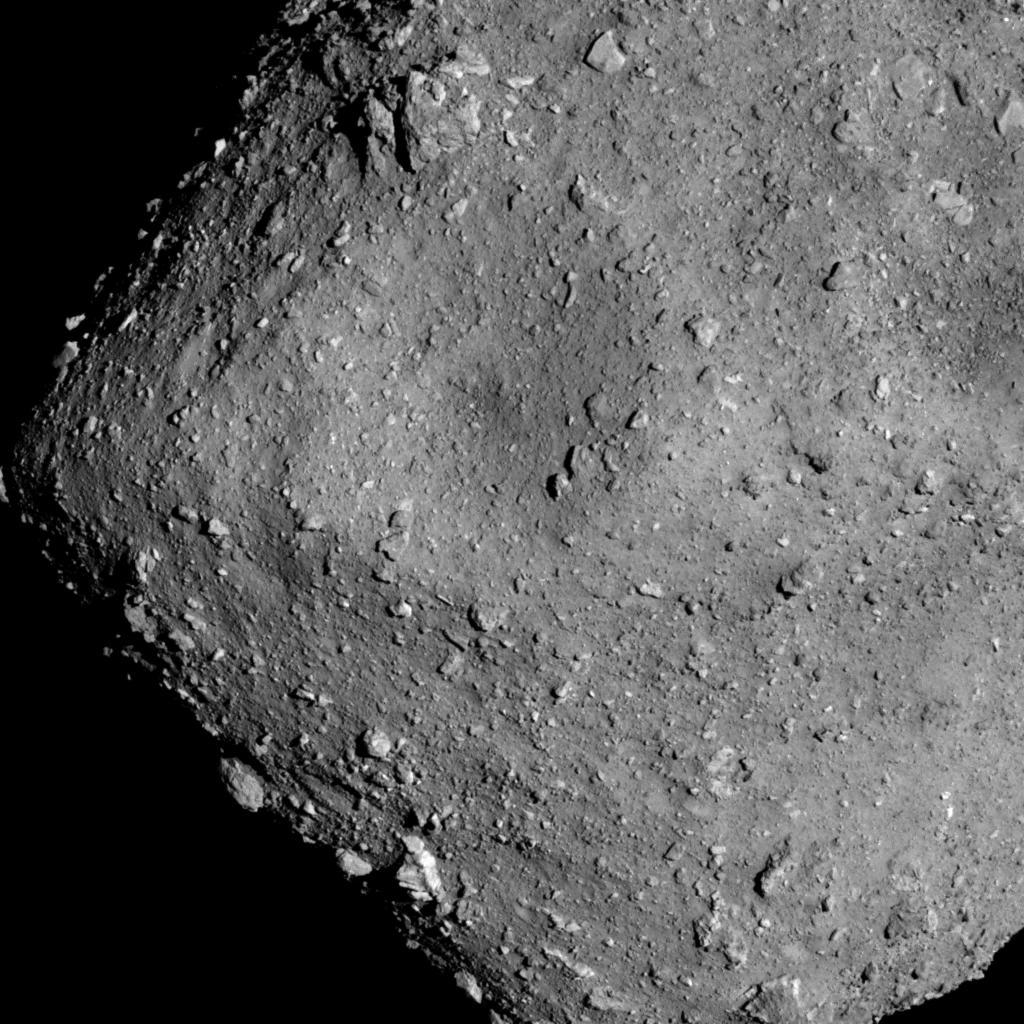
Ryugu from less than 4 miles distance

The image on the right as a cropped section of an image taken by Hayabusa-2 from only 3.7 miles distance from the asteroid Ryugu. If you click on the link you can see the full image. I picked this section to crop out because it shows the asteroid’s limb, an interesting boulder field, and part of a the asteroid’s largest crater, on the lower right. As noted by the Hayabusa-2 science team in describing details in the full image:

The resolution in Figure 1 is about 3.4 times higher than the images taken from the Home Position [20 kilometers distance] so far. 1 pixel in Figure 1 corresponds to about 60cm. The largest crater on the surface of Ryugu is situated near the center of the image and you can see that it has a shape like a “mortar”. You can also see that the surface of Ryugu is covered with a large number of boulders. This picture will provide important information as we choose the landing site.

The smallest objects visible are thus about two feet across.

1 comment

Hayabusa-2 finds Ryugu covered with scattered large boulders

Hayabusa-2 has found that the asteroid Ryugu is covered with many scattered large boulders.

The Hayabusa 2 space probe discovered many boulders scattered on the asteroid Ryugu, suggesting it was formed from fragments of other celestial bodies, the Japan Aerospace Exploration Agency (JAXA) said July 19. More than 100 rocks larger than 8 meters in length were confirmed on the surface of the “spinning top” asteroid from images captured by Hayabusa 2, according to JAXA. The largest boulder was about 130 meters in length near the south pole.

The rocks are likely too big to be meteor fragments from collisions with Ryugu, which has a diameter of about 900 meters. “(The finding) is compelling evidence to prove that the Ryugu asteroid was formed by fragments of larger celestial bodies,” said Seiichiro Watanabe, head of the study team and professor of Nagoya University.

The asteroid’s slightly tilted axis of rotation gives Ryugu two seasons: summer and winter. Hayabusa 2 found the temperature ranged from about 20 to 100 degrees on Ryugu’s surface.

Surprise! This finding makes Ryugu very different from every other asteroid previously visited. Most have had relatively smooth surfaces, with lots of dust.

1 comment

3D image of Ryugu

The lead guitarist of the rock band Queen, Brian May, is also an astronomer, and he has taken Hayabusa-2’s first full close-up image of Ryugu and produced a 3D image of the asteroid.

If you have red/blue 3D glasses you should definitely click on the link and view the image. The asteroid appears much more elongated back to front than it appears in the flat image.

3 comments

Ryugu from 25 miles

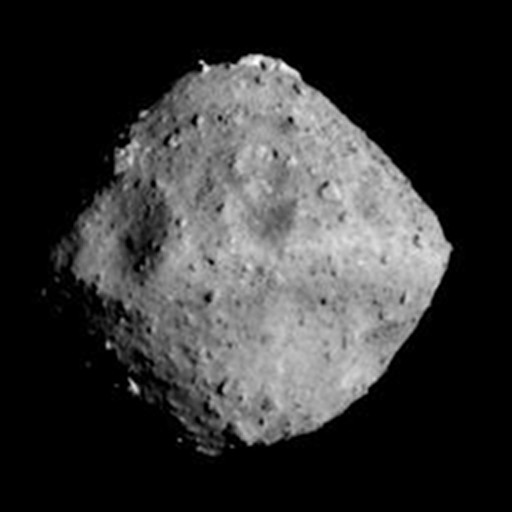
Ryugu from 25 miles

The Hayabusa-2 science team has released its first image of Ryugu, posted to the right, from a distance of only 25 miles. From the project manager:

The shape of Ryugu is now revealed. From a distance, Ryugu initially appeared round, then gradually turned into a square before becoming a beautiful shape similar to fluorite [known as the ‘firefly stone’ in Japanese]. Now, craters are visible, rocks are visible and the geographical features are seen to vary from place to place. This form of Ryugu is scientifically surprising and also poses a few engineering challenges.

First of all, the rotation axis of the asteroid is perpendicular to the orbit. This fact increases the degrees of freedom for landing and the rover decent operations. On the other hand, there is a peak in the vicinity of the equator and a number of large craters, which makes the selection of the landing points both interesting and difficult. Globally, the asteroid also has a shape like fluorite (or maybe an abacus bead?). This means we expect the direction of the gravitational force on the wide areas of the asteroid surface to not point directly down. We therefore need a detailed investigation of these properties to formulate our future operation plans.

They are going to have to spend some time in orbit to figure out not only where to land, but how to do it. More information on the mission can be found here.

0 comments
1 6 7 8 9