Hayabusa-2’s highest resolution image so far
Ryugu up close

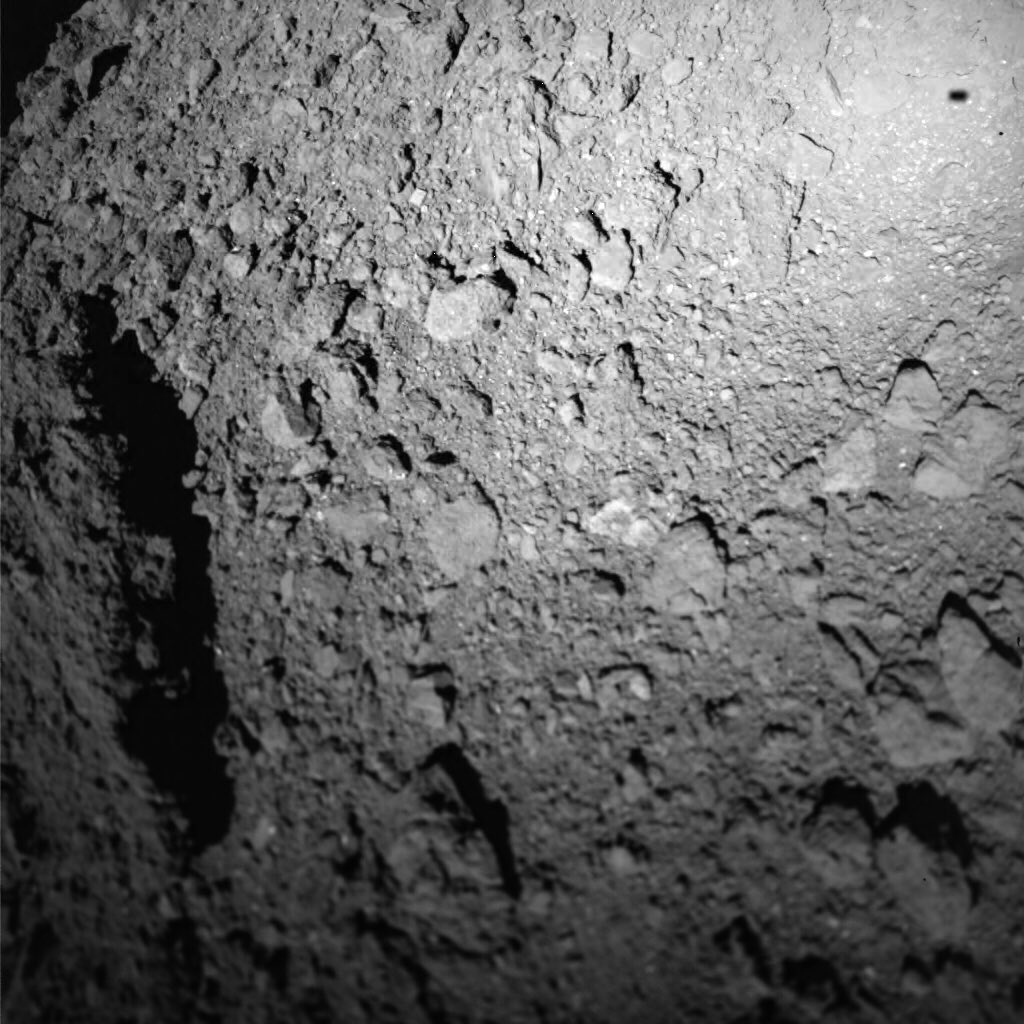
The Hayabusa-2 science team has released the highest resolution image taken by the spacecraft so far. The image on the right, reduced to post here, is that image. Click on it to see the full resolution version.

The image resolution is about 4.6mm/pixel. This is the highest resolution image that Hayabusa2 has taken so far and even small rocks with a diameter of 2 โ€“ 3cm are clearly visible. The maximum resolution of AMICA โ€“the camera at the time of the first Hayabusa missionโ€” was 6 mm/pixel, so even its resolution has now been exceeded. As the image captured of the asteroid surface from the spacecraft, it will be one of the highest resolution to be taken of Ryugu (MINERVA-II1 and MASCOT which landed on the surface, have captured even higher resolution images).

A feature from the image is the lack of regolith (sandy substance). This was suspected to be true from the images obtained so far, but it is more clearly seen in this high resolution photograph. There is also a collection of pebbles with different colors, which may be evidence that the surface material of Ryugu is mixed.

This was taken during the second landing rehearsal about two weeks ago. The image clearly shows the rubble pile that is Ryugu, lacking anything but cemented rocks. It also illustrates the landing problem faced by Hayabusa-2’s engineers. They need a flat smooth area to land, and they have not really found one that fits their needs.
6 comments

Hayabusa-2 completes third Ryugu touchdown rehearsal

Ryugu up close

Hayabusa-2 today completed its third Ryugu touchdown rehearsal.

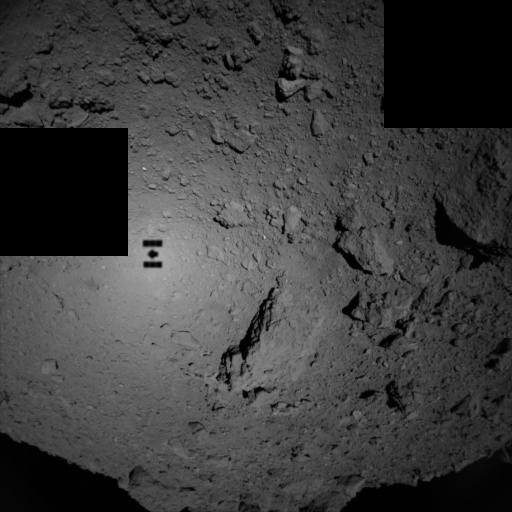
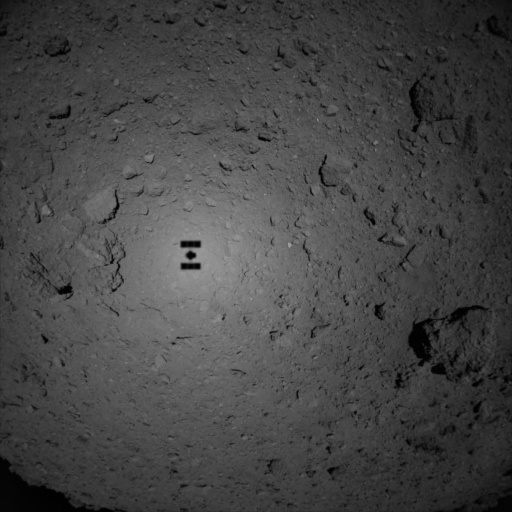
According to their operation schedule, they were planning to descent to about 20 meters of the surface, about 65 feet. The image on the right is the closest image taken during the rehearsal. You can see the shadow of Hayabusa-2 in the middle of the frame.

They have not released any information about the rehearsal results. The key here is how accurately they were able to get Hayabusa-2 to approach the asteroid’s largest flat spot, a tiny 20 meter wide spot less than half the size of their original planned landing diameter. From the image, it is unclear how successful they were.

They will now spend the next two months analyzing the data from their landing rehearsals in preparation for a landing attempt in January. During this time observations will be reduced because the Sun will be between the Earth and the asteroid.

4 comments

Hayabusa-2 will do two touchdown rehearsals prior to landing in January

In order to test whether they can bring Hayabusa-2 down to the surface within a circle only 20 meters (65 feet) across (the largest smooth landing area they have found so far on Ryugu), their engineering team has decided to first do two more touchdown rehearsals in October.

In the area where the spacecraft will touchdown, it is dangerous to have boulders with a height greater than about 50cm. Since the length of the sampler horn is about 1m and the spacecraft will be to be slightly inclined during the touchdown, there is a possibility that if a boulder with a height above about 50cm is present, it will strike the main body of the spacecraft or the solar panels. Viewed from the position in Figure 2, there is no boulder larger than 50cm in the area L08-B. L08-B is the widest part within all the candidate sites without a boulder larger than 50cm.

The difficulty is that area L08-B is only about 20m in diameter. Originally, it was assumed that a safe region for touchdown would be a flat area with a radius of about 50m (100m in diameter). This has now become a radius of just 10m; a fairly severe constraint. On the other hand, during the descent to an altitude of about 50m during the MINERVA-II1 and MASCOT separation operations, we were able to confirm that the spacecraft can be guided within a position accuracy of about 10m for a height 50m above the surface of Ryugu (Figure 3). This is a promising feature for touchdown.

Although the spacecraft can be controlled with a position error of 10m at an altitude down to 50m, there remains the question of whether this accuracy can be retained as the spacecraft descends to the surface. This must be confirmed before touchdown operations. Therefore, the touchdown itself will be postponed until next year, during which time we will have two touchdown rehearsals; TD1-R1-A and TD1-R3.

After the rehearsals in October they must wait until January to do the landing because in November and December the sun will be in-between the Earth and the spacecraft, making operations more difficult. They want to also use this time to review the results of the rehearsals to better prepare for the January landing.

0 comments

MASCOT’s journey on Ryugu

MASCOT's journey on Ryugu

MASCOT’s German science team has released a summary of the lander/hopper’s results and seventeen hour journey across the surface of the asteroid Ryugu. The image on the right, reduced and cropped to post here, shows the spacecraft approach, landing, and numerous hops across the surface. If you click on the image you can see the full high resolution image.

Having reconstructed the events that took place on asteroid Ryugu, the scientists are now busy analysing the first results from the acquired data and images. “What we saw from a distance already gave us an idea of what it might look like on the surface,” reports Ralf Jaumann from the DLR Institute of Planetary Research and scientific director of the MASCOT mission. “In fact, it is even crazier on the surface than expected. Everything is covered in rough blocks and strewn with boulders. How compact these blocks are and what they are composed of, we still do not know. But what was most surprising was that large accumulations of fine material are nowhere to be found โ€“ and we did not expect that. We have to investigate this in the next few weeks, because the cosmic weathering would actually have had to produce fine material,” continues Jaumann.

The spacecraft apparently bounced eight times after first contact, then executed three hops. The rubble pile nature that is observed I think explains why the Hayabusa-2 science team decided to delay its own landing for a few months so they could figure out a plan. It really appears that Ryugu does not have any smooth flat spots, as expect.

0 comments

Hayabusa-2 landing on Ryugu delayed until January

Because of the roughness of the surface of Ryugu, the Hayabusa-2 science team has decided to delay the landing of the spacecraft on the asteroid from the end of this month until late January at the earliest.

JAXA project manager Yuichi Tsuda said they needed more time to prepare the landing as the latest data showed the asteroid surface was more rugged than expected.

“The mission … is to land without hitting rocks,” Tsuda said, adding this was a “most difficult” operation. “We had expected the surface would be smooth … but it seems there’s no flat area.”

.

This decision is a wise one. They will have the ability to land very precisely, and this will give them time to find the least risky spot. It does indicate however that the landing itself is going to be risky, which is probably why they want more time to gather data beforehand. Should the landing fail, the mission will essentially be over. This way they can maximize what they learn.

0 comments

Images of Mascot by Hayabusa released

MASCOT descending towards Ryugu

The Hayabusa-2 science team today released images taken of MASCOT as it descended to the surface of Ryugu, including images showing where it landed.

In the image on the right, reduced slightly to post here, you can see MASCOT as it slowly moves downward towards the asteroid shortly after its release from Hayabusa-2. At the link there is another image showing the mini-lander as a white dot when it was still about 115 feet above the surface. Other images show its location on the surface where it operated for seventeen hours and completed three hops.

The next big event from Hayabusa-2 will be the spacecraft’s own landing, sometime later this month.

0 comments

MASCOT ends its mission on Ryugu, as planned

Hayabusa-2’s mini-lander MASCOT has ended its mission on Ryugu after seventeen hours, slightly longer than the planned sixteen hours.

The lander made one hop, and successfully transmitted all its data back to Hayabusa-2, which still has one more mini-lander on board that will be sent to Ryugu’s surface, probably after Hayabusa-2 makes its own landing.

Meanwhile, the two Minerva-2 bouncers continue to operate on Ryugu.

0 comments

Hayabusa-2’s third mini-lander successfully lands on Ryugu

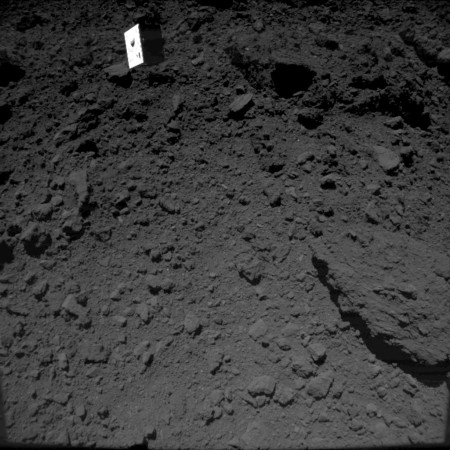
MASCOT image of Ryugu surface

Update: The image at right, reduced to post here, was taken by MASCOT during its descent. You can see the spacecraft’s shadow in the upper right. If you click on the image you can see the full resolution version.

Original post: The German/French-build mini-lander MASCOT has been successfully deployed by Hayabusa-2 and has successfully landed on the asteroid Ryugu.

MASCOT came to rest on the surface approximately 20 minutes after the separation. Now, the team is analysing the data that MASCOT is sending to Earth to understand the events occurring on the asteroid Ryugu. The lander should now be on the asteroidโ€™s surface, in the correct position thanks to its swing arm, and have started to conduct measurements independently. There are four instruments on board: a DLR camera and radiometer, an infrared spectrometer from the Institut d’Astrophysique Spatiale and a magnetometer from the TU Braunschweig. Once MASCOT has performed all planned measurements, it is expected to hop to another measuring location. This is the first time that scientists will receive data from different locations on an asteroid.

The spacecraft took 20 pictures during its descent, which were beamed to Hayabusa-2 where they are presently stored.

0 comments

Deployment operations for Hayabusa-2’s MASCOT lander have begun

Engineers have begun the deployment sequence for Hayabusa-2’s MASCOT lander, with deployment planned for tomorrow.

Right now Hayabusa-2 is slowly moving closer to Ryugu, with live images appearing about once every half hour. More information about MASCOT can be found here. The lander can also hop like the MINERVA bouncers, but it can only do it once. Its battery life is about sixteen hours, so once it is deployed it will only operate on the surface for a short while.

Both the MINERVA and MASCOT mini-landers are mostly engineering tests for using small cubesat-sized spacecraft as probes. So far the MINERVA bouncers have been an unqualified success. Hopefully MASCOT will be as successfully.

0 comments

New images from Hayabusa-2’s mini-bouncers

Three press releases from the Hayabusa-2 science team last night provide new images from the spacecraft’s MINERVA bouncers, presently on the surface of Ryugu, as well as new high resolution images from Hayabusa-2 during its recent close-in maneuvers.

The images from the first story also includes a ten second movie showing a very rocky surface with the sun moving across the sky. The last link shows the primary landing site candidate with two backup sites.

All told, these images suggest that Ryugu is nothing more than a rubble pile stuck together. If it was heading to Earth, it might be difficult to deflect it, as it might break apart caused by any stress.

1 comment

Creeping into Ryugu

Ryugu

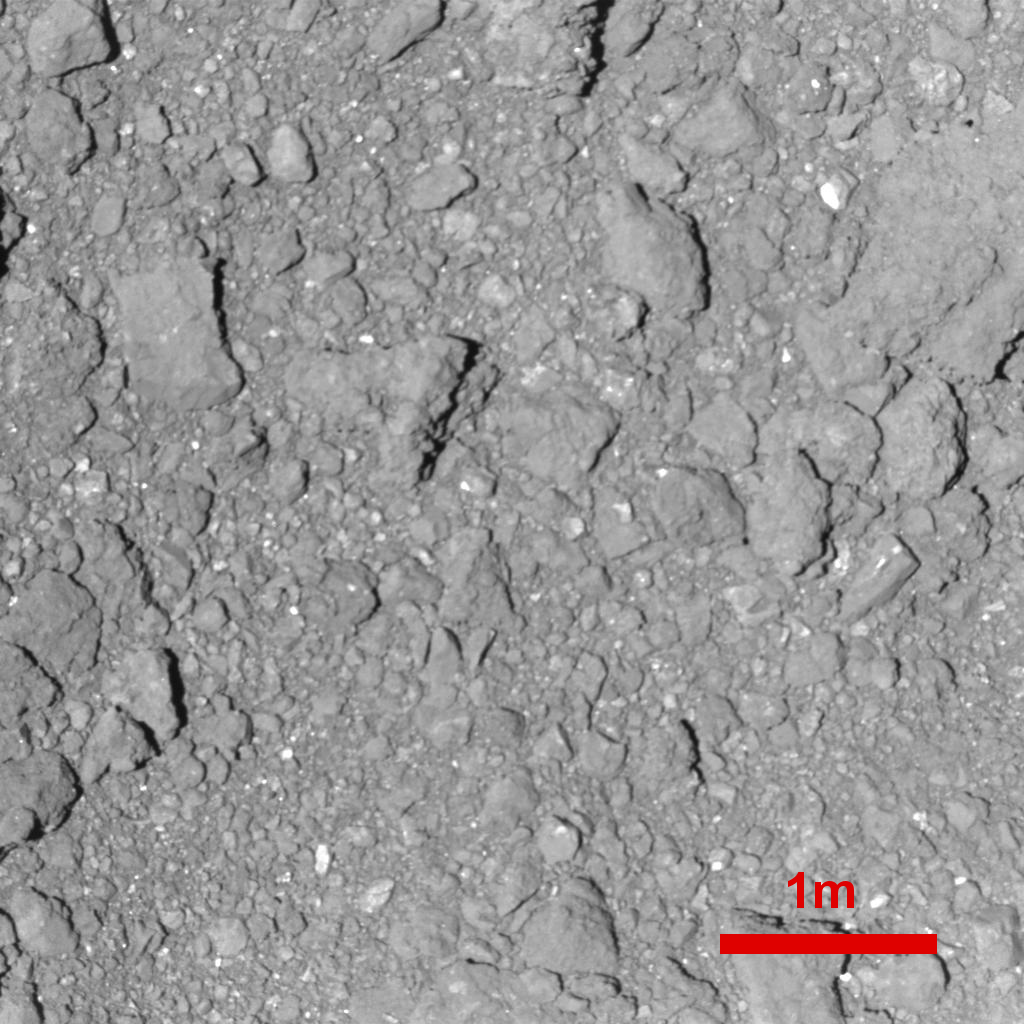
Cool images! As Hayabusu-2 creeps to its closest approach to Ryugu in preparation to releasing its first two mini-landers, dubbed MINERVA-II-1 and 2, the images coming down about once every half hour show the asteroid increasingly closer, with the spectacular shadow of Hayabusa-2 with its solar panels clearly visible.

The image on the right was downloaded about 10 pm (Pacific) tonight. The boulder-strewn field of Ryugu is also clearly visible. The black areas are where data has not yet been downloaded. The bright area under the shadow is merely an optical illusion.

UPDATE: A look at this webpage provides some details. When this image was taken the spacecraft was about 60 100 meters above the surface, its closest approach yet. This was also when the MINERVA-II landers were to be deployed.

All later images at the first link above were from a greater distance.

UPDATE: I have corrected the post. They released both MINERVA-II rovers, and they did it about 100 meters distance from the asteroid, not 60. We will not know the mini-landers’ status until late today.

4 comments
1 5 6 7 8 9