Hayabusa-2 schedules explosion on Ryugu

The Hayabusa-2 science team has scheduled April 5 for when it will use the spacecraft to fire an explosive device into Ryugu to create a crater and debris cloud.

The probe is scheduled to detach a device loaded with explosives some 500 meters away from Ryugu. The device will set off the explosives using a timer some 40 minutes later and launch a copper “impactor” weighing about 2 kilograms into the asteroid’s surface.

The target point is several hundreds of meters away from where the space probe first touched down. The mission will require the spacecraft to move quickly to the other side of the asteroid so it won’t get hit by flying shards from the blast. A detached camera will shoot the moment of impact.

JAXA will analyze the size and shape of the crater, and how rocks fly off in a bid to collect underground samples for possible clues to the origin of the solar system.

This is different than the touchdown last month, as the spacecraft itself will not get close to the asteroid.
1 comment

Hayabusa-2 to get close to Ryugu again to observe next touchdown point

Hayabusa-2’s engineering team has decided it will on March 8 do a close approach to within 75 feet of its next planned touchdown target site in order to inspect it.

The DO-S01 operation schedule is shown in Figure 2. The spacecraft will begin descending on March 7 at 13:27 (JST, onboard time: times below are stated similarly) at a speed of 0.4m/s. The speed will then be reduced to 0.1 m/s around 23:47 on the same day. Continuing descent at this rate, we will reach our lowest altitude at around 12:22 on March 8 and then immediately begin to rise. The altitude of this lowest point will be about 23m. Please note that the times stated here are the planned values but the actual operation times may differ.

As before, they will upload navigation images as this approach is happening.

0 comments

Video from Hayabusa-2’s touchdown

The Hayabusa-2 science team has released a video taken of the spacecraft’s quick touchdown and sample grab on the asteroid Ryugu.

I have embedded the video below the fold. It not only shows the incredible rockiness of Ryugu’s surface, with the spacecraft barely missing a large rock as it came down, it also clearly shows the resulting debris cloud and surface changes after touchdown and the firing of Hayabusa-2’s projectile into the surface to throw up material that the spacecdraft could catch. You can actually see pebbles flying about below and around the spacecraft as it quickly retreats.

The Hayabusa-2 science team plans another touchdown in the next few months, this time using a different technique to disturb the surface and grab the resulting ejecta.
» Read more

3 comments

Hayabusa-2 touchdown images released

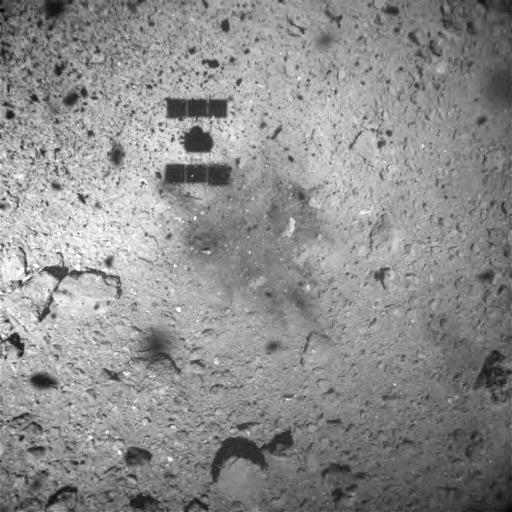
Surface of Ryugu 1 minute after touchdown

The Hayabusa-2 science team today released images taken during its quick touchdown on the asteroid Ryugu last week.

The image to the right was taken:

roughly 1 minute after touchdown at an estimated altitude of about 25m (error is a few meter) [80 feet]. The color of the region beneath the spacecraft’s shadow differs from the surroundings and has been discolored by the touchdown. At the moment, the reason for the discoloration is unknown but it may be due to the grit that was blown upwards by the spacecraft thrusters or bullet (projectile).

The image proves that everything on Hayabusa-2 worked as planned, and it almost certainly captured some of that grit.

They are going to do at least two more touchdowns before they have Hayabusa-2 leave Ryugu and head back to Earth.

3 comments

Confirmed: Hayabusa-2 grabbed got a sample of Ryugu

The Hayabusa-2 science team has confirmed that in the spacecraft’s quick touchdown on the surface of the asteroid Ryugu today it successfully snagged an asteroid sample.

Mission team members announced at about 6:30 p.m. EST (2330 GMT) today that the order to fire the bullet had been issued, and that Hayabusa2 had moved away from Ryugu as planned. But it took a few more hours for them to confirm that the bullet had indeed fired, and that sample collection occurred.

…The collected samples are key to this objective: The Ryugu material will come down to Earth in a special return capsule in December 2020. Scientists in labs around the world can then scrutinize the stuff with far more advanced equipment than the Hayabusa2 team could pack onto a single spacecraft.

The sample bounty will include more than just the material Hayabusa2 collected today. The mothership is expected to grab two more samples in the coming weeks and months. The second sampling sortie will unfold much like today’s did, but the third will be dramatically different: Hayabusa2 will fire a copper projectile into Ryugu, wait a bit for the dust to clear, and then swoop in to grab material from the newly created crater. This formerly subsurface stuff will be pristine, unaffected by weathering from deep-space radiation.

More thrills to come, obviously.

3 comments

Hayabusa-2 has begun approach to Ryugu

Ryugu during approach

Hayabusa-2 has begun its approach to Ryugu, aiming for a quick touchdown and sample grab at approximately 7:06 pm (Eastern) tonight. The image at the right is the most recent taken during the approach.

The risks? From the Hayabusa-2 website:

Our original schedule planned for touchdown in late October of last year (2018). However, Ryugu was revealed as a boulder strewn landscape that extended across the entire surface, with no flat or wide-open regions. Before arriving at Ryugu, it was assumed there would be flat areas around 100 meters in size. But far than finding this, we have not even seen flat planes 30 meters across!

During the scheduled time for touchdown in late October, we did not touchdown but descended and dropped a target marker near the intended landing site. We were able to drop the target marker in almost the planned spot and afterwards we examined the vicinity of the target marker landing site in detail. Finally, the area denoted L08-E1 was selected as the place for touchdown.

From the first link above you can see approach images as they are downloaded today, about once every half hour.

0 comments

Hayabusa-2 prepares to land

Ryugu's northern hemisphere

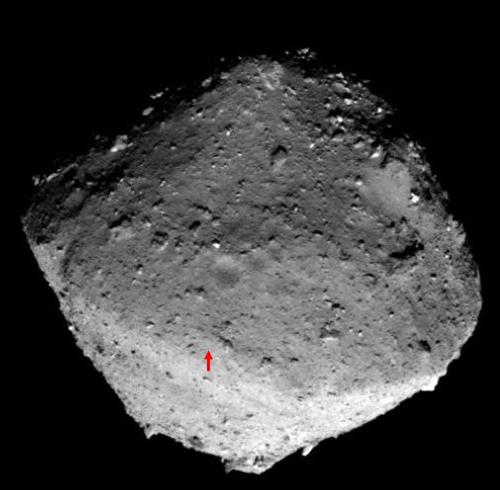
The JAXA science team has released a set of images taken in January by Hayabusa-2 of its landing site on Ryugu, describing how those images helped map the region where touchdown will occur on February 22. The image on the right is one such image.

[It] shows a diagonally imaged photograph of Ryugu, captured by moving the spacecraft towards the direction of the north pole. The upper side of the image shows the north pole and reveals a landscape dominated with many large boulders. The white band extending to the left and right slightly below the center of the image is the equatorial ridge (Ryujin Ridge). The arrow tip marks the planned touchdown site and you can see this site is on the main ridge.

This is the first time we have images the northern hemisphere of Ryugu. In this observation, we acquired data on the equatorial region of Ryugu, the southern and northern hemisphere. Imaging the entire area is very important for creating accurate global shape models for Ryugu.

They should begin beaming images down of the landing approach sometime tomorrow, and will do so about every 30 minutes throughout the sequence.

0 comments

Hayabusa-2 to attempt asteroid landing on February 22

JAXA, Japan’s space agency, today announced that Hayabusa-2 will attempt a landing on the asteroid Ryugu on February 22.

The landing was delayed from October because of the unexpected roughness of Ryugu’s surface, which literally has no spot smooth enough and large enough for Hayabusa-2, as planned. This landing will therefore be attempted in one of two places that are almost large enough, but not quite. It thus carries some additional risks.

0 comments

Hayabusa-2 names features on Ryugu

The Hayabusa-2 science/engineering teams have now revealed the names they have given to all the significant features on Ryugu that they have photographed.

To name a place on a celestial body in the Solar System, you must first decide on a theme. For example, the theme for places on Venus is the “names of goddesses”. During discussions between the domestic and overseas project members, suggestions such as “names of castles around the world”, “word for ‘dragon’ in different languages” and the “names of deep-sea creatures” were proposed for the place name theme on Ryugu. After an intense debate, the theme was selected to be “names that appear in stories for children” and a theme proposal was put to the IAU WG. The proposal was accepted on September 25, after which the discussion moved to selecting the topographical features to be named and the choice of name.

The link provides a table describing the meaning of many of the names, which is often quite amusing. For example, Kolobok Crater comes from a Russian story about “A small round bread that ran away from home.”

2 comments

Hayabusa-2 to grab asteroid samples in February

The Hayabusa-2 science team has decided that it will make their first attempt to land and grab samples from the asteroid Ryugu in February.

“The time has finally come,” JAXA senior project member Takashi Kubota said at a news conference on Jan. 8. “Two candidate landing spots have their own advantages and drawbacks, but we will robustly try to collect samples.” The two sites are near the equator of the asteroid. JAXA said it will pick one by early February.

Between Feb. 18 and Feb. 23, the Hayabusa 2 will start descending from its “home position” at an altitude of 20 kilometers from the asteroid. JAXA will use “target markers,” which will be dropped on Ryugu beforehand, to guide the probe.

Hayabusa 2 is scheduled to make three touch-and-go landings.

There are clearly risks here, since the asteroid is strewn so completely with rocks and boulders.

0 comments

Comparing Ryugu and Bennu

Link here. As much as they are alike, which is not surprising as they both come from the same asteroid family, the article notes the surprising differences.


Both asteroids are also liberally strewn with boulders – a challenge to mission planners on each team, who hope to descend close enough to scoop up samples for return to Earth. “It’s certainly more rugged than we had expected,” Lauretta says. 

But while boulders on Ryugu look to be unpleasantly ubiquitous, Bennu’s terrain is more varied, with more-obvious places where a safe touchdown might be possible. And, Lauretta notes, the OSIRIS-REx spacecraft is only recently arrived.

“We have a long time to explore and make the crucial decisions about where to go,” he says.

The biggest difference has to do with water. Even though scientists believe them to be portions of the same parent body, which broke apart between 800 million and one billion years ago, Bennu appears to be water rich, while Ryugu is less so. Within a week of arrival, infrared spectrometers on OSIRIS-REx were finding evidence of water-bearing minerals, and not just in localised patches. “We saw this in every single one of the spectra we have taken to date,” says Amy Simon, of NASA’s Goddard Space Flight Centre in Greenbelt, Maryland. 

One of the reasons Bennu was chosen as OSIRIS-REx’s target, Lauretta says, was the hope it would be rich in water, and possibly in organic compounds.

The similarities and differences in the samples both spacecraft will bring back will be most revealing.

0 comments
1 4 5 6 7 8 9