Astronomers measure the vibrations of a star 21 light years away

Using an instrument on the ground-based Keck telescope in Hawaii, astronomers have been able to measure the internal vibrations of a star 21 light years away, the equivalent of recording a star’s seismology.

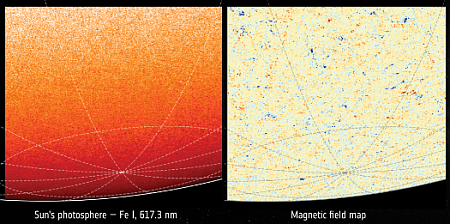
Keck Observatory’s KPF instrument precisely measures the motion of the stellar surface towards and away from the observer. Over four consecutive nights, the team used KPF to collect over 2,000 ultra-precise velocity measurements of the star — enabling them to catch the star’s vibrations in action. This is the first asteroseismic inference of the age and radius for a cool star using KPF.

The astronomers next claim that this data allowed them to date the star’s age as 10.2 billion years old, and that it was about 4% smaller in diameter than measured by other observations. Both these conclusions carry uncertainties, but the former has implications if true for the present theories of stellar evolution, since this star appears to be behaving differently than expected for a star this old.

Astronomers have been doing this kind of stellar seismology for the Sun for several decades. To now have instruments sensitive enough to detect it on stars light years away is truly astonishing.

0 comments

Giant galactic magnetic filament disturbed by pulsar

A giant galactic filament disturbed by a pulsar
Click for original image.

Cool image time! The false-color X-ray picture to the right, reduced and sharpened to post here, was released today by the science team for the Chandra X-ray Observatory, showing some interesting astronomical features about 26,000 light years away near the galactic center.

The press release attempts to catch the ignorant press’s interest by referring to the long white filament that crosses this image as “a bone”, implying that this is similar to a medical X-ray of a person’s bones. Hogwash. What we are looking at is a filament of energized particles forced into this long thin shape by the magnetic field lines that exist in the central regions of the Milky Way galaxy.

What makes this X-ray data of interest is shown in the inset. The pulsar appears to have disturbed that filament, pulling those energetic particles away to form a trailing cloud.

In the first composite image, the largely straight filament stretches from the top to the bottom of the vertical frame. At each end of the grey filament is a hazy grey cloud. The only color in the image is neon blue, found in a few specks which dot the blackness surrounding the structure. The blue represents X-rays seen by NASA’s Chandra X-ray Observatory.

In the annotated close-up, one such speck appears to be interacting with the structure itself. This is a fast-moving, rapidly spinning neutron star, otherwise known as a pulsar. Astronomers believe that this pulsar has struck the filament halfway down its length, distorting the magnetic field and radio signal.

As big and empty as space is, there is still enough stuff within it to cause these kinds of interactions. It just requires the luxury of endless eons, something that we as short-lived humans have trouble conceiving.

4 comments

A Martian river of ice

A Martian river of ice
Click for original image.

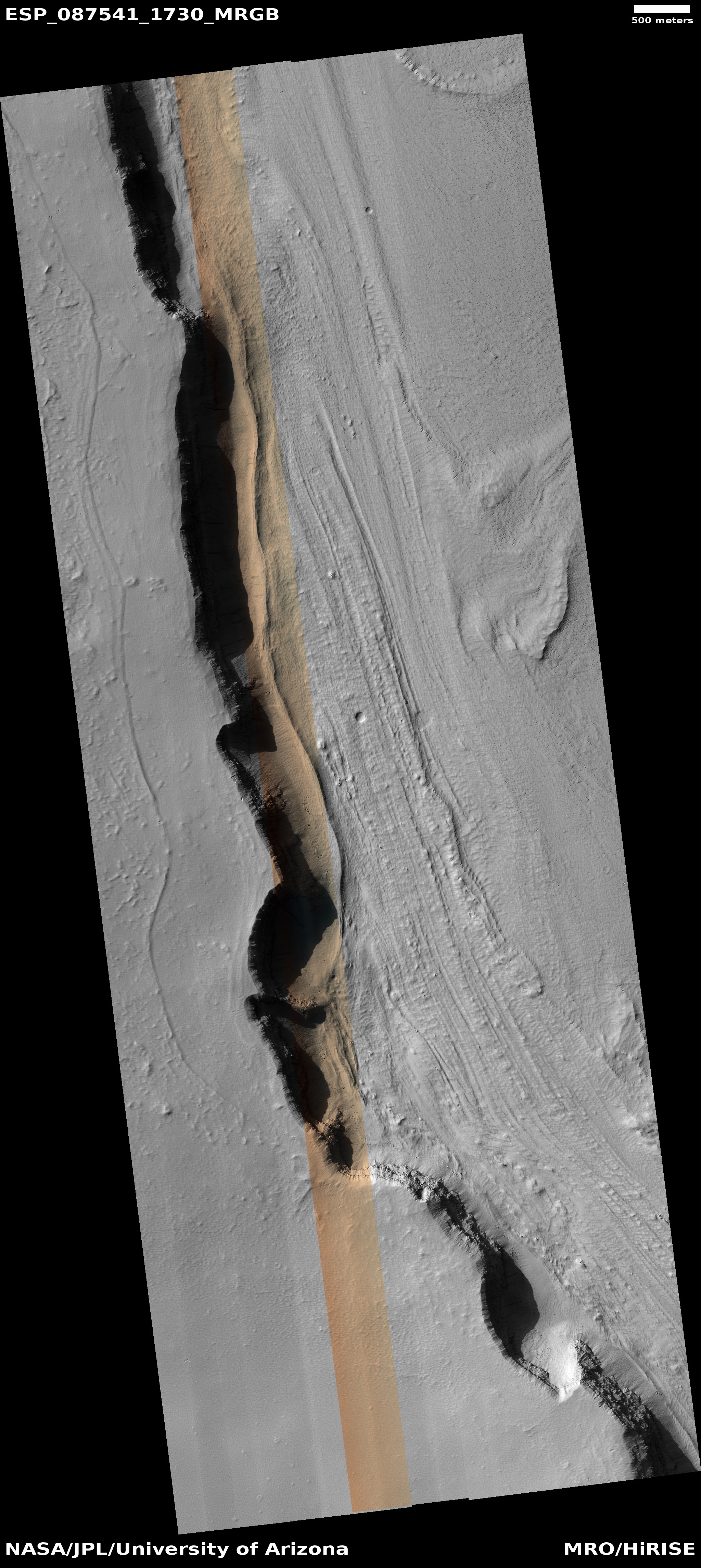
Cool image time! The picture to the right, cropped, reduced, and sharpened to post here, was taken on January 26, 2025 by the high resolution camera on Mars Reconnaissance Orbiter (MRO). The science team labeled it “Looking for Gullies” because the researchers were likely searching for such geological features on the cliff wall that runs down the right side of the picture.

What is more significant however about this picture is the glacier features in the canyon below that cliff. The downhill grade is to the southwest, and it is very evident that the canyon is filled with glacial-type debris, flowing down that grade. Along the base of the cliff the flow seems focused but squeezed, the larger blocks to the west moving slower and thus acting like a wall themselves. In between the flow moves like rapids in a narrow part of a river, albeit in slow motion.
» Read more

0 comments

Astronomers discover a cluster of a thousand very young stars that is flying apart for unknown reasons

Astronomers using data from Gaia, which measured the precise distance and position of more than two billion stars, have discovered a very young cluster of a thousand stars that is flying apart for unknown reasons.

The cluster is about 650 light-years away in Ophiuchus, the Serpent Bearer, and has been nicknamed “Ophion” in honor of its resident constellation. “Ophion is filled with stars that are set to rush out across the galaxy in a totally haphazard, uncoordinated way, which is far from what we’d expect for a family so big,” said Huson in a statement. “What’s more, this will happen in a fraction of the time it’d usually take for such a large family to scatter. It’s like no other star family we’ve seen before.”

You can read the peer-reviewed paper here [pdf]. The scientists proposed several theories that might explain what disrupted this cluster so early in its history, but none are very convincing, with the data available.

0 comments

Psyche asteroid probe experiences an unexplained engine problem

Psyche's flight path to the asteroid Psyche
Psyche’s flight path to the asteroid Psyche.
Click for original image.

The probe Psyche, presently on its way to the asteroid of the same name, has experienced a thruster issue with its electric ion-type main engine that has forced engineers to postpone further engine use as they troubleshoot the problem.

Psyche began firing its thrusters in May 2024. On April 1, the spacecraft detected a pressure drop in the line that feeds the xenon gas to the thrusters, going from 36 pounds per square inch (psi) to about 26 psi. As designed, the orbiter powered off the thrusters in response to the decrease.

The mission team has chosen to defer thrusting while engineers work to understand the pressure decrease. The mission design supports a pause in thrusting until at least mid-June before the spacecraft would see an effect on its trajectory. The electric propulsion system has two identical fuel lines, and the team may decide to switch to the backup fuel line to resume thrusting.

This mission has been plagued with problems. First its software was completed late, forcing a year delay in its launch. Next it was discovered — too late to fix — that transistors on the spacecraft had not been properly hardened for the hostile environment of space. Engineers hope these transistors “will heal themselves” once in that environment, but there are no guarantees. [My memory is becoming fuzzy. As many of my readers pointed out, this transistor problem was with Europa Clipper, not Psyche.]

Now its electric ion engine, essential to getting it to Psyche, is not working properly.

If this problem is fixed and Pysche resumes engine firing, it is targeting an arrival at the asteroid Psyche in 2029.

6 comments

The American Geophysical Union: the privileges of government-paid scientists must come above the Constitution and the ordinary citizens who pay the bills

The American Geophysical Union, where science is no longer practiced
The American Geophysical Union, where
science is no longer practiced

In a public letter issued late yesterday, the American Geophysical Union (AGU) announced it has joined a lawsuit attempting to make the salaries, jobs, and various research grants of scientists immune from cancellation or the budget cuts that have been ordered by the elected president of the United States, Donald Trump.

Plaintiffs assert that such a sweeping Executive Order — which would impact hundreds of thousands of federal workers — goes far beyond the authority of the President to direct, and that such a massive reorganization of federal agencies must be planned in accordance with law and approved by Congress. AGU’s role in the case will involve illustrating the extensive ways in which scientists and the public will be irreparably harmed by the execution of the President’s order, in particular through proposed mass terminations at NOAA, the Department of Agriculture, Department of Energy, the Environmental Protectional Agency, and the National Science Foundation.

“This Executive Order is demanding layoffs on such a massive scale that they will have drastic, cascading effects on our members, the global scientific community, and the public,” said Janice R. Lachance, Interim Executive Director and CEO of AGU. “From forecasting severe weather and ensuring healthy crops to preventing uncontrollable wildfires and preparing communities for sea level rise, fully functioning federal scientific agencies are critical.” [emphasis mine]

The highlighted phrases show the priorities. The public comes last. More important are “federal workers,” the “members” of the AGU, and “the global scientific community.” Moreover, the letter reeks of privilege and smug superiority. It assumes that the paychecks from the taxpayers must never end, no matter what. The very idea that the president — duly elected by the American people and whom the Constitution vests with the sole power to run the executive branch of the federal government — should actually do what he promised the voters during the campaign actually offends them. “We come first! To hell with what the public wants!”

None of this should surprise anyone. The AGU, along with most national scientific organizations, has been corrupted by leftist politics for decades. It threw out the fundamentals of objective science years ago when it declared that it will reject any paper that does not support the theory of human-caused global warming. Its PR department has consistently reinforced this unscientific bias, pushing global warming in practically every press release.

And if you still have doubts about its leftist agenda divorced from objective science, you need only read its own description at the end of yesterday’s letter, outlining the organization’s priorities:
» Read more

22 comments

Hubble snaps picture of barred spiral galaxy

A barred spiral galaxy as seen by Hubble
Click for original image.

Cool image time! While NASA celebrates the 35th anniversary of the Hubble Space Telescope with photos from its past, astronomers continue to use it to produce new wonders. The picture to the right, cropped, reduced, and sharpened to post here, was taken by Hubble recently and released today.

NGC 5335 is categorized as a flocculent spiral galaxy with patchy streamers of star formation across its disk. There is a striking lack of well-defined spiral arms that are commonly found among galaxies, including our Milky Way. A notable bar structure slices across the center of the galaxy. The bar channels gas inwards toward the galactic center, fueling star formation. Such bars are dynamic in galaxies and may come and go over two-billion-year intervals. They appear in about 30 percent of observed galaxies, including our Milky Way.

The theorized formation process of that bar is based on computer modeling using the limited data we presently have, and thus carries a great deal of uncertainty.

2 comments

NASA re-releases a slew of Hubble images to celebrate its 35th anniversary

Eta Carina, in focus, after 1993 repair mission

As part of its celebration of the telescope’s 35th anniversary, NASA on April 25, 2025 re-released what it called 27 key images from the history of the Hubble Space Telescope.

More than half the images are historical, showing the telescope’s conception by astrophysicist Lyman Spitzer, its construction, its launch in 1990, and its repair in 1993 of its faulty optics. The subsequent sharp astronomical images include only a few of Hubble’s most famous and significant later photographs, including the first Hubble Deep Field, the Hourglass planetary nebula, and the Pillars of Creation snapshot.

What NASA did not include in this collection however was without doubt to those alive at the time after Hubble was finally repaired its most historically significant photo. That picture is to the right. It shows the exploding star Eta Carina as taken by Hubble in 1993 right after its repair.

For the very first time, we had a telescope above the Earth’s fuzzy atmosphere capable of taking sharp in-focus images of the mysteries of the heavens. And for the first time, we could see in this star its actual nature. It wasn’t simply surrounded by a pretty cloud — as all previous ground-based images had suggested — that cloud was formed by eruptions from the star itself. Those earlier eruptions, which had occurred in the previous century, had spewed from the star’s poles, forming two bi-polar clouds that were expanding away from the star most dramatically.

In the three decades since astronomers have used Hubble and its later upgraded cameras to track those expanding clouds, with the most recent photo taken in 2019. Hubble has shown that such massive heavenly objects are not static, but evolving, and with the right high resolution telescopes in space we can track that evolution, in real time.

At the moment no comparable replacement of Hubble is planned, or even on the drawing board. The Einstein space telescope, just launched, will provide magnificent optical images at a slight lower resolution. So will China’s planned Xuntian space telescope, set for launch in 2027. Neither however matches Hubble’s capabilities.

And Hubble is now long past its original lifespan of fifteen years. Though engineers say it is in good shape, this is not true. It presently has only two trustworthy working gyroscopes. To extend its lift, the telescope is operated on only one gyroscope, with a second held back in reserve. When these go, however, so will Hubble.

Meanwhile, the astronomy community continues to put most of its energy in building giant ground-based telescopes that not only cannot match Hubble but are threatened by the coming wave of new communication constellations. Do they rethink their approach and shift to orbital astronomy?

Nah. Instead, the astronomical community demands new powers to to ban those constellations!

Of all people, one would think astronomers more than anyone else would not put their head in the sand. But that’s what they continue to do.

1 comment

Curiosity’s recent travels as seen from orbit

The view of Curiosity from orbit
Click for original image.

Oveview map
Click for interactive map.

Cool image time! Using Mars Reconnaissance Orbiter (MRO), scientists have captured a very cool image of Curiosity in its recent travels on Mars. That picture is above, reduced and sharpened to post here.

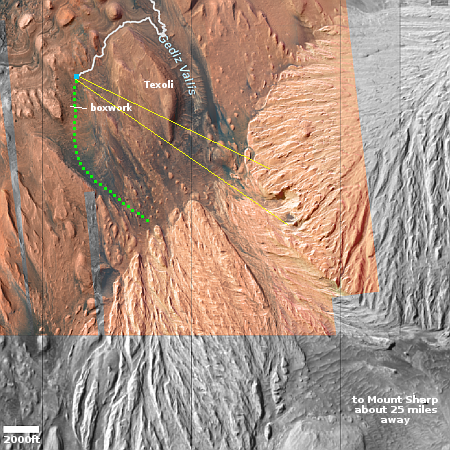
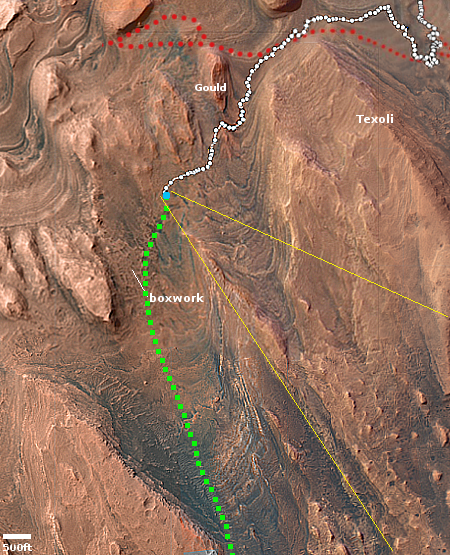
Taken by the HiRISE (High-Resolution Imaging Science Experiment) camera aboard NASA’s Mars Reconnaissance Orbiter, the image shows Curiosity as a dark speck at the front of a long trail of rover tracks. Likely to last for months before being erased by wind, the tracks span about 1,050 feet (320 meters). They represent roughly 11 drives starting on Feb. 2 as Curiosity trucked along at a top speed of 0.1 mph (0.16 kph) from Gediz Vallis channel on the journey to its next science stop: a region with potential boxwork formations, possibly made by groundwater billions of years ago.

The overview map to the right provides some context. Curiosity’s present position is indicated by the blue dot. The yellow lines indicate the approximate section of its past travels photographed by the picture above.

According to the press release at the link, the science team is now estimating the rover will arrive at the boxwork geology in about a month.

0 comments

Trump cuts apparently shutting down NASA’s climate office in New York

Schmidt's data tampering, as documented in 2017
Schmidt’s data tampering, as documented in 2016.

As part of the Trump administration’s aggressive effort to trim the federal budget as well as shift the research focus at the federal government’s many science agencies, on April 24, 2025 it revealed that it has canceled the building lease for the Goddard Institute for Space Studies (GISS) in New York that has existed since 1961 and in 2016 and 2017 was found to be tampering with past climate data with no explanation, lowering past temperature numbers while raising more recent ones in order to make the data fit the as-yet unproven theory that human activity is causing global warming.

Those “adjustments” have never been justified in any way. Nor has Gavin Schmidt, the man who heads GISS, ever done anything to correct them. Moreover, when his office was accused of this tampering in 2016 he not only refused to fix or justify the changes, he responded by claiming “planetary warming does not care about the election.” In the years since it has been his office that annually declares each year “the hottest on record,” using these tampered numbers to do so and demonstrating that he has been acting not as a real researcher but as a political operative of the global warming crowd.

Though the office lease is being canceled, GISS has not been shut down, as of now.

While NASA is terminating the lease on the GISS offices, it is not closing the institute itself. Lystrup said in the email that it will help employees move “to remote work agreements in the short-term as the agency seeks a new, permanent space for the team.”

I suspect this statement is merely designed by Trump officials to dampen the screams of opposition against its actions. It is very likely GISS is going away, and most of its employees will have to find new jobs.

The hope is that new scientists can be hired to review these tampered numbers and get them fixed so that climate research in the future can proceed with reliable data.

8 comments

A telescope picture of blackness

A dust cloud in space
Click for original image.

Cool image time! The picture to the right, cropped, reduced, and sharpened to post here, was released today by the science team running the Dark Energy Camera on the Blanco 4-meter telescope in Chile.

This winding, shadowy form, accentuated by a densely-packed starry background, is the Circinus West molecular cloud — a region rich in gas and dust and known for its host of newly formed stars. Molecular Clouds, the cradles of star formation, are interstellar clouds that are so dense and cold that atoms within them bond with each other to form molecules. Some, such as Circinus West, are so dense that light cannot pass through, giving them a dark, mottled appearance and earning them the name dark nebulae. The cloud’s flourishing population of young stars has offered astronomers a wealth of insight into the processes driving star formation and molecular cloud evolution.

…Circinus West is known for harboring dozens of young stellar objects — stars that are in their early stages of development. Despite being shrouded in dense gas and dust, these infant stars make themselves known. Zooming in, various clues to their presence can be seen dotted throughout Circinus West’s snaking tendrils.

The cloud is about 2,500 light years away and is estimated to be about 180 light years across. Scientists estimate the mass in the cloud to be about 250,000 times that of the Sun.

No one however would ever even know this cloud existed if it wasn’t back dropped by thick field of stars behind it.

1 comment

Ispace’s Resilience lunar lander completes all maneuvers prior to entering lunar orbit

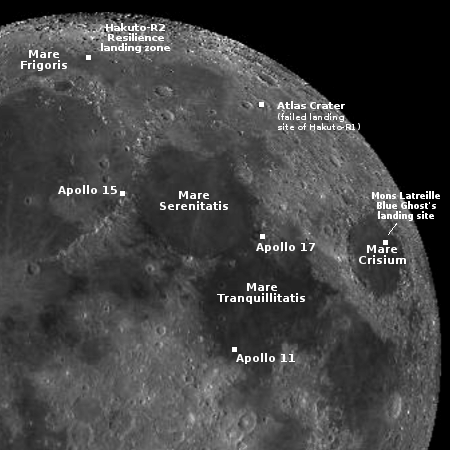
Map of lunar landing sites
Landing sites for both Firefly’s Blue Ghost and
Ispace’s Resilience

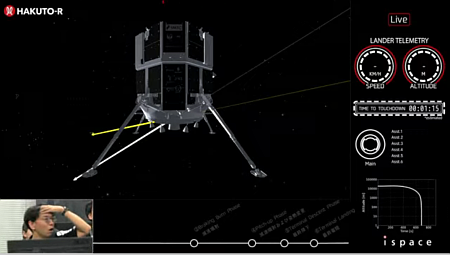
The Japanese startup Ispace today announced that its Resilience lunar lander — launched on a Falcon 9 to the Moon in January — has now completed all the orbital maneuvers required to send it on a path to enter lunar orbit in early May.

Ispace engineers performed the final orbit maneuver from the Mission Control Center in Nihonbashi, Tokyo, Japan in accordance with the mission operation plan. In total, the RESILIENCE lunar lander has completed 8 orbit control maneuvers. RESILIENCE is now maintaining a stable attitude in its planned orbit and mission operations specialists are now preparing for the Mission 2 milestone Success 7, “Entering Lunar Orbit.” The RESILIENCE lander is expected to enter lunar orbit on May 7, 2025.

The map to the right shows the landing zone, near the top of Moon’s near hemisphere in the region of Figoris Mare. The landing will occur a week or so after orbital insertion, after the company’s engineers have fully assessed the situation.

The rover carries eight commercial payloads, including its own Tenacious mini-rover, as well as a “water electrolyzer” from a Japanese company, a “food production experiment” from another company, and a “deep space radiation probe” from the National Central University of Taiwan.

Resilience’s main purpose however remains to prove the company can build and successfully soft land on the Moon. Its only previous attempt, Hakuto-R1, crashed in Atlas Crater. Despite that failure Ispace has won a contract each from NASA and Japan to launch additional lunar landers, so a success here is critical for the company’s future.

Hat tip BtB’s stringer Jay.

1 comment

China accelerates its schedule for its upcoming Moon/Mars missions while admitting its lunar base will take longer

Phase I of China/Russian Lunar base roadmap
The original phase I plan of Chinese-Russian lunar
base plan, from June 2021.

The new colonial movement: In several different reports today in China’s state-run press — timed to coincide with the launch of three astronauts to Tiangong-3 — Chinese officials confirmed that it has moved up the planned launch dates for both its first lunar rover as well as its Mars sample return mission, and it is also expanding its offers to the international community to partner on those missions.

At the same time it let slip the fact that it will not be establishing its lunar base on the Moon in 2030, as previously claimed. Moreover, note how this so-called accelerated schedule of lunar missions is actually behind the announced timetable outlined by China and Russia in 2021, as shown on the right. None will fly by this year, as promised.

As for the news today, first China announced that its Tianwen-3 Mars sample return mission will launch in 2028.
» Read more

6 comments

Eroding lava layers in Mars’ volcano country

Eroding lava in Mars' volcano country
Click for original image.

Cool image time! The picture to the right, cropped, reduced, and sharpened to post here, was taken on February 28, 2025 by the high resolution camera on Mars Reconnaissance Orbiter (MRO).

The scientists label this picture “enigmatic terrain.” And there are certainly mysteries here. For example, why are there scattered tiny knobs across the surface in the low areas, but not on the higher areas? Also, what caused that top layer to get stripped in places? Was it erosion from wind? Or did some other process cause that layer to vanish in these spots?

Note too that this landscape has few craters. Whatever happened here occurred recently enough that it was able to cover over the impact history from the early solar system that peppered the planets with craters as the planets formed. Though impacts continue even to this day, the impact rate is far less, which allows younger terrain like this to remain largely crater free.

The location provides us some answers, but it still leaves much of this geology a puzzlement.
» Read more

0 comments

More wheel damage detected on Curiosity

Increased wheel damage on Curiosity
Click for the Sol 4518 original image.

In a set of new pictures taken of Curiosity’s wheels yesterday it appears that the damage to those wheels has increased significantly in the past year, with the most damaged wheel (which based on contradictory science team reports is either the middle left or middle right wheel), having more had more sections broken to the point where this wheel might even fail in the near future.

The pictures to the right show these changes. The treads, called grousers, have been numbered to make the comparisons easier. The bottom two pictures were taken in September 2024, and look at this wheel with the damage on the side to show how a whole section of the wheel had at that time collapsed to form a depression.

The top two pictures show the increase in the damage in this section between February 2024 and yesterday. Note especially the changes in growlers 4, 5, and 6. Not only have large sections broken off in the wheel’s central section, it appears that the wheel’s outside section is beginning to separate from that central section.

The increased damage in the past year illustrated starkly the roughness of the terrain that the rover is traversing. Moreover, there is no sign that roughness is going to ease anytime in the near future. This increased damage thus explains partly why the science team changed the rover’s route to get to the nearby boxwork geology as fast as possible. That unique geology is likely to provide some important scientific information unobtainable elsewhere, and it seems worthwhile to get to it before this particular wheel fails.

There is one silver lining to this cloud. This particular wheel is a middle wheel, which means it is less critical to maintaining the rover’s stability as it travels as well as sits. The photographs of the other wheels taken today do not show as much change. Even if this wheel fails, the rover will still have five working wheels, including the most essential four corner wheels.

13 comments

Transiting exoplanet appears to be losing matter with each transit

Astronomers using the TESS space telescope have discovered an exoplanet about 140 light years away that appears to have a tail of trailing material that is gaining mass with each transit as the planet slowly disintegrates.

The typical signal of an orbiting exoplanet looks like a brief dip in a light curve, which repeats regularly, indicating that a compact body such as a planet is briefly passing in front of, and temporarily blocking, the light from its host star.

This typical pattern was unlike what Hon and his colleagues detected from the host star BD+05 4868 A, located in the constellation of Pegasus. Though a transit appeared every 30.5 hours, the brightness took much longer to return to normal, suggesting a long trailing structure still blocking starlight. Even more intriguing, the depth of the dip changed with each orbit, suggesting that whatever was passing in front of the star wasn’t always the same shape or blocking the same amount of light.

You can read the peer-reviewed paper here [pdf]. Their calculations estimate the planet will disintegrate entirely in about two million years.

Because of the nature of these transits, the relative nearness of the star system, and the existence of this tail of material, this exoplanet is an excellent candidate for studying the planet’s structure and make-up. The scientists advocate further studies using a range of telescopes, including Webb and Hubble.

3 comments

Trump cuts to NOAA include major shake-up on how it gathers weather data

According to the budget data that was leaked anonymous last week, the Trump administration is proposing a major restructuring of NOAA’s satellite operations, shifting from building geosynchronous weather/climate satellites in partnership with NASA to focusing on buying weather data from commercial smallsats.

The plan would initially reduce NOAA’s program by two-thirds.

The document suggests NOAA’s National Environmental Satellite, Data and Information Service (NESDIS) “immediately cancel all major instrument and spacecraft contracts on the GeoXO program,” saying the projected costs are “unstainable, lack support of Congress, and are out of step with international peers.”

GeoXO is a $19.6 billion program that includes six satellites and ground infrastructure to significantly enhance NOAA’s ability to monitor weather, map lightning, and track ocean and atmospheric conditions over decades. To maintain observations from geostationary orbit at the conclusion of the Geostationary Operational Environmental Satellite (GOES)-R Series, the White House memo calls on NOAA to “immediately institute a major overhaul to lower lifecycle costs by 50 percent” with annual costs below $500 million, while remaining on schedule to launch the first satellite in 2032.

Rather than expanding the geostationary constellation to include satellites over the East, West and Central United States, the proposal includes only East and West satellites like the GOES-R Series. OMB also recommends an immediate end to NOAA relying on NASA to help it acquire weather satellites.

Maybe the most controversial recommendation calls for NOAA to focus on gathering daily weather data while ending its monitoring of long term ocean and atmospheric climate trends.

The shift from NOAA-built satellites to purchasing weather data from commercially launched and built satellites makes great sense, and is the most likely part of this plan to get implemented. Similarly, ending NOAA’s reliance on NASA will help streamline the fat from both agencies.

Whether the Trump administration can force an end to NOAA’s climate gathering operations is less clear. The politics suggest this will be difficult. The realities however suggest that a major house-cleaning in this area is in order, as there is ample evidence that the scientists running this work have been playing games with the data, manipulating it in order to support their theories of human-caused global warming.

9 comments

First images from Lucy’s fly-by of asteroid Donaldjohanson

Asteroid Donaldjohanson
Closest view of asteroid DonaldJohanson.
Click for movie.

The science team for the asteroid probe Lucy today released the pictures taken by the spacecraft as it approached the asteroid Donaldjohanson on April 20, 2025, compiled into a short movie.

The asteroid was previously observed to have large brightness variations over a 10-day period, so some of Lucy team members’ expectations were confirmed when the first images showed what appeared to be an elongated contact binary (an object formed when two smaller bodies collide). However, the team was surprised by the odd shape of the narrow neck connecting the two lobes, which looks like two nested ice cream cones.

…From a preliminary analysis of the first available images collected by the spacecraft’s L’LORRI imager, the asteroid appears to be larger than originally estimated, about 5 miles (8 km) long and 2 miles (3.5 km) wide at the widest point. In this first set of high-resolution images returned from the spacecraft, the full asteroid is not visible as the asteroid is larger than the imager’s field of view. It will take up to a week for the team to downlink the remainder of the encounter data from the spacecraft; this dataset will give a more complete picture of the asteroid’s overall shape.

Lucy is now on its way to the orbit of Jupiter, where it will get close-up views of five different Trojan asteroids in 2027, followed by a later visit to another group of Trojans in 2033.

2 comments

Martian ridges that imitate rivers

Martian ridges that imitate rivers
Click for original image.

Cool image time! The picture to the right, cropped, reduced, and sharpened to post here, was taken on February 26, 2025 by the high resolution camera on Mars Reconnaissance Orbiter (MRO).

The scientists describe these features as “dendritic relief features,” an apt description of the thousands of miles of river-like meandering ridges that orbital images have discovered in the past decade scattered across Mars, as noted in 2016:

The inverted channels are similar to those found elsewhere on Mars and Earth. They are made of sand and gravel deposited by a river and when the river becomes dry, the channels are left upstanding as the surrounding material erodes. On Earth, inverted channels often occur in dry, desert environments like Oman, Egypt, or Utah, where erosion rates are low – in most other environments, the channels are worn away before they can become inverted.

The most dramatic example of these Martian ridge rivers are the fernlike ridges in Antoniadi Crater. The ridges to the right however are almost as striking.
» Read more

2 comments

Curiosity drill cores suggest there are more carbon-based minerals on Mars than previously believed

The uncertainty of science: Scientists studying four different core samples drilled by the Mars rover Curiosity have detected abundant amounts of the iron carbonate mineral siderite, suggesting that there is more carbon within Mars’ crust than previously believed.

If that quantity of carbon is confirmed, there might also have been a carbon cycle between Mars’s atmosphere and the liquid water theorized to have once been on the surface. This cycle could also have made the atmosphere both thicker and warmer, conditions necessary for that liquid water to exist on the surface. From the research paper:

[D]ecomposition of siderite occurred in multiple locations and released CO2 into the atmosphere, recycling CO2 that was originally sequestered during siderite formation. Diagenetic carbonate destruction observed elsewhere on Mars, in martian meteorites, and in sandstones on Earth yields nearly identical reaction products to those we found in Gale crater and are observed globally in orbital data. We therefore conclude that in situ, orbital, and terrestrial analog evidence all indicate that postdepositional alteration of siderite closed the loop in Mars’ carbon cycle, by returning CO2 to the atmosphere.

The uncertainties here are gigantic. For these conclusions to be right, the scientists extrapolate without evidence the same amount of CO2 found in these four cores as existing across the entire surface of Mars. That is a very big extrapolation that no one should take very seriously.

Furthermore, this research assumes the geological features we see on Mars were formed from liquid water. More recent orbital data suggests glacial and ice processes might have played a part instead, with one study concluding that Gale Crater was never warm enough for long-standing liquid water, and that ice and glacial processes must have played the larger part in forming what we find there.

The data from these core samples however is intriguing for sure, though it mostly raises more questions about Mars’ past geological history than it answers.

0 comments
1 22 23 24 25 26 438