Where is Pluto’s nitrogen coming from?

As New Horizons’ engineers download data and plan future maneuvers to fly past one of two candidate Kuiper Belt objects, the science team today outlined the background mystery of Pluto’s nitrogen.

Pluto’s atmosphere is similar to Earth’s in that it is predominantly composed of nitrogen (N). But Pluto’s atmosphere is ~98% N, while Earth’s is only ~78% N. Pluto’s atmosphere is also considerably thinner than Earth’s with ~10,000 times lower pressure at the surface.

The nitrogen in Pluto’s atmosphere (in the form of N2 gas) is actually flowing away and escaping the planet at an estimated rate of hundreds of tons per hour. We also see what looks like flowing ice on Pluto’s surface in high resolution images made by New Horizons. The water ice (H2O) that we are familiar with on Earth would be completely rigid and stiff at Pluto’s surface temperatures, but ice made out of N2 would be able to flow like a glacier. So where does all of this nitrogen come from?

They have rejected comets as a source, and have predicted that geologic activity on Pluto itself could dredge the nitrogen up from the planet’s interior. (This prediction by the way was made before the New Horizons’ flyby, which has proved it likely.)

If their theory ends up the answer, then they will also prove that Pluto is losing mass, albeit slowly. Nitrogen from within is being processed out of the interior, into the atmosphere as gas, and then into space because Pluto’s gravity is too small to hold it.

1 comment

Sudden outburst activity on Comet 67P/C-G

jet on Comet 67P/C-G

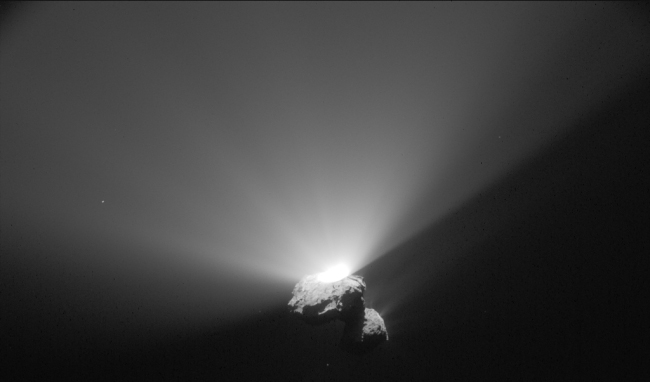
Cool image time! As Comet 67P/C-G approaches perihelion, Rosetta is detecting and imaging more and more activity coming from the nucleus, including a power outburst lasting less than a half hour.

In the approach to perihelion over the past few weeks, Rosetta has been witnessing growing activity from Comet 67P/Churyumov–Gerasimenko, with one dramatic outburst event proving so powerful that it even pushed away the incoming solar wind.

The comet reaches perihelion on Thursday, the moment in its 6.5-year orbit when it is closest to the Sun. In recent months, the increasing solar energy has been warming the comet’s frozen ices, turning them to gas, which pours out into space, dragging dust along with it.

The three pictures above were taken 18 minutes apart. The first shows nothing, and in the last the jet has almost completed dissipated. In the middle image, however, the jet is well defined, and data from the spacecraft indicated that it was so strong that it “had pushed away the solar wind magnetic field from around the nucleus.”

3 comments

Scientists narrow the next Mars rover candidate landing sites to 8

Jezero Crater

For the next Mars rover, scheduled to launch in 2020, scientists have now narrowed their candidate landing sites to eight, with Jezero Crater (pictured on the right) the favorite choice.

The top vote getter was Jezero crater, which contains a relic river delta that could have concentrated and preserved organic molecules. “The appeal is twofold,” says Bethany Ehlmann, a planetary scientist at the California Institute of Technology (Caltech) in Pasadena. “Not only is there a delta, but the rocks upstream are varied and diverse.”

The image clearly shows the scientific attraction of Jezero Crater, with an obvious meandering river canyon opening out into an obvious river delta. The crater in the delta will also give them an opportunity to do some dating research, since that crater had to have been put there after the delta was formed.

The choice however illustrates the difference in goals between scientists and future colonists. Scientists are looking for the most interesting locations for understanding the geological history of Mars. Future colonists want to find the best places to establish a home. Jezero Crater, as well as the other eight candidate sites, do not necessarily fit that settlement need. For a colonist it might be better to put a rover down on the flanks of Arsia Mons, one of Mars’ giant craters where scientists have evidence of both water-ice and caves. None of the candidate sites, however, are aimed anywhere close to this volcanic region, because scientifically it is not as interesting.

This is not to say that the candidate sites might not be good settlement sites. It is only to note that the focus of these scientists is research only. Furthermore, it is probably premature anyway to look for settlement sites. We need to know more about Mars itself.

2 comments

The bog bodies of Europe

Link here. The peat bogs preserve the bodies, providing scientists a window into the past. However, the bodies exhibit one mysterious tendency: violent death.

Since the 18th century, the peat bogs of Northern Europe have yielded hundreds of human corpses dating from as far back as 8,000 B.C. Like Tollund Man, many of these so-called bog bodies are exquisitely preserved—their skin, intestines, internal organs, nails, hair, and even the contents of their stomachs and some of their clothes left in remarkable condition. Despite their great diversity—they comprise men and women, adults and children, kings and commoners—a surprising number seem to have been violently dispatched and deliberately placed in bogs, leading some experts to conclude that the bogs served as mass graves for offed outcasts and religious sacrifices. Tollund Man, for example, had evidently been hanged.

Read it all. It is a fascinating combination of history, archeology, and forensics.

1 comment

The sunspot decline continues

On Monday NOAA posted its monthly update of the solar cycle, showing the Sun’s sunspot activity in July. As I have done every month since 2010, I am posting it here, below the fold, with annotations to give it context.

Sunspot counts continue to decline at a rate faster than predicted or is usual during ramp down from solar maximum. Normally the ramp down is slow and steady. This time it has so far been more precipitous. While the 2009 prediction of the solar science community (indicated by the red curve) suggests minimum will occur sometime after 2020, the actual counts suggest it will occur much sooner.

» Read more

7 comments

Curiosity looks ahead at its future travels

The future terrain at Mt Sharp

Cool image time! The above image is a cropped version of a full resolution image taken by Curiosity of the terrain the rover will be traveling in the coming years.

I have also enhanced the contrast slightly to bring out the details. The terrain is rugged and very diverse, from rounded buttes to rocky outcrops.

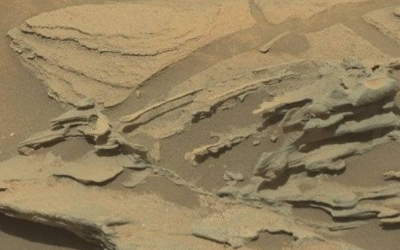
Gravel and sand ripples fill the foreground [not shown in my cropped version above], typical of terrains that Curiosity traversed to reach Mount Sharp from its landing site. Outcrops in the midfield are of two types: dust-covered, smooth bedrock that forms the base of the mountain, and sandstone ridges that shed boulders as they erode. Rounded buttes in the distance contain sulfate minerals, perhaps indicating a change in the availability of water when they formed. Some of the layering patterns on higher levels of Mount Sharp in the background are tilted at different angles than others, evidence of complicated relationships still to be deciphered.

Traversing this rugged terrain will be a challenge but it is necessary to obtain data that will help decipher its origins. The immediate goal will be to reach the light brown terrain in the distance. In the full image, that region gently slopes upward to the left to the mountain summit, providing a route to the rover’s eventual goal.

0 comments

New Ebola vaccine 100% successful in trial

Using a different experimental approach aimed not only to test a new vaccine but also to stem an Ebola outbreak, scientists have found the new vaccine is 100% successful in providing exposed individuals protection from the virus.

Rather than create a complicated time-consuming trial with a control group getting a placebo — which also allows the epidemic to rage undisturbed — they focused on a different approach:

The Guinea trial — called ‘Ebola, ça suffit’ in French (‘Ebola, that’s enough’) — tested a ring vaccination design, a strategy that was borrowed from successful smallpox eradication efforts in the 1970s. After one patient contracts the disease, their close contacts are vaccinated in the hope of stemming the onward spread of the virus.

The Guinea trial included two arms: one in which adults who had been in contact with someone infected with Ebola and their subsequent contacts were vaccinated shortly after the original patient developed Ebola, and a second in which contacts instead received the vaccine three weeks later. The trial tested a vaccine called rVSV-ZEBOV, which is composed of an attenuated livestock virus engineered to produce an Ebola protein. The vaccine was developed by the Public Health Agency of Canada and then licensed to the drug companies NewLink Genetics and Merck.

Of the 2,014 people who received the vaccine immediately as part of the first arm, none developed Ebola ten days after getting the vaccine. The 10-day window allows the vaccine to summon an immune response and accounts for any pre-existing Ebola infection. (A few people in the immediate vaccination group, however, did develop the disease between 1 and 10 days after vaccination.) That compares with 16 infections among the 2,380 people in the second arm.

The findings mean that the vaccine provided 100% protection from the virus.

The results bring hope that Ebola is now a defeated virus.

0 comments

Alan Stern gives the IAU a piece of his mind

New Horizons’ principle investigator yesterday told the International Astronomical Union what he thinks of their definition of a planet:

“It’s bulls—,” he told Tech Insider (and said we could quote him on that).

The problem, Stern said, is that the reclassification largely stemmed from the opinions of astronomers, not planetary scientists. His beef here is that astronomers study a large variety of celestial objects and cosmic phenomena, while planetary scientists focus solely on planets, moons, and planetary systems.

“Why would you listen to an astronomer about a planet?” Stern said. He compared it to going to a podiatrist for brain surgery instead of a brain surgeon. “Even though they’re both doctors, they have different expertise,” Stern said. “You really should listen to planetary scientists that know something about this subject. When we look at an object like Pluto, we don’t know what else to call it.”

Stern’s opinion is not unique among planetary scientists. I have interviewed many, and read reports by others, which consistently say that they object strongly to the IAU’s definition. To them, if a object has enough mass to force it into a sphercial shape, it is a planet.

5 comments

Philae results published

Cool image time! The Philae science team yesterday published in Science a set of papers describing their results from the lander’s approach and bouncing landing on Comet 67P/C-G.

Data were obtained during the lander’s seven-hour descent to its first touchdown at the Agilkia landing site, which then triggered the start of a sequence of predefined experiments. But shortly after touchdown, it became apparent that Philae had rebounded and so a number of measurements were carried out as the lander took flight for an additional two hours some 100 m above the comet, before finally landing at Abydos.

Some 80% of the first science sequence was completed in the 64 hours following separation before Philae fell into hibernation, with the unexpected bonus that data were ultimately collected at more than one location, allowing comparisons between the touchdown sites.

The images from lander so far released show the approach to the first site, with one boulder getting larger and larger as it descends, followed by images at the final landing site, showing a fractured, uneven, and very rough surface with the lander apparently sitting sideways with one foot off the ground.

An animation of the first touchdown, created by these images, can be viewed here.

Update: A good summary of the results can be read here.

0 comments

The supernova of 1987 finally begins to fade

Almost thirty years after Supernova 1987a became the first naked eye supernova since the invention of the telescope, the necklace ring of spots that the explosion’s shockwave ignited in the late 1990s are finally beginning to fade.

But now the hotspots have slowly begun to fade, Claes Fransson (Stockholm University, Sweden) and colleagues report in the June 10th Astrophysical Journal Letters. The team studied images taken by the Hubble Space Telescope from 1994 to 2014, and spectra from the Very Large Telescope spanning 2000 to 2013. Based on the rate at which the hotspots are fading, the researchers predict the glittering necklace will fade away sometime between 2020 and 2030, with the calculations favoring closer to 2020. The clumps of gas in the central ring are likely dissolving, thanks to a combination of instabilities and conduction in the hot gas surrounding the clumps. In other words, the central ring is being destroyed.

The show really isn’t over. The aftermath of a star exploding goes on for thousands of years. So to will SN1987a’s show.

0 comments

Astronomers confirm existence of Earthlike exoplanet 21 light years away

Worlds without end: Astronomers have confirmed the existence of a rocky Earthlike exoplanet only 21 light years away.

HD 219134b is also the closest exoplanet to Earth to be detected transiting, or crossing in front of, its star and, therefore, perfect for extensive research. “Transiting exoplanets are worth their weight in gold because they can be extensively characterized,” said Michael Werner, the project scientist for the Spitzer mission at NASA’s Jet Propulsion Laboratory in Pasadena, California. “This exoplanet will be one of the most studied for decades to come.”

The planet has a mass 4.5 times that of Earth, and orbits its sun every three days, which means it is not likely to harbor life. Its sun also harbors three other small exoplanets, but little is known of them.

Expect a lot more news coming from HD 219134b, however. With transits every three days, astronomers are going to have a lot of opportunities to study its atmosphere and make-up.

1 comment

Counting bats on a Saturday evening

While most normal people spend their Saturday evenings going out to dinner followed by either a movie or a show, I spent this past Saturday doing something entirely different: counting bats!

There is a local cave here in the Tucson area that is a maternity colony for one species of bats. During the summer the females gather here to gossip and then give birth to their babies, after which they move on until next year. Because of a desire to help these bats, a few years ago the managers of the cave decided to close it during the summer months. This way humans wouldn’t be there to disturb the mothers during their labor.

The managers also decided to do regular bat counts of the bats leaving the cave each evening to feed, in order to get an estimate of the population size. To everyone’s delight they found the numbers rising year-to-year, following the summer closure. The total population of bats isn’t actually going up, but it appears that bats are finding this cave to be a good place to give birth, so more and more of them are making it their summer residence.

In the end the situation will contribute to an actual rise in population, as providing the maternity colony a safe haven will allow for more successful births and more babies.

In the past three years the bat count numbers over each summer would exhibit a typical bell curve, going up and then declining as the summer progressed, with the largest numbers ranging between 75 to 150 each night. However, last year there was one evening in which no bats left the cave. The bat biologist leading the bat count, Sandy Wolf, has theorized that this might be because the mothers are synchronizing their labor so that everyone gives birth at the same time and, because of that, on that night no one exits for feeding.. She knows that some species do this, but for this particular species such behavior has never been documented.

Anyway, she decided to find out. This has required that someone be at the entrance counting the bats at least every other evening. (In past years the counts were only done about once a week.) This has required more help, and thus Sandy has called for volunteers to do the work.

And that is how I and fellow caver Jerry Isaman ended up hiking up the hill to the cave with digital camera, infrared lights, and monitor this past Saturday.

» Read more

2 comments

Puzzling red arcs on the Saturn moon Tethys

Red arcs on Tethys

Baffling image time! Images taken in April 2015 by Cassini of the Saturn moon Tethys have produced the best images yet of the puzzling red arcs on the moon’s surface, first identified in 2004.

The origin of the features and their reddish color is a mystery to Cassini scientists. Possibilities being studied include ideas that the reddish material is exposed ice with chemical impurities, or the result of outgassing from inside Tethys. They could also be associated with features like fractures that are below the resolution of the available images.

Except for a few small craters on Saturn’s moon Dione, reddish-tinted features are rare on other moons of Saturn. Many reddish features do occur, however, on the geologically young surface of Jupiter’s moon Europa. “The red arcs must be geologically young because they cut across older features like impact craters, but we don’t know their age in years.” said Paul Helfenstein, a Cassini imaging scientist at Cornell University, Ithaca, New York, who helped plan the observations. “If the stain is only a thin, colored veneer on the icy soil, exposure to the space environment at Tethys’ surface might erase them on relatively short time scales.”

I could also file this under “the uncertainty of science”, as the scientists at this point haven’t the slightest idea what created these arcs.

3 comments

How Comet 67P/C-G interacts with the solar wind

Accumulating data from Rosetta is now giving scientists an excellent picture of how this comet interacts with the solar wind as it moves in towards its closest approach to the Sun.

They have seen that the number of water ions – molecules of water that have been stripped of one electron – accelerated away from the comet increased hugely as 67P/C-G moved between 3.6AU (about 538 million km) and 2.0AU (about 300 million km) from the Sun. Although the day-to-day acceleration is highly variable, the average 24-hour rate has increased by a factor of 10,000 during the study, which covered the period August 2014 to March 2015.

The water ions themselves originate in the coma, the atmosphere of the comet. They are placed there originally by heat from the Sun liberating the molecules from the surface ice. Once in gaseous form, the collision of extreme ultraviolet light displaces electrons from the molecules, turning them into ions. Colliding particles from the solar wind can do this as well. Once stripped of some of their electrons, the water ions can then be accelerated by the electrical properties of the solar wind.

Not all of the ions are accelerated outwards, some will happen to strike the comet’s surface. Solar wind particles will also find their way through the coma to hit home. When this happens, they cause a process called sputtering, in which they displace atoms from material on the surface – these are then ‘liberated’ into space.

There’s more at the link, including animations and simulations.

0 comments

Names on Ceres

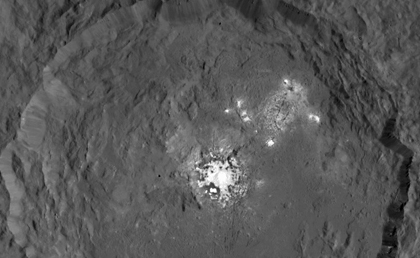
The science team for Dawn have released a colored map of Ceres, showing the dwarf planet’s varied topography as well as the names they have chosen for many features.

The data suggests that Ceres is very icy, with an ice-rich crust.

I have embedded an animation of the globe showing the topography below the fold.
» Read more

0 comments
1 275 276 277 278 279 438