
IPCC needs reform
Better late than never. An independent academic panel has concluded that the IPCC needs reform.
Better late than never. An independent academic panel has concluded that the IPCC needs reform.
This guy is thinking ahead: a paper extolling the scientific benefits of interstellar space travel (published in a 2009 issue of the Journal of the British Interplanetary Society) was made available today on the Los Alamos astro-ph website. Fun quote from the abstract:
Significant benefits are identified in the fields of interstellar medium studies, stellar astrophysics, planetary science and astrobiology. In the latter three areas the benefits would be considerably enhanced if the interstellar vehicle is able to decelerate from its interstellar cruise velocity to rest relative to the target system. Although this will greatly complicate the mission architecture, and extend the overall travel time, the scientific benefits are such that this option should be considered seriously in future studies.
Evidence continues to build that volcanic activity on Venus has occurred in the very recent past, and might even be going on today.
India announced today the scientific instruments it plans for its second lunar probe, scheduled for launch in 2013. India is building the orbiter and Russia is building the lander/rover.
Scientists have confirmed that the just ending low solar minimum had considerable influence in shrinking the Earth’s outer atmosphere. Key quote:
[The scientist] says the research indicates that the Sun could be going through a period of relatively low activity, similar to periods in the early 19th and 20th centuries. This could mean that solar output may remain at a low level for the near future. “If it is indeed similar to certain patterns in the past, then we expect to have low solar cycles for the next 10 to 30 years.”
Kepler had found a solar system with two Saturn-sized planets, plus a possible third planet 1.5 times the diameter of the Earth, with a mass three to four times as big.
After a short four day stretch with no sunspots — the first time in months — two new sunspots appeared today. It is very possible that this will be the last time the Sun will be blank for years as it continues to ramp up to its next solar maximum.
The publication of the results of the material found within the Hayabusa capsule has been delayed until December. The researchers have found that the particles in the capsule are smaller than expected, and they need more time to study them properly.
Exoplanet news! Scientists today announced the discovery of a host of planets, all orbiting a single star similar to the Sun. Though five are Neptune-sized, a sixth (not yet confirmed) might be the size of Earth. What makes this even more exciting is that the astronomers made the discovery using a ground-based telescope.
But wait, there’s more! Thursday NASA will hold a press conference about a new discovery by Kepler!
More information on the recently discovered fireball that impacted Jupiter on August 20, including images.
For the third time in the last year, Jupiter has been hit by a large previously unknown object.
Why bother with research when all we need to do is ask our politicians? Scientist Hillary Clinton studies the floods in Pakistan and the forest fires in Russia and declares them both proof that global warming is happening!
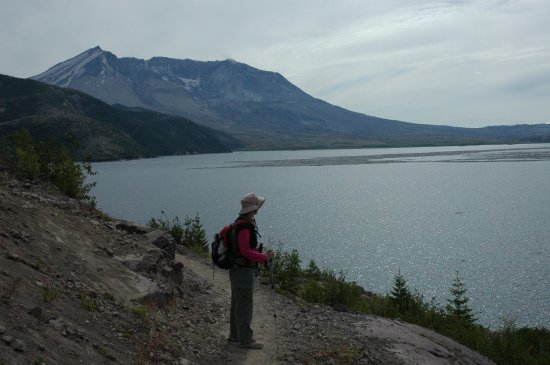
Today we hiked almost ten miles around Mt. St. Helens, walking down to the shore of Spirit Lake (see below) as well as tromping about on the debris field just below the crater. I will have a long post on the experience tomorrow.
Another scientific scandal, this time in the field of animal and human cognitive research: Harvard scientist Marc Hauser has admitted to eight instances of misconduct. Three key quotes:
The university said in a statement last week that Dr. Hauser or a co-author had been directed to correct three published papers for which the original data could not be found. [emphasis mine]
Harvard itself had faced growing criticism for not releasing more details of the inquiry since The Boston Globe reported on Aug. 10 that the university had found evidence of scientific misconduct in Dr. Hauser’s lab. On Friday, Michael D. Smith, dean of the Harvard faculty of arts and sciences, issued a letter to the faculty confirming the inquiry and saying the eight instances of scientific misconduct involved problems of “data acquisition, data analysis, data retention, and the reporting of research methodologies and results.” No further details were given.
Harvard’s findings against him, if sustained, may cast a shadow over the broad field of scientific research that depended on the particular research technique often used in his experiments.
Gee, this sure sounds a lot like the Phil Jones/East Anglia University climategate scandal, where both the researcher and his university provided cover for each other, thereby leaving a cloud over a vast amount of climate research that depends on Jones’s data.
Want to see what the Earth-Moon double planet looks like from 114 million miles away? Take a look at this image taken recently by the Messenger spacecraft on its long journey to Mercury.
Images from Lunar Reconnaissance Orbiter have proven that as the Moon cooled and solidified, it shrunk, leaving behind a network of cliffs, called thrust faults, across its entire face.
Astronomers have discovered the first star/neutron star binary system where the normal star is eclipsing the neutron star several times each week.
Despite increasing use by humans, the plastic pollution floating in the North Atlantic ocean has not increased over the last two decades,and scientists don’t know why. From the Science press notice:
The authors propose a handful of possible explanations for why more discarded plastic is not appearing out in the open Atlantic Ocean. It may break up into pieces too small to be collected by the nets, or it might be sinking beneath the surface. Or, it might be consumed by marine organisms. More research will be necessary to determine the likelihood of each scenario.
Mud volcanoes on Mars.