For the First Time Ever, Scientists Watch an Atom’s Electrons Moving in Real Time
For the first time, scientists watch an atom’s electrons moving in real time.
For the first time, scientists watch an atom’s electrons moving in real time.
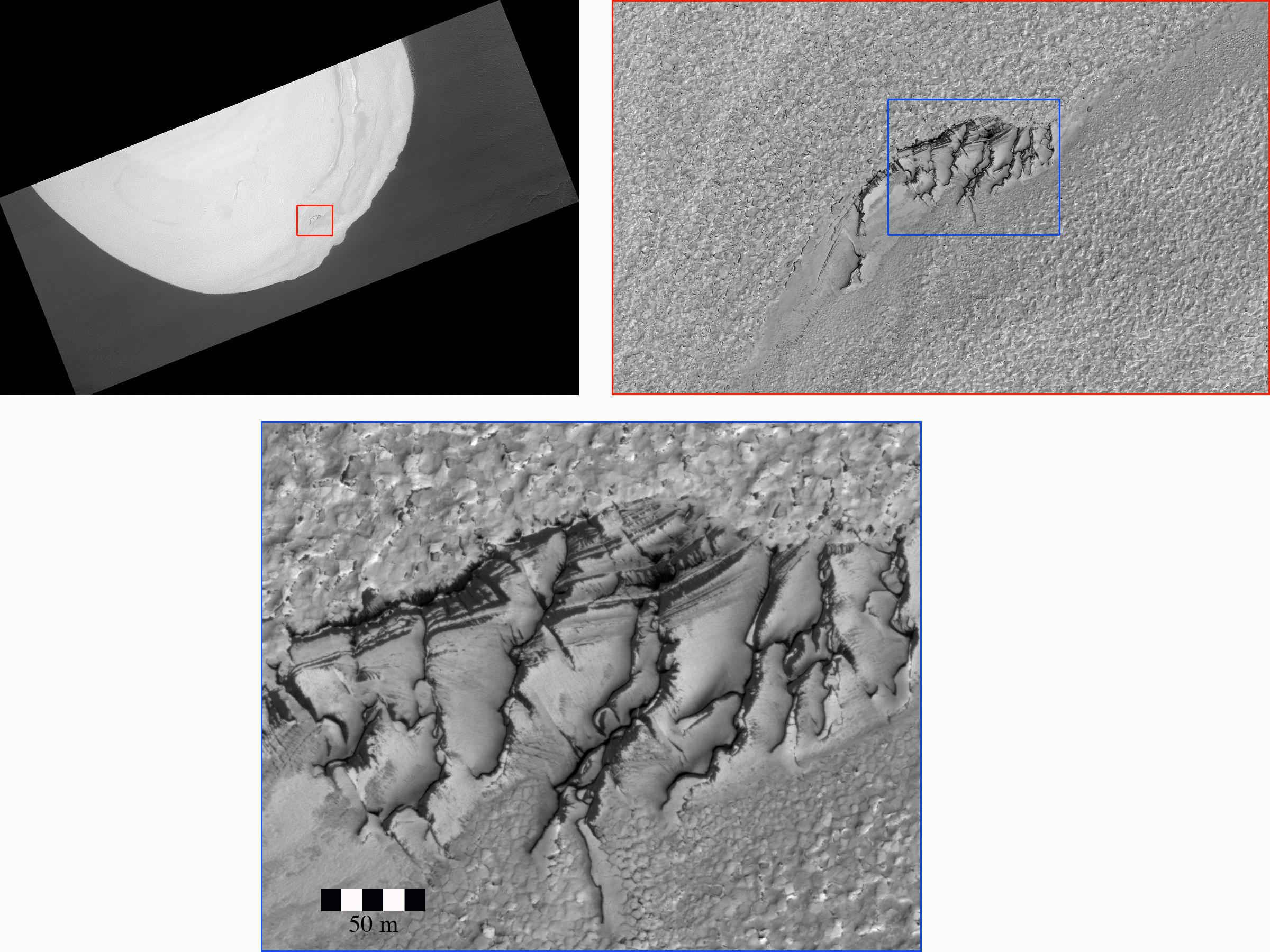
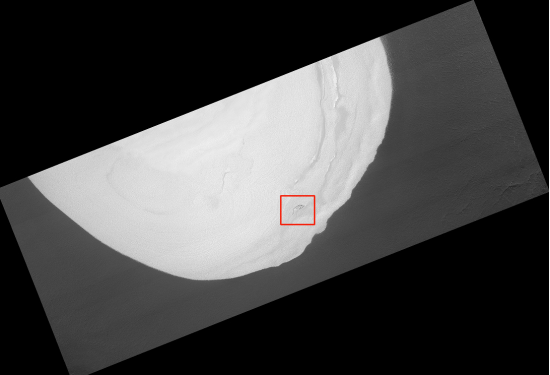
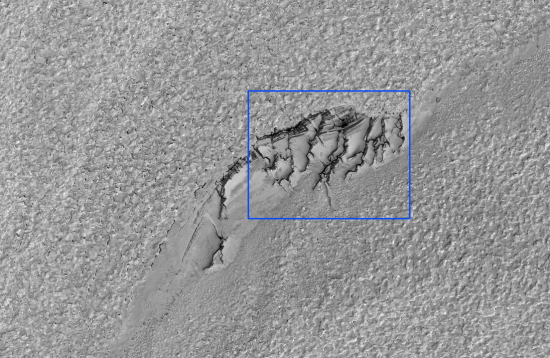
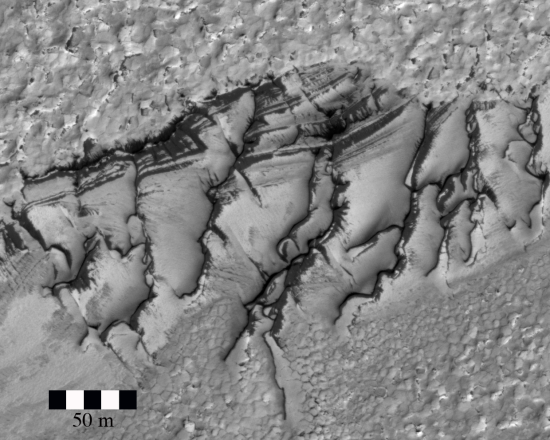
These Mars Reconnaissance Orbiter images show in increasing magnification a puzzling feature in the southeast part of a ice mound in Louth Crater on Mars. Located at 70 degrees north latitude, this is the farthest south that scientists have found permanent water ice. The close-up image suggests melting ice with the draining water running down hill to the south, though on Mars the low air pressure would cause any liquid water to evaporate instantly. Key quote:
These may be the crests of partially defrosted dark sand dunes or perhaps some other feature that we do not understand. This is the only area on Louth where these enigmatic ridges are found.
Scientists studying Apollo lunar samples have found evidence that most of the Moon appears very dry, with no water at all. These results obviously contradict the recent findings of water in the craters near the lunar poles, and will require some explaining.
Want to know what museum holds that mummy of a fish found in Egypt in 1905? Check out Animal Mummies, the largest animal mummie database in the world.
After a very long winter where the Arctic Oscillation has been deeply negative, setting records and resulting in very cold conditions in the northern hemisphere, the oscillation has finally entered its positive phase in the last month.
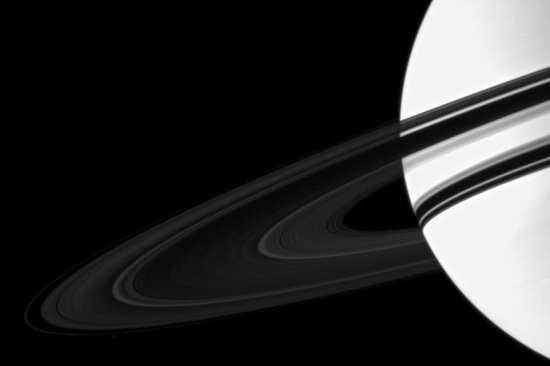
This stunning image of Saturn, taken by Cassini on June 24, 2010, shows the ring’s widening shadow across the planet. As the planet orbits the Sun the tilt of its rings relative to the Sun changes with time. In August 2009 the tilt was essentially zero, so that the shadow was very narrow. Since then the tilt has been increasing, as has the width of the shadow.
Correction.Regular reader James Fincannon emailed me to say that he thinks the image below is an artist’s impression. He is correct. I should have looked more closely at the press release. In reading the actual research paper [pdf] on the results it seems that the VLT did some very sophisticated spectroscopy, thereby measuring the uneven distribution of the velocity and density of the gas around the star. The image below was then created, based largely on Hubble images combined with the new data. In other words, this ground-based telescope did not match the abilities of a space-based telescope in any way. Had the Hubble images not existed the astronomers would have struggled to interpret their spectroscopic data.
Some important astronomy news: The European Southern Observatory’s Very Large Telescope (VLT) has released this spectacular image of supernova 1987a, the first and so far only supernova visible to the naked eye since the invention of the telescope.
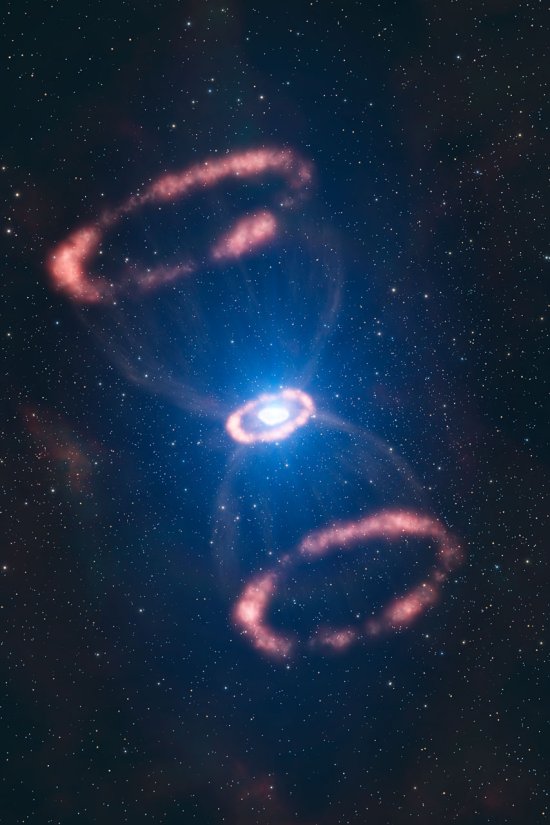
This image is important for two reasons. First, The data shows that the supernova explosion was not symmetrical, with more material being thrown outward in some directions than in others. This fact confirms what astronomers in recent years have increasingly come to believe: Supernovae explosions are not simple spherical bursts, but chaotic events ripping stars apart in a lopsided manner.
Second, this image demonstrates that ground-based telescopes are becoming amazingly good at doing what the Hubble Space Telescope has done routinely for the past two decades. Five years ago, no telescope on the ground could have resolved the inner ring of supernova 1987a. Only Hubble in space had that capability. Now, VLT can do it, almost as well as Hubble. Though a space-based telescope can still beat any ground-based telescope, it is great news that the technology for ground-based telescopes has improved so much, especially since there presently are no plans to replace Hubble.
Archeologists have uncovered a previously unknown tunnel and several chambers under the Temple of Quetzacoatl north of Mexico City. Key quote:
Experts say a tomb discovery would be significant because the social structure of Teotihuacan remains a mystery after nearly 100 years of archaeological exploration at the site, which is best known for the towering Pyramids of the Moon and the Sun. No depiction of a ruler, or the tomb of a monarch, has ever been found, setting the metropolis apart from other pre-Hispanic cultures that deified their rulers.
That coronal mass ejection thrown out by the Sun on Sunday is expected to energize the aurora tonight and again on Thursday. Look up at night if you live in the high northern latitudes.
Steve Goddard notes the state of ice at the North Pole, both then and now, with pictures.
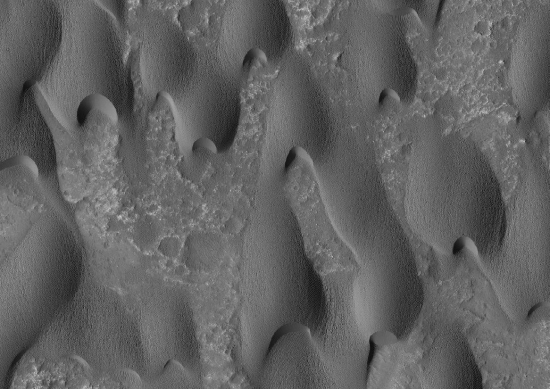
Sand dunes on Mars, from the HiRise camera on Mars Reconnaissance Orbiter:
Fun quote:
These dunes are “barchan” dunes, which are also commonly found on Earth. Barchan dunes are generally crescent-shaped, with their “horns” oriented in the downwind direction. They have a steep slip face (the downwind side of the dune). Barchan dunes form by winds that blow mostly in one direction and thus are good indicators of the dominant wind direction. In this case, the strongest winds blow approximately north to south.
Two new predictions of the upcoming solar maximum were published today on the Los Alamos astro-ph preprint webpage. Both call for a weak solar maximum, with one expecting a sunspot number of 92 at maximum while the other predicting a number of 72.
Scientists have found that the methods used to measure frog populations in the U.S. might be flawed, producing many more false positives than expected and thereby overestimating the populations.
The Met Office in the United Kingdom has issued a report on the state of the climate. In it they state unequivocally that the “world is warming”. Unfortunately, the report fails to address the questions that have been raised about much of the existing climate data, following the climategate scandal.
Archeologists have discovered the largest Roman canal ever built at the mouth of the Tiber river.
It appears that McCarthyism and the blacklist are both alive and well, thriving happily in the field of climate research. Key quote:
It is disturbing, to say the least, that organisations and persons who would be quick to claim professional status consider that it is their current duty to disparage, or to refuse to debate with, or to muzzle scientists whose views on climate change they apparently disagree with.
Read the whole article.
Duck! The Sun has unleashed a coronal mass ejection towards the Earth.
Undersea adventure by robot. An unmanned probe completed its first dive beneath the Arctic ice this week.
Scientists are beginning to unravel the wind patterns on Titan.