SDO celebrates its fifth year in space with a time-lapse of the Sun

Cool images! In celebration of Solar Dynamics Observatory’s fifth year in space observing the Sun, the scientists at the Goddard Space Flight Center have released a time-lapse movie showing the Sun for the past five years.

Video below the fold. It is astonishing and hypnotic. The movie images were taken one image every 8 hours beginning in 2010. If you compare the Sun at the beginning of the movie with the end, you can see the slow shifting of sunspots/flares from higher to equatorial latitudes, as is normal as the solar cycle ramps up to solar maximum and beyond.
» Read more

2 comments

Week long movie of Pluto produced by New Horizons

Cool images! Using New Horizons’ long range camera scientists have compiled a movie showing Charon and Pluto orbiting each other during the last week of January 2015.

Pluto and Charon were observed for an entire rotation of each body; a โ€œdayโ€ on Pluto and Charon is 6.4 Earth days. The first of the images was taken when New Horizons was about 3 billion miles from Earth, but just 126 million miles (203 million kilometers) from Plutoโ€”about 30% farther than Earthโ€™s distance from the Sun. The last frame came 6ยฝ days later, with New Horizons more than 5 million miles (8 million kilometers) closer.

The wobble easily visible in Plutoโ€™s motion, as Charon orbits, is due to the gravity of Charon, about one-eighth as massive as Pluto and about the size of Texas.

Our view of Pluto, and Charon, is only going to get better as New Horizons zooms towards its July fly-by.

1 comment

The endless and all-compassing terrors of global warming

Want to know what scientists have predicted climate change will do to the Earth? Go to ClimateChangePredictions.org, where they keep a full list of every prediction they can find.

I especially like the category “Having it both ways,” where they list different predictions that insisted on opposite consequences. For example did you know that global warning is going to bring both “less rain” and “more rain”, Other predictions are equally amusing.

7 comments

Sunspot activity tracks prediction

On Monday NOAA posted its monthly update of the solar cycle, showing the sunspot activity for the Sun in January. As I do every month, I am posting it here below the fold, with annotations to give it context.

As I have noted previously, the ramp down from solar maximum continues to track the 2009 prediction of the solar scientist community (indicated by the red curve) quite closely. As NOAA also notes,

While awaiting final confirmation, all evidence points to the most recent solar maximum having peaked at 82 in April, 2014. This was within the expected range for the peak, but occurred significantly later than predicted.

Since their graph doesn’t show the entire curves for their predictions, the above statement seems reasonable. However, looking at the graph with those curves inserted (see my annotated graph below the fold), it becomes clear that not only did the peak occur much later than predicted, the maximum’s overall activity was also generally less than predicted.
» Read more

0 comments

Rosetta preps for close fly-by of Comet 67P/C-G

Single frame image

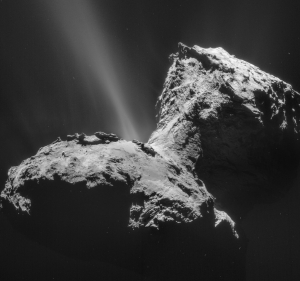
Cool image time! In preparation for a close fly-by of Comet 67P/C-G on Saturday — where it will zip past the comet less than three miles above its surface — Rosetta has eased away to a distance of about 60 miles, allowing its navigation camera to snap its first single frame image since the spacecraft’s initial close approach last summer.

The image brightness has been adjusted to make the plume more obvious. Also, if you look closely at the full resolution version of the image, it is possible to see the dusty material that forms the coma surrounding the nucleus.

0 comments

Cholesterol warning about to disappear

The uncertainty of science: The federal government is about to withdraw its half-century old warning against cholesterol in the diet.

I think the key quote from the article was said by Walter Willett, chair of the nutrition department at the Harvard School of Public Health:

Thereโ€™s been a shift of thinking.

I’d call that statement a bit understated.

2 comments

New ebola drug appears somewhat effective

Drug trails in Guinea of a new ebola drug suggest that it might have some positive effect on mortality.

A researcher who had seen the data and asked not to be identified told Science that favipiravir did not help all of the patients treated with it at two trial sites in Guinea. In a subset of trial participants who had low levels of Ebola virus in the blood, however, the mortality was just 15%. In similar patients who entered the centers earlier and did not receive favipiravir, mortality was 30%.

The trials with this drug are being conducted without a control group, which makes it harder to pin down the cause of these results. The article also describes several other drugs being readied for testing, some of which are expected to be more effective.

The trials, however, are faced with two issues. First, the easing of the epidemic is making it more difficult to do the studies. And second,

So far, Guinea and Sierra Leone, where Ebola is still infecting dozens of people a week, have refused invitations to join the study. Their main stumbling block is trial design. ZMapp will be the first Ebola treatment that will be tested against a placebo control. โ€œI think thatโ€™s the only way to tell whether these drugs are safe and effective,โ€ Lane says. The governments of Guinea and Sierra Leone, as well as Doctors Without Borders, which runs Ebola centers in those countries, have for ethical reasons been reluctant to participate in treatment trials that use a placebo.

The moral dilemma of doing drug tests where some patients get a placebo has always been a problem for medical research. It is therefore not surprising to see it here as well.

1 comment

“The fiddling with temperature data is the biggest science scandal ever.”

Link here.

This is a nicely written review of some of the research that Steven Goddard, Paul Homewood, and others have done to uncover the wholesale and unjustified adjustments to the surface temperature data that have been done by scientists at the Goddard Institute of Space Studies and at NOAA. Essentially, the warming of the past half century has been faked by artificially lowering the recorded temperatures of the past while artificially raising the recorded temperatures of the present.

8 comments

Plumes and dust surrounding Comet 67P/C-G

Plumes and dust

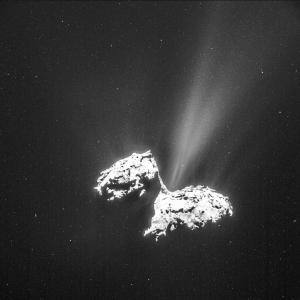
Cool image time! A new navigation camera mosaic from Rosetta shows both a clear plume rising out of Comet 67P/C-G as well as a “large number of small white blobs and streaks in the image are likely specks of dust or other small objects in the vicinity of the comet.”

The fact that, unlike previously, they did not have to significantly overexpose the image to bring out the plume and dust illustrates the increasing activity at the comet.

0 comments
1 480 481 482 483 484 729