
New Horizons spots some of Pluto’s smaller moons
Getting closer! As it zooms to its July fly-by, New Horizons has now been able to image some of the smaller moons that orbit Pluto.
Getting closer! As it zooms to its July fly-by, New Horizons has now been able to image some of the smaller moons that orbit Pluto.
Islamic science: At student discussion on Sunday an Islamic cleric insisted that the Sun orbits the Earth.
Sheikh Bandar al-Khaibari told a student that the Earth is “stationary and does not move,” according to Al-Arabiya, justifying the statement with religious texts and statements. But then he tried to debunk the common knowledge about the Earth’s rotation using “logic,” in a visual demonstration that prompted the speech to go viral. “First of all, where are we now?” he asked. “We go to Sharjah airport to travel to China by plane, clear?!” Khaibari argued, confusingly, that the Earth cannot rotate because it would render air travel impossible.
Even if Islam was peaceful, which it is not, it remains a problem because it apparently also encourages this kind of ignorance.
Astronomers have identified a nearby star, now 20 light years away, that 70,000 years ago flew past the solar system at a distance of only 0.8 light years.
The star’s trajectory suggests that 70,000 years ago it passed roughly 52,000 astronomical units away (or about 0.8 light years, which equals 8 trillion kilometers, or 5 trillion miles). This is astronomically close; our closest neighbor star Proxima Centauri is 4.2 light years distant. In fact, the astronomers explain in the paper that they are 98% certain that it went through what is known as the “outer Oort Cloud” – a region at the edge of the solar system filled with trillions of comets a mile or more across that are thought to give rise to long-period comets orbiting the Sun after their orbits are perturbed.
I feel it necessary to note that the Oort Cloud itself has never been directly observed and only exists theoretically based on the random arrival of comets from the outer solar system.
Take Pew Research’s 13 question quiz and find out!
Took about a minute. I got all 13 right and found that I knew more than 93% of the population. The overall demographics of who knows what are intriguing, especially considering how basic to knowledge these questions are.
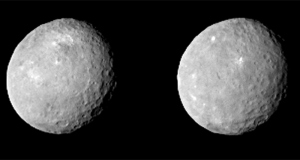
Cool images! The Dawn science team has released new even sharper images of the giant asteroid Ceres, taken by Dawn on February 12 at a distance of 52,000 miles.
Though the surface appears to have many of the typical craters, scientists continue to be puzzled by the bright spots. This newest image suggests that they are ice-filled craters, but don’t hold me to that guess. For one thing, why are only a handful of craters filled with ice, and none of the others?
Want silence? Scientists can tell you where to find it.
Not surprisingly they have found that the western states, and especially the national parks within those states, are the quietest places in the nation.
The competition heats up: South Korea has revealed its preliminary design for a lunar rover, set to launch in 2020 on a Korean-built rocket.
The article does not indicate whether this project has actually been approved or is merely being touted by Korea Institute of Science and Technology, which made the announcement. The cost to build it is estimated to be more than $7 billion, which seems quite exorbitant and over-priced.
Update: I had misread the conversion in the article from U.S. to Korean currency and thought the proposed cost for this mission was way more than it really is, which is about $7 million, a much more reasonable number. Thanks to Edward for the correction.
Scientists have devised a method that preserves DNA, potentially for millions of year, thus raising the possibility that it can be used to store data, much like a hard drive.
The best part of this story mght be how they came up with the technique.
The uncertainty of science: The origin of the Chelyabinsk meteorite that crashed over that Russian city two years ago remains murky to scientists.
Originally, astronomers thought that the Chelyabinsk meteor came from a 1.24-mile-wide (2 kilometers) near-Earth asteroid called 1999 NC43. But a closer look at the asteroid’s orbit and likely mineral composition, gained from spectroscopy, suggests few similarities between it and the Russian meteor.
The scientists noted in their paper that you really can’t use the similarity of orbits to link different asteroids, as their orbits are chaotic and change too much.
Link here.
The images are only from the spacecraft’s navigational camera, and while cool, are thus to me not that interesting. What the high resolution camera saw they are once again keeping under wraps, for release later as part of a paper by the scientists involved.
The competition heats up? The private effort to choose 24 people to make a one-way flight to Mars has narrowed its candidates down from more than two hundred thousand to 100 finalists.
More here.
As interesting as this effort is, it is very important to remember that it is not an effort to fly these people to Mars. They don’t have the money and no one yet has the technical ability to make the flight. What they are actually doing is putting together a television reality show, where these 100 individuals will compete to be the final 24. If they do it right, which I am somewhat doubtful, the show will be entertaining and scientifically educational.
The uncertainty of science: Scientists struggle to explain the discovery by amateurs of Martian atmospheric plumes 125 to 150 miles high.
Amateur astronomers spotted the bizarre feature rising off the edge of the red planet in March and April of 2012. It looked like a puff of dust coming off the surface, but it measured some [125 to 155] kilometres high. That is much higher than would be expected from the lower-altitude dust storms that rage across the planet. Now a team of astronomers proposes that the plume was either a cloud of ice particles or a Martian aurora. But neither possibility fully explains the plume — raising new questions about the state of the Martian atmosphere.
Read it all. No explanation really works to explain the plume’s height.
