
The arrival of two new childhood diseases to America

Link here.

In the span of four months, at least 94 children in 33 U.S. states have developed a devastating form of paralysis with symptoms similar to polio. Some require a ventilator to breathe. And some of the greatest government health minds in the country say they have no idea whatโ€™s causing it. At the same time, during the past four months, at least 12 children have died after falling ill with a respiratory virus called Enterovirus D-68 (EV-D68). Again, federal health officials are at a loss to explain the origin of the epidemic.

It appears that the first, now dubbed acute flaccid myelitis (AFM), might be linked to the second.

In a November 7 alert to practitioners, the CDC noted, โ€œthe unusual clustering of acute limb weakness occurred against a background of a nationwide outbreak of severe respiratory illness among children due to enterovirus-D68 (EV-D68). Several of the patients in California and nearly half of the 11 cases identified in Colorado had tested positive for EV-D68 from nasopharyngeal (NP) swabs at the time of admission for their neurologic illness. This raised a possible association between these neurologic illnesses and the ongoing outbreak of respiratory disease due to EV-D68.โ€

Whether both are linked to the flood of illegal immigrant children allowed to enter the U.S. this past summer remains unclear.
1 comment

When did humans begin using fire?

A cave in Israel suggests that the human use of fire began around 350,000 years ago.

The researchers examined artifacts previously excavated from the site, which are mostly flint tools for cutting and scraping, and flint debris created in their manufacture. To determine when fire became a routine part of the lives of the cave dwellers, the team looked at flints from about 100 layers of sediments in the lowermost 16 meters of the cave deposits.

In layers older than roughly 350,000 years, almost none of the flints are burned. But in every layer after that, many flints show signs of exposure to fire: red or black coloration, cracking, and small round depressions where fragments known as pot lids flaked off from the stone. Wildfires are rare in caves, so the fires that burned the Tabun flints were probably controlled by ancestral humans, according to the authors. The scientists argue that the jump in the frequency of burnt flints represents the time when ancestral humans learned to control fire, either by kindling it or by keeping it burning between natural wildfires.

There are enormous uncertainties here, but the data also appears to match with what has been found in Europe. The problem however is that this date is long after humans had already migrated to colder climates, which means that they were somehow surviving for a long time in these hostile environments without fire, something that is puzzling.

2 comments

NIH panel recommends cancelling multi-billion dollar study

An government advisory panel has recommended the NIH cancel a controversial nationwide study to track the health of 100,000 children.

The study has already cost one billion, has had two scientists resign because they didn’t like how the study was being run, and has as yet only enrolled 4,000 children.

Update: The NIH officially cancelled the study later the same day the panel’s report was released.

0 comments

Comet 67P/C-G in color

Comet 67P/C-G in color

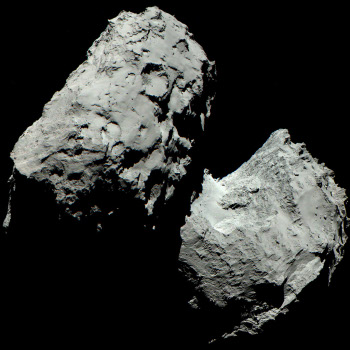
You might not believe it, but the image on the right is the first color image taken by Rosetta of Comet 67P/C-G. (Click on the link to see a full image.)

To create an image revealing 67Pโ€™s โ€œtrueโ€ colours, the scientists superposed images taken sequentially through filters centred on red, green, and blue wavelengths. However, as the comet rotated and Rosetta moved during this sequence, the three images are slightly shifted with respect to each other, and are taken from slightly different observing perspectives. Painstaking work is needed to superimpose the images accurately, which is one reason it has taken so long to come up with the first meaningful colour image of 67P/C-G.

As you can see, there really isn’t much color there. Moreover, the comet is so coal-dark that they had to brighten the images to bring out any detail.

0 comments

Global views of six Saturnian moons

Using images collected after ten years in orbit around Saturn, Cassini scientists have released global color maps of six of Saturn’s icy moons, Mimas, Enceladus, Tethys, Dione, Rhea and Iapetus.

These enhanced colour views have yielded several important discoveries about the icy moons. The most obvious are differences in colour and brightness between the two hemispheres of Tethys, Dione and Rhea. The dark reddish colours on the moons’ trailing hemispheres are due to alteration by charged particles and radiation in Saturn’s magnetosphere. The blander leading hemispheres, the sides that always face forward as the moons orbit Saturn, are all coated with icy dust from Saturn’s E-ring, formed from tiny particles erupting from the south pole of Enceladus.

0 comments

The geography of scientific plagiarism

A review of the text of hundreds of thousands of papers submitted by scientists worldwide has revealed the countries from which plagiarism is most likely.

Researchers from countries that submit the lion’s share of arXiv papersโ€”the United States, Canada, and a small number of industrialized countries in Europe and Asiaโ€”tend to plagiarize less often than researchers elsewhere. For example, more than 20% (38 of 186) of authors who submitted papers from Bulgaria were flagged, more than eight times the proportion from New Zealand (five of 207). In Japan, about 6% (269 of 4759) of submitting authors were flagged, compared with over 15% (164 out of 1054) from Iran.

The global map illustrating this geography at the link is quite fascinating to peruse, as it generally shows the cultural roots of plagiarism. Happily, western culture does not appear to be the source.

0 comments

Comet 67P/C-G unveils a scientific surprise

Data from Rosetta of Comet 67P/C-G strongly suggests that the origin of the comets of its class come from a wide range of locations within the early solar system, and that many of these comets might not have delivered the water to Earth as previously believed.

The data also suggests that the Earth’s water came more from asteroids, not comets, something that scientists had not expected.

0 comments

Solar maximum ramp down continues

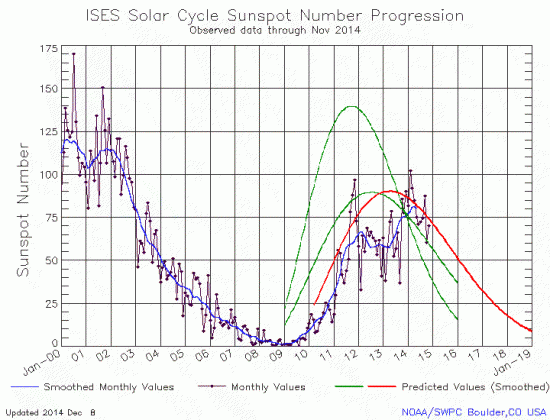
The monthly update by NOAA of the solar cycle, showing the sunspot activity for the Sun in November, was released on December 8, just before NOAA completely revamped its website. As I have been doing every month for the past four years, I am posting it here, with annotations to give it context.

As noted in previous months, the 2009 prediction of the solar scientist community is looking better and better with time. Though there was an increase in sunspot activity in November, the overall trend continues downward very close to that prediction, though at levels that have generally been less than predicted.

November 2014 Solar Cycle graph

The graph above has been modified to show the predictions of the solar science community. The green curves show the community’s two original predictions from April 2007, with half the scientists predicting a very strong maximum and half predicting a weak one. The red curve is their revised May 2009 prediction.

Future updates will depend on whether NOAA continues to track sunspots using these same standards. After much searching I was finally able to locate the graph above at this link, suggesting that at least for now, they are holding to these standards. I note however that the links to the 2007 and the 2009 solar cycle predictions have vanished down the memory hole. Fortunately, I still have this data, and can continue to annotate the graphs to compare prediction with actual data.

That they might have removed these predictions from their webpage however is a shame. I have emailed them to ask them about this and will let you know what I learn.

3 comments

Science spending steady in proposed Congressional budget

The proposed budget deal announced by Congress yesterday essentially leaves level the overall spending on science.

I have a spreadsheet where I track the budgets of the various science agencies in the federal government, and from this I can say that since the Republicans took control of the House in 2010 the funding has remained very steady. Despite the partisan screams from the left that Republicans are destroying science, all these science agencies have pretty much gotten stable funding in the past four years.

Nonetheless, much of this funding could be trimmed significantly, as there is enormous featherbedding and pork among these science agencies. That won’t have a chance of happening until next year, when the Republicans control both houses of Congress. Even then, Obama and much of the Republican leadership will oppose significant cuts, Obama because he wants to see increases and the Republican leadership because they wish to maintain the status quo.

The unending growth in these budgets, routine from the 1970s through the 2000s, has definitely ceased. I also expect the political pressure to cut these budgets to grow with time. The newer Republican members of Congress tend to be much more radical than their leadership, and are much more willing to slash budgets radically.

0 comments

NOAA admits that California drought is not man-made

A new study by NOAA scientists has confirmed that the recent severe California drought was not caused by the human-caused increase of carbon dioxide in the atmosphere but was instead the result of natural weather patterns.

The persistent weather pattern over the past several years has featured a warm, dry ridge of high pressure over the eastern north Pacific Ocean and western North America. Such high-pressure ridges prevent clouds from forming and precipitation from falling. The study notes that this ridge โ€” which has resulted in decreased rain and snowfall since 2011 โ€” is almost opposite to what computer models predict would result from human-caused climate change. [emphasis mine]

The climate models, which have all spectacularly failed to predict the lack of warming in the past 18 years, had also predicted that global warming would cause more rain in California, not less.

The article quotes both fake scientist Michael Mann and his buddy in the climategate scandal Kevin Trenberth in their effort to refute the study. They don’t provide much convincing data to explain why the models were all wrong, only loud whines about how they are right and everyone else is wrong.

0 comments

Curiosity confirms that Gale Crater was once a water filled lake.

New geological data from Curiosity suggests that the interior of Gale Crater was shaped by sediments placed there by the rise and fall of a lake over millions of years.

The data also confirms that conditions on Mars were good enough for liquid water to be maintained on the surface for long periods of time. The problem is that scientists still do not understand how Mars could have maintained such kind of atmosphere and environmental conditions, based on its location and size.

0 comments
1 487 488 489 490 491 729