Looking down a comet’s neck

Looking down Comet 67P/C-G's neck

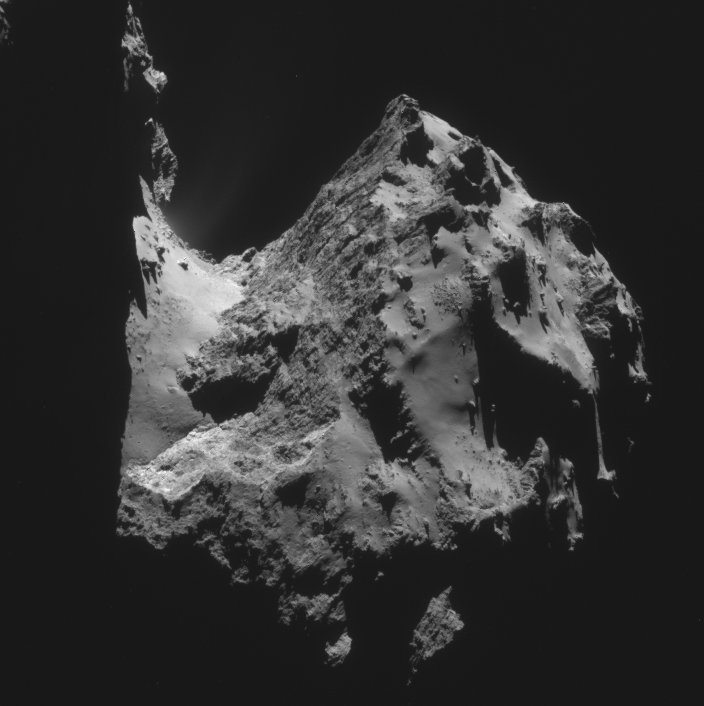
Because all the focus in past two weeks has been on the attempt to land Philae on the surface of Comet 67P/C-G, no one has been paying much attention to the images that Rosetta has continued to produce. On the right however is a humdinger, released on November 17. The image looks into the neck or saddle of the comet, from the side. The giant boulder Cheops can be seen in the saddle, with a jet visible against the black sky above it.

What I like about this image is that I can imagine hiking up the sandy slope to this narrow saddle, where I could stand next to Cheops and look out at that jet. For the explorer in all of us this sure wets the appetite for the future. If only people could go and do that now!

1 comment

Even if you liked your plan, Obamacare will pick a plan for you

Finding out what’s in it: In order to prevent Obamacare enrolless from experiencing the rate hikes expected when they automatically renew their 2014 plans for 2015, the Obama administration is proposing that it instead choose cheaper plans for those that automatically renew, even if that new plan will change the available doctors and hospitals in their network.

So, you decide that the plan you had in 2014 was worth keeping in 2015 and thus allow that plan to automatically renew rather than spend another week trying to struggle through the badly designed and hack-prone Obamacare website. When you visit your doctor however you then discover that you actually didn’t renew that plan, the Obama administration picked a different plan for you, and your doctor is no longer a participant in your plan. You have to change doctors!

Isn’t wonderful how much the Obama administration cares?

2 comments

IRS finds lost Lerner emails

Surprise! IRS has found 30,000 Lois Lerner emails they had previously said were lost forever.

The U.S. Treasury Inspector General for Tax Administration (TIGTA) informed congressional staffers from several committees on Friday that the emails were found among hundreds of “disaster recovery tapes” that were used to back up the IRS email system. “They just said it took them several weeks and some forensic effort to get these emails off these tapes,” a congressional aide told the Washington Examiner.

The IRS, in a statement provided to the Examiner, said the agency and IRS Commissioner John Koskinen is fully cooperating with the investigation. “As Commissioner Koskinen has stated, the IRS welcomes TIGTA’s independent review and expert forensic analysis.” The IRS statement said. “Commissioner Koskinen has said for some time he would be pleased if additional Lois Lerner emails from this time frame could be found.”

What happened here is that lower level officials have decided they are not going to take the rap for Lerner or Obama. They realized that if they did not cooperate with Congress they would be legally at risk and could be charged with aiding the cover-up. They decided Obama is certainly not worth it. I also think recent news about Obama lying abut Obamacae and the election results helped them make this decision.

All in all, the public is beginning to realize that the emperor has no clothes. Obama might not realize it, but his power to accomplish anything is fading rapidly.

2 comments

MAVEN in safe mode

A timing conflict between two computers on board MAVEN has put the Mars probe into safe mode.

The issue seems relatively minor and something that engineers should resolve without difficulty. Even so, I refuse to use the bureaucratic term “glitch” to describe it, as the article does, as this term is often employed by government employees to disguise much more serious problems. Journalists shouldn’t help them do this.

0 comments

Philae’s landing site dust-covered ice

Based on the data that Philae beamed down prior to going into hibernation, scientists believe the landing site on Comet 67P/C-G is made of a layer of dust 4 to 8 inches thick covering solid ice.

At Philae’s final landing spot, the MUPUS probe recorded a temperature of –153°C close to the floor of the lander’s balcony before it was deployed. Then, after deployment, the sensors near the tip cooled by about 10°C over a period of roughly half an hour. “We think this is either due to radiative transfer of heat to the cold nearby wall seen in the CIVA images or because the probe had been pushed into a cold dust pile,” says Jörg Knollenberg, instrument scientist for MUPUS at DLR.

The probe then started to hammer itself into the subsurface, but was unable to make more than a few millimetres of progress even at the highest power level of the hammer motor. “If we compare the data with laboratory measurements, we think that the probe encountered a hard surface with strength comparable to that of solid ice,” says Tilman Spohn, principal investigator for MUPUS.

Looking at the results of the thermal mapper and the probe together, the team have made the preliminary assessment that the upper layers of the comet’s surface consist of dust of 10–20 cm thickness, overlaying mechanically strong ice or ice and dust mixtures.

In many ways, this result is a testament to the magnificence of science and the industrial revolution. The methods and technology that made it possible for scientists to predict the make up of comets (dirty snowballs) were developed in the period from the 16th to the 19th centuries, hundreds of years before it was even possible to see Comet 67P, no less land on it and sample its surface. And what do we find when we do land there? The data gathered beforehand from far away is confirmed, as precisely as one can imagine.

Update: Another of Philae’s instruments also detected organics on the surface, though the reports so far are very vague.

0 comments

Philae spotted before and after first bounce

A close review of a series of Rosetta images has identified Philae’s first landing site, as well as the spacecraft itself as it approached and bounced away.

The second link is especially amazing, as it includes a gif animation of the landing site, showing the before situation, the puff of dust just after impact, and then Philae drifting away with its shadow hitting the surface of the comet.

0 comments

Philae has gone to sleep

Despite several attempts to reposition the lander to get more sunlight to its solar panels, Philae went into hibernation on Saturday.

There is still a chance the lander will come back awake, but right now the Rosetta science team considers its mission complete. Meanwhile, Rosetta will continue its flight with Comet 67P/C-G, tracking it closely for the next year as it makes its next close approach to the sun.

6 comments
1 489 490 491 492 493 729