Opportunity to get a reboot

Because of an increasing number of computer resets on the Mars rover Opportunity, engineers plan to reformat the rover’s computer.

The resets, including a dozen this month, interfere with the rover’s planned science activities, even though recovery from each incident is completed within a day or two.

Flash memory retains data even when power is off. It is the type used for storing photos and songs on smart phones or digital cameras, among many other uses. Individual cells within a flash memory sector can wear out from repeated use. Reformatting clears the memory while identifying bad cells and flagging them to be avoided.

Obviously there is a risk, though small, that this action will not work and the mission will end here. Stay tuned.

2 comments

Spitzer spots asteroid collision

A monitoring program of a young star by the Spitzer Space Telescope has paid off with evidence of a major collision between asteroids in the debris disk that surrounds the star.

Scientists had been regularly tracking the star, called NGC 2547-ID8, when it surged with a huge amount of fresh dust between August 2012 and January 2013. “We think two big asteroids crashed into each other, creating a huge cloud of grains the size of very fine sand, which are now smashing themselves into smithereens and slowly leaking away from the star,” said lead author and graduate student Huan Meng of the University of Arizona, Tucson.

While dusty aftermaths of suspected asteroid collisions have been observed by Spitzer before, this is the first time scientists have collected data before and after a planetary system smashup. The viewing offers a glimpse into the violent process of making rocky planets like ours.

0 comments

Rosetta’s camera zooms in

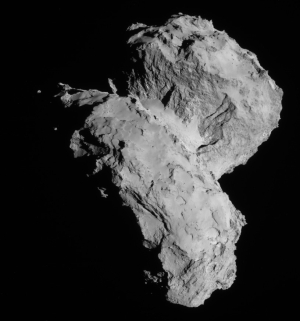
67P/C-G on August 23, 2014
Comet 67P/C-G as seen on August 23, 2014 from 38 miles.
Click on image for uncropped version.

The Rosetta team has begun releasing more close-up images of Comet 67P/C-G taken by the spacecraft. The image to the right was taken by the navigation camera, but rather than capture the entire nucleus in a single image the camera is now zoomed in and taking a mosaic of four images. This picture is one quarter of that mosaic.

Note the boulders and the sharp peaks in the image. The boulders are important to map for planning Philae’s landing site. The sharp peaks suggest recent outgassing.

0 comments

Natural methane plumes found on the sea floor

The uncertainty of science: Scientists have discovered hundreds of natural methane sea-floor seeps that had not been predicted by theory.

The bubble streams showed up on sonar scans of the sea floor taken between September 2011 and August 2013 during oceanographic expeditions ranging from Cape Hatteras in North Carolina to Georges Bank off Cape Cod. Altogether, researchers analysed data covering a 94,000-square-kilometre arc (an area about the size of Indiana or Hungary) that includes the edge of the continental shelf and the steep slope just seaward of it, says co-author Adam Skarke, a geologist at Mississippi State University in Starkville. Within a distance of about 950 kilometres, the team found about 570 bubble plumes β€” an astounding number considering that scientists had previously reported only a handful in the region, he notes.

The article’s first two paragraphs breathlessly attempt to link these plumes to human-caused global warming, noting that there is theory that a warming ocean could produce such methane seeps. Worse, the article adds, once this methane is released it will accentuate warming, as methane is a very powerful greenhouse gas.

The article’s last paragraph, however, finally tells us the real story. Hard data gathered by remote robot vehicles that have actually visited these kinds of plumes instead suggests that the plumes have been there for more than a thousand years and thus could have nothing to do with human-caused global warming. In fact, their natural existence is a significant problem for most climate theories, as they now have to account for this additional greenhouse gas, naturally produced.

0 comments

Russia to continue on ISS past 2020?

A Russian news story today suggests that they are leaning strongly to continuing their partnership with the United States on ISS beyond 2020.

“The issue of Russia’s participation at the ISS after 2020 remains open, but there is a 90-percent chance that the state’s leadership will agree to participate in the project further,” [Izvestia] wrote, citing a source at Russia’s Federal Space Agency Roscosmos.

This report gives a better overview of the debate going on with Russia’s government and space agency. If they abandon ISS the work they have already done on new modules for the station will have to be written off, and it appears assembling their own station from those modules will be too expensive and take too long.

It also looks like NASA offered them a second year long mission if they stuck around.

5 comments

Rosetta’s comet landing sites

67P/C-G landing sites

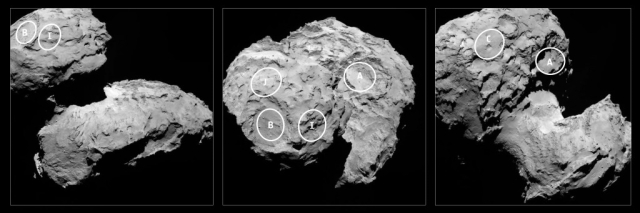
The Rosetta science team has narrowed the choices for Philae landing sites on Comet 67P/C-G to five, three on the smaller lobe and two on the larger lobe.

The smaller lobe sites, being on the outside surface of the lobe, don’t provide as good a view of the rest of the comet, while the larger lobe sites are on its inside surface, looking down at the neck and the smaller lobe. In addition, the terrain for the larger lobe sites looks to me more interesting.

Being on the inside surface, however, the larger lobe sites are going to be more difficult to land on.

0 comments

Cooking the climate numbers in Australia

A comparison of the raw climate data with the adjusted numbers released by Australia’s Bureau of Meteorology shows that the adjustments have routinely turned the trends from cooling to warming.

This is the same finding that Steven Goddard and others in the U.S. found when they did the same comparison of NASA and NOAA numbers. In every case the adjustments either cooled the past or warmed the present in order to accentuate the appearance of a warming trend, sometimes in complete contradiction of numbers that had been accepted by scientists for decades.

So, does this mean the climate isn’t warming? No. What it means is we haven’t the slightest idea what’s happening, since the data has now been corrupted so badly that it is almost meaningless.

5 comments

Picking a comet landing site

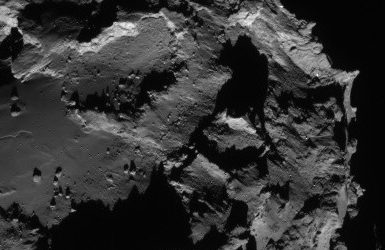
67P/C-G on August 22, 2014
Comet 67P/C-G as seen on August 22, 2014
from 40 miles. Click on image for full resolution.

Engineers have begun the landing site selection for Rosetta’s Philae lander.

This week, up to ten possible sites are being laid on the table for a first round of dedicated discussions and for the LCC and the SONC to carry out a technical analysis on each site, ready to be presented at the weekend meeting. Participants of the LSSG will then review the results from the technical analysis and discuss the scientific merits of the candidate sites. By the end of the weekend meeting, as many as five sites could be selected for further detailed investigation.

They will announce the five finalist sites on Monday.

1 comment

Confirmed: Life in buried Antarctic lake

American scientists have confirmed that water samples from the buried Antarctic Lake Whillans, first obtained in January 2013, contained almost 4,000 different species of life.

Samples from the lake show that life has survived there without energy from the Sun for the past 120,000 years, and possibly for as long as 1 million years. And they offer the first look at what may be the largest unexplored ecosystem on Earth β€” making up 9% of the world’s land area. β€œThere’s a thriving ecosystem down there,” says David Pearce, a microbiologist at Northumbria University, UK, who was part of a team that tried, unsuccessfully, to drill into a different subglacial body, Lake Ellsworth, in 2013.

5 comments

A problem with drilling on Mars

In drilling a new hole while scientists considered Curiosity’s future route to Mount Sharp, the drill cut off operations prematurely.

Engineers think that the rock might have shifted during drilling, causing the robot rover to abort. They have ordered the rover to take a lot of pictures of the situation so they can figure out what happened.

I should note that engineers take a large risk every time they use Curiosity’s drill, as the design of the rover’s electrical system is such that the drill might short everything out while it operates. Thus, when I see a story about a problem with any drilling operation, I become very concerned. In this case, however, it appears to not be a problem with the rover itself.

5 comments
1 500 501 502 503 504 729