Giant Greek tomb discovered

Archeologists have uncovered the largest tomb ever discovered in Greece and think it is linked to the reign of Alexander the Great.

The tomb, dating to around 300 BC, may have held the body of one of Alexander’s generals or a member of his family. It was found beneath a huge burial mound near the ancient site of Amphipolis in northern Greece. Antonis Samaras, Greece’s prime minister, visited the dig on Tuesday and described the discovery as “clearly extremely significant”.

A broad, five-yard wide road led up to the tomb, the entrance of which was flanked by two carved sphinxes. It was encircled by a 500 yard long marble outer wall. Experts believe a 16ft tall lion sculpture previously discovered nearby once stood on top of the tomb.

The excavations began in 2012, and by this month hope to identify who actually was buried there.
2 comments

The weather is finally changing on Titan

New Cassini images of Titan have spotted the appearance of clouds above the planet’s northern seas, suggesting the overdue onset of the summer storms that climate models have predicted.

For several years after Cassini’s 2004 arrival in the Saturn system, scientists frequently observed cloud activity near Titan’s south pole, which was experiencing late summer at the time. Clouds continued to be observed as spring came to Titan’s northern hemisphere. But since a huge storm swept across the icy moon’s low latitudes in late 2010, only a few small clouds have been observed anywhere on the icy moon. The lack of cloud activity has surprised researchers, as computer simulations of Titan’s atmospheric circulation predicted that clouds would increase in the north as summer approached, bringing increasingly warm temperatures to the atmosphere there.

“We’re eager to find out if the clouds’ appearance signals the beginning of summer weather patterns, or if it is an isolated occurrence,” said Elizabeth Turtle, a Cassini imaging team associate at the Johns Hopkins University Applied Physics Lab in Laurel, Maryland. “Also, how are the clouds related to the seas? Did Cassini just happen catch them over the seas, or do they form there preferentially?”

Any conclusions drawn at this time about the seasonal weather patterns of Titan must be considered highly uncertain, since we only have been observing the planet for a period that only covers one very short portion of its very long 30 year-long year.

10 comments

A blue flask of viruses

The story of the discovery of Ebola.

The next day—September 29—the package arrived: a cheap plastic thermos flask, shiny and blue. I settled down with Guido Van Der Groen—a shy, funny, fellow Belgian aged about thirty, a few years older than I—and René Delgadillo, a Bolivian postdoc student, to open it up on the lab bench. Nowadays it makes me wince just to think of it. Sure, we were wearing latex gloves—our boss insisted on gloves in the lab but we used no other precautions, no suits or masks of any kind.

We didn’t even imagine the risk we were taking. Indeed, shipping those blood samples in a simple thermos, without any kind of precautions, was an incredibly perilous act. Maybe the world was a simpler, more innocent place in those days, or maybe it was just a lot more reckless.

Unscrewing the thermos, we found a soup of half-melted ice: it was clear that subzero temperatures had not been constantly maintained. And the thermos itself had taken a few knocks, too. One of the test tubes was intact, but there were pieces of a broken tube—its lethal content now mixed up with the ice water—as well as a handwritten note, whose ink had partially bled away into the icy wet.

Read it all. The excerpt is from a book length memoir that looks to me to be a very worthwhile read.

0 comments

The Milky Way’s most distant stars

Astronomers have discovered the two most distant stars of the Milky Way.

Both stars are red giants, aging suns that shine so brightly observers can see them from afar. One star is about 890,000 light-years from Earth in the constellation Pisces—33 times farther from the Milky Way’s center than we are and well beyond the edge of the galactic disk. The only other Milky Way member at a comparable distance is a small galaxy named Leo I, which orbits ours at a distance of 850,000 light-years. If the star in Pisces revolves on a circular path as fast as we do, it takes some eight billion years to complete a single orbit around the galaxy. That’s more than half the age of the universe.

The other newfound star is about 780,000 light-years distant in the constellation Gemini and more than a million light-years from the other star. For comparison, the previous record-breaking individual star was only about half a million light-years from Earth.

Both stars are so far outside the galaxy’s disk that it is quite possible that they are not part of the Milky Way at all.

0 comments

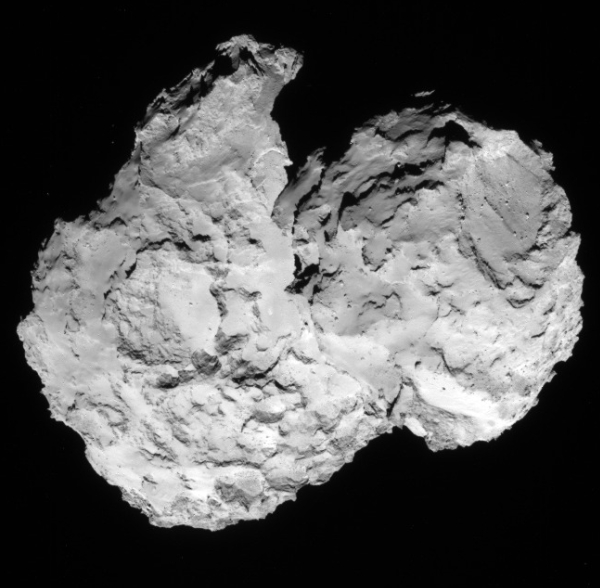
Another Rosetta closeup of 67P/C-G

67P on August 8

The above image is not the most recent daily image from Rosetta, but it is the most interesting of the last three.

It shows the side of the comet nucleus that has not been featured in most images, as the topographical differences between its two sections is not as distinctly highlighted. What is highlighted is the neck that connects the two sections, lighter colored and thus likely made up of less dusty ice.

Also of interest here is the circular features on the larger bottom section. These certainly resemble craters, and are likely remnants of early impacts that are now been corroded away as the nucleus’s ice particles evaporate off the surface. The scientific question here is this: Why are crater features more evident on this side and section of the comet nucleus than on other areas of its surface?

0 comments

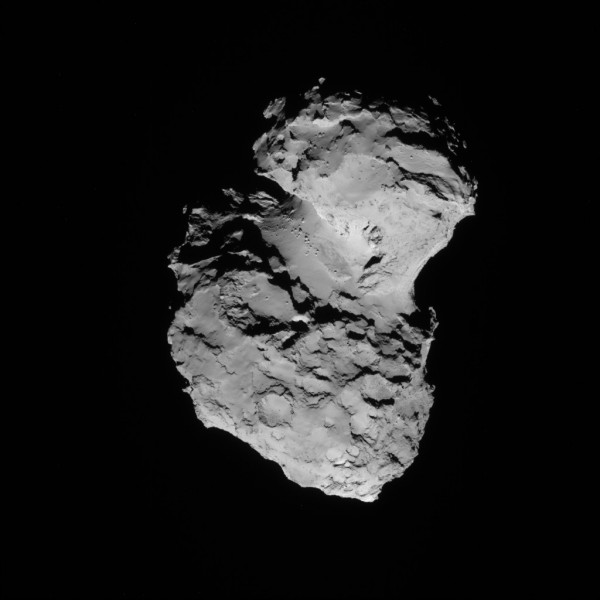
67P from 52 miles

67P from 52 miles, August 7, 2014

The image above was taken on August 7 from only 52 miles. For the first time I had to scale it down slightly so that it would fit on the webpage.

My impression with this image is that there actually might be hints of some very ancient craters at several of the vaguely circular pitted features. For example, look at the large feature on the end of the nucleus’s smaller component on the right. This might be a crater that now is significantly eroded as the comet’s surface evaporated away each time it approached the Sun every 6.5 years.

0 comments

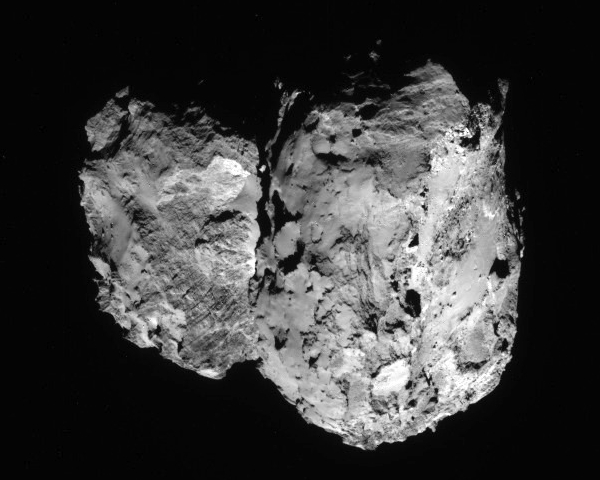
Comet 67P on the day of rendezvous

67P/C-G on August 6

The image above was taken at a distance of 60 miles by Rosetta’s navigation camera on August 6, the day the spacecraft rendezvoused and began flying in tandem with it. It looks at the “backside” of the comet, the side where the distinction between its two components is less pronounced. Once again, no obvious craters, and the surface is pockmarked and corroded.

1 comment

Rosetta arrives

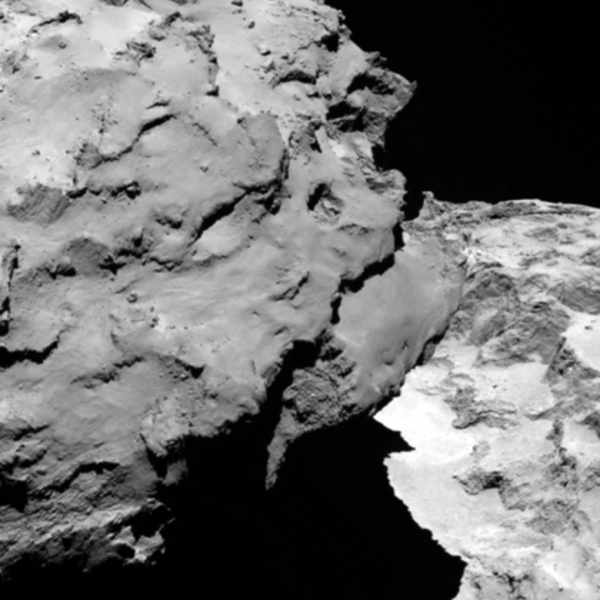
Rosetta has successfully achieved orbit around Comet 67P/C-G and has transmitted its first close up images. More information here and here about the rendezvous and what science the mission scientists plan to do as they orbit the comet.

The image below is looking down and past the comet’s smaller component as it casts a shadow on the neck and the larger component beyond. As with the earlier images, the comet’s pitted and corroded surface, lacking any obvious craters, is reminiscent to me of a pile of dirty snow that has been dissolving away. In fact, when I lived in New York I would see this kind of look every winter. When the city would get a big snowfall snowplows would push it into large mounds on the side of the road. As time passed these piles would get dirty from the city’s soot and grime, and also slowly melt away. After several weeks it would look almost exactly like the surface of Comet 67P/C-G.

The images and data that will come down from Rosetta over the next year and half as it orbits the comet in its journey around the Sun will be most fascinating. Stay tuned!

67P/C-G up close

12 comments

The lingering weak solar maximum

On Monday NOAA posted its monthly update of the solar cycle, showing the sunspot activity for the Sun in July. As I do every month, I am posting it here, below the fold, with annotations to give it context.

For the first time in four months the decline in sunspots ceased, though the sunspot count hardly rose either. Instead the numbers stayed almost the same in July as they were in June. This was during a month that began with lots of sunspots, and yet saw the first blank sun in almost three years. In fact, the Sun’s activity in July was a roller coaster, as noted by the Solar Influences Data Analysis Center (SIDC) of the Royal Observatory of Belgium.
» Read more

1 comment

Eta Carinae’s next big show

Astronomers are gearing up to observe the next binary fly-by of Eta Carinae’s companion star over the next few weeks.

A binary system, η Carinae has two stars that swing past one another every 5.5 years. The bigger star — some 90 times the mass of the Sun — is incredibly unstable, always seemingly on the verge of blowing up. When the smaller companion star makes its closest approach to the primary star, as is happening now, the interaction between the two triggers violent changes in the high-energy radiation pouring out of the system.

Astronomers are watching the show in the hope of learning what drives this enigmatic system. In the 1840s, η Carinae had a mysterious eruption; in recent decades, it has again brightened unexpectedly. “The star is in an awfully deranged state, and no one knows why,” says Kris Davidson, an astronomer at the University of Minnesota in Minneapolis.

Eta Carinae is also famous because it was one of the first objects imaged by Hubble after its repair in 1993, and was thus the first stellar explosion ever caught on camera in a visually sharp and clear manner. (See my book The Universe in a Mirror for that fascinating story.)

0 comments
1 502 503 504 505 506 729