
How does Comet 67P compare with other comets?
A quick preliminary comparison of the surface features of Comet 67P/C-G, compared to other comets that spacecraft have visited.
A quick preliminary comparison of the surface features of Comet 67P/C-G, compared to other comets that spacecraft have visited.
In 2013 the ground-based Gemini telescope imaged a gigantic volcanic eruption on Jupiter’s moon Io.
More here, including information on two other eruptions that occurred about the same time.
The uncertainty of science: A second look at cores drilled in the Pacific northwest has raised doubts about the previous conclusions that the region faces the threat of megaquakes every few centuries.
The bottom line is that though geologists are very confident the northwest faces the threat of future quakes, they can’t yet predict with any confidence their rate or intensity.
Of the seven science instruments proposed for the next U.S. Mars rover, scheduled for a 2020 launch date, MOXIE test the engineering to produce and store oxygen, pulled from the Martian atmosphere.
Developed in partnership with NASA’s Jet Propulsion Laboratory, it’s based on the fact that the Martian atmosphere, though extremely thin, is composed of 96 percent carbon dioxide, which means its a vast potential source of oxygen for future explorers and settlers. Essentially, MOXIE is a fuel cell in reverse. Instead of generating electricity by using oxygen to burn a fuel, it uses a process called solid oxide electrolysis , where electricity is employed to split carbon dioxide into oxygen and carbon monoxide.
This process would see Martian air pumped into the unit through a dust filter and pressurized before being passed into a fuel cell. At high temperatures, some ceramic oxides act as oxygen ion conductors. In the fuel cell, a thin, non-porous disc of this ceramic separates two porous electrodes. One electrode acts as the cathode and the other as the anode. Carbon dioxide passes through the cathode and when it comes into contact with the ceramic, the interaction of electricity and the ceramic causes the carbon dioxide to split into oxygen and carbon monoxide. The oxygen and the carbon monoxide are then separated and the oxygen stored.
What makes this unusual is that NASA has actually dedicated one science instrument to engineering research, not pure science. The agency does not do this much anymore, but such research is essential if the U.S. is going to someday send humans to other planets.
It appears that several U.S. scientists have been forced to cancel their appearances at science conferences in Russia because of the increased tension between the U.S. and Russia over Ukraine.
The disruptions seem to be almost random and are not being applied across the board, as the story also notes that many other programs are not being affected at all.
Because of the increased workload imposed on Russia when the U.S. suddenly pulled out of the European ExoMars mission, the Russians have imposed a three year delay on their entire program of unmanned science probes.
Although all previously approved projects still remain on the table, the nation’s series of lunar missions face a domino effect of delays. Russia’s first post-Soviet attempt to land on the surface of the Moon was pushed back from 2016 to 2019. Known as Luna-Glob or Luna-25, the unmanned lunar lander was designed to test landing techniques for future lunar missions. On the political front, the successful landing of the Luna-Glob would be a signal to the international scientific community that Russia is back in the planetary exploration business after the 2011 fiasco of the Phobos-Grunt mission.
This report above is a more nuanced analysis than yesterday’s story about the presentation given by the head of the Russia’s Space Research Institute at Saturday’s science conference in Moscow. Today’s story gives the reasoning for the delays, as explained by the Russians themselves, as well as outlines the entire program more thoroughly.
The story describes a string of planned Russian lunar probes, beginning with Luna-Glob. This program was probably approved by the government when the U.S. decided to return to the Moon in 2004 under George Bush. The Russians don’t seem to be able any longer to be self-starters, but instead need the competition from the U.S. to get them jump-started.
Even so, while the U.S. has already flown most of the unmanned probes to the Moon that were proposed in 2004, the Russian program had not yet gotten off the ground.
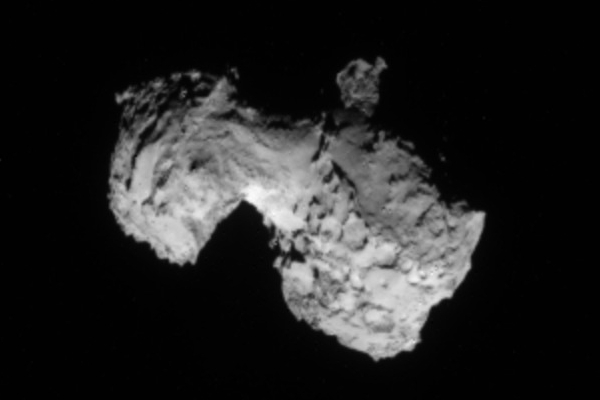
Today’s Rosetta image of Comet 67P, shown above, gives us a different angle of the comet. The spacecraft was only 186 miles (300 kilometers) away when it snapped the picture, and this side view emphasizes the nucleus’s jagged shape.
I am reminded of what happens to a block of ice when you spray warm water on it. It begins to melt away, but very randomly and unevenly, producing very weird shapes and the surface evaporates off. In the case of Comet 67P, the nucleus is a dirty ball of ice, and the Sun’s rays have been causing its surface to evaporate off every time it approaches the Sun. Thus, we get a very weird shape.
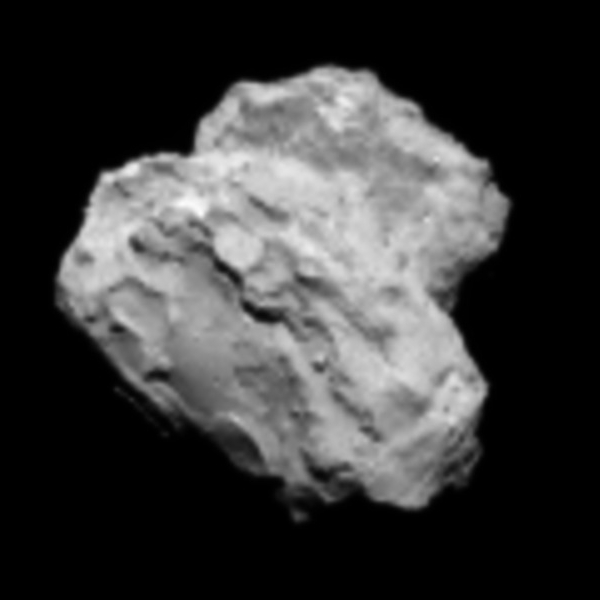
The image above was taken on August 2 using Rosetta’s navigation camera. It has been processed by the science team to bring out the details. I have also rotated it to match the August 1 image taken at a distance of 620 miles that was taken by Rosetta’s OSIRIS narrow angle camera, designed to do the actual science.
You can see that the navigation camera does a pretty good job on its own of capturing the comet’s nucleus. Both images show that the instruments are working perfectly, and thus tell us that the next few months will be quite spectacular after Rosetta goes into orbit in three days, followed in November by the landing of Philae somewhere on the comet’s surface.
If you download both images and then switch back and forth between them you can get a better feel for the geometry of the surface features.
Doctors in charge of the specialized isolation unit for treating dangerous infectious diseases are confident that they will be able to treat the infected patients safely without the disease escaping.
I have complete confidence that a well run facility like this, with modern technology, could keep the disease isolated. The key words, however, are “well run.” I pray that this description still applies to Emory University Hospital.
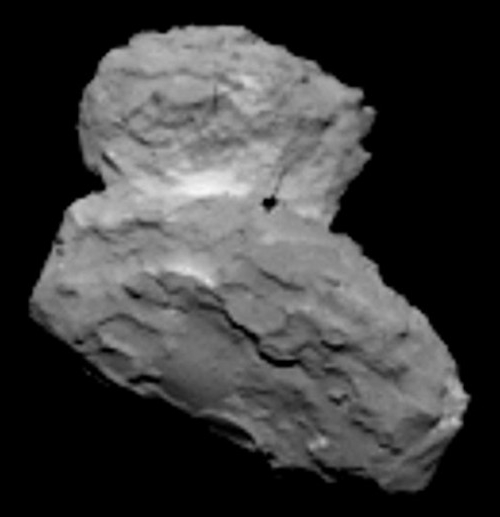
Above is a new image of Comet 67P as seen from about 1000 kilometers, or about 620 miles, released by the Rosetta science team today. The image was taken on August 1 and has been processed somewhat to bring out the details. The black spot near the junction between the nucleus’s two sections is not real but an artifact of the camera’s CCD.
This image is the first real clear and sharp look at the nucleus, and what it shows us is a surface quite different from the many other asteroids that science probes have imaged close-up in the past. From this angle there are far few craters visible then is normally seen on asteroids, and the surface has complex roughness and pitted look that I suspect the planetary geologists are right now scratching their heads about and waving their arms trying to explain. My first guess, which no one should take too seriously, is that as material vents off the comet when it gets close to the Sun it leaves behind these scars.
One more thing: If you go here you can see a number of additional image releases in the last 24 hours, all fascinating. This link explains that the features that looked like craters in earlier images were actually artifacts from the camera’s CCD.
The uncertainty of science and engineering: A physicist takes a close and skeptical look at the “impossible” space drive that NASA engineers discovered seemed to work. Key quote:
“All in all,” Lee concluded, “it will take a lot more information before we can judge whether the thrust is really a thrust or not.”
Read the whole article. They point out the areas of doubt and weakness, as well as the possibilities.
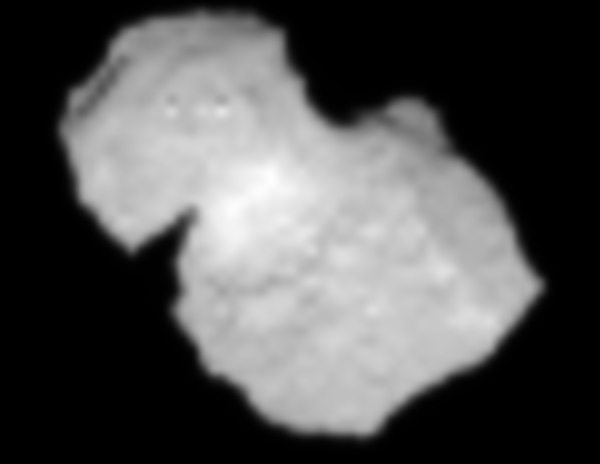
This image of Comet 67P from Rosetta was taken yesterday. Though it has not been processed like the image I posted yesterday, more details continue to come out as the spacecraft each day gets closer to the comet. This image was taken from a distance of 825 miles, 375 miles closer than the previous day.
Very soon these close-up images will become too large to show the entire nucleus in one image. Rosetta will instead begin to snap images of specific features.
Meanwhile, the Rosetta science team released its first temperature readings of the comet.
» Read more