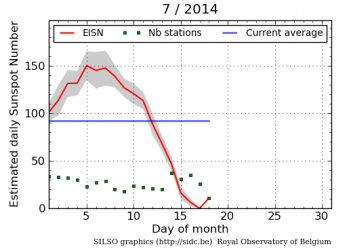
The first blank Sun since 2011

No sunspots on July 17, 2014

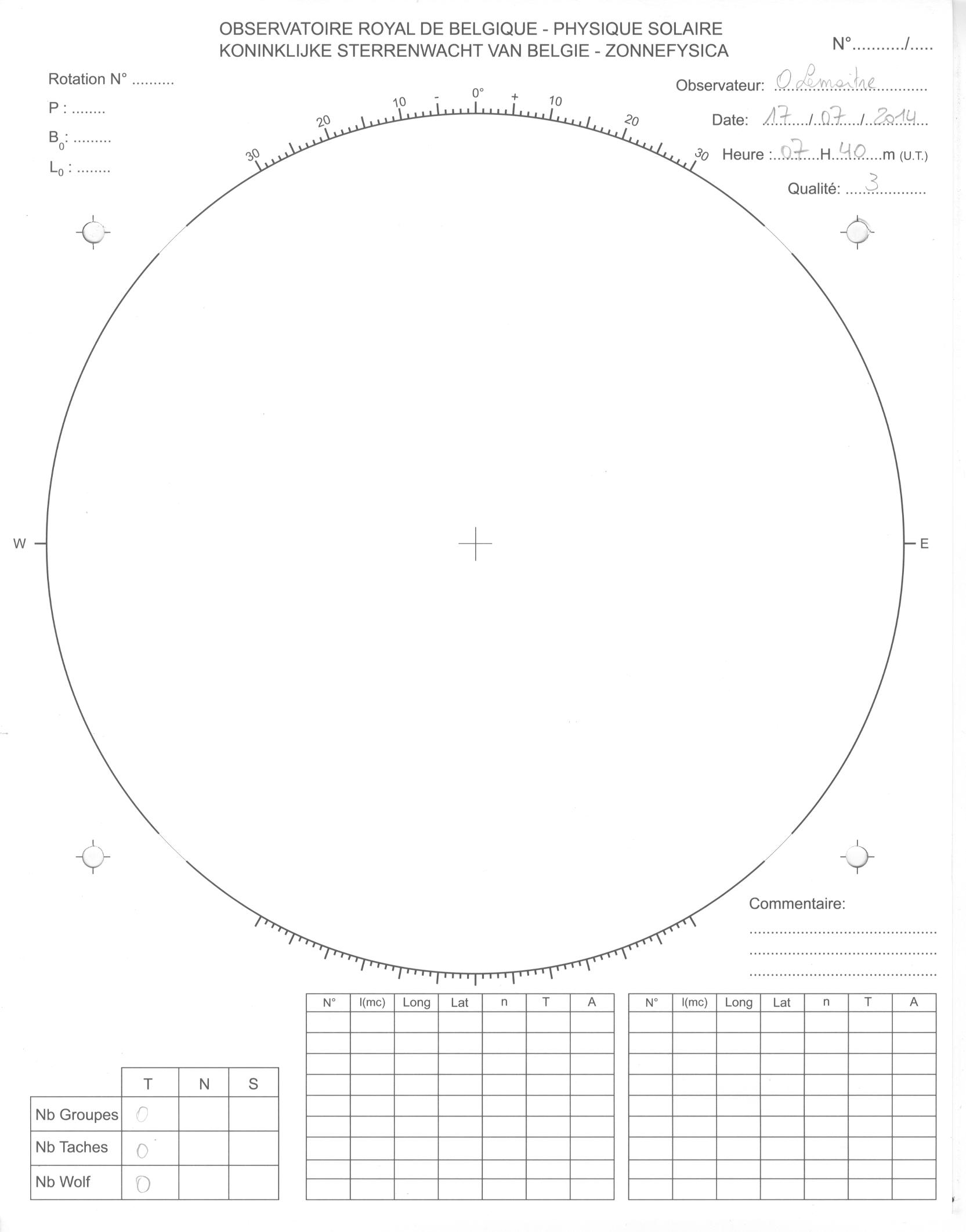
For the first time since August 14, 2011, the Sun showed no sunspots on its surface today. It started the day, July 17, 2014, with one small sunspot, but that spot apparently decayed away by the end of the day, as indicated by the fact that the sunspot number for the day was listed as zero, the first time that has happened since the solar maximum ramp up began in 2011.

This is strong evidence that the ramp down to solar minimum is beginning.

3 comments

Voyager 1 might not have left the solar system

The uncertainty of science: Two scientists dispute the finding this year that Voyager 1 has entered interstellar space.

Voyager has yet to detect what scientists long predicted would be the calling card of interstellar space: a shift in the direction of the magnetic field. Scientists had expected the probe to encounter particles under the influence of the interstellar magnetic field draped over the outer shell of the heliosphere, inducing an abrupt shift. But the direction has remained stubbornly constant, and researchers can’t explain why. “This whole region is a lot messier than anyone dreamed of,” Christian says.

It’s a bit too messy for George Gloeckler and Lennard Fisk, Voyager scientists at the University of Michigan in Ann Arbor. They wondered whether the magnetic field and particle density conditions measured by Voyager could exist within the heliosphere. In a paper accepted for publication in Geophysical Research Letters, Gloeckler and Fisk argue that the outer heliosphere could allow an influx of galactic particles from beyond the bubble that would explain the density measurements.

The researchers’ analysis includes a way to definitively test the idea: If Voyager 1 is within the heliosphere, Gloeckler and Fisk note, then it should still be at the mercy of the sun’s magnetic field. If that were the case, within a year or so, Voyager should detect a 180-degree flip in the field’s direction, a regular occurrence caused by the sun’s rotation. “If that happens,” Gloeckler says, “Len and I will have a big celebration.”

I suspect that both sides are right, and that the transition into interstellar space is simply very complex. Some data will say the spacecraft is outside the solar system, while other data will say it is inside.

1 comment

The elusive effort to detect gravitational waves.

After spending more than half a billion dollars and eight years of looking without a single detection, the Laser Interferometer Gravitational-Wave Observatory (LIGO) has gotten a major upgrade.

If commissioning continues to go relatively smoothly, plans call for the first Advanced LIGO observing run to start in late 2015. A second run, with a decent shot of finding a gravitational wave, would occur in the winter of 2016–17. (Weiss likes to point out that a 2016 discovery would be a nice 100th-anniversary commemoration of Einstein’s paper describing gravitational waves.) By the third science run, planned for 2017–18, the machine should be getting sensitive enough to almost certainly nail a detection, says Reitze.

It is hoped that the increased sensitivity, ten times better than before. will allow LIGO to finally make the first detection of a gravitational wave.

1 comment

More images from Rosetta

67P

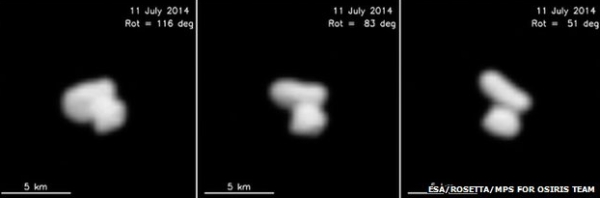
The comet that Rosetta will orbit is getting stranger and stranger, with new images suggesting that it is really two objects stuck together.

The pictures show that 67P/Churyumov-Gerasimenko appears to be not one but two objects joined together. It is what scientists call a “contact binary”. How the comet came to take this form is unknown. It is possible that 67P suffered a major fracture at some point in its past; it is also possible the two parts have totally different origins.

What is clear is that the European Space Agency (Esa) mission team now has additional and unexpected considerations as it plans how to land on the comet later this year – not least, which part of the comet should be chosen for contact?

1 comment

Sixty science papers retracted

The uncertainty of peer review: An internal investigation has caused the retraction of sixty peer-reviewed scientific papers that were published by a single journal, the Journal of Vibration and Control (JVC).

The network of JVC papers that emerged was incestuous, with the same small group of authors reviewing each other’s work and appearing together as co-authors. By the end of the year, the investigators had a list of 130 e-mail addresses associated with 60 papers, with one scientist as co-author on all of them: Chen-Yuan Chen of NPUE, who goes by “Peter.” When SAGE sent an e-mail to all 130 e-mail addresses requesting that the authors confirm their identity, none responded. “The authors were contacted again by SAGE in May 2014 to inform them that their papers would be retracted in the July 2014 issue,” says Sherman, but again none responded. According to SAGE’s official statement, Chen resigned from NPUE in February. Neither Chen nor officials at NPUE responded to e-mails from ScienceInsider

How was it possible for a scientist to become the sole reviewer on dozens of his own papers? The answer appears to be that Chen was allowed to nominate his own reviewers, who were not vetted by JVC,

Chen apparently created fake gmail accounts for both real and non-existing scientists and then chose these scientists both as his co-authors as well as his peer-reviewers.

0 comments

The darkest material ever made

Scientists have developed a material so dark it is difficult to discern the shape of any object it coats.

The material absorbs all but 0.035 per cent of light, a new world record, and is so dark the human eye struggles to discern its shape and dimension, giving the appearance of a black hole. Named Vantablack, or super black, it also conducts heat seven and half times more effectively than copper, and is ten times stronger than steel. It is created by Surrey NanoSystems using carbon nanotubes, which are 10,000 thinner than human hair and so miniscule that light cannot get in but can pass into the gaps in between.

The pictures at the website are especially amazing. They coated half of a sheet of aluminum foil with the material and then crinkled the foil. You can see the crinkles in the uncoated material, but the coated material just looks black.

This will be very useful for astronomical instruments, as well as many other technical applications. For example, if you coat the body of your telescope with this material it will help eliminate stray light, which means that you will increase the efficiency of your observations.

5 comments

CDC suspends shipments of dangerous pathogens

Due to a series of recent errors and mishaps in the shipment of dangerous pathogens such as anthrax and influenza, the Centers for Disease Control (CDC) has suspended future shipments while it conducts an investigation.

After news of the anthrax exposure broke on 19 June, the CDC began investigating why its lab workers did not follow proper procedure to inactivate Bacillus anthracis spores before shipping them to another lab on the agency’s Atlanta campus. The receiving lab was not equipped to handle the pathogen, and once the mistake was discovered, more than 70 people were pre-emptively treated for anthrax infection. The CDC now says that the lab never needed to work with B. anthracis in the first place; another bacterium would have sufficed to test the diagnostic equipment that the lab was evaluating. The good news, Frieden says, is that the CDC now does not believe that anyone was actually exposed to anthrax spores.

But the agency’s ongoing investigation has revealed more bad news: on 12–13 March, the CDC’s influenza lab contaminated a harmless flu strain with the highly dangerous H5N1 variety, and sent it to a laboratory operated by the US Department of Agriculture (USDA) in Athens, Georgia. The mistake was discovered on 23 May, but Frieden says that he was not notified until 9 July. “Why it took six weeks for that to be made apparent, I can think of no valid explanation,” he says. The USDA lab was equipped to handle highly infectious agents, and the agency is confident that there were no exposures.

1 comment

Venus Express is coming up for less air

After spending a month dropping down deep into Venus’s atmosphere, engineers are now raising Venus Express’s orbit.

Thus routine science operations concluded on 15 May, and the spacecraft’s altitude was allowed to drop naturally from the effect of gravity, culminating in a month ‘surfing’ between 131 km and 135 km above the surface. Additional small thruster burns were used to drop the spacecraft to lower altitudes, reaching 130.2 km earlier this week. Tomorrow, it is expected to dip to 129.1 km.

After eight years orbiting Venus, the mission is finally ending. They will use the spacecraft’s thrusters to lift it back up to almost 500 kilometers, where they will then allow its orbit to naturally decay, eventually ending the mission when it burns up in the atmosphere. There is also the chance they will run out of fuel during these last burns, ending the mission slightly sooner.

0 comments

Dry ice evaporation creates the fresh gullies on Mars

New data from Mars Reconnaissance Orbiter shows that the fresh gullies that have been seen on the Red Planet are caused by dry ice evaporation, not liquid water as had been hoped.

Dundas and collaborators used the High Resolution Imaging Science Experiment (HiRISE) camera on MRO to examine gullies at 356 sites on Mars, beginning in 2006. Thirty-eight of the sites showed active gully formation, such as new channel segments and increased deposits at the downhill end of some gullies.

Using dated before-and-after images, researchers determined the timing of this activity coincided with seasonal carbon-dioxide frost and temperatures that would not have allowed for liquid water.

Frozen carbon dioxide, commonly called dry ice, does not exist naturally on Earth, but is plentiful on Mars. It has been linked to active processes on Mars such as carbon dioxide gas geysers and lines on sand dunes plowed by blocks of dry ice. One mechanism by which carbon-dioxide frost might drive gully flows is by gas that is sublimating from the frost providing lubrication for dry material to flow. Another may be slides due to the accumulating weight of seasonal frost buildup on steep slopes.

The findings in this latest report suggest all of the fresh-appearing gullies seen on Mars can be attributed to processes currently underway, whereas earlier hypotheses suggested they formed thousands to millions of years ago when climate conditions were possibly conducive to liquid water on Mars.

0 comments
1 506 507 508 509 510 729