The sun continues its ramp down

On Monday NOAA posted its monthly update of the solar cycle, showing the sunspot activity for the Sun in June. As I do every month, I am posting it here, below the fold, with annotations to give it context.

The decline in sunspots continued for the fourth month in a row, increasing the likelihood that the peak of solar maximum has finally come and gone and that we now seeing the beginning of the ramp down to solar minimum. This resulting solar maximum comes close to matching the science community’s final prediction (indicated by the red line), though that prediction was not detailed enough to include the distinct and unusual double peak for this maximum.
» Read more

5 comments

The effort to resurrect ISEE-3’s is over

The private effort to resurrect the 1980s research probe ISEE-3 has been stymied by a non-working propulsion system.

Before the July 9 attempt, the ISEE-3 Reboot Project thought it had a chance of completing its planned trajectory correction maneuver. The spacecraft’s small hydrazine thrusters were spun up July 3, and systems appeared nominal, Cowing said. On July 8, the spacecraft even managed to perform one of the six multipulse burns that would have set it up for a return to the orbit into which it was launched in 1978.

But further attempts to activate the thrusters July 8 proved unsuccessful, as were all attempts the following day. After eliminating a malfunctioning valve as the cause of the problem, the ISEE-3 Reboot Project was forced to conclude that the satellite’s hydrazine fuel simply was not being pushed through its plumbing at the right pressure to conduct a burn.

The spacecraft is in science mode and will gather data as long as it is in communication range, which will only be for another three months.

0 comments

Fast radio pulses exist, come from outside the galaxy, and no one knows what they are

A new astronomical mystery: The Arecibo radio telescope has confirmed the existence of fast radio pulses.

Fast radio bursts (FRBs) are bright flashes of radio waves that last only a few thousandths of a second. Scientists using the Parkes Observatory in Australia have recorded such events for the first time, but the lack of any similar findings by other facilities led to speculation that the Australian instrument might have been picking up signals originating from sources on or near Earth. The discovery at Arecibo is the first detection of a fast radio burst using an instrument other than the Parkes radio telescope. The position of the radio burst is in the direction of the constellation Auriga in the Northern sky. …

“Our result is important because it eliminates any doubt that these radio bursts are truly of cosmic origin,” continues Victoria Kaspi, an astrophysics professor at McGill University in Montreal and Principal Investigator for the pulsar-survey project that detected this fast radio burst. “The radio waves show every sign of having come from far outside our galaxy – a really exciting prospect.”

Exactly what may be causing such radio bursts represents a major new enigma for astrophysicists. Possibilities include a range of exotic astrophysical objects, such as evaporating black holes, mergers of neutron stars, or flares from magnetars — a type of neutron star with extremely powerful magnetic fields.

Be warned: All of the above theories could also be wrong. These fast radio flashes could just as easily turn out to be something entirely unpredicted.

0 comments

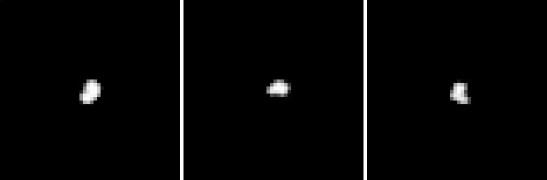
Rosetta snaps more comet pictures

rotating comet nucleus

Rosetta’s new images of Comet 67P/Churyumov-Gerasimenko show the very irregular shape and rotation of its nucleus.

These images were taken on July 4 from a distance of only 23,000 miles. The rendezvous is expected in early August, with the touchdown of Rosetta’s landing probe Philae sometime in November after they have done a reconnaissance of the nucleus to pick a landing spot.

0 comments

ISEE-3 effort aborted?

The engineers trying to resurrect ISEE-3 think their engine burn yesterday ended prematurely because the spacecraft’s supply of nitrogen needed for such a burn has been depleted.

They have still not given up hope, but it sounds like it is increasingly unlikely that they will be able to shift the spacecraft’s orbit as needed.

3 comments

Mapping the inside of Mt St. Helens

A new array of seismometers, combined with a series of planned explosions, will be used to map the interior of the Mt. St. Helens volcano to a depth of eighty kilometers or fifty miles.

To get the job done, starting next week roughly 65 people will fan out across the mountain to deploy 3,500 small seismometers along roads and back-country trails. They will drill 24 holes some 25 metres deep, drop in industrial explosives used for quarrying, and refill the holes (see ‘Under the dome’). The plan is to detonate the explosives in separate shots over four nights. Each blast will shake the ground as much as a magnitude-2 earthquake.

Results from the active blasts will be combined with the passive seismic part of the experiment, which is already under way: 70 larger seis­mometers around the mountain are measuring how long waves from natural earthquakes take to travel through the ground. Their data can be used to probe as far as 80 kilo­metres down, says Vidale.

3 comments

ISEE-3 engine burn

The major course correction burn for ISEE-3 was only partially successful today.

We managed to conduct the first segment (composed of 63 thruster pulses) but encountered problems with the second and halted the remainder of segment firings. Today’s burn was supposed to be 7.32987 m/s. We’re looking at data and formulating a plan for tomorrow. Our window tomorrow (Wednesday) at Arecibo opens at 12:39 pm EDT and extends to 3:26 pm EDT.

6 comments

A source for the most powerful cosmic rays?

Astronomers think they have discovered a region in the sky, within or near the Milky Way, which might be the source of the most energetic cosmic rays

Nobody knows how ultra–high-energy cosmic rays—mainly protons or heavier atomic nuclei—acquire energies millions of times higher than have been achieved with humanmade particle accelerators. (Physicists dubbed one of the first ones observed the “Oh-My-God particle.”) Lower energy cosmic rays are thought to spring from the lingering remnants of stellar explosions called supernovas. But such clouds are far too small to produce the highest energy cosmic rays. Instead, theorists generally expect that the most energetic cosmic rays rev up over millions of years in unidentified accelerators the size of galaxies.

The Telescope Array aims to help solve that mystery. When a high-energy cosmic array strikes the atmosphere, it disappears in an avalanche of lower energy particles. Those particles trigger the detectors in the array, enabling researchers to deduce the direction and energy of the original cosmic ray. From 2008 to 2013, researchers spotted 72 cosmic rays with energies above 57 exaelectron volts—15 million times the highest energy achieved with a particle accelerator. And 19 of them appear to cluster in a hotspot in the sky about 20° in radius, as Hiroyuki Sagawa, a co-representative for the Telescope Array team from the University of Tokyo, reported today in a press conference at the university. [emphasis mine]

The low number of detections, 19 out of 72 total, that seem to come from this wide 20 degree region, suggests that this report falls most certainly under the heading of “the uncertainty of science.” I would not be surprised at all if this conclusion does not stand up after further research.

Nonetheless, the article is worth reading because it outlines nicely this astronomical mystery. Something out there accelerates these particles to these high energies, and astronomers do not yet know what that something is.

0 comments

ISEE-3 engine burn tomorrow

The private effort to resurrect the 1970’s sun-observing space probe ISEE-3’s will attempt its first full engine burn on July 8.

They hope to get the spacecraft back into one of the Earth-Sun Lagrangian points where it can be controlled reliably from Earth and can thus resume its study the solar wind, as originally designed. They have most of July to make the burn that will shift the orbit appropriately, so if this first attempt fails they can still make it happen.

3 comments

Problems with the European Gaia space telescope

Shades of Hubble: The first data from Europe’s Gaia space telescope, launched to map a billion Milky Way stars, will be delayed 9 months while engineers grapple with several problems.

Gaia managers started taking test images early this year, but soon noticed three issues. For one, more light than anticipated is bending around the 10-metre sunshield and entering the telescope.

Small amounts of water trapped in the spacecraft before launch are being released now that the telescope is in the vacuum of space, and more ice than calculated is accumulating on the telescope’s mirrors. In addition, the telescope itself is expanding and contracting by a few dozen nanometres more than expected because of thermal variations.

Mission managers say the number of stars detected will remain the same even if these complications remain untreated, but the accuracy in measurements of the fainter stars will suffer.

Unlike Hubble, however, there is no way to send a shuttle and a team of astronauts to Gaia to fix it. And it sounds like these issues will have an impact on the telescope’s abilities to gather its intended data.

This story raises my hackles for another reason. Gaia was a very technically challenging space telescope to build, but it was far easier and less cutting edge than the James Webb Space Telescope. It also cost far less. What will happen when Webb gets launched later this decade? How likely is it to have similar issues? Based on a story I just completed for Sky & Telescope on the difficulties of building ground-based telescopes, I’d say Webb is very likely to have similar problems, with no way to fix them. The American astronomy community could then be faced with the loss of two decades of research because they had put all the eggs into Webb’s basket, and thus had no money to build anything else.

15 comments
1 507 508 509 510 511 729