Plastic bags do not kill birds and fill the oceans

Another environmental claim turns out to be vastly exaggerated: The scientist who claimed that islands of plastic bags were filling the oceans has found that his claim was bogus.

The scientist whose findings environmentalists used to shame us into bringing our own reusable bags to the grocery store now says that his estimate of one million tons of plastic floating in the ocean may have been off by a factor of perhaps 143. His latest estimate ranges from 7,000 to 35,000 tons, and even most of that has biodegraded into granules. …

Also doubtful: The environmentalist claim that 1.5 million marine animals choke to death each year on plastic bags that ran away from home for a life at sea. They’ve revised their estimates downward to 6.6 percent of that, but even the new figure has no empirical support.

But remember, Barack Obama says the science is settled, and that anyone who questions him or expresses any doubt is the equivalent of a Holocaust denier.

2 comments

Two exoplanets disappear

The uncertainty of science: Two exoplanets orbiting Gliese 581, both thought to be in the habitable zone, have now been proven to not even exist.

“We’ve proven that some of the controversial signals from Gliese 581 don’t come from two proposed Goldilocks planets, but instead are coming from activity within the star itself masquerading as planets,” lead study author Paul Robertson, an astronomer at Pennsylvania State University in University Park, told Space.com.

This result should serve as a strong reminder: Though it is likely that many if not most of the so far discovered exoplanets are real, it is also likely that many will turn out to be false positives. We won’t have solid real knowledge about them until we can actually get a close look at them, which will require far better telescopes in space, and maybe even interstellar missions to them.

0 comments

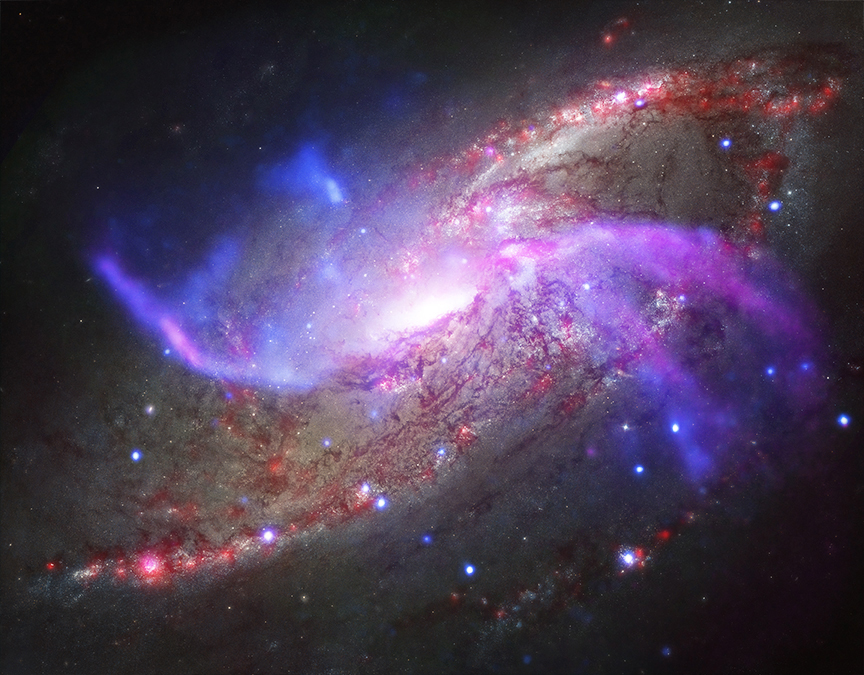
Telescope teamwork produces spectacular galaxy image

M106

Combining images from a host of space and ground-based telescopes, astronomers have created a spectacular image of the galaxy M106.

This galactic fireworks display is taking place in NGC 4258 (also known as M106), a spiral galaxy like the Milky Way. This galaxy is famous, however, for something that our Galaxy doesn’t have – two extra spiral arms that glow in X-ray, optical, and radio light. These features, or anomalous arms, are not aligned with the plane of the galaxy, but instead intersect with it.

The anomalous arms are seen in this new composite image of NGC 4258, where X-rays from NASA’s Chandra X-ray Observatory are blue, radio data from the NSF’s Karl Jansky Very Large Array are purple, optical data from NASA’s Hubble Space Telescope are yellow and blue, and infrared data from NASA’s Spitzer Space Telescope are red.

A new study of these anomalous arms made with Spitzer shows that shock waves, similar to sonic booms from supersonic planes, are heating large amounts of gas – equivalent to about 10 million Suns. What is generating these shock waves? Radio data shows that the supermassive black hole at the center of NGC 4258 is producing powerful jets of high-energy particles. Researchers thinkthat these jets strike the disk of the galaxy and generate shock waves. These shock waves, in turn, heat some of the gas – composed mainly of hydrogen molecules – to thousands of degrees.

The astronomers also used the Herschel Space Observatory to confirm the data from Spitzer.

0 comments

Newly discovered dinosaur tracks

A cluster of dinosaur tracks discovered recently in Alaska has revealed to paleontologists a wealth of new information about their behavior.

The thousands of impressions, created on a 180-meter-long portion of near-coastal flood plain, today pepper a steep mountainside. Most of the tracks, made somewhere between 69 million and 72 million years ago, were left by hadrosaurs, commonly known as duck-billed dinosaurs (the crested creatures in this artist’s representation).

The consistent and excellent preservation of tracks suggests all the footprints were created within a short time period. Varying in width from 8 to 64 centimeters, the footprints cluster within four distinct size ranges, which researchers suggest represent specific age groups within a multigenerational herd. About 84% of the tracks were made by adult and near-adult hadrosaurs and 13% by young presumed to be less than 1 year old. A mere 3% of the tracks represent juvenile hadrosaurs, a rarity that strongly suggests the young of this species experienced a rapid growth spurt and therefore spent only a short time at this vulnerable size, the researchers report online this week in Geology.

0 comments

More fraud in peer-reviewed science

The science journal Nature today announced the retraction of two controversial stem cell papers.

The two papers reporting the stimulus-triggered acquisition of pluripotency (STAP) phenomenon appeared online on 29 January. Questions about the papers arose almost immediately, leading to an investigation by RIKEN, the headquarters of the network of the nationally funded laboratories that is based in Wako near Tokyo. Investigators documented several instances of fabrication and falsification in the papers and concluded that some of these constituted research misconduct on the part of [Haruko] Obokata [the lead author].

Japanese media recently reported that authors had agreed to retract the papers but were discussing the wording of the notice. In the note that appeared today, the authors point to errors previously identified by RIKEN investigations in supplementary documents. They also identify additional errors in both papers, including mix-ups in images, mislabeling, faulty descriptions, and “inexplicable discrepancies in genetic background and transgene insertion sites between the donor mice and the reported” STAP cells. [emphasis mine]

The list of errors now documented sound astonishing. In fact, I can’t see how any serious review by any competent specialist in this field could have missed them all, which suggests that for this research at least the peer-review process is mostly a sham. In fact, in the article Nature admits that its
» Read more

7 comments

OCO-2 in orbit

Second time’s the charm: A Delta 2 rocket successfully launched the Orbiting Carbon Observatory 2 (OCO-2) into orbit on Wednesday, five years after the first OCO was lost at launch when its Taurus XL rocket fell into the ocean.

The Earth-observing satellite is designed to globally track the amount of carbon dioxide in the atmosphere.

I have to note that if the science of climate change was so “settled,” as President Barack Obama keeps insisting, why did we then spend half a billion dollars on this satellite? Wouldn’t it make more sense to drop the research and focus entirely on saving the planet?

6 comments

Hubble to search for Kuiper Belt targets for New Horizons

After completing a preliminary search for potential Kuiper Belt objects which the Pluto probe New Horizons might visit, scientists have decided to use the space telescope for a deeper more complete search.

As a first step, Hubble found two KBOs drifting against the starry background. They may or may not be the ideal target for New Horizons. Nevertheless, the observation is proof of concept that Hubble can go forward with an approved deeper KBO search, covering an area of sky roughly the angular size of the full Moon. The exceedingly challenging observation amounted to finding something no bigger than Manhattan Island, and charcoal black, located 4 billion miles away.

More here.

1 comment

The sad and dishonest state of economic research

A survey of professional academic economists finds that a large percentage are quite willing to cheat or fake data to get the results they want.

From the paper’s abstract:

This study reports the results of a survey of professional, mostly academic economists about their research norms and scientific misbehavior. Behavior such as data fabrication or plagiarism are (almost) unanimously rejected and admitted by less than 4% of participants. Research practices that are often considered “questionable,” e.g., strategic behavior while analyzing results or in the publication process, are rejected by at least 60%. Despite their low justifiability, these behaviors are widespread. Ninety-four percent report having engaged in at least one unaccepted research practice. [emphasis mine]

That less than 4% engage in “data fabrication or plagiarism” might seem low, but it is a terrible statistic. Worse, the other results make me think that the many of the 96% who said they didn’t do this were lying. 40% admit to doing what they agree are “questionable” research practices, while 94% admit to committing “at least one unaccepted research practice.”

In other words, almost none of these academic economists can be trusted in the slightest. As the paper notes, “these behaviors are widespread.”

5 comments

Rosetta measures its comet

As Rosetta approaches Comet 67P/Churyumov-Gerisimenko, it has measured the amount of water evaporating of the comet as it slowly comes to life as it approaches the Sun.

ESA’s Rosetta spacecraft has found that comet 67P/Churyumov–Gerasimenko is releasing the equivalent of two small glasses of water into space every second, even at a cold 583 million kilometres from the Sun. The first observations of water vapour streaming from the comet were made by the Microwave Instrument for Rosetta Orbiter, or MIRO, on 6 June, when the spacecraft was about 350 000 kilometres from the comet. Since the initial detection, water vapour has been found every time MIRO has been pointed towards the comet.

That rate of evaporation will increase with time.

0 comments

South Pole ice cap sets new record

The uncertainty of science: The Antarctic ice cap set a record for size this past week.

The sea ice coverage around Antarctica over the weekend marked a record high, with the ice surrounding the continent measuring at 2.07 million square kilometers, according to an environmentalist and author who says the ice there has actually been increasing since 1979 despite continued warnings of global warming.

The article notes how global warming climate scientists conveniently insist that the growing south pole ice cap and the extended cold temperatures there are irrelevant to their theirs. A real scientist, however, would dismiss no data, as to do so skews the results.

3 comments

More evidence of data tampering at NOAA

A close analysis of NOAA climate data from just one randomly picked Texas rural location reveals significant data tampering to make the climate appear to be growing warming.

In other words, the adjustments have added an astonishing 1.35C to the annual temperature for 2013. Note also that I have included the same figures for 1934, which show that the adjustment has reduced temperatures that year by 0.91C. So, the net effect of the adjustments between 1934 and 2013 has been to add 2.26C of warming. ,,,

So what possible justification can USHCN [the climate data center at NOAA] have for making such large adjustments? Their usual answer is TOBS, or Time of Observation Bias, which arises because temperatures are now monitored in the early morning rather than the late afternoon, which tended to be the practice before. But by their own admittance, TOBS adjustments should only account for about 0.2C.

What about station location? Has this changed? Well, not since 1949 according to the official Station Metadata. Luling is a small town of about 5000 people, and the station is situated at the Foundation Farm, 0.7 miles outside town. In other words, a fairly rural site, that should not need adjusting for urban influences.

It is plain that these adjustments made are not justifiable in any way. It is also clear that the number of “Estimated” measurements made are not justified either, as the real data is there, present and correct.

In doing this analysis, the author, Paul Homewood, does something that Steven Goddard of the Real Science website, the man who broke this story, doesn’t do very often: He carefully illustrates the full raw dataset and shows us how he isolates the raw data from the estimated and adjusted numbers. Goddard generally only shows his results, which means we have to trust his analysis. Homewood therefore approaches Goddard’s results skeptically, and thus acts to check his work to see if it is accurate and correct. He finds that it is.

This is science at its best.

I should also note that I found Homewood’s analysis because Steven Goddard posted a link on his own webpage. As a true scientist, Goddard does not fear a close look at his work. He welcomes it.

2 comments

Using bath salts to make solar cells

Engineers have discovered they can replace a toxic material used to manufacture one type of solar cell with simple bath salts.

The chemical used is also used to make tofu. It costs far less to buy, and its benign nature means it also costs far less to use as well. This could significantly lower the cost for making these solar cells, though two companies quoted in the article seemed skeptical.

0 comments
1 508 509 510 511 512 729