The coming blindness of astronomy

Fried Egg Nebula

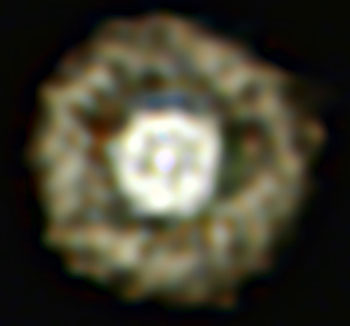
The European Southern Observatory today released this infrared image today of what astronomers have named the Fried Egg Nebula. Taken by the Very Large Telescope in Chile, the picture shows the concentric dust shells surrounding a post-red supergiant star, thought to be transitioning to the next stage of stellar evolution called a yellow hypergiant. As the press release explains,

The monster star, known to astronomers as IRAS 17163-3907, has a diameter about a thousand times bigger than our Sun. At a distance of about 13 000 light-years from Earth, it is the closest yellow hypergiant found to date and new observations show it shines some 500 000 times more brightly than the Sun. . . . If the Fried Egg Nebula were placed in the centre of the Solar System the Earth would lie deep within the star itself and the planet Jupiter would be orbiting just above its surface. The much larger surrounding nebula would engulf all the planets and dwarf planets and even some of the comets that orbit far beyond the orbit of Neptune. The outer shell has a radius of 10 000 times the distance from the Earth to the Sun.

Yellow hypergiants are in an extremely active phase of their evolution, undergoing a series of explosive events β€” this star has ejected four times the mass of the Sun in just a few hundred years. The material flung out during these bursts has formed the extensive double shell of the nebula, which is made of dust rich in silicates and mixed with gas.

According to the science paper [pdf] describing this research, the stage of yellow hypergiants is a preliminary to the star evolving into a luminous blue variable, of which Eta Carinae is the most famous. In this next stage a star is thought to have a good chance of going supernova.

Though this image is truely spectacular, taken by a ground-based telescope of a star 13,000 light years away, what I find most significant about this image is its fuzziness. It reminds me of the kind of images astronomers and the public routinely accepted as the best possible, before the launch of the Hubble Space Telescope.
» Read more

1 comment

NASA science administrator Ed Weiler is retiring after 33 years

Science administrator Ed Weiler is retiring after almost 33 years at NASA.

Among Weiler’s many achievements, he was crucial to getting the Hubble Space Telescope launched. Even more important, though others had conceived the idea of using the shuttle to maintain Hubble, he designed the maintenance schedule for the telescope. Seven years before it was launched, he insisted that a regular schedule of repair missions be placed on the shuttle manifest. He also insisted that a duplicate of the telescope’s main camera be built, so that if anything went wrong with the first a repaired unit could be launched quickly. It was his foresight here that made the first repair of Hubble in December 1993 go so smoothly. For this, astronomers will always be grateful.

0 comments

Virtual monkeys typing Shakespeare

A computer programmer has created a legion of virtual monkeys programmed to randomly type until the works of Shakespeare are reproduced.

If the nine-letter sequence appears anywhere in one of Shakespeare’s writings, it is matched against the relevant passage in a copy of the Bard’s complete works, and is checked off the list. The monkeys, which started typing on August 21, have already completed more than five trillion of the 5.5 trillion possible nine-letter combinations, but have so far only finished one whole work.

They appear to be doing better than Congress’s attempt to balance the federal budget.

1 comment

Obama: “You’ve got a governor whose state is on fire denying climate change.”

Obama on Sunday at a fundraiser, attacking Rick Perry: “You’ve got a governor whose state is on fire denying climate change.”

Here is another example of a politician making a fool of himself. The wildfires in Texas have nothing to do with climate change. And if Obama thinks they do, he immediately shows himself to be completely ignorant of the science behind the Earth’s climate.

2 comments

Faster than light?

Can neutrinos travel faster than light? After three years of gathering data, an experiment at CERN says they do, though by only a tiny amount.

[Physicist Antonio] Ereditato says that he is confident enough in the new result to make it public. The researchers claim to have measured the 730-kilometre trip between CERN and its detector to within 20 centimetres. They can measure the time of the trip to within 10 nanoseconds, and they have seen the effect in more than 16,000 events measured over the past two years. Given all this, they believe the result has a significance of six-sigma β€” the physicists’ way of saying it is certainly correct.

You can download and read a preprint of their paper here.

What I find intriguing about this result, other than its exciting groundbreaking possibilities, is how it illustrates sharply the contrast between normal and healthy science, and the sad and sick state of the field of climate science.
» Read more

2 comments

UARS crash updated

The most recent prediction now says that the UARS satellite will come down tonight between 9 pm and 3 am Eastern time, during one of four orbits, all of which pass over North America, Europe, and Africa. One orbit also passes over Australia.

0 comments
1 638 639 640 641 642 729