
Five truths about climate change
Five truths about climate change. I like #2:
Regardless of whether it’s getting hotter or colder—or both—we are going to need to produce a lot more energy in order to remain productive and comfortable.
Five truths about climate change. I like #2:
Regardless of whether it’s getting hotter or colder—or both—we are going to need to produce a lot more energy in order to remain productive and comfortable.
New results using the Herschel Space Telescope suggest that Earth’s water was brought here by comets.
Astronomers have found a dozen supernovae taking place only a few billion years after the Big Bang.
[The results suggest that these types of supernovae] were exploding about five times more frequently 10 billion years ago than they are today. These supernovas are a major source of iron in the universe, the main component of the Earth’s core and an essential ingredient of the blood in our bodies.
Aden Meinel, astronomer and innovator, has passed away.
Meinel, first director of the Kitt Peak Observatory, was the also first to conceive and try to build robotic telescopes that could be operated remotely. Many of his ideas were later incorporated both on the ground and in space.
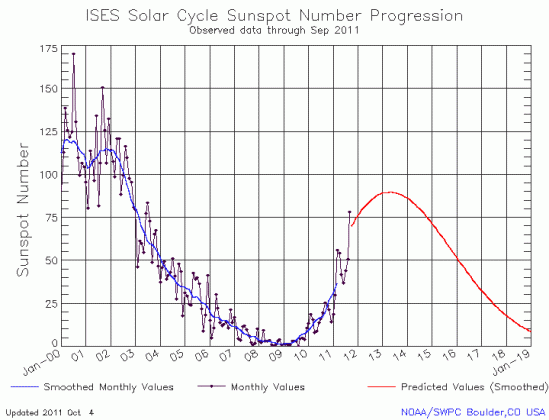
Today NOAA’s Space Weather Prediction Center released its monthly graph of the Sun’s solar cycle sunspot activity. Posted below, it shows the Sun’s activity finally leaping upward in September, after several months of less than expected performance.
It is interesting to see how the sun’s rising sunspot activity for the past year has followed a consistent fluctuating pattern, whereby a sudden monthly jump in sunspots is then followed by several months of decline. If this pattern repeats itself again, we should expect to see the numbers ease off again in October and November.
Regardless, the higher sunspot counts for September are more in line with past predictions. In fact, the solar scientists at the Marshall Space Flight Center have increased their prediction for the time and intensity for the peak of the sun’s maximum. Last month they had called for a peak in May 2013 with a sunspot number of 70. Now, they are predicting the peak will come in April 2013 with a number of 77. They note however that even this higher number will result in the weakest maximum in more than a hundred years.
A summary of Messenger’s first six months in orbit around Mercury.
Though packed with lots of results, this strikes me as the most interesting discovery so far:
Orbital data reveal that Mercury’s magnetic field is offset far to the north of the planet’s center, by nearly 20% of Mercury’s radius. Relative to the planet’s size, this offset is much more than in any other planet, and accounting for it will pose a challenge to theoretical explanations of the field. . . . This finding has several implications for other aspects of Mercury, says Anderson, who co-authored several of the presentations in the MESSENGER session. “This means that the magnetic field in the southern hemisphere should be a lot weaker than it is in the north. At the north geographic pole, the magnetic field should be about 3.5 times stronger than it is at the south geographic pole.
Office politics in science: Chronic fatigue syndrome researcher fired amidst new controversy.
I read this story and wonder if these scientists are as bad as politicians.
The 2011 Nobel Prize for Physics has been awarded to the astronomers who discovered dark energy.
Saul Perlmutter from the Lawrence Berkeley National Laboratory and University of California, Berkeley, has been awarded half of this year’s prize for his work on the Supernova Cosmology Project, with the other half awarded to Brian P. Schmidt from the Australian National University and Adam G. Riess from the Johns Hopkins University and Space Telescope Science Institute, Baltimore, for their work on the High-z Supernova Search Team.