
The strange hollows on the mountain tops of Mercury
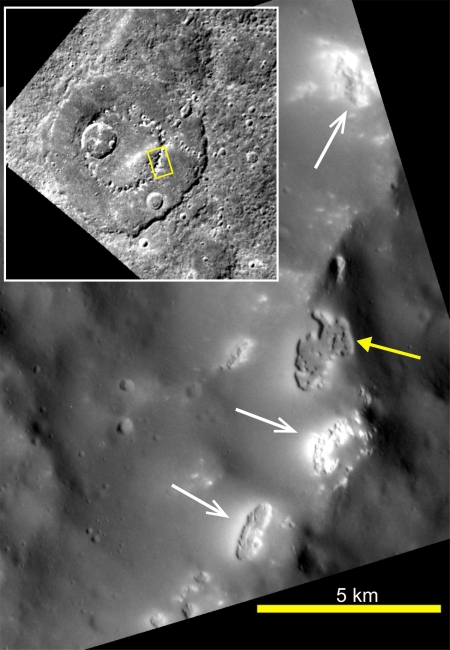
hollows on Mercury

Another spectacular planetary science image, this time from Messenger orbiting Mercury. This close-up image of the hollows of Mercury only illustrates their mystery. The insert shows the context of the close-up image. These irregular sinks are here found on the mountain top ridge of an inner crater rim. Also, some but not all of the hollows have bright interiors.

Scientists have proposed that some form of impact melt process caused these hollows. At impact, the ground literally rippled like water when you toss a stone into a pool. Here, however, the molten ripples quickly froze, creating the inner and outer crater rim rings. To my untrained eye, the hollows look like collapse features where the surface hardened first, then collapsed when the molten inner material drained away as it became solid.

Why some hollows are bright, however, is not yet understood.
0 comments

The red cliffs of Mars

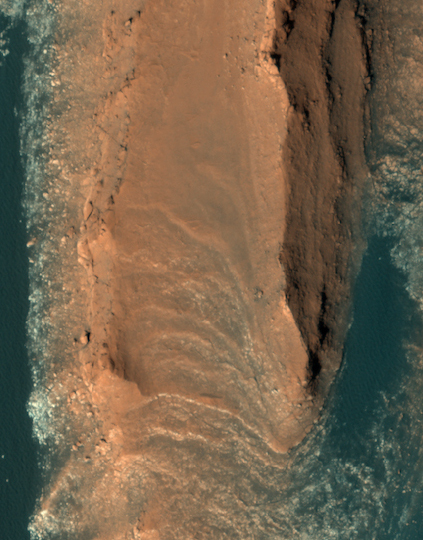
Red cliffs on Mars

Last week the Mars Reconnaissance Orbiter team released this beautiful image of what they call “layered yardangs” on Mars.

What creates these sharp ridges? This layered terrain has been sculpted by the wind. The aligned ridges are called yardangs, which are formed in areas where the dominant erosional force is the wind. Yardangs are also found on Earth, usually in very dry areas.

What I see are majestic red cliffs rising out of a aqua-colored sand desert. What a place to visit!

0 comments

Scientist proposes that the superluminal neutrinos are merely measuring the true speed of light

On Thursday physicist Susan Gardner of the University of Kentucky proposed in a preprint on the Los Alamos astro-ph website that the neutrinos measured at CERN that appeared to be going faster than light were merely giving us a much more accurate measure of the speed of light.

This is only one of a plethora of papers published this last week on astro-ph discussing and attacking the CERN neutrino results. I expect the scientists will solve this mystery before too long.

0 comments

Arctic ozone loss at record level

The ozone levels over the Arctic this past year were the lowest on record, caused by unusually cold temperatures.

No records for low temperature were set this year, but the air remained at its coldest for an unusually long period of time, and covered an unusually large area. In addition, the polar vortex was stronger than usual. Here, winds circulate around the edge of the Arctic region, somewhat isolating it from the main world weather systems.

“Why [all this] occurred will take years of detailed study,” said Dr. [Michelle] Santee [from NASA’s Jet Propulsion Laboratory]. “It was continuously cold from December through April, and that has never happened before in the Arctic in the instrumental record.”

0 comments

Mars atmosphere has more water vapor than predicted

Data from Mars Express has found that the Martian upper atmosphere has far more water vapor than predicted.

“The vertical distribution of water vapour is a key factor in the study of Mars’ hydrological cycle, and the old paradigm that it is mainly controlled by saturation physics now needs to be revised,” said Luca Maltagliati [of the Laboratoire Atmosphรจres, Milieux, Observations Spatiales (LATMOS) in Guyancourt, France]. “Our finding has major implications for understanding the planet’s global climate and the transport of water from one hemisphere to the other.”

“The data suggest that much more water vapour is being carried high enough in the atmosphere to be affected by photodissociation,” added Franck Montmessin, also from LATMOS, who is the Principal Investigator for SPICAM and a co-author of the paper. “Solar radiation can split the water molecules into oxygen and hydrogen atoms, which can then escape into space. This has implications for the rate at which water has been lost from the planet and for the long-term evolution of the Martian surface and atmosphere.”

0 comments

Scientists push for monitoring network to collect environmental and socioeconomic data from around the world

What could go wrong? Scientists push for a monitoring network to collect environmental and socioeconomic data from around the world.

Sandy Andelman, an ecologist with Conservation International in Arlington, Virginia, discussed her work setting up a pilot project that began two years ago in southern Tanzania. In addition to basic environmental data about soils, nutrients and land cover, the project tracks agricultural practices. It also incorporates data about income, health and education that is maintained by the government. Andelman says that all the data she collects can be broken down to the level of individual households, and that initial results from the project have already prompted the Tanzanian government to adjust the way it zones agricultural land in the area. [emphasis mine]

Lord help the farmers whose lives will be tracked by this network.

0 comments

NASA has identified ninety percent of the largest near-Earth asteroids

Data from the infrared telescope WISE has now identified ninety percent of the largest near-Earth asteroids.

NASA researchers also downgraded their estimate of the number of medium-sized asteroids, saying there are 44 percent fewer than previously believed. The downside is that scientists have yet to find many of these mid-sized asteroids, which could destroy a metropolitan city.

1 comment
1 637 638 639 640 641 729