
Astronomers argue about the legitimacy of the first exoplanet to be directly imaged
Astronomers question the legitimacy of the first exoplanet to be directly imaged.
Astronomers question the legitimacy of the first exoplanet to be directly imaged.
The Times Atlas has backed down on its false claim of a 15% loss to the Greenland icecap due to global warming and has issued an apology.
An international team of scientists said on Thursday they had recorded sub-atomic particles that travel faster than light.
A total of 15,000 beams of neutrinos — tiny particles that pervade the cosmos — were fired over a period of 3 years from CERN toward Gran Sasso 730 (500 miles) km away, where they were picked up by giant detectors. Light would have covered the distance in around 2.4 thousandths of a second, but the neutrinos took 60 nanoseconds — or 60 billionths of a second — less than light beams would have taken. “It is a tiny difference,” said Ereditato, who also works at Berne University in Switzerland, “but conceptually it is incredibly important. The finding is so startling that, for the moment, everybody should be very prudent.”
The forecast of when and where the climate satellite UARS will re-enter the atmosphere has been narrowed to the afternoon/evening of Friday, September 23.
Archaeologists have uncovered evidence of an ancient shipyard near Rome, “the largest of its kind in Italy or the Mediterranean.”
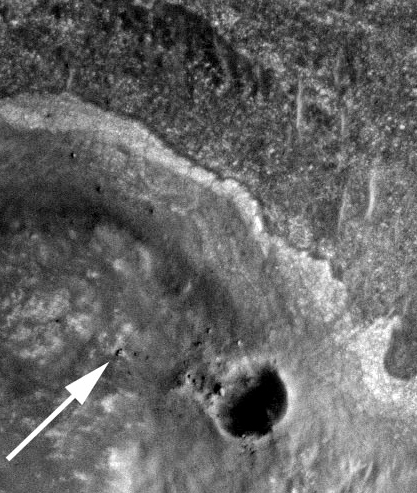
The image to the right was taken by Mars Reconnaissance Orbiter, with the white arrow showing the Mars rover Opportunity perched on the rim of Endeavour Crater.
The rover’s scientists hope that the rocks found on the crater rim, dredged up from deep below when the crater impact occurred, will be the oldest rocks so far touched on the Martian surface, and thus give them a peek at ancient Martian geology.
China’s second moon orbiter Chang’e-2 sends data from a million miles away.
Now for some good reporting: A Senate committee today approved an NIH budget that trimmed the health agency’s budget by $190 million.
This report actually gives us an accurate description of the proposed budget, which offers a 2012 budget of $30.5 billion compared to the $30.7 that NIH got in 2011. For further context, note that the 2012 budget is still more than the agency got in 2009 ($30.2 billion), and more than a billion above what it got in 2008 ($29.2 billion). Anyone who cries poverty at this budget cut immediately discredits themselves.
Farmers begin fleeing as Indonesia’s Mount Tambora volcano comes back alive.
Villagers like Hasanuddin Sanusi have heard since they were young how the mountain they call home once blew apart in the largest eruption ever recorded — an 1815 event widely forgotten outside their region — killing 90,000 people and blackening skies on the other side of the globe. . . . The April 1815 eruption of Tambora left a crater 7 miles (11 kilometers) wide and half a mile (1 kilometer) deep, spewing an estimated 400 million tons of sulfuric gases into the atmosphere and leading to “the year without summer” in the U.S. and Europe.
Europe’s first Mars lander appears threatened by budget woes in both Europe and the United States.
Blurred vision is now considered a serious risk for astronauts who spend months in space.
According to one NASA survey of about 300 astronauts, nearly 30 percent of those who have flown on space shuttle missions – which usually lasted two weeks — and 60 percent who’ve completed six-month shifts aboard the station reported a gradual blurring of eyesight.
This story is a followup on information contained in an earlier National Academies report on astronaut staffing.
The plethora of new exoplanet discoveries has astronomers longing for a telescope that can see them up close.
Astronomers need either a giant space telescope equipped with a device for blocking starlight, or an interferometer, consisting of several telescopes flying in formation. NASA did develop a proposal for such a space telescope, called Terrestrial Planet Finder, and the European Space Agency hoped to fly a similar mission called Darwin. But budgetary constraints have left both missions in limbo, unlikely to advance to the front of either agency’s queue until well into the next decade. At the conference, Traub raised the issue. “People are not thinking deeply about the distant future. People are wrapped up with what they’re doing right now,” he says. “Clearly, I’m concerned.”