
Japan has successfully test fired the engine on Akatsuki
Japan has successfully completed a two second test fire of the engine on its lost Venus probe Akatsuki.
Japan has successfully completed a two second test fire of the engine on its lost Venus probe Akatsuki.
A defunct seven-ton NASA climate satellite is about to fall to Earth.
The Upper Atmosphere Research Satellite, or UARS, is expected to come down in late September or early October, the space agency said today in an advisory. “Although the spacecraft will break into pieces during re-entry, not all of it will burn up in the atmosphere,” NASA said.
A Dutch university has fired a noted social psychologist who has admitted his science research was based on faked data.
[Diederik] Stapel has worked at the university, located in southern Netherlands, since 2006. He is known as a prolific researcher and a successful fundraiser. His studies appeared to offer new insights into the workings of the human mind; for instance, a Science paper published in April showed that people are more likely to stereotype or discriminate in messy environments.
In the TV interview, [university rector Philip] Eijlander says he was first contacted on 27 August by “junior researchers” in Stapel’s lab who alleged that his conduct was fraudulent. Stapel immediately admitted that there was “something strange” in his papers, Eijlander says, and “yesterday, he told me that there are faked data.” The university has asked Willem Levelt, a psycholinguist and former president of the Royal Netherlands Academy of Arts and Sciences, to lead a panel investigating the extent of the alleged fraud. Eijlander says that all “tainted papers” will be retracted. [emphasis mine]
I purposely emphasis the publication of this faked research in the peer review journal Science to illustrate how this story once again demonstrates that just because a science paper is peer reviewed, that is absolutely no guarantee that it is either correct, or even legitimate. The field of science (with a small “s”) always requires everyone to exercise a strong sense of skepticism. Appeals to authority (“It was published in Science!”) should carry no weight.
The Left has fought the spread of genetically modified (GM) foods with every weapon in its arsenal. Leftists did this in the name of combating a long list of “potential risks” that never materialized. They have been permitted to overlook the fact that their assaults on GM food were not cost free. For instance, they have greatly delayed and in some places stopped cold the use of rice modified to increase vitamin A content. For the Left this is cause for celebration. In fact, widespread use of this “golden rice” would have prevented a half-million cases of child blindness a year. So the next time someone talks to you about the evils of genetically modified foods, remind him of the millions of poor children this crusade has condemned to a lifetime of blindness. How do folks prepared to allow millions to needlessly go blind still command the respect of any truly moral person?
And that’s only the start. Read the whole thing.
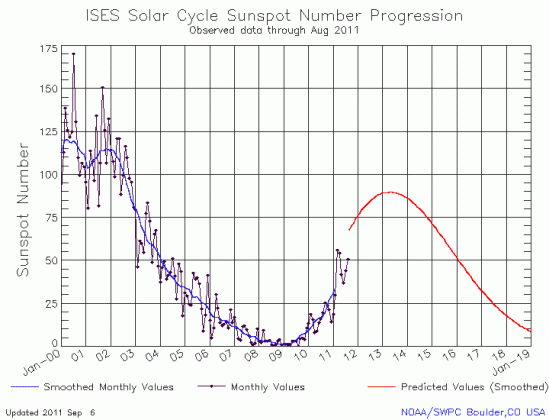
The monthly graph from NOAA’s Space Weather Prediction Center of the Sun’s solar cycle sunspot activity is out and I have posted it below. Though activity increased for the second month in a row, the totals are still below the activity levels of March and April 2011.
I am beginning to think that I sound like a broken record. This monthly graph once again suggests that the next solar maximum will be weak, possibly weaker than the most up-to-date predictions for the next solar maximum. And even if that prediction is correct, the data continues to point towards a quieter Sun, with the likelihood of a long period of no sunspots beginning in the next decade.
Based on past history, the consequences of a long Maunder-type minimum, where there are no sunspots for decades, should be very profound. Every time the Sun has gone this quiet in the past, the Earth’s climate has cooled. Furthermore, new results just released add weight to this conclusion. A less active Sun allows more intergalactic cosmic rays to hit the atmosphere, and the CLOUD experiment at CERN strongly suggests that the higher rate of cosmic rays could in turn increase the atmosphere’s cloudiness, thereby reflecting more light and energy and making the Earth colder.
A just released report from the National Academies, Preparing for the High Frontier: the role and training of NASA astronauts in the post-space shuttle era, describes the challenges that NASA faces in staffing its astronaut corps in the coming years. More important, however, is some new information buried in the report about the hazards of long term exposure to weightlessness.
For example, it seems a significant number of astronauts have come back from spending months at ISS with serious vision problems, caused by a newly discovered condition dubbed papilledema, the swelling of the optic disk.
» Read more
A baby star has been found only 27 light years away.
AP Columbae lies in the constellation Columba the Dove, south of the brilliant constellation Orion. “AP Columbae is still contracting under gravity towards the main sequence,” says astronomer Adric Riedel of Georgia State University in Atlanta, whose team measured the star’s parallax—an indication of its distance—and discovered that the star is abnormally luminous. Although the star is dim and red, it’s four times as bright as it should be, because it’s twice the diameter of a main-sequence star of the same color.
The Kepler team pushes for a mission extension in order to find Earth-sized planets.
The Kepler spacecraft has hit an unexpected obstacle as it patiently watches the heavens for exoplanets: too many rowdy young stars. The orbiting probe detects small dips in the brightness of a star that occur when a planet crosses its face. But an analysis of some 2,500 of the tens of thousands of Sun-like stars detected in Kepler’s field of view has found that the stars themselves flicker more than predicted, with the largest number varying twice as much as the Sun. That makes it harder to detect Earth-sized bodies. As a result, the analysis suggests that Kepler will need more than double its planned mission life of three-and-a-half years to achieve its main goal of determining how common Earth-like planets are in the Milky Way.
While it is important to find those Earth-sized planets, to me the important discovery here is that Kepler is confirming what previous research has suggested: Stars like our Sun are generally far more active and variable than the Sun itself. Which means that either the Sun is unusual, or has been unusually inactive during recorded human history.
Awakening the only British launched science satellite, dead for decades.
Japan plans to test fire the engine of its failed Venus probe Akatsuki twice this month, in anticipation of another try at Venus orbit in 2015.