
Japan Tsunami Broke Huge Icebergs Off Antarctica
Satellite data has confirmed that the March 11 Japanese tsunami caused icebergs to calf off the Sulzberger Ice Shelf in Antarctica.
Satellite data has confirmed that the March 11 Japanese tsunami caused icebergs to calf off the Sulzberger Ice Shelf in Antarctica.
A discovery in Nebraska of rare earth minerals appears set to challenge China’s monopoly.
To me these were the key quotes from this article:
The U.S. used to produce rare earths through the Mountain Pass Mine in California, but it was shut down in 2002, primarily because of environmental concerns, including the spillage of hundreds of thousands of gallons of water carrying radioactive waste into a nearby lake.
and
Although studies have shown the U.S. has 13 million metric tons of rare-earth minerals, National Mining Association spokeswoman Carol Raulston said it does not mine any of it – partly as a result of the difficulty of obtaining permits. “One of the key problems that investors tell us about is that the permitting regime in this country is so complicated and time-consuming that it has hurt investments here in the United States,” Ms. Raulston said.
Global warming: Half of the Earth’s internal heat comes from radioactive decay.
A thin belt of antimatter particles trapped by the Earth’s magnetic field has been spotted for the first time.
Opportunity is now less than 400 feet from the rim of Endeavour Crater.
The north pole of Mars in summer: the dry ice is gone, leaving an icecap of water only.
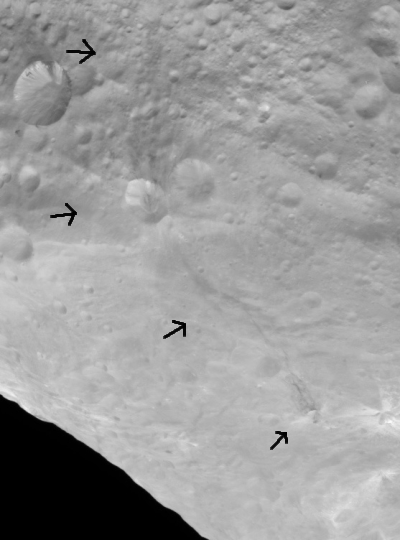
The Dawn mission team released another image today of the giant asteroid Vesta, this time taken from about 2,300 miles away. At this distance the resolution is still somewhat coarse, with the smallest visible detail about 0.43 miles in size.
To the right is a cropped section of the full image, focusing in on what appears to be a very strange geological feature, indicated by the arrows. From what I can tell, the dark meandering streak looks like a rille or flow coming out of the mound or peak near the bottom of the image. Yet, this dark meander continues directly across a crater as if it were a wind-blown dust streak.
I really have no idea what geological process created this. I also suspect that the scientists don’t quite know yet either, though I am sure they have some good theories, mostly based on the very light gravity that should exist on a world only 330 miles in diameter. As I’ve already noted, however, it is going to take them a couple of months to digest the data they are getting and come up with some reasonable conclusions. It will be fun to finally find out what they have learned.
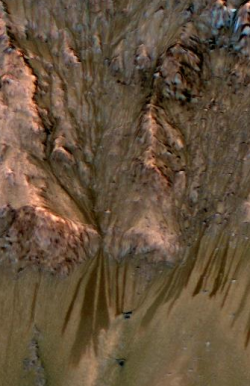
More evidence that there are active flows of water on Mars.
Dark, finger-like features appear and extend down some Martian slopes during late spring through summer, fade in winter, and return during the next spring. Repeated observations have tracked the seasonal changes in these recurring features on several steep slopes in the middle latitudes of Mars’ southern hemisphere.
Though there are a number of unsolved issues about these features, the best explanation appears to be a liquid brine.
Saltiness lowers the freezing temperature of water. Sites with active flows get warm enough, even in the shallow subsurface, to sustain liquid water that is about as salty as Earth’s oceans, while pure water would freeze at the observed temperatures.
Go here to see the full image.
A new Rasmussen poll finds that 69% of the public now believe that climate scientists falsified data to support their own theories about global warming. Moreover, these numbers are up ten points since December 2009, which happens to be just after the climategate emails were released.
These terrible numbers are further evidence that the willingness of the scientific community to whitewash their investigations of the climategate scientists, what I consider to be the equivalent of a community-wide cover-up, has done serious harm to science and its reputation.
» Read more
New research on the influence of a large moon to a habitable planet.
