Cost issues might force Europe to downsize its 2016 Mars mission
Cost issues might force Europe to downsize its 2016 Mars mission.
Cost issues might force Europe to downsize its 2016 Mars mission.
Did the Earth once have two moons?
Both satellites would have formed from debris that was ejected when a Mars-size protoplanet smacked into Earth late in its formation period. Whereas traditional theory states that the infant Moon rapidly swept up any rivals or gravitationally ejected them into interstellar space, the new theory suggests that one body survived, parked in a gravitationally stable point in the Earth–Moon system.
This new model also posits that the two moons eventually collided, producing the moon we have today.
Oxygen molecules have been detected for the first time in space, and they were found in the Orion nebula, a giant molecular cloud where stars are being born. More here.
The Dawn science team today released what they are calling “the first full-frame image” of Vesta. The image is shown below the fold.
The picture was taken from 3,200 miles, and shows a pockmarked irregularly shaped world. While many features that resemble the Moon (the craters, the rays radiating out from those craters), that Vesta itself is not spherical makes it very much unlike the Moon. It is probably going to take scientists several months at least to decipher the data they are getting and come up with some concrete conclusions about this strange dwarf planet.
» Read more
Six of the most ridiculous scientific studies ever commissioned.
The story of Hayabusa, the Japanese space probe that was the first to successfully return material from an asteroid despite serious technical failures, has now inspired three major movies.
Guest post by Phil Berardelli
John H. Marburger III, former science adviser to President George W. Bush and head of the White House Office of Science and Technology Policy, died this past week from non-Hodgkins lymphoma. He was 70.
Just about every news article reporting the death describes Dr. Marburger, a physicist and former head of the Brookhaven National Laboratory, as a controversial figure. This article, for instance, in The New York Times, said the following about Marburger:
In a critical editorial in April 2004, The New York Times, addressing accusations that the Bush administration had distorted or suppressed scientific information that would conflict with its policy preferences, acknowledged the respect Dr. Marburger commanded, calling him “a respected physicist and lifelong Democrat who would not seem an automatic apologist for this administration.” But it added, “The question yet to be answered is whether he is speaking from conviction when he claims that the critics are off base or is serving as a frontman for an administration whose activities in this area are sometimes hard to defend.”
Apparently, because Marburger — a Democrat and one of the longest-serving members of the administration — supported some of the positions espoused by the Bush White House, that made him controversial. But in my 40 years as a journalist and 15 years of covering science, I can’t think of a person I encountered who was more earnest and straightforward.
» Read more
Could this weird lunar crater be the crash site for Lunar Orbiter 2?
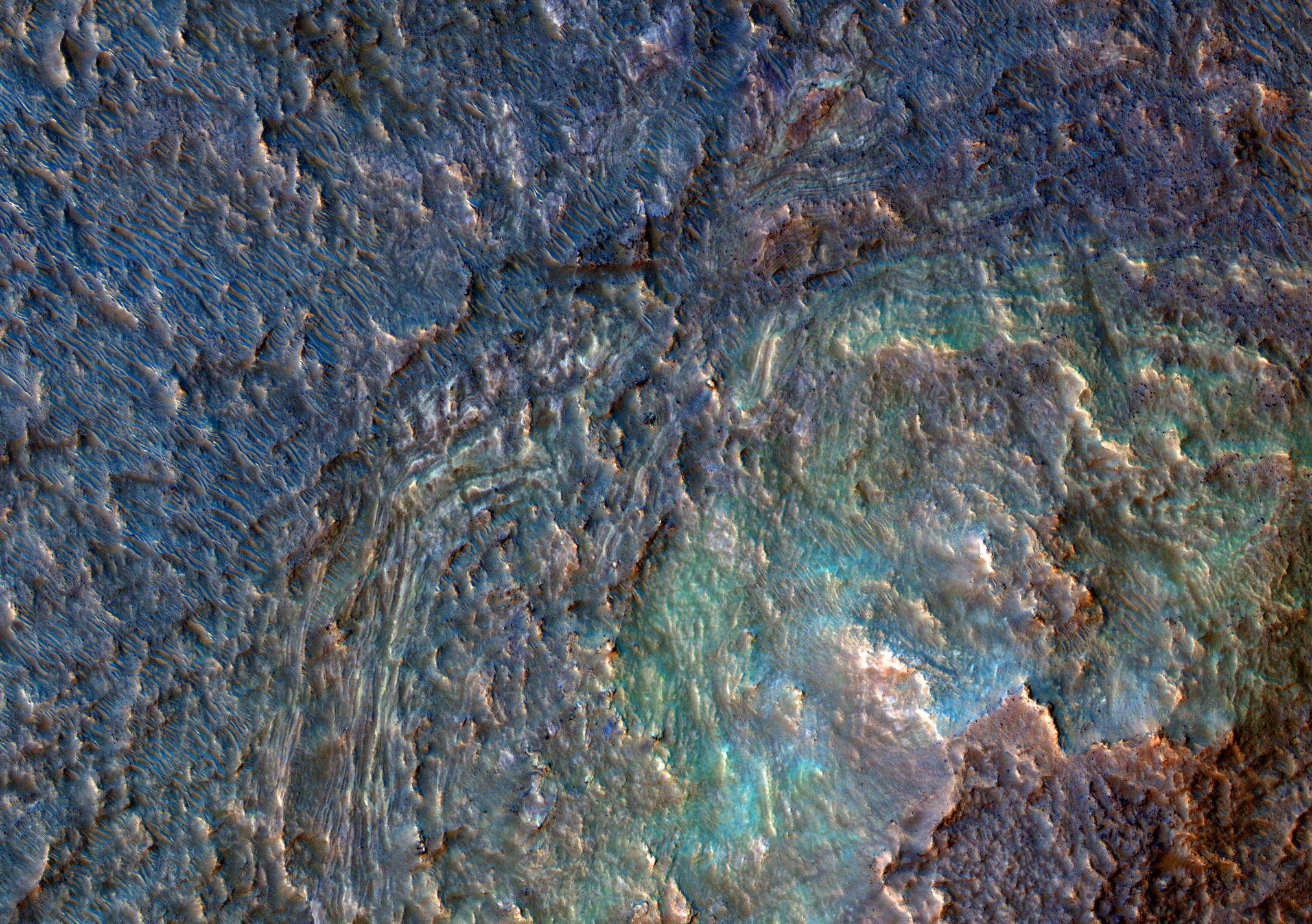
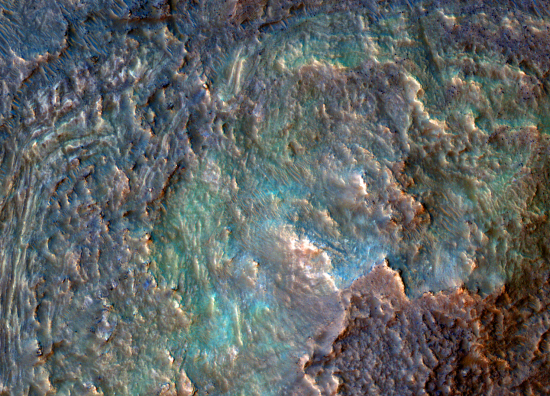
Mars Reconnaissance Orbiter released this picture yesterday of what the Orbiter’s scientists have labeled “The crazy floor of Hellas Basin.” Below you can see a cropped image of only one part of the large higher resolution image. The NASA caption says that the wild colors probably “indicate that diverse minerals are present,” meaning that any settlers of the red planet will probably take a close look at this location with the reasonable hope of finding the resources they need to colonize a planet.
To me, these colors also indicate that this place on Mars would probably one of its most popular tourist spots. As I look at the image my eye instinctively wants to trace out the best trail route along the ridges and down into the gullies in order to give hikers the best view of this colorful terrain.
After almost three years and seven miles of travel, Opportunity is now only about 1500 feet from the rim of Endeavour Crater.
The headline says it all: New NASA data blow gaping hole in global warming alarmism.
Scientists on all sides of the global warming debate are in general agreement about how much heat is being directly trapped by human emissions of carbon dioxide (the answer is “not much”). However, the single most important issue in the global warming debate is whether carbon dioxide emissions will indirectly trap far more heat by causing large increases in atmospheric humidity and cirrus clouds. Alarmist computer models assume human carbon dioxide emissions indirectly cause substantial increases in atmospheric humidity and cirrus clouds (each of which are very effective at trapping heat), but real-world data have long shown that carbon dioxide emissions are not causing as much atmospheric humidity and cirrus clouds as the alarmist computer models have predicted.
The new NASA Terra satellite data are consistent with long-term NOAA and NASA data indicating atmospheric humidity and cirrus clouds are not increasing in the manner predicted by alarmist computer models. The Terra satellite data also support data collected by NASA’s ERBS satellite showing far more longwave radiation (and thus, heat) escaped into space between 1985 and 1999 than alarmist computer models had predicted. Together, the NASA ERBS and Terra satellite data show that for 25 years and counting, carbon dioxide emissions have directly and indirectly trapped far less heat than alarmist computer models have predicted. [emphasis mine]
Astronomers have spotted the first Trojan asteroid to the Earth.
The asteroid is roughly 1,000 feet (300 meters) in diameter. It has an unusual orbit that traces a complex motion near a stable point in the plane of Earth’s orbit, although the asteroid also moves above and below the plane. The object is about 50 million miles (80 million kilometers) from Earth. The asteroid’s orbit is well-defined and for at least the next 100 years, it will not come closer to Earth than 15 million miles (24 million kilometers).